


07 Aug Congress Issues Whip for FCRA Bill: Key Polity Developments in Monsoon Session 2026
✎ The FCRA, 2010, regulates foreign funding in India, and amendments to it must balance transparency with the operational freedom of NGOs, as debates in Parliament often reflect tensions between national security and democratic…
Subject Relevance — Where This Topic Fits
- GS Paper II — Polity and Governance (Parliamentary Procedures, Whips, Anti-Defection Law) | GS Paper III — Economy (Foreign Contributions Regulation, NGO Funding, Economic Governance)
- Prelims: Foreign Contributions Regulation Act (FCRA), 2010, Parliamentary whip, Anti-Defection Law (Tenth Schedule), Foreign funding of NGOs, Monsoon Session of Parliament, Constitution (One Hundred and Twenty-Seventh Amendment) Bill, 2026 (Delimitation)
- Essay: The role of parliamentary discipline in democratic governance: A study of the whip system in India, Balancing transparency and accountability: The FCRA framework and civil society in India
Quick Revision: The FCRA, 2010, regulates foreign funding in India, and amendments to it must balance transparency with the operational freedom of NGOs, as debates in Parliament often reflect tensions between national security and democratic freedoms.
Why is this in the news?
This legislative move, coupled with the potential reintroduction of the Constitution (One Hundred and Twenty-Seventh Amendment) Bill on delimitation, underscores the government’s intent to amend key regulatory frameworks governing foreign funding and electoral representation. The development has triggered political mobilisation, with the Congress urging its allies in the INDIA bloc to ensure attendance, reflecting the Bill’s contentious nature and its implications for civil society, political funding, and parliamentary processes.
Background
- The Foreign Contributions Regulation Act (FCRA), 2010, regulates the acceptance and utilisation of foreign contributions by individuals, associations, and companies in India, with the primary objective of preventing foreign interference in domestic affairs.
- The FCRA was amended in 2020 to introduce stricter provisions, including a ban on sub-granting of foreign funds, reduced administrative expenses limits (from 50% to 20%), and mandatory opening of FCRA accounts in the State Bank of India (SBI), New Delhi.
- The 2020 amendments were challenged in the Supreme Court, with petitioners arguing that they violate the constitutional right to freedom of association (Article 19(1)(c)) and disproportionately restrict the functioning of non-governmental organisations (NGOs).
- The Monsoon Session of Parliament, commencing in early August 2026, is a critical legislative window, with the government prioritising bills that align with its policy agenda, including electoral reforms and regulatory oversight.
- The Congress’s decision to issue a whip highlights the Bill’s polarising nature, with opposition parties likely to scrutinise its provisions for potential overreach and erosion of democratic freedoms.
What is the Foreign Contributions Regulation (Amendment) Bill?
- Key provisions under consideration may include: (i) stricter compliance requirements for NGOs receiving foreign funds; (ii) enhanced powers for the government to suspend or cancel FCRA registrations; (iii) mandatory disclosure of foreign funding sources; and (iv) potential limits on the utilisation of foreign funds for administrative expenses.
- The Bill is part of a broader trend of regulatory tightening in India, aimed at ensuring transparency in foreign funding and preventing misuse, particularly in the context of national security and sovereignty.
- Critics argue that the Bill could disproportionately impact grassroots NGOs, particularly those working in human rights, environmental conservation, and social justice, by limiting their operational flexibility and financial sustainability.
- Proponents of the Bill contend that it is necessary to curb foreign interference, prevent money laundering, and ensure that foreign contributions do not undermine India’s domestic policies or democratic institutions.
- The Bill’s passage would require approval from both Houses of Parliament, followed by the President’s assent, before it becomes law.
- The timing of the Bill’s introduction during the Monsoon Session aligns with the government’s broader agenda of electoral reforms, including the potential reintroduction of the Constitution (One Hundred and Twenty-Seventh Amendment) Bill on delimitation.
- Parliamentary debates on the Bill are expected to focus on the balance between national security and the right to association, as well as the practical implications for civil society organisations operating in India.
Key Features
| Feature | Significance |
|---|---|
| Whip Issuance by Congress | Ensures party discipline among MPs, mandating attendance and voting alignment during critical legislative discussions, particularly on the FCRA Amendment Bill. |
| FCRA Amendment Bill | Proposes changes to the Foreign Contribution (Regulation) Act, 2010, potentially altering the regulatory framework for foreign funding of NGOs, political parties, and individuals. |
| Parliamentary Session Schedule (August 10-12, 2026) | Highlights the strategic timing of legislative business, focusing on contentious bills to maximize political pressure and scrutiny. |
| INDIA Bloc Coordination | Demonstrates inter-party solidarity in opposition to government legislative proposals, reflecting broader political alliances and strategic alignment. |
| Government’s Legislative Agenda | Includes potential reintroductions of bills such as the Constitution (Amendment) Bill on delimitation, indicating broader constitutional and electoral reforms under consideration. |
Why it Matters
Political Significance
- The issuance of a whip by the Congress underscores the high-stakes nature of the FCRA Amendment Bill, which may have implications for political funding, NGO operations, and civil society engagement.
- The INDIA bloc’s coordination suggests a unified opposition strategy, potentially influencing the bill’s passage or amendments through collective bargaining.
- The timing of the whip aligns with the Monsoon Session, a critical period for legislative activity, particularly on contentious issues that may face parliamentary scrutiny.
- The Congress’s directive to its MPs reflects internal party discipline and strategic positioning ahead of potential electoral or legislative battles.
Legal and Regulatory Implications
- The FCRA Amendment Bill, if passed, could redefine the scope of foreign contributions, impacting NGOs, political parties, and individuals receiving foreign funds.
- Changes to the FCRA may alter compliance requirements, reporting mechanisms, and penalties, thereby influencing the operational landscape for civil society organizations.
- The bill’s discussion coincides with broader debates on transparency and accountability in political funding, aligning with constitutional principles of electoral integrity.
Constitutional and Electoral Relevance
- The potential reintroductions of the Constitution (Amendment) Bill on delimitation highlight ongoing discussions on electoral reforms, including seat adjustments and representation issues.
- The FCRA’s regulatory framework intersects with Article 19(1)(c) (freedom to form associations) and Article 32 (right to constitutional remedies), raising questions about balancing regulatory oversight with fundamental rights.
Strategic Importance for UPSC Preparation
- The FCRA Amendment Bill exemplifies the interplay between legislative intent, regulatory oversight, and constitutional rights, a recurring theme in UPSC’s Polity and Governance syllabus.
- The opposition’s coordinated response provides a case study in parliamentary strategy, coalition dynamics, and the role of whips in legislative proceedings.
Challenges
1. Regulatory Overreach vs. Fundamental Rights
- The FCRA Amendment Bill risks encroaching upon the fundamental right to association (Article 19(1)(c)) if restrictions on foreign contributions are deemed excessive or arbitrary.
- Balancing national security concerns with the need for a vibrant civil society remains a persistent challenge in framing such legislation.
UPSC Link: GS-II: Fundamental Rights (Part III), GS-II: Parliament and State Legislatures
2. Parliamentary Disruptions and Legislative Efficiency
- Frequent disruptions in Parliament, driven by opposition to contentious bills, may delay critical legislative agendas, including economic and social reforms.
- The issuance of whips, while ensuring party discipline, can also exacerbate political polarization, hindering consensus-building on key issues.
UPSC Link: GS-II: Parliament and State Legislatures, GS-II: Role of Opposition
3. Coordination Among Opposition Parties
- Maintaining unity within the INDIA bloc is essential for effective opposition but faces challenges due to ideological differences and regional priorities.
- Failure to coordinate could weaken the bloc’s bargaining power, allowing the government to push through legislative agendas with minimal scrutiny.
UPSC Link: GS-II: Pressure Groups and Formal/Informal Associations
4. Electoral Reforms and Delimitation Challenges
- The potential reintroductions of the Constitution (Amendment) Bill on delimitation may face resistance from states, given its implications for political representation and electoral outcomes.
- Ensuring fairness and transparency in the delimitation process is critical to uphold democratic principles and prevent gerrymandering.
UPSC Link: GS-II: Constitutional Framework, GS-II: Electoral Reforms
5. Public Perception and Trust in Institutions
- Controversial legislative moves, such as the FCRA Amendment Bill, can erode public trust in democratic institutions if perceived as partisan or lacking in transparency.
- The government must balance legislative priorities with public accountability to maintain institutional credibility.
UPSC Link: GS-II: Role of Civil Services in a Democracy
Challenges — UPSC Perspective
| Issue | Concern |
|---|---|
| Regulatory Overreach in FCRA | Potential violation of Article 19(1)(c) if restrictions on foreign contributions are deemed excessive. |
| Parliamentary Disruptions | Risk of delayed legislative agendas due to opposition-led disruptions. |
| Opposition Unity | Challenges in maintaining cohesion within the INDIA bloc on contentious bills. |
| Delimitation Reforms | Resistance from states over potential changes to electoral representation. |
| Public Trust Erosion | Controversial bills may undermine confidence in democratic institutions. |
Way Forward
- Examine the draft provisions of the FCRA Amendment Bill to assess their alignment with constitutional rights and judicial precedents.
- Analyze the INDIA bloc’s strategy for opposing the bill, focusing on potential amendments or compromises to ensure legislative scrutiny.
- Evaluate the role of parliamentary whips in maintaining party discipline and its impact on democratic deliberation.
- Study the historical evolution of the FCRA, 2010, and its judicial interpretations to contextualize the proposed amendments.
- Assess the implications of delimitation reforms on electoral fairness and representation, drawing parallels with past constitutional amendments.
- Explore the balance between national security concerns and civil society freedoms in the context of foreign funding regulations.
- Prepare for potential UPSC questions on the interplay between legislative intent, constitutional rights, and parliamentary procedures.
UPSC Value Addition
Keywords for Mains Answer-Writing
Foreign Contribution Regulation Act (FCRA), 2010 · FCRA Amendment Bill 2026 · Parliamentary whip · Rajya Sabha proceedings · Lok Sabha proceedings · Foreign funding regulations · Civil society organisations (CSOs) · Non-governmental organisations (NGOs) · Parliamentary procedure · Whole House consensus · Legislative business · Monsoon Session 2026 · India bloc alliances · Constitution Amendment Bill on delimitation
Constitutional & Policy Linkages
- Article 19(1)(c) – Right to form associations
- Article 21 – Right to life and personal liberty (judicial interpretation of FCRA)
- Article 32 – Right to constitutional remedies
- Seventh Schedule – Union and State List (FCRA as a Concurrent Subject)
Concept Flow
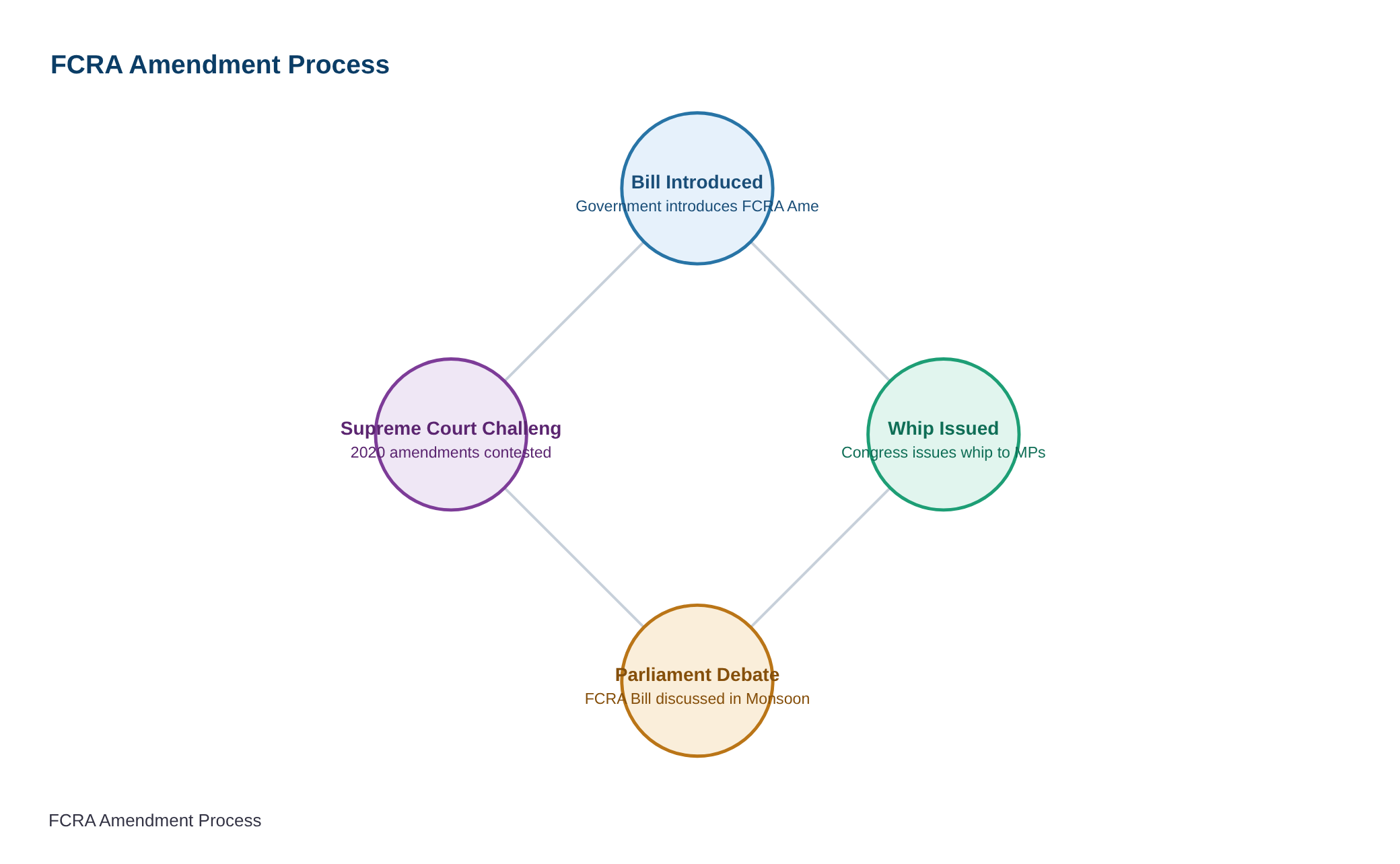
Government introduces FCRA Amendment Bill to Parliament → → Congress issues whip to MPs to ensure attendance and voting alignment → → Opposition parties (INDIA bloc) coordinate to oppose the bill → → Parliamentary discussions on August 10-12, 2026, with potential disruptions → → Bill undergoes scrutiny, with amendments or rejection possible → → Judicial review if provisions are challenged as unconstitutional → → Implementation of finalized provisions, impacting NGOs and political funding
Prelims Practice Questions
Q1. Consider the following statements regarding the Foreign Contribution Regulation Act (FCRA), 2010:
1. The FCRA regulates the acceptance and utilisation of foreign contributions by individuals, associations, and companies.
2. Under the FCRA, foreign contributions can be accepted by any entity without prior registration.
3. The Act prohibits the transfer of foreign contributions to other entities.
4. The FCRA Amendment Bill 2026 seeks to further restrict the utilisation of foreign contributions by NGOs.
How many of the above statements are correct?
- Only one
- Only two
- Only three
- All four
Answer: All four — Statements 1, 3, and 4 are correct. Statement 2 is incorrect as the FCRA mandates prior registration or prior permission for accepting foreign contributions.
Q2. Assertion (A): The issuance of a whip by a political party in Parliament is a constitutional provision.
Reason (R): The Constitution of India, under Article 102(1)(c), explicitly empowers the Speaker of the Lok Sabha to issue whips to members of Parliament.
In the context of the above two statements, which one of the following is correct?
- Both A and R are true, and R is the correct explanation of A
- Both A and R are true, but R is not the correct explanation of A
- A is true, but R is false
- A is false, but R is true
Answer: A is false, but R is true — Assertion (A) is true as the issuance of a whip is a parliamentary practice recognised under the Constitution. However, Reason (R) is false because whips are issued by political parties, not the Speaker under Article 102(1)(c).
Q3. Match the following columns related to parliamentary procedures in India:
Column I (Term) Column II (Description)
A. Whip 1. A formal notice issued by the government to the Parliament to discuss a matter of urgent public importance
B. Adjournment Motion 2. A directive issued by a political party to its members to vote in a particular manner
C. Calling Attention Notice 3. A procedure to raise a matter of public importance without a formal motion
D. No-Confidence Motion 4. A motion expressing lack of confidence in the Council of Ministers
Select the correct match:
- A-2, B-1, C-3, D-4
- A-1, B-2, C-3, D-4
- A-4, B-1, C-2, D-3
- A-3, B-4, C-1, D-2
Answer: A-2, B-1, C-3, D-4 — The correct matches are: A-2 (Whip: directive to vote), B-1 (Adjournment Motion: urgent public importance), C-3 (Calling Attention Notice: raise matter without motion), D-4 (No-Confidence Motion: express lack of confidence in government).
Mains Practice Question
✍ Critically examine the implications of the proposed FCRA Amendment Bill 2026 on the operational autonomy of civil society organisations (CSOs) in India. Also, analyse how the issuance of a parliamentary whip by a political party reflects the evolving dynamics of parliamentary democracy in contemporary India. (15 Marks)
Approach: MODEL-ANSWER SKELETON:
1. **Introduction (2 Marks)**
– Briefly define the Foreign Contribution Regulation Act (FCRA), 2010, and its primary objectives (regulating foreign funds to ensure national security and transparency).
– Mention the key provisions of the FCRA Amendment Bill 2026 as reported in the media (e.g., stricter utilisation norms, enhanced reporting requirements, or restrictions on sub-granting).
2. **Impact on CSOs (6 Marks)**
– **Operational Autonomy**: Discuss how the proposed amendments may restrict the operational freedom of CSOs, particularly those dependent on foreign funding (e.g., NGOs, think tanks).
– **Transparency vs. Over-regulation**: Weigh the need for transparency against the risk of over-regulation, citing examples of CSOs that may face funding shortages or administrative burdens.
– **Legal and Constitutional Concerns**: Reference judicial precedents (e.g., *Common Cause v. Union of India*, 2018) on the balance between regulatory oversight and fundamental rights (Article 19(1)(c)).
3. **Parliamentary Whip and Democratic Dynamics (5 Marks)**
– Define a parliamentary whip and its constitutional basis (Conduct of Business of the Houses of Parliament Rules, 1952).
– Analyse the role of whips in ensuring party discipline and its impact on parliamentary debates and consensus-building.
– Critically examine the implications of issuing a whip for a contentious bill (FCRA Amendment Bill) on the principle of deliberative democracy and the independence of MPs.
4. **Conclusion (2 Marks)**
– Summarise the dual challenge: balancing national security concerns with the need to preserve the autonomy and effectiveness of CSOs.
– Offer a balanced view on whether the FCRA Amendment Bill 2026 strikes the right balance or risks undermining democratic pluralism.
Source: Times of India
Generated by AanyaAi for educational purpose.

- महाराष्ट्र में त्योहार जुलूसों पर बॉम्बे हाईकोर्ट का बड़ा फैसला: पटाखे, लेजर और संगीत पर रोक - September 24, 2026
- Bombay HC Bans Firecrackers, Music in Maharashtra Processions: Key UPSC Analysis - September 24, 2026
- तमिलनाडु में महिला कर्मचारियों के लिए सवैतनिक माहवारी अवकाश नीति पर HC का आदेश - September 24, 2026

No Comments