


07 Aug Mission Poshan 2.0: UPSC’s Guide to India’s Latest Nutrition Strategy
✎ Mission Poshan 2.0 is a technology-enabled, converged nutrition programme that uses the Poshan Tracker with facial recognition to ensure targeted delivery of supplementary nutrition and counselling services, building on the…
Subject Relevance — Where This Topic Fits
- GS Paper II — Social Justice and Welfare Schemes for Vulnerable Sections | GS Paper III — Human Development and Nutrition
- Prelims: Poshan Tracker, Mission Poshan 2.0, Anganwadi Services, Stunting, Anaemia in Women, Breastfeeding, ICT-based Governance Tools, Facial Recognition System (FRS), NITI Aayog’s Development Monitoring and Evaluation Office (DMEO), World Bank’s Impact Assessment
- Essay: The Role of Technology in Public Health Delivery: A Case Study of Mission Poshan 2.0, Addressing Malnutrition: A Multi-Sectoral Approach to Sustainable Development
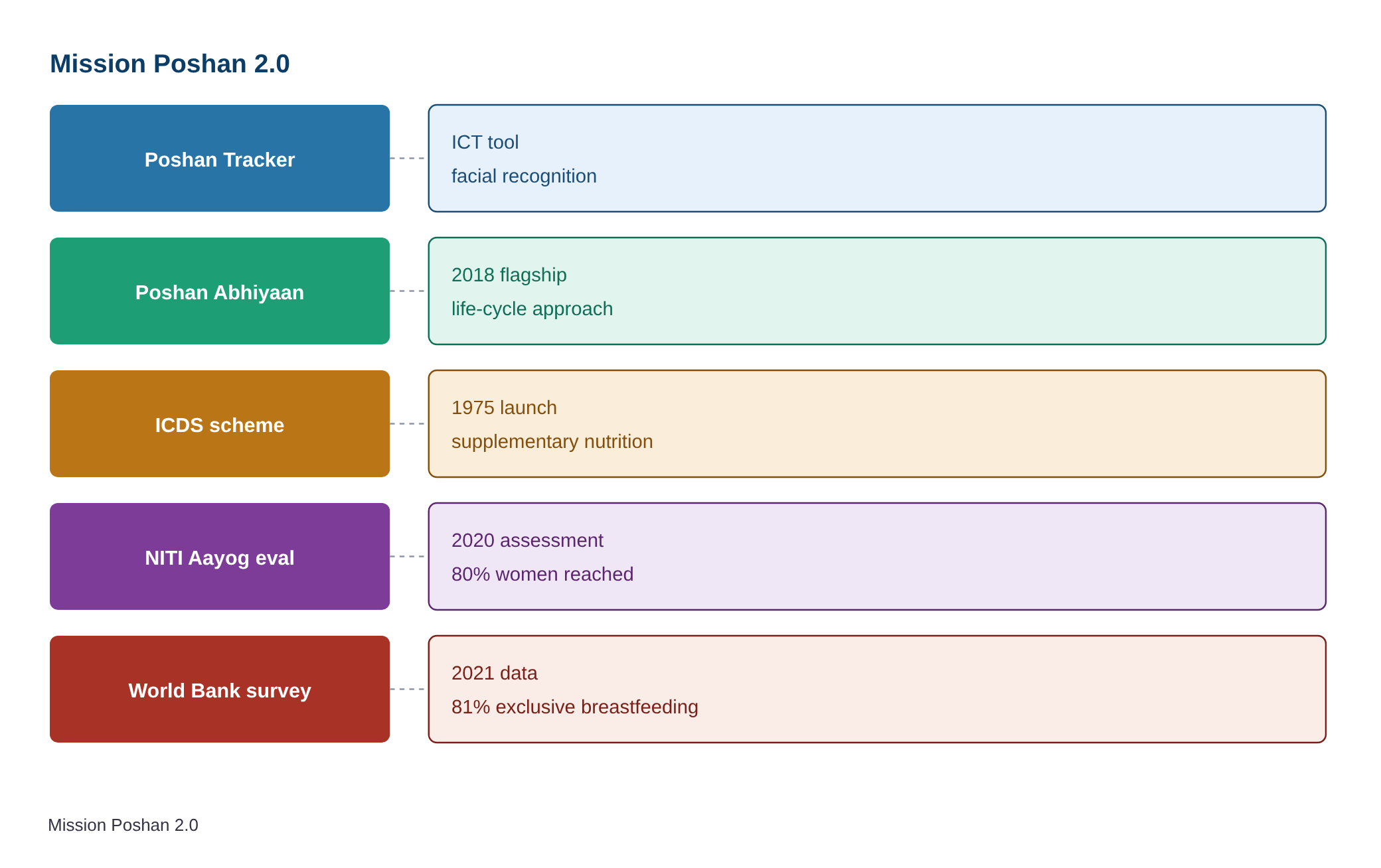
Quick Revision: Mission Poshan 2.0 is a technology-enabled, converged nutrition programme that uses the Poshan Tracker with facial recognition to ensure targeted delivery of supplementary nutrition and counselling services, building on the successes of Poshan Abhiyaan to combat malnutrition through a life-cycle approach.
Why is this in the news?
The Union Ministry of Women and Child Development (MWCD) has launched Mission Poshan 2.0 as a comprehensive and fortified initiative to combat malnutrition and promote child development, building on the successes and lessons of previous nutrition programmes such as the Poshan Abhiyaan. The initiative has been highlighted for its integrated approach, digital governance tools like the Poshan Tracker, and evidence-based evaluations demonstrating measurable improvements in nutritional behaviours among women and children across selected states.
Background
- The Government of India’s commitment to addressing malnutrition is reflected in multiple programmes, including the Integrated Child Development Services (ICDS) scheme, launched in 1975, which provides supplementary nutrition, immunisation, and health check-ups for children under six and pregnant/lactating women.
- Poshan Abhiyaan, launched in 2018 as a flagship programme under the National Nutrition Mission, aimed to reduce stunting, underweight, and anaemia among children and women through a life-cycle approach, convergence of ministries, and community mobilisation.
- A third-party evaluation and impact assessment of Poshan Abhiyaan conducted by NITI Aayog in 2020 found the programme’s relevance satisfactory in addressing malnutrition across India.
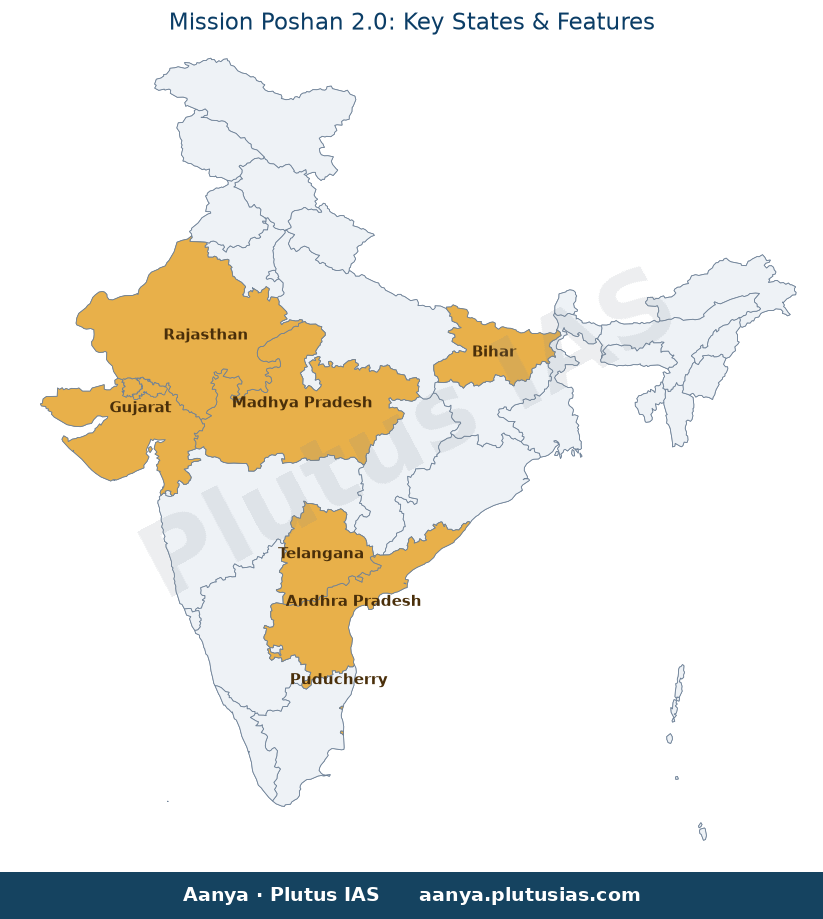
- The World Bank’s 2021 survey in 11 high-burden states (including Andhra Pradesh) demonstrated significant improvements in nutritional behaviours, with 80% of women receiving nutrition messages and 81% exclusively breastfeeding for the first six months.
- Mission Saksham Anganwadi and Poshan 2.0 (Mission Poshan 2.0) was evaluated in 2025 by NITI Aayog’s Development Monitoring and Evaluation Office (DMEO) across 12 states and one Union Territory, confirming its effectiveness in reducing malnutrition and promoting child development.
- The launch of the Poshan Tracker, an ICT-based governance tool with facial recognition capabilities, underscores the government’s emphasis on transparency, accountability, and real-time monitoring in nutrition service delivery.
What is Mission Poshan 2.0?
- Mission Poshan 2.0 is an upgraded and converged version of the Poshan Abhiyaan, designed to address malnutrition in a holistic and sustainable manner through a multi-sectoral and multi-stakeholder approach.
- It integrates the objectives of the Anganwadi Services Scheme, Poshan Abhiyaan, and other nutrition-related programmes under a unified framework to ensure synergy and avoid duplication of efforts.
- The initiative adopts a life-cycle approach, targeting pregnant women, lactating mothers, infants, and children under six years, with a focus on reducing stunting, wasting, underweight, and anaemia.
- Mission Poshan 2.0 leverages digital governance tools, particularly the Poshan Tracker, to monitor the real-time delivery of supplementary nutrition, growth monitoring, and counselling services at the Anganwadi centres.
- The Poshan Tracker employs facial recognition technology (FRS) to ensure that take-home rations and other benefits reach only the intended beneficiaries, thereby preventing leakages and fraud.
- Aadhaar-based tracking enhances beneficiary identification, prevents data leaks, and eliminates fake entries, ensuring efficient and transparent service delivery.
- The programme is implemented through a convergence of ministries such as the Ministry of Women and Child Development, Ministry of Health and Family Welfare, Ministry of Rural Development, and Ministry of Panchayati Raj, among others.
- Mission Poshan 2.0 is aligned with the Sustainable Development Goals (SDGs), particularly SDG 2 (Zero Hunger) and SDG 3 (Good Health and Well-being), and contributes to the National Nutrition Strategy and the National Health Policy 2017.
Key Features
| Feature | Significance |
|---|---|
| Integrated Approach | Combines multiple nutrition programs into a unified framework to address malnutrition holistically, building on past initiatives like the POSHAN Abhiyaan. |
| Digital Tracking via ‘Poshan Tracker’ | Uses ICT-based governance tools for real-time monitoring of service delivery, beneficiary identification, and data integrity through Aadhaar-based authentication. |
| Facial Recognition System (FRS) | Ensures targeted delivery of Take-Home Ration (THR) by verifying beneficiary identity at the last mile, reducing leakages and fraud. |
| Behaviour Change Communication | Leverages nutrition messaging to improve dietary practices, with demonstrated impact such as 81% exclusive breastfeeding rates in surveyed states. |
| Anganwadi Services Integration | Enhances utilisation and acceptance of supplementary nutrition, growth monitoring, and counselling services at the grassroots level. |
Why it Matters
Public Health
- Addresses multi-dimensional malnutrition (stunting, wasting, anaemia) through a coordinated, evidence-based strategy, reducing long-term health burdens.
- Strengthens maternal and child health outcomes by promoting optimal feeding practices and growth monitoring.
Governance & Transparency
- Improves accountability through digital tracking of service delivery, reducing leakages and ensuring last-mile connectivity.
- Facilitates data-driven decision-making for policymakers via real-time monitoring of programme performance.
Social Equity
- Targets high-burden states and vulnerable groups, ensuring equitable access to nutrition interventions.
- Empowers women through behaviour change communication, enhancing their agency in child-rearing and dietary choices.
Challenges
1. Implementation Gaps
- Ensuring consistent quality of Anganwadi services across diverse geographical and socio-economic contexts.
- Maintaining high uptake of digital tools like ‘Poshan Tracker’ among frontline workers and beneficiaries in remote areas.
UPSC Link: GS-II: Welfare Schemes
2. Nutrition Behaviour Sustainability
- Translating short-term behaviour change into long-term dietary habits, particularly in resource-constrained households.
- Overcoming cultural and socio-economic barriers to adoption of recommended nutrition practices.
UPSC Link: GS-I: Social Empowerment
3. Data Privacy & Security
- Safeguarding Aadhaar-linked beneficiary data against breaches or misuse in digital tracking systems.
- Balancing real-time monitoring with ethical considerations of surveillance in public health programmes.
UPSC Link: GS-II: Governance
4. Inter-Sectoral Coordination
- Aligning nutrition goals with health, sanitation, and education sectors to avoid siloed implementation.
- Ensuring convergence between central schemes (e.g., PMMVY, ICDS) and state-level initiatives.
UPSC Link: GS-II: Government Policies
Challenges — UPSC Perspective
| Issue | Concern |
|---|---|
| Digital Divide | Limited smartphone/internet access in rural and tribal areas hinders adoption of ‘Poshan Tracker’. |
| Frontline Worker Capacity | Inadequate training and high workloads for Anganwadi workers may reduce service quality. |
| Funding Sustainability | Dependence on central allocations risks discontinuity if budgetary priorities shift. |
| Cultural Practices | Deep-rooted traditions (e.g., early supplementary feeding) may undermine programme objectives. |
| Monitoring Fatigue | Excessive data reporting requirements could lead to burnout among field staff. |
Way Forward
- Scale up digital literacy programmes for Anganwadi workers and beneficiaries to enhance ‘Poshan Tracker’ adoption.
- Strengthen inter-ministerial convergence (e.g., with Ministry of Health and Family Welfare, Ministry of Drinking Water and Sanitation) to align nutrition goals.
- Institute periodic third-party audits of service delivery quality and beneficiary satisfaction.
- Expand community-based behaviour change campaigns using local influencers (e.g., ASHA workers, self-help groups).
- Develop a graded incentive system for states/districts achieving measurable improvements in nutrition outcomes.
- Integrate climate-resilient agriculture initiatives to ensure year-round access to diverse, nutritious foods.
- Establish a grievance redressal mechanism for beneficiaries to report service delivery gaps in real time.
UPSC Value Addition
Keywords for Mains Answer-Writing
Mission Poshan 2.0 · Malnutrition eradication · Child development · Poshan Tracker · Anganwadi Services · NITI Aayog DMEO · World Bank survey on nutrition · ICT-based governance tools · Facial Recognition System for welfare delivery · Complementary nutrition · Growth monitoring · Behavior change communication · Stunting reduction · Anaemia in women · Breastfeeding practices · Aadhaar-based welfare delivery
Constitutional & Policy Linkages
- [‘Article 47 (DPSP)’, ‘State duty to raise nutrition and public health standards.’]
- [‘Article 243G’, ‘Empowerment of Panchayats for local governance of nutrition programmes.’]
Concept Flow
High prevalence of child stunting and maternal anaemia → Government launches POSHAN Abhiyaan (2018) → Third-party evaluations (2020) identify behavioural gaps → World Bank survey (2021) validates programme impact → Mission Poshan 2.0 (2025) integrates digital tracking (‘Poshan Tracker’) and FRS → Enhanced service delivery and behaviour change → Improved nutrition outcomes and long-term child development.
Prelims Practice Questions
Q1. Consider the following statements regarding Mission Poshan 2.0:
1. It is an initiative of the Ministry of Women and Child Development to address malnutrition and promote child development.
2. The Poshan Tracker application uses Facial Recognition System (FRS) to ensure targeted delivery of take-home rations.
3. The Mission is based on the Integrated Child Development Services (ICDS) scheme and does not introduce any new services.
How many of the above statements are correct?
- Only one
- Only two
- All three
- None
Answer: All three — Statements 1 and 2 are correct. Statement 3 is incorrect as Mission Poshan 2.0 introduces enhanced services such as ICT-based governance tools like the Poshan Tracker and FRS, alongside existing ICDS services.
Q2. Assertion (A): The Poshan Tracker application is designed to monitor and review the implementation of Mission Poshan 2.0 using ICT-based governance tools.
Reason (R): The Poshan Tracker application enables real-time tracking of health and nutrition parameters of women and children, ensuring targeted delivery of services and preventing data leaks.
In the context of the above two statements, which one of the following is correct?
- Both A and R are true, and R is the correct explanation of A.
- Both A and R are true, but R is not the correct explanation of A.
- A is true, but R is false.
- A is false, but R is true.
Answer: Both A and R are true, but R is not the correct explanation of A. — Both the Assertion and Reason are true, and the Reason correctly explains the Assertion as the Poshan Tracker’s ICT-based tools are specifically designed for real-time monitoring and targeted service delivery.
Q3. Match the following initiatives with their respective objectives:
Initiative Objective
A. Poshan Tracker 1. To conduct third-party evaluations of nutrition programs
B. NITI Aayog DMEO 2. To ensure targeted delivery of take-home rations using biometric verification
C. Mission Poshan 2.0 3. To monitor and review the implementation of nutrition services using ICT
D. Facial Recognition System (FRS) 4. To address malnutrition and promote child development through a coordinated approach
- A-3, B-1, C-4, D-2; A-2, B-1, C-3, D-4; A-3, B-4, C-1, D-2; A-1, B-2, C-3, D-4
Answer: A-3, B-1, C-4, D-2; A-2, B-1, C-3, D-4; A-3, B-4, C-1, D-2; A-1, B-2, C-3, D-4 — A matches with 3 (Poshan Tracker is an ICT-based tool for monitoring), B matches with 1 (NITI Aayog DMEO conducts evaluations), C matches with 4 (Mission Poshan 2.0 aims to address malnutrition and promote child development), and D matches with 2 (FRS ensures targeted delivery of rations).
Mains Practice Question
✍ Mission Poshan 2.0 represents a paradigm shift in India’s approach to tackling malnutrition by integrating technology, data-driven governance, and multi-sectoral coordination. Critically examine the structural, technological, and behavioral dimensions of this initiative. Also, assess its potential to achieve Sustainable Development Goal 2 (Zero Hunger) by 2030. (15 Marks)
Approach: A full answer must cover the following dimensions:
1. **Structural Dimensions**
– Evolution from Poshan Abhiyaan to Mission Poshan 2.0: integration of ICDS, anganwadi services, and convergence with health, sanitation, and education sectors.
– Role of NITI Aayog’s DMEO in evidence-based policy formulation and third-party evaluations (2020 and 2025 studies).
– Inclusion of 12 states and 1 UTs in the 2025 evaluation, with emphasis on high-burden regions (e.g., Andhra Pradesh).
2. **Technological Dimensions**
– ICT-based governance tools: Poshan Tracker as a digital platform for real-time monitoring of health and nutrition parameters.
– Aadhaar-based tracking to prevent data leaks and ensure beneficiary identification.
– Facial Recognition System (FRS) for authentication in take-home ration delivery, addressing pilferage and leakage.
– Data-driven decision-making: linking behavioral change communication to measurable outcomes (e.g., 80% reach of nutrition messages, 81% exclusive breastfeeding rate in surveyed states).
3. **Behavioral Dimensions**
– Focus on behavior change communication (BCC) to alter nutrition-related behaviors (e.g., breastfeeding, complementary feeding).
– Evidence from World Bank surveys (2021) and NITI Aayog evaluations (2025) demonstrating improvements in maternal and child nutrition practices.
– Challenges: sustaining behavioral change, addressing socio-cultural barriers, and ensuring last-mile delivery.
4. **Potential for SDG 2 (Zero Hunger) by 2030**
– Strengths: multi-sectoral convergence, technological integration, and evidence-based policymaking.
– Weaknesses: scalability in diverse socio-economic contexts, digital divide, and ensuring equity in service delivery.
– Opportunities: leveraging global partnerships (e.g., World Bank support) and aligning with national nutrition strategies (e.g., National Nutrition Mission).
– Threats: funding constraints, bureaucratic inertia, and lack of inter-state coordination.
5. **Conclusion**
– Mission Poshan 2.0 is a significant step toward addressing malnutrition but must overcome structural and behavioral challenges to achieve SDG 2. Provide a balanced assessment, acknowledging progress while highlighting areas requiring urgent intervention.
Source: PIB (Press Information Bureau)
Generated by AanyaAi for educational purpose.

- सुप्रीम कोर्ट ने चुनाव आयोग को दिल्ली में ‘यांत्रिक’ SIR नोटिस पर सावधानियां बरतने को कहा - September 22, 2026
- ‘स्वच्छता ही सेवा-2026’ अभियान: सरकारी विभागों में स्वच्छता क्रांति, जानिए मुख्य बिंदु - September 22, 2026
- DFPD Launches ‘Swachhata Hi Seva-2026’ Campaign for Clean India Mission - September 22, 2026

No Comments