


07 Aug DMK’s Stance on Delimitation Bill: Key Implications for UPSC & State PCS Aspirants
✎ Delimitation is the process of redrawing constituency boundaries to ensure equitable representation based on population changes, as mandated by Article 82 of the Constitution and governed by the Representation of the People Act…
Subject Relevance — Where This Topic Fits
- GS Paper II — Constitutional and Non-Constitutional Bodies (Election Commission of India) | GS Paper III — Government Policies and Interventions for Development in various sectors
- Prelims: Delimitation Commission, Article 82 of the Constitution, Representation of People Act, 1950, Lok Sabha seat increase, Southern states’ demographic concerns
- Essay: Federalism and Centre-State Relations in India: Balancing Representation and Equity, Demographic Shifts and Political Representation: Challenges for Inclusive Governance
Quick Revision: Delimitation is the process of redrawing constituency boundaries to ensure equitable representation based on population changes, as mandated by Article 82 of the Constitution and governed by the Representation of the People Act, 1950.
Why is this in the news?
The DMK has adopted a cautious and conditional approach to the proposed Delimitation Bill 2026, deferring its final stance until the official draft is tabled in Parliament. This stance reflects the party’s strategic emphasis on safeguarding the political and demographic interests of southern states, particularly Tamil Nadu, amid concerns over potential underrepresentation in a population-based delimitation model.
Background
- The Constitution of India mandates delimitation of parliamentary and assembly constituencies to ensure equitable representation based on population changes, as per Article 82 and the Representation of the People Act, 1950.
- The last delimitation exercise was conducted in 2002–2008, freezing the number of Lok Sabha seats at 543 until 2026, despite population growth and regional disparities.
- Southern states, including Tamil Nadu, have historically expressed concerns over population-based delimitation, citing fears of reduced political representation due to lower population growth rates compared to northern states.
- The Election Commission of India (ECI) is constitutionally empowered to conduct delimitation exercises, though the process is currently governed by statutory provisions under the Representation of the People Act.
- The DMK’s reluctance to commit without reviewing the draft underscores the political sensitivity of delimitation, particularly in the context of federalism and regional autonomy.
What is the Delimitation Bill 2026?
- The Delimitation Bill 2026 is a legislative proposal aimed at redrawing the boundaries of parliamentary and assembly constituencies in India to reflect population changes, as mandated by the Constitution.
- The Bill is expected to address disparities in political representation arising from population growth, particularly in states with slower growth rates, such as those in southern India.
- The delimitation process is conducted by the Election Commission of India (ECI), which uses the latest census data to ensure fair and equitable representation.
- The Bill includes provisions for the formation of a Delimitation Commission, which will oversee the redrawing of constituency boundaries based on census data and other demographic factors.
- The proposed model aims to balance representation with demographic realities, though critics argue that population-based delimitation may disproportionately affect states with lower growth rates.
- The Bill’s passage is contingent on parliamentary approval, with political parties, including the DMK, adopting cautious and conditional stances pending the release of the official draft.
Key Features
| Feature | Significance |
|---|---|
| Proposed increase in Lok Sabha seats | Expands total representation from 543 to 816 seats, altering the electoral landscape and necessitating reallocation of seats among states. |
| Population-based delimitation | Shifts seat allocation from historical to demographic criteria, potentially altering regional political balances. |
| Southern states’ seat allocation | Tamil Nadu’s seats proposed to rise from 39 to 59, maintaining proportional share at 7.2%, while other southern states await detailed allocation. |
| DMK’s conditional stance | Party refrains from declaring support or opposition until the official bill is tabled and reviewed, ensuring evidence-based decision-making. |
| Government’s assurance on proportionality | Asserts that the new delimitation model will not reduce the relative representation of southern states despite demographic shifts. |
Why it Matters
Political
- Alters the balance of power in the Lok Sabha by increasing total seats, potentially benefiting parties with stronger presence in high-growth states.
- May trigger regional political realignments, particularly in southern states where demographic growth has outpaced northern states.
- DMK’s cautious approach reflects broader southern apprehensions about perceived marginalisation in national politics.
Constitutional
- Reinforces the constitutional mandate under Article 82 for periodic delimitation based on the latest census, ensuring democratic representation aligns with demographic realities.
- Tests the balance between federal principles and central authority in electoral reforms, a recurring theme in India’s constitutional evolution.
Administrative
- Requires meticulous logistical planning for boundary adjustments, voter enumeration, and electoral roll updates across 816 constituencies.
- Demands robust data systems to reconcile census data with electoral boundaries, minimising disputes and litigation.
Challenges
1. Regional Representation Disparity
- Southern states fear demographic shifts may dilute their proportional representation despite assurances, citing historical precedents of perceived neglect.
- Potential for political backlash if seat allocations are perceived as inequitable, particularly in states with high literacy and lower fertility rates.
UPSC Link: GS2/Polity/Representation
2. Data Accuracy and Dispute Resolution
- Census data discrepancies or delays could undermine the credibility of delimitation, leading to legal challenges and administrative bottlenecks.
- Need for transparent mechanisms to address objections from states or political parties regarding seat allocations.
UPSC Link: GS2/Polity/Election Commission
3. Political Consensus and Opposition
- Lack of bipartisan agreement on delimitation may stall legislative progress, as seen in past attempts to amend the Representation of the People Act, 1950.
- Southern parties’ scepticism, exemplified by DMK’s conditional stance, could delay or complicate the bill’s passage.
UPSC Link: GS2/Polity/Parliamentary Procedures
4. Operational and Logistical Hurdles
- Massive increase in constituencies demands extensive training for election officials, updating of electoral rolls, and redrawing of administrative boundaries.
- Risk of delayed implementation if the Election Commission faces resource constraints or procedural delays.
UPSC Link: GS2/Polity/Election Commission
Challenges — UPSC Perspective
| Issue | Concern |
|---|---|
| Perceived marginalisation of southern states | Political narrative of ‘demographic bias’ may gain traction, fueling regionalist sentiments. |
| Data reliability for delimitation | Census 2021 delays or inaccuracies could undermine the entire exercise, necessitating supplementary data sources. |
| Legal challenges to seat allocation | States or parties may file PILs or petitions in the Supreme Court, citing constitutional violations. |
| Implementation timeline | Tight deadlines for delimitation and subsequent elections may strain administrative capacities. |
| Federal-state coordination | Lack of consensus among states on allocation criteria could lead to disputes and delays. |
Way Forward
- Conduct a detailed comparative analysis of the proposed bill with past delimitation exercises (e.g., 2002-2008) to identify continuity and deviations.
- Engage southern states in pre-legislative consultations to address concerns and incorporate their suggestions, ensuring broader acceptance.
- Strengthen the Election Commission’s institutional capacity to handle increased logistical and technical demands of delimitation.
- Establish a transparent dispute resolution mechanism, including an independent panel to adjudicate objections from states or political parties.
- Publish a white paper on the methodology for seat allocation, including demographic projections and proportionality calculations, to enhance credibility.
- Ensure the Census 2026 data is finalised and validated well in advance to avoid delays in delimitation timelines.
- Incorporate sunset clauses in the bill to mandate periodic reviews of seat allocations, ensuring adaptability to future demographic changes.
UPSC Value Addition
Keywords for Mains Answer-Writing
Delimitation Commission · Representation of States in Parliament · Article 82 and 170 of the Constitution · Dravidian parties and federalism · Lok Sabha seat increase · Proportional representation · Political federalism in India · Constitutional provisions on delimitation · Regional parties and Centre-state relations · Parliamentary democracy and representation
Constitutional & Policy Linkages
- Article 82: Periodic delimitation of constituencies.
- Article 324: Powers of the Election Commission.
- Seventh Schedule: Distribution of seats in the Lok Sabha.
- Article 325: Prohibition of discrimination in electoral rolls.
Concept Flow
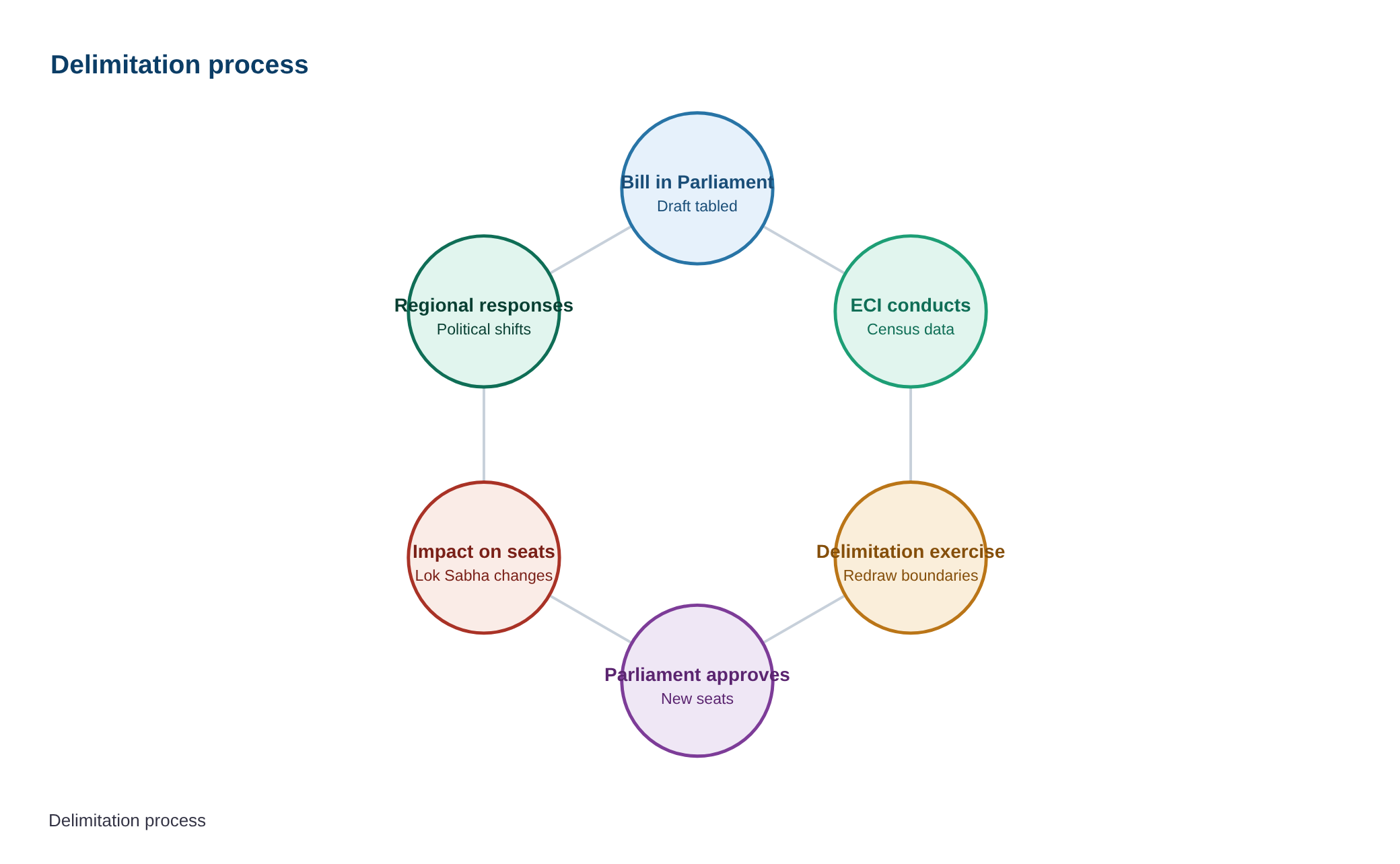
Demographic shifts (fertility rates, migration) → Census data collection → Delimitation exercise → Parliamentary approval of bill → Redrawing of electoral boundaries → Reallocation of seats → Impact on political representation → Regional political responses.
Prelims Practice Questions
Q1. Consider the following statements regarding the Delimitation Commission in India:
1. The Delimitation Commission is a statutory body established under the provisions of the Delimitation Act, 2002.
2. The Commission is tasked with redrawing the boundaries of parliamentary and assembly constituencies based on the latest census.
3. The President of India constitutes the Delimitation Commission.
4. The recommendations of the Delimitation Commission are binding on the Election Commission of India.
How many of the above statements are correct?
- Only one
- Only two
- Only three
- All
Answer: All — Statements 1, 2, and 3 are correct. The Delimitation Commission is indeed a statutory body under the Delimitation Act, 2002, and is constituted by the President. It redraws constituency boundaries based on the latest census. Statement 4 is incorrect as the recommendations of the Delimitation Commission are binding on the government but not on the Election Commission, which is an autonomous constitutional body.
Q2. Assertion (A): The Delimitation Commission in India is empowered to increase the total number of seats in the Lok Sabha beyond the current limit of 543.
Reason (R): The Constitution (84th Amendment) Act, 2001, froze the delimitation of constituencies till the first census after 2026.
In the context of the above two statements, which one of the following is correct?
- Both A and R are true, and R is the correct explanation of A.
- Both A and R are true, but R is not the correct explanation of A.
- A is true, but R is false.
- A is false, but R is true.
Answer: A is false, but R is true. — Assertion (A) is true as the Delimitation Commission can increase the number of seats in the Lok Sabha, subject to parliamentary approval. However, Reason (R) is false because the 84th Amendment Act, 2001, froze the delimitation of constituencies till the first census after 2000, not 2026.
Q3. Match the following provisions of the Constitution of India with their respective articles:
Column I (Provisions) | Column II (Articles)
— | —
1. Composition of the Lok Sabha | A. Article 81
2. Composition of the Rajya Sabha | B. Article 80
3. Delimitation of constituencies | C. Article 327
4. Power of Parliament to make laws with respect to delimitation | D. Article 324
Select the correct match:
- 1-A, 2-B, 3-C, 4-D
- 1-B, 2-A, 3-D, 4-C
- 1-A, 2-B, 3-D, 4-C
- 1-B, 2-A, 3-C, 4-D
Answer: 1-A, 2-B, 3-C, 4-D — The correct matches are: 1-A (Article 81: Composition of the Lok Sabha), 2-B (Article 80: Composition of the Rajya Sabha), 3-C (Article 327: Delimitation of constituencies), and 4-D (Article 324: Power of Parliament to make laws with respect to delimitation).
Mains Practice Question
✍ The proposed Delimitation Bill, 2026, aims to increase the total number of seats in the Lok Sabha from 543 to 816, ostensibly to reflect demographic changes. Critically examine the constitutional, political, and federal implications of such an exercise. Also, analyse the apprehensions expressed by southern states regarding the potential dilution of their representation in Parliament. (15 Marks)
Approach: Constitutional Framework and Delimitation Process: – Articles 82 and 170: Mandate for delimitation based on census data. – Role of the Delimitation Commission: Statutory body under Delimitation Act, 2002. – Constitutional amendments: 84th Amendment (2001) freezing delimitation till 2026. Political and Federal Implications: – Representation of States: Impact on federal balance; Article 1(1) and cooperative federalism. – Regional Parties and Dravidian Politics: DMK’s stance and federalism concerns. – Proportional Representation: Does the increase in seats ensure proportionality or dilute southern states’ voice? Apprehensions of Southern States: – Demographic Shift: Northern states’ growing population vs. southern states’ stable demographics. – Perceived Dilution: Fear of reduced proportional representation despite seat increase. – Historical Context: 1971 Census freeze and its implications; Article 327 and 328. Judicial and Institutional Safeguards: – Judicial Review: Scope for judicial intervention in delimitation disputes. – Role of the Election Commission: Autonomy and constitutional mandate. Conclusion: – Balance between demographic representation and federal equity. – Need for consensus among states to preserve federal harmony.
Source: amarujala.com
Generated by AanyaAi for educational purpose.

- पेरियार टाइगर रिजर्व में 6 नई प्रजातियाँ खोजी गईं, जानिए क्या हैं विशेषताएँ - September 22, 2026
- Six New Species Discovered in Periyar Tiger Reserve: UPSC & PCS Key Biodiversity Insights - September 22, 2026
- तमिलनाडु में बस किराए में संशोधन: सरकार को चार सप्ताह और समय मिला, उच्च न्यायालय का फैसला - September 22, 2026

No Comments