


07 Aug DMK’s Stance on Delimitation Bill: Key Implications for UPSC & State PCS
✎ The Delimitation Bill 2026 seeks to address southern states’ concerns over proportional representation.
Subject Relevance — Where This Topic Fits
- GS Paper II — Parliament and State Legislatures — Structure, Functioning, Conduct of Business, Powers & Privileges and Issues Arising out of these | GS Paper II — Constitutional Framework, Role and Functions of the Union and the States, Issues and Challenges Pertaining to the Federal Structure
- Prelims: Delimitation Commission, Article 82, Article 170, Lok Sabha Seat Increase, Southern States’ Representation, DMK, Dravidian Politics
- Essay: Federalism in India: Balancing Unity and Diversity, The Challenge of Representation in a Diverse Democracy
Quick Revision: The Delimitation Bill 2026 seeks to address southern states’ concerns over proportional representation.
Why is this in the news?
The DMK has adopted a cautious and deliberative stance on the Delimitation Bill 2026, refusing to disclose its position until the official draft is tabled in Parliament. This reflects broader political and constitutional concerns in southern states regarding potential shifts in parliamentary representation, particularly given proposed increases in the total number of Lok Sabha seats and the specific impact on Tamil Nadu and other southern states.
Background
- The Delimitation Commission is a constitutional body established under Article 82 to readjust the division of territorial constituencies for the Lok Sabha and State Legislative Assemblies based on the latest census data.
- The next delimitation, originally scheduled after the 2021 Census, was deferred due to the COVID-19 pandemic and subsequent delays.
- Southern states, including Tamil Nadu, have historically expressed concerns that population-based delimitation may dilute their proportional representation in Parliament due to lower population growth rates compared to northern states.
- The DMK, a key political party in Tamil Nadu, has historically opposed delimitation exercises that it perceives as detrimental to the state’s political interests, as seen in its opposition to the delimitation issue ‘पिछली बार जब परिसीमन का मुद्दा उठा था’.
- The Bill’s introduction follows political debates and concerns raised by opposition parties, including the Congress, regarding the potential impact on federalism and regional representation.
What is the Delimitation Bill 2026?
- The Delimitation Bill 2026 is a legislative proposal aimed at redrawing the boundaries of parliamentary and assembly constituencies in India based on the most recent census data, as mandated by the Constitution.
- The Bill is framed under Article 82 of the Constitution, which empowers Parliament to determine the delimitation process and the number of seats allocated to each state.
- The Delimitation Commission, once constituted, will be responsible for the actual redrawing of constituency boundaries, ensuring that each constituency has a roughly equal population as per the latest census.
- The DMK’s cautious stance reflects broader apprehensions in southern states that population-based delimitation could reduce their political influence in Parliament, despite official assurances to the contrary.
Key Features
| Feature | Significance |
|---|---|
| Delimitation Commission | Constitutional body tasked with redrawing electoral boundaries to reflect population changes, as per Article 82 and the Delimitation Act, 2002. |
| Proportional Representation | Ensures legislative seats align with population distribution, preventing malapportionment and ensuring fair political representation. |
| Lok Sabha Seat Expansion | Proposal to increase Lok Sabha seats from 543 to 816, aiming to accommodate population growth while maintaining federal balance. |
| Southern States’ Share | Concerns over potential reduction in political representation of southern states due to demographic shifts and seat redistribution. |
| DMK’s Stance | Party awaiting official draft of the Delimitation Bill to assess impact on Tamil Nadu’s representation before finalizing its position. |
Why it Matters
Political Representation
- Delimitation directly impacts the federal structure by altering the balance of power between northern and southern states in Parliament.
- Southern states fear disproportionate reduction in their Lok Sabha seats due to lower population growth rates compared to northern states.
- Expansion of Lok Sabha seats (543 to 816) aims to address demographic changes but risks altering the existing power dynamics.
- Political parties like DMK must evaluate the Bill’s provisions to safeguard regional interests and electoral competitiveness.
Constitutional Framework
- Delimitation is governed by Articles 81, 82, and 327 of the Constitution, which mandate periodic redrawing of electoral boundaries.
- The Delimitation Act, 2002, provides the legal framework for the process, including the use of Census data and exclusion of certain areas.
- The Constitution (One Hundred and Twenty-Fourth Amendment) Bill, 2019, sought to defer delimitation until after the first Census post-2026, but its status remains pending.
Demographic and Electoral Impact
- Southern states, with slower population growth, risk losing political influence if delimitation is based solely on current demographic trends.
- Tamil Nadu’s proposed seat increase (39 to 59) maintains its proportional share (7.2%) but does not address broader concerns of underrepresentation.
- Delimitation could exacerbate regional disparities, particularly if northern states gain disproportionately more seats.
Challenges
1. Regional Disparity in Representation
- Southern states may face a decline in their share of Lok Sabha seats due to lower population growth, undermining their political voice.
- The proposed seat expansion (543 to 816) does not guarantee proportional representation, as allocation depends on Census data and delimitation criteria.
- Historical data shows that southern states have consistently contributed to higher voter turnout and political stability, necessitating safeguards.
UPSC Link: GS-II: Federalism and Representation
2. Political Polarisation and Opposition Strategy
- Parties like DMK face a dilemma: supporting delimitation may dilute regional influence, while opposing it risks alienating voter bases.
- The absence of a clear stance from DMK reflects broader opposition uncertainty, as parties await the Bill’s draft to assess its implications.
- Delimitation debates often become tools for political grandstanding, complicating consensus-building in Parliament.
UPSC Link: GS-II: Political Parties and Electoral Reforms
3. Constitutional and Legal Ambiguities
- The pending status of the Constitution (One Hundred and Twenty-Fourth Amendment) Bill, 2019, creates legal uncertainty about the timing and criteria for delimitation.
- The use of Census data (e.g., 2031 Census) for delimitation introduces delays, as the process cannot commence until data is finalised and published.
- Disputes over the exclusion of certain areas (e.g., Scheduled Areas under the Fifth Schedule) may arise, requiring judicial intervention.
UPSC Link: GS-II: Constitutional Provisions
4. Administrative and Logistical Challenges
- Delimitation requires extensive administrative coordination, including the formation of a Delimitation Commission, data verification, and public consultations.
- Delays in Census data publication (e.g., post-2026) could postpone the delimitation process, creating a vacuum in electoral representation.
- The need for multiple rounds of stakeholder consultations (e.g., state governments, political parties) adds to the complexity.
UPSC Link: GS-II: Governance and Electoral Reforms
Challenges — UPSC Perspective
| Issue | Concern |
|---|---|
| Southern States’ Underrepresentation | Risk of losing political influence due to lower population growth rates. |
| Political Polarisation | Opposition parties may adopt divergent stances, complicating consensus on delimitation. |
| Constitutional Ambiguities | Pending amendments and legal uncertainties delay the delimitation process. |
| Administrative Delays | Census data publication and stakeholder consultations may postpone implementation. |
| Regional Disparities | Northern states may gain disproportionately more seats, altering federal balance. |
Way Forward
- Parliament must expedite the tabling of the Delimitation Bill to enable stakeholders like DMK to assess its provisions thoroughly.
- The government should ensure transparency in the delimitation process by publishing draft proposals and inviting public feedback.
- Political parties, particularly in southern states, must engage in cross-party consultations to develop a unified stance on delimitation.
- The Delimitation Commission should incorporate safeguards to prevent disproportionate reduction in southern states’ representation.
- Judicial and constitutional clarity is required on the deferral of delimitation post-2026, as envisaged in the pending amendment.
- State governments must proactively participate in consultations to ensure regional interests are represented in the delimitation process.
- Civil society and think tanks should conduct independent analyses of the Bill’s impact on federalism and electoral equity.
- Parliamentary debates on delimitation must prioritise evidence-based discussions, avoiding political rhetoric.
UPSC Value Addition
Keywords for Mains Answer-Writing
Delimitation Commission · Representation of States Act, 1950 · Constitutional provisions for delimitation · Lok Sabha seat expansion · Federalism and territorial representation · Dravidian parties and federal concerns · Article 82 and Article 170 · Ethnic and demographic federalism · Parliamentary democracy and territorial equity · Judicial review of delimitation
Constitutional & Policy Linkages
- Article 81: Composition of the House of the People (Lok Sabha)
- Article 82: Readjustment of representation after each Census
- Article 327: Power of Parliament to make laws relating to elections
- Fifth Schedule: Provisions for Scheduled Areas and tribal representation
Concept Flow
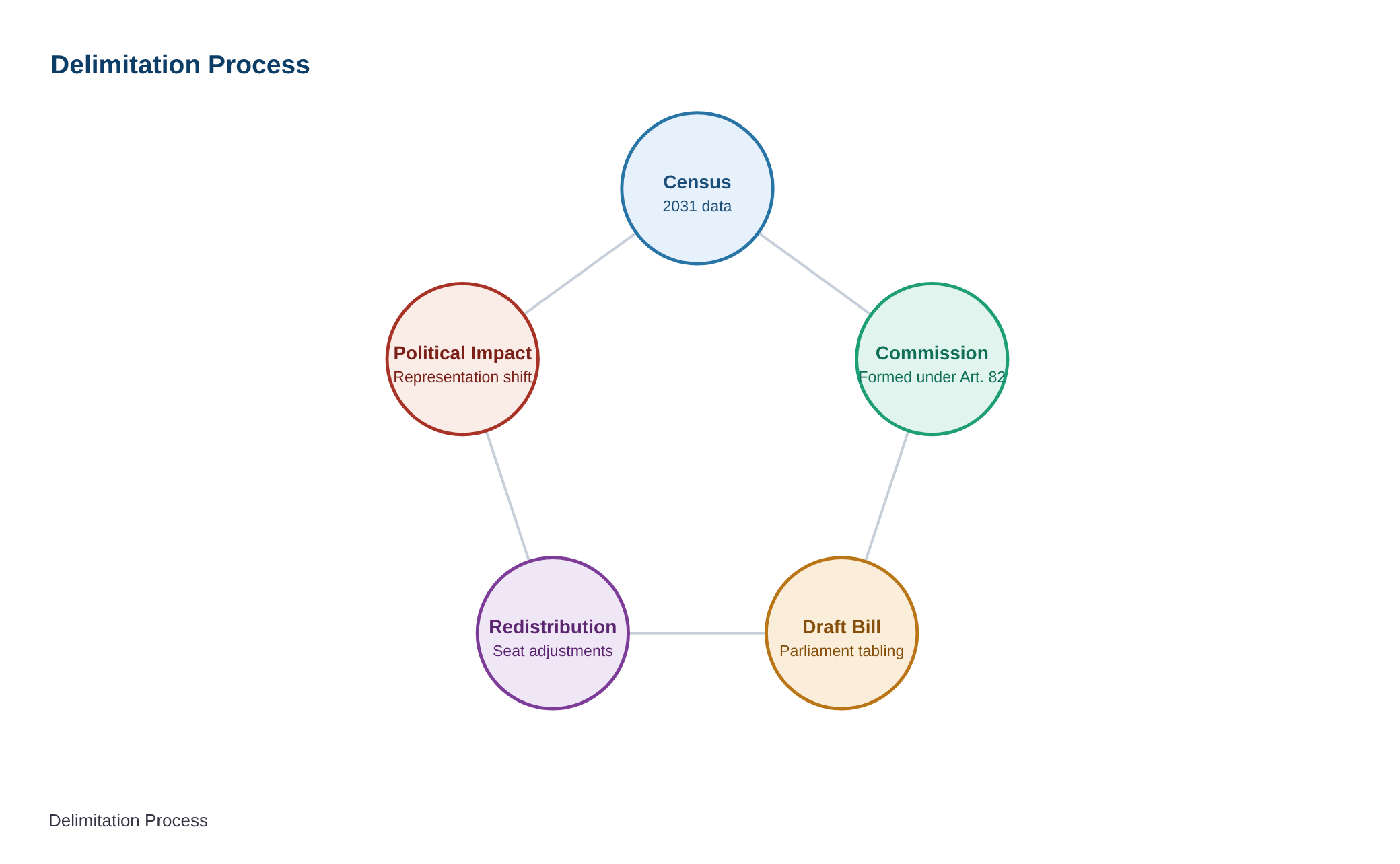
Population Census (2031) → Data Collection and Verification → Formation of Delimitation Commission → Draft Proposals → Public Consultations → Final Delimitation Order → Lok Sabha Seat Redistribution → Political Representation Adjustment → Southern States’ Growth Rate (Slower) → Proposed Seat Reduction → Political Influence Decline → Opposition to Delimitation → Awaiting Bill Draft → DMK’s Stance Finalisation → Lok Sabha Seat Expansion (543 to 816) → Proportional Representation Debate → Northern States’ Gain → Southern States’ Share Maintenance → Federal Balance Concerns → Constitution (One Hundred and Twenty-Fourth Amendment) Bill, 2019 → Deferral of Delimitation → Legal Ambiguity → Judicial Intervention → Process Delay → Delimitation Act, 2002 → Legal Framework → Census Data Utilisation → Exclusion of Scheduled Areas → Administrative Coordination → Implementation Challenges
Prelims Practice Questions
Q1. Consider the following statements regarding the Delimitation Commission in India:
1. It is a permanent constitutional body.
2. Its orders cannot be challenged in any court of law.
3. It is entrusted with the task of redrawing the boundaries of parliamentary and assembly constituencies.
4. The Commission is headed by the Chief Election Commissioner of India.
How many of the above statements are correct?
- Only one
- Only two
- Only three
- All
Answer: Only three — Statements 1 and 4 are incorrect. The Delimitation Commission is a temporary body constituted by the President under Article 82 and Article 170 of the Constitution. It is headed by the Chief Election Commissioner, with other members including the State Election Commissioners and delimitation experts. Statement 2 is also incorrect as the orders of the Commission can be challenged in the High Courts.
Q2. Assertion (A): The 42nd Amendment Act, 1976 froze the delimitation of parliamentary and assembly constituencies till the first census after 2000.
Reason (R): The freeze was imposed to prevent frequent changes in electoral boundaries due to population shifts.
In the context of the above two statements, which one of the following is correct?
- Both A and R are true, and R is the correct explanation of A.
- Both A and R are true, but R is not the correct explanation of A.
- A is true, but R is false.
- A is false, but R is true.
Answer: Both A and R are true, but R is not the correct explanation of A. — Both the Assertion (A) and Reason (R) are correct. The 42nd Amendment Act, 1976 indeed froze delimitation until after the first census post-2000 to ensure stability in electoral boundaries. The Reason (R) correctly explains the purpose behind the freeze.
Q3. Match the following constitutional provisions with their respective subjects:
Column I (Constitutional Provision)
A. Article 82
B. Article 170
C. Article 324
D. Article 325
Column II (Subject)
1. Delimitation of constituencies
2. Reservation of seats for Scheduled Castes and Scheduled Tribes
3. Superintendence, direction and control of elections
4. Composition of the Legislative Assemblies
- A-1, B-4, C-3, D-2
- A-2, B-1, C-4, D-3
- A-3, B-2, C-1, D-4
- A-4, B-3, C-2, D-1
Answer: A-1, B-4, C-3, D-2 — The correct match is: A (Article 82) – 1 (Delimitation of constituencies), B (Article 170) – 4 (Composition of the Legislative Assemblies), C (Article 324) – 3 (Superintendence, direction and control of elections), D (Article 325) – 2 (Reservation of seats for Scheduled Castes and Scheduled Tribes).
Mains Practice Question
✍ Critically examine the constitutional and political implications of the proposed delimitation of Lok Sabha constituencies, with particular reference to the concerns raised by southern states. (15 Marks)
Approach: MODEL-ANSWER SKELETON:
1. **Constitutional Framework**:
– Article 82 and Article 170: Role of Parliament and State Legislatures in delimitation.
– Delimitation Commission: Composition, functions, and temporary nature (Article 327).
– Historical context: 42nd Amendment (1976) freeze and its rationale.
2. **Proposed Changes and Data**:
– Expansion of Lok Sabha seats from 543 to 816 (April 2026 legislative package).
– Tamil Nadu’s seat increase from 39 to 59, maintaining 7.2% share.
– Objective: Reflecting population growth while ensuring proportional representation.
3. **Political and Federal Concerns**:
– Southern states’ apprehension: Perceived dilution of their representation due to higher population growth in northern states.
– Dravidian parties (e.g., DMK): Demand for safeguards to protect federal equity.
– Federalism vs. territorial representation: Balancing demographic changes with equitable political voice.
4. **Judicial and Expert Views**:
– Judicial precedents: Supreme Court’s stance on delimitation (e.g., *Re: Delimitation Act, 2002*).
– Expert committees: Recommendations on ensuring fair representation (e.g., Justice Kuldeep Singh Committee).
5. **Balancing Views and Way Forward**:
– Arguments for population-based delimitation: Ensuring democratic fairness.
– Counter-arguments: Need for safeguards to prevent marginalization of states with controlled population growth.
– Proposed solutions: Weighted representation, regional caps, or phased implementation.
6. **Conclusion**:
– Delimitation must balance constitutional mandates with federal principles to uphold democratic equity. The concerns of southern states underscore the need for a nuanced, consultative approach.
Source: amarujala.com
Generated by AanyaAi for educational purpose.

- यूपी हाईकोर्ट ने स्कूल बस सुरक्षा पर दिया सख्त आदेश, डीएम को 1 माह में रिपोर्ट देने का निर्देश - September 22, 2026
- UP High Court Directs DM & Chief Secretary on School Vehicle Safety: Key Facts for UPSC/PCS - September 22, 2026
- पेरियार टाइगर रिजर्व में 6 नई प्रजातियाँ खोजी गईं, जानिए क्या हैं विशेषताएँ - September 22, 2026

No Comments