


07 Aug UPSC Alert: PLI Scheme for Pharma Sector – Key Updates & Challenges
✎ The PLI scheme for pharmaceuticals disburses incentives only after incremental sales of eligible products, making it a performance-driven model to boost domestic manufacturing and reduce import dependency.
Subject Relevance — Where This Topic Fits
- GS Paper II — Government Policies and Interventions for Development in various sectors | GS Paper III — Indian Economy and Issues relating to Planning, Mobilization of Resources, Growth, Development and Employment | GS Paper III — Effects of Liberalization on the Economy, Changes in Industrial Policy and their Effects on Industrial Growth
- Prelims: Production-Linked Incentive (PLI) Scheme, Pharmaceutical Policy 2020, Bulk Drugs and Medical Devices Policy, Self-Reliance in Pharmaceuticals (Atmanirbhar Bharat), Fermentation-based bulk drug manufacturing, Environmental Clearances in Industrial Projects
- Essay: India’s Pharmaceutical Sector: From Dependence to Global Leadership, Balancing Industrial Growth with Environmental Sustainability in India
Quick Revision: The PLI scheme for pharmaceuticals disburses incentives only after incremental sales of eligible products, making it a performance-driven model to boost domestic manufacturing and reduce import dependency.
Why is this in the news?
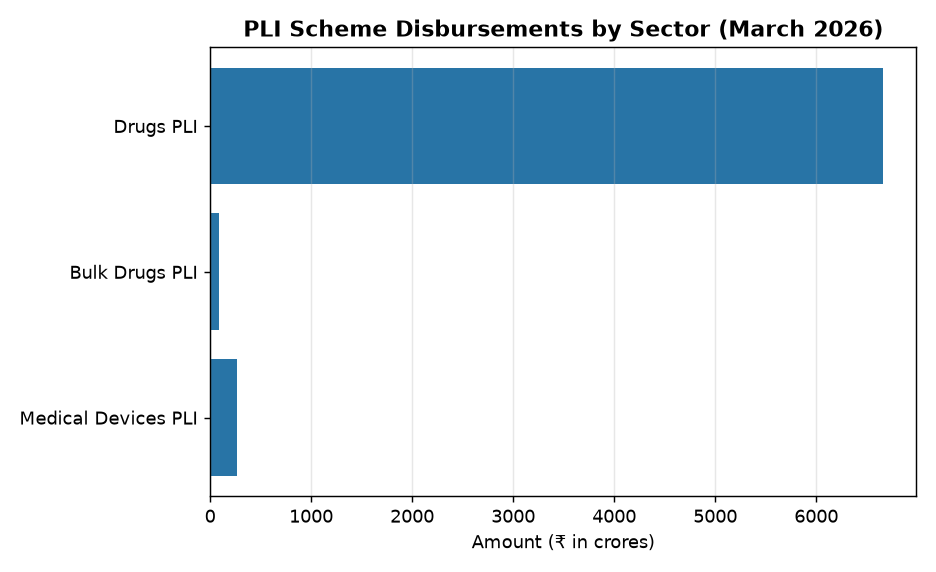
The Press Information Bureau (PIB) released an official update on 7 August 2026 detailing the progress of the Production-Linked Incentive (PLI) schemes for the pharmaceutical and medical devices sectors. The report highlights the disbursement of ₹6,659 crore under the PLI scheme for pharmaceuticals and ₹87.70 crore under the PLI scheme for bulk drugs by March 2026, while also underscoring implementation challenges such as delays in land acquisition, environmental clearances, and the inherent complexities of fermentation-based bulk drug manufacturing. This development is significant for UPSC aspirants as it reflects the government’s strategic efforts to enhance India’s domestic pharmaceutical manufacturing capacity and reduce import dependence, while also addressing structural bottlenecks in the sector.
Background
- The pharmaceutical sector is a critical component of India’s healthcare ecosystem, contributing significantly to both domestic supply and global exports, with India being the world’s largest provider of generic medicines.
- Bulk drugs (active pharmaceutical ingredients or APIs) are the foundation of the pharmaceutical industry, and their domestic production is essential for reducing import dependency, particularly from China.
- The PLI scheme for pharmaceuticals was introduced with a financial outlay of ₹15,000 crore, while the PLI scheme for bulk drugs was allocated ₹6,940 crore to incentivize domestic production and reduce reliance on imports.
- The medical devices sector, though smaller in scale, is also a focus area under the PLI scheme, with ₹266.64 crore disbursed by March 2026.
- The scheme operates on a performance-linked model, where incentives are disbursed based on incremental sales of eligible products, ensuring accountability and efficiency in fund utilization.
What is the Production-Linked Incentive (PLI) Scheme for Pharmaceuticals and Bulk Drugs?
- The PLI scheme for pharmaceuticals is a government initiative aimed at incentivizing domestic manufacturing of pharmaceutical formulations and bulk drugs by providing financial incentives linked to incremental sales.
- The scheme operates under a performance-based model, where incentives are disbursed only after the eligible products are manufactured and sold, ensuring fiscal prudence and accountability.
- The PLI scheme for bulk drugs specifically targets the production of active pharmaceutical ingredients (APIs), which are critical inputs for the pharmaceutical industry and are currently imported in large quantities from countries like China.
- The scheme offers financial incentives ranging from 10% to 20% of incremental sales, depending on the category of drugs and the level of domestic value addition, to encourage investment in high-cost, high-risk manufacturing processes.
- The PLI scheme for pharmaceuticals was launched in FY 2020-21 with a total financial outlay of ₹15,000 crore, while the PLI scheme for bulk drugs was introduced with a ₹6,940 crore outlay to address the critical gap in domestic API production.
- The scheme is designed to attract investments in fermentation-based bulk drug manufacturing, which is technologically complex and capital-intensive, but essential for reducing import dependency.
- The scheme is implemented by the Department of Pharmaceuticals under the Ministry of Chemicals and Fertilizers, with disbursements monitored by the Ministry of Finance to ensure transparency and efficiency.
Key Features
| Feature | Significance |
|---|---|
| Production-Linked Incentive (PLI) Scheme for Pharmaceuticals | Aims to enhance domestic manufacturing capacity, reduce import dependence, and promote self-reliance in critical pharmaceutical ingredients and formulations. |
| Financial Outlay of ₹15,000 crore | Provides substantial budgetary support to incentivize large-scale investments in high-cost, high-risk pharmaceutical manufacturing projects. |
| Dual PLI Schemes (Drugs & Bulk Drugs) | Separate but complementary schemes to address the distinct challenges in formulation manufacturing and bulk drug production, including fermentation-based processes. |
| Performance-Based Disbursement | Incentives are linked to actual sales of manufactured products, ensuring accountability and efficiency in fund utilization. |
| Component-Linked Incentives for Medical Devices | A hybrid incentive model combining PLI with component-specific support to attract diverse manufacturing firms in the medical devices sector. |
Why it Matters
Economic and Industrial
- Boosts domestic pharmaceutical manufacturing, reducing reliance on imports for critical drugs and bulk drugs, thereby improving trade balance.
- Enhances India’s position as a global pharmaceutical hub by incentivizing high-value, high-technology production.
- Stimulates ancillary industries such as packaging, logistics, and R&D, creating employment and fostering innovation.
- Encourages investment in fermentation-based bulk drug production, a niche area with high entry barriers but strategic importance.
Strategic and Geopolitical
- Reduces vulnerability to supply chain disruptions by localizing production of essential pharmaceuticals, including those critical for public health emergencies.
- Supports India’s ‘Atmanirbhar Bharat’ initiative, aligning with national security priorities in the pharmaceutical sector.
- Enhances India’s export competitiveness in high-demand pharmaceutical products, strengthening its role in global supply chains.
Public Health
- Ensures steady supply of affordable and high-quality pharmaceutical products, including bulk drugs and formulations, for domestic consumption.
- Reduces dependence on imported active pharmaceutical ingredients (APIs), mitigating risks of price volatility and shortages.
- Supports the production of fermentation-based drugs, which are often used in critical therapies such as antibiotics and vaccines.
Challenges
1. Implementation Bottlenecks in Bulk Drug PLI
- Prolonged land acquisition processes due to regulatory and bureaucratic delays, increasing project timelines.
- Stringent environmental clearance requirements, particularly for fermentation-based units, leading to extended approval periods.
- High utility costs, including electricity and water, which escalate operational expenses for bulk drug manufacturers.
- Technological and infrastructural limitations in fermentation-based production, which requires precise control of biological processes and longer gestation periods.
- Dependence on imported fermentation strains and specialized equipment, adding to costs and delays.
UPSC Link: GS3: Industrial Policy
2. Performance-Based Disbursement Constraints
- Incentive disbursement is contingent on sales, which delays fund flow for projects with long gestation periods, such as fermentation-based bulk drug units.
- Market uncertainties, including price fluctuations and demand volatility, can impact the timely realization of incentives.
- Small and medium enterprises (SMEs) face cash flow challenges due to delayed disbursements, limiting their ability to scale up production.
UPSC Link: GS3: Public Finance
3. Limited Uptake in Bulk Drug PLI
- Only ₹87.70 crore disbursed out of ₹6,940 crore allocated, indicating slow project implementation and low industry participation.
- High capital requirements and risk aversion among manufacturers due to the capital-intensive nature of bulk drug production.
- Competition from low-cost imports, particularly from China, which undermines the cost competitiveness of domestic bulk drug manufacturers.
UPSC Link: GS3: Industrial Policy
4. Sectoral Fragmentation and Coordination Gaps
- Lack of integration between the Drugs PLI and Bulk Drugs PLI schemes, leading to suboptimal resource allocation and missed synergies.
- Delays in inter-ministerial coordination, particularly between the Department of Pharmaceuticals, Ministry of Environment, and state governments, exacerbating project timelines.
- Inadequate infrastructure support, such as common effluent treatment plants (CETPs) and specialized industrial parks, for bulk drug manufacturing.
UPSC Link: GS2: Government Policies
5. Technological and Skill Gaps
- Shortage of skilled labor trained in advanced fermentation technologies and bulk drug manufacturing processes.
- Limited R&D investment in process optimization and scaling up fermentation-based production, hindering innovation and efficiency.
UPSC Link: GS3: Science & Technology
Challenges — UPSC Perspective
| Issue | Concern |
|---|---|
| Land Acquisition Delays | Prolonged regulatory and bureaucratic processes increase project timelines and costs. |
| Environmental Clearances | Stringent and time-consuming approvals for fermentation-based units delay project implementation. |
| High Utility Costs | Escalating operational expenses due to electricity and water costs reduce profit margins. |
| Fermentation-Based Production Challenges | Biological processes require precise control, longer gestation periods, and specialized infrastructure. |
| Market Dependence on Imports | Limited domestic availability of fermentation strains and specialized equipment increases costs and delays. |
| Performance-Based Disbursement | Delayed incentive realization due to sales-linked disbursement affects cash flow and project viability. |
| Low Industry Participation | Only 1.26% of allocated funds disbursed in Bulk Drugs PLI, indicating slow uptake and risk aversion. |
| Regulatory Fragmentation | Lack of coordination between central and state agencies exacerbates implementation delays. |
Government Initiatives — Must-Memorise for Prelims
- Production-Linked Incentive (PLI) Scheme for Pharmaceuticals
- Production-Linked Incentive (PLI) Scheme for Bulk Drugs
- Production-Linked Incentive (PLI) Scheme for Medical Devices
Way Forward
- Streamline land acquisition processes by delegating powers to state-level nodal agencies and implementing digital land records to reduce delays.
- Fast-track environmental clearances for fermentation-based bulk drug units by creating dedicated fast-track committees and pre-approved zones.
- Provide financial support for high utility costs, such as subsidized electricity and water, to improve cost competitiveness of domestic manufacturers.
- Establish common infrastructure facilities, including CETPs and fermentation-specific industrial parks, to reduce capital expenditure and improve efficiency.
- Enhance R&D support for fermentation technologies through public-private partnerships and grants for process optimization and scaling up.
- Introduce a hybrid incentive model for bulk drugs, combining upfront grants with performance-linked disbursements to mitigate cash flow risks for manufacturers.
- Strengthen industry-academia collaboration to address skill gaps through specialized training programs and apprenticeships in fermentation technologies.
- Promote domestic production of fermentation strains and specialized equipment through targeted PLI sub-schemes and import substitution incentives.
UPSC Value Addition
Keywords for Mains Answer-Writing
Production Linked Incentive (PLI) Scheme · Pharmaceutical Sector · Bulk Drugs · Fermentation-based Medicines · Land Acquisition Delays · Environmental Clearances · Component-Linked Incentive (CLI) · Medical Devices PLI · Public Sector Undertakings (PSUs) · Atmanirbhar Bharat · Union Budget 2022-23 · Union Ministry of Chemicals and Fertilizers
Concept Flow
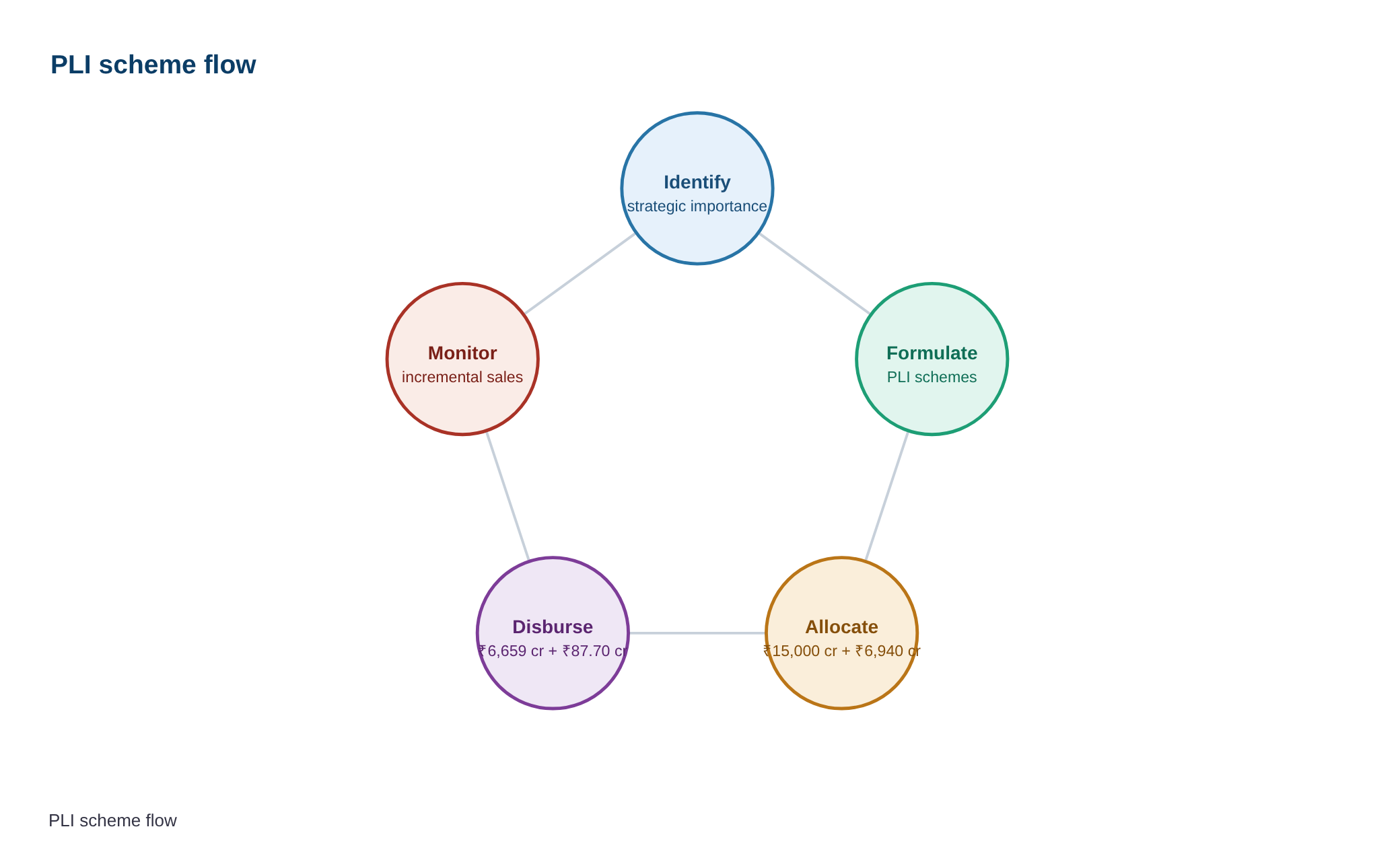
Identification of strategic importance of self-reliance in pharmaceuticals under ‘Atmanirbhar Bharat’ → → Formulation of PLI schemes for pharmaceuticals, bulk drugs, and medical devices → → Allocation of financial outlays and establishment of performance-linked disbursement mechanisms → → Implementation challenges in bulk drug production due to regulatory, infrastructural, and technological constraints → → Delayed disbursement of incentives due to sales-linked performance criteria → → Impact on industry participation and economic viability of projects → → Need for structural reforms to address bottlenecks and enhance sectoral competitiveness
Prelims Practice Questions
Q1. Consider the following statements regarding the Production Linked Incentive (PLI) Scheme for the Pharmaceutical sector:
1. The PLI Scheme for Pharmaceuticals was launched in the Union Budget 2022-23.
2. The total financial outlay for the PLI Scheme for Pharmaceuticals is ₹15,000 crore.
3. The PLI Scheme for Bulk Drugs has a financial outlay of ₹6,940 crore.
4. The PLI Scheme for Medical Devices includes a component-linked incentive (CLI) framework.
How many of the above statements are correct?
- Only one
- Only two
- Only three
- All four
Answer: Only three — Statements 2 and 3 are correct. Statement 1 is incorrect as the PLI Scheme for Pharmaceuticals was launched in FY 2022-23 (not the Union Budget 2022-23). Statement 4 is incorrect as the PLI Scheme for Medical Devices does not include a CLI framework.
Q2. Assertion (A): Fermentation-based bulk drugs require longer manufacturing periods compared to chemically synthesized drugs.
Reason (R): Fermentation relies on the biological activity of living cells, which grow at a slower, natural pace.
Options:
A. Both A and R are true, and R is the correct explanation of A.
B. Both A and R are true, but R is not the correct explanation of A.
C. A is true, but R is false.
D. A is false, but R is true.
- A
- B
- C
- D
Answer: A — Both the Assertion (A) and Reason (R) are true, and R correctly explains A. Fermentation-based production is inherently slower due to biological constraints, unlike chemical synthesis.
Q3. Match the following PLI Schemes with their respective financial outlays:
Column I (PLI Scheme) Column II (Financial Outlay)
1. Pharmaceuticals PLI A. ₹15,000 crore
2. Bulk Drugs PLI B. ₹6,940 crore
3. Medical Devices PLI C. ₹5,000 crore
Options:
A. 1-A, 2-B, 3-C
B. 1-B, 2-A, 3-C
C. 1-C, 2-B, 3-A
D. 1-A, 2-C, 3-B
- A
- B
- C
- D
Answer: A — The correct match is: Pharmaceuticals PLI (₹15,000 crore), Bulk Drugs PLI (₹6,940 crore), and Medical Devices PLI (₹5,000 crore).
Mains Practice Question
✍ The Production Linked Incentive (PLI) Scheme for the pharmaceutical sector, launched in FY 2022-23, aims to enhance domestic manufacturing and reduce import dependence. Critically examine the challenges faced in the implementation of the PLI Scheme for bulk drugs, particularly those arising from fermentation-based production. Also, assess the efficacy of the PLI framework in achieving its stated objectives of self-reliance in the pharmaceutical sector. (15 Marks)
Approach: MODEL-ANSWER SKELETON:
1. **Introduction (2 Marks)**
– Briefly define the PLI Scheme and its objectives in the pharmaceutical sector.
– Mention the financial outlay (₹15,000 crore for pharmaceuticals, ₹6,940 crore for bulk drugs).
2. **Challenges in Bulk Drugs PLI Implementation (6 Marks)**
– **Land Acquisition Delays**: Highlight the time-consuming process and its impact on project timelines.
– **Environmental Clearances**: Discuss the stringent regulatory hurdles and their role in delaying projects.
– **High Utility Costs**: Explain the financial burden on manufacturers due to infrastructure and operational expenses.
– **Fermentation-Based Production**: Elaborate on the biological constraints (slow growth of living cells) and their impact on manufacturing timelines.
– **Fund Disbursement Mechanism**: Explain how incentives are tied to sales, leading to delays when production is stalled.
3. **Efficacy of the PLI Framework (5 Marks)**
– **Progress So Far**: Cite the disbursed amounts (₹6,659 crore for pharmaceuticals, ₹87.70 crore for bulk drugs) as a measure of success.
– **Gaps in Implementation**: Discuss the underperformance in bulk drugs due to the challenges outlined.
– **Comparative Analysis**: Contrast the PLI Scheme for medical devices (₹266.64 crore disbursed) to highlight sectoral variations.
– **Suggestions for Improvement**: Propose measures such as streamlining approvals, financial support for infrastructure, and incentivizing R&D.
4. **Conclusion (2 Marks)**
– Summarize the key challenges and the need for a balanced approach to achieve self-reliance.
– Emphasize the importance of addressing structural bottlenecks to realize the scheme’s potential.
Source: PIB (Press Information Bureau)
Generated by AanyaAi for educational purpose.


No Comments