


07 Aug Mission Poshan 2.0: UPSC’s Latest Govt Initiative to Combat Malnutrition
✎ Mission Poshan 2.0 is a technology-enabled, convergent nutrition mission that builds on Poshan Abhiyaan, using Poshan Tracker with Facial Recognition System and Aadhaar-based tracking to ensure targeted delivery of supplementary…
Subject Relevance — Where This Topic Fits
- GS Paper II — Governance, Social Justice and Welfare | GS Paper III — Human Development and Nutrition
- Prelims: Malnutrition, Poshan Tracker, Anganwadi Services, Anaemia, Stunting, ICDS, Mission Poshan 2.0, NITI Aayog, World Bank, Third-Party Evaluation, Facial Recognition System (FRS)
- Essay: The Role of Technology in Public Health Delivery: A Case Study of Mission Poshan 2.0, Intersection of Nutrition, Gender, and Governance: Lessons from India’s Poshan Abhiyaan
Quick Revision: Mission Poshan 2.0 is a technology-enabled, convergent nutrition mission that builds on Poshan Abhiyaan, using Poshan Tracker with Facial Recognition System and Aadhaar-based tracking to ensure targeted delivery of supplementary nutrition and health services to pregnant women, lactating mothers, and children under six.
Why is this in the news?
The Press Information Bureau (PIB), Ministry of Women and Child Development, Government of India, released a press note on 7 August 2026 highlighting Mission Poshan 2.0 as the latest government initiative to comprehensively address malnutrition and promote child development. The initiative incorporates a coordinated and robust approach with evidence-based interventions and digital governance tools like the Poshan Tracker application, including Facial Recognition System (FRS) for beneficiary verification.
Background
- The Government of India launched the ‘Poshan Abhiyaan’ (National Nutrition Mission) in 2018 to address malnutrition among children, pregnant women, and lactating mothers through a multi-sectoral convergence approach.
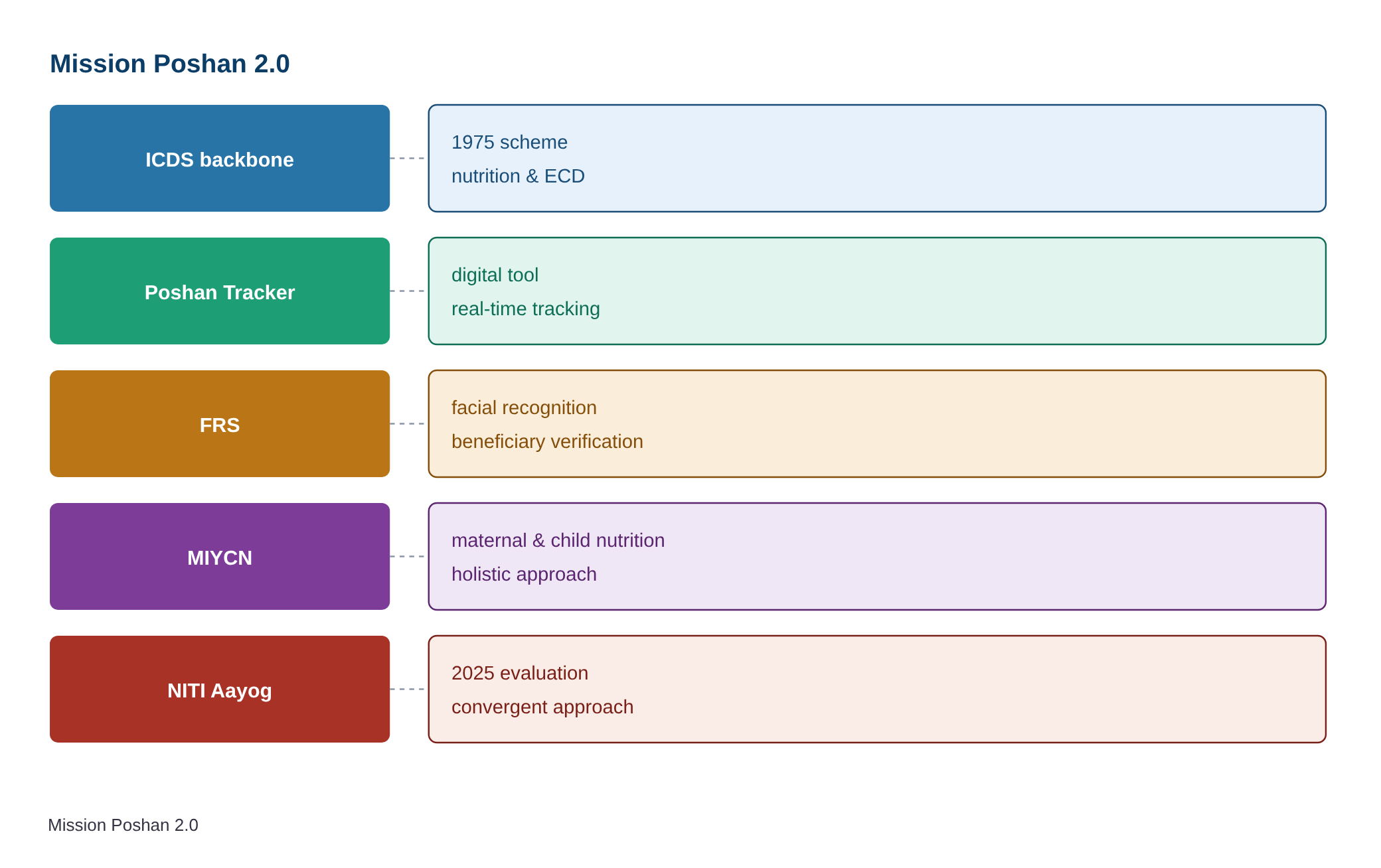
- A third-party evaluation and impact assessment of Poshan Abhiyaan conducted by NITI Aayog in 2020 found the mission’s relevance in combating malnutrition in India to be satisfactory, validating its design and implementation.
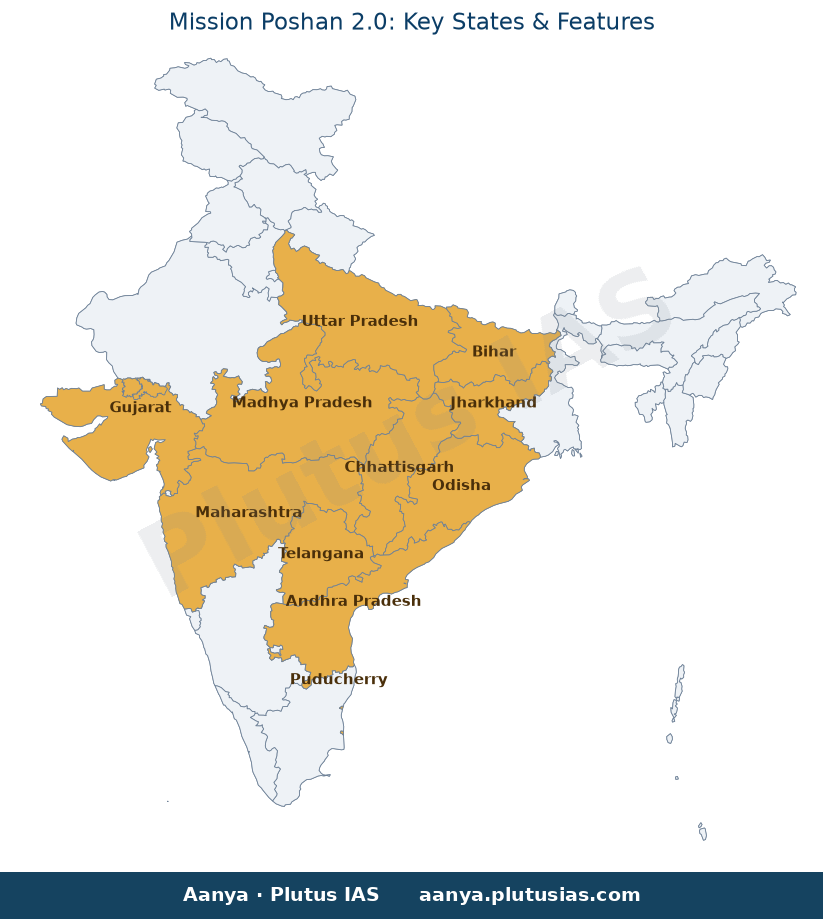
- In 2021, the World Bank conducted a survey in 11 states, including Andhra Pradesh, selected based on high prevalence of stunting in children and anaemia in women, to assess the effectiveness of Poshan Abhiyaan services.
- The survey revealed significant improvements in nutrition-related behaviours among beneficiaries, with 80% of women receiving nutrition messages and 81% exclusively breastfeeding for the first six months.
- NITI Aayog’s Development Monitoring and Evaluation Office (DMEO) conducted a result-based evaluation study of Mission Poshan 2.0 in 2025 across 12 states and one Union Territory, reinforcing the need for a strengthened and convergent approach.
- The Integrated Child Development Services (ICDS) scheme, launched in 1975, forms the backbone of India’s nutrition and early childhood development programmes, providing supplementary nutrition, immunisation, health check-ups, and pre-school education.
What is Mission Poshan 2.0?
- Mission Poshan 2.0 is an upgraded version of the Poshan Abhiyaan, creating a comprehensive, convergent, and technology-enabled framework for addressing malnutrition and promoting child development.
- The mission adopts a life-cycle approach, targeting pregnant women, lactating mothers, infants, and children under six years, with a focus on reducing stunting, wasting, underweight, and anaemia among women and children.
- It leverages the existing Anganwadi Services infrastructure under the ICDS scheme, enhancing service delivery through improved monitoring, counselling, and supplementary nutrition with fortified foods.
- Mission Poshan 2.0 incorporates evidence-based interventions validated by third-party evaluations, including the World Bank survey and NITI Aayog’s DMEO studies, to ensure targeted and effective programme design.
- The mission introduces the ‘Poshan Tracker’ digital application, an ICT-based governance tool developed by the Ministry of Women and Child Development to monitor and review the implementation of services, including health and nutrition status of beneficiaries.
- The Poshan Tracker employs Facial Recognition System (FRS) for beneficiary verification to ensure that take-home rations and other entitlements reach only the registered and eligible beneficiaries, thereby reducing leakages and fraud.
- Aadhaar-based tracking is integrated into the Poshan Tracker to prevent data leaks, eliminate fake entries, and ensure accurate identification of beneficiaries, thereby enhancing transparency and accountability in service delivery.
- The mission emphasizes convergence with other government schemes such as the National Health Mission (NHM), Swachh Bharat Mission (SBM), and Mahatma Gandhi National Rural Employment Guarantee Scheme (MGNREGS) to address the multi-dimensional nature of malnutrition.
Key Features
| Feature | Significance |
|---|---|
| Integrated Convergence Approach | Combines multiple nutrition schemes (e.g., Supplementary Nutrition, Growth Monitoring) under a single framework to eliminate duplication and enhance efficiency in service delivery. |
| ICT-Based Governance Tool: Poshan Tracker | Enables real-time monitoring of beneficiaries’ health and nutrition status, ensuring transparency, accountability, and data-driven decision-making across administrative levels. |
| Facial Recognition System (FRS) | Prevents leakage of Take-Home Ration (THR) by authenticating beneficiaries, ensuring targeted delivery to registered individuals and reducing fraudulent claims. |
| Aadhaar-Based Tracking | Facilitates accurate beneficiary identification, prevents data leaks, and eliminates fake entries, thereby improving the integrity of the welfare system. |
| Behavioural Change Communication | Leverages nutrition messaging to improve dietary practices, with demonstrated success in increasing exclusive breastfeeding rates (81%) and awareness among women (80%+). |
Why it Matters
Public Health
- Addresses multi-dimensional malnutrition (stunting, wasting, anaemia) through a holistic approach, integrating maternal, infant, and young child nutrition (MIYCN) strategies.
- Aims to reduce India’s high burden of child undernutrition, which contributes to 68% of under-five mortality (NFHS-5 data).
- Enhances the effectiveness of Anganwadi services by ensuring high utilisation and acceptance of supplementary nutrition and growth monitoring.
Governance & Technology
- Demonstrates the role of digital public infrastructure (DPI) in improving welfare delivery through real-time tracking, reducing leakages, and enhancing transparency.
- Sets a precedent for scalable, data-driven governance models in social sector schemes, aligning with the vision of ‘Minimum Government, Maximum Governance’.
- Highlights the importance of third-party evaluations (e.g., NITI Aayog, World Bank) in validating programme impact and guiding policy refinements.
Socio-Economic Impact
- Improves human capital development by addressing early-life malnutrition, which is linked to cognitive deficits, lower productivity, and intergenerational poverty cycles.
- Supports the achievement of Sustainable Development Goal 2 (Zero Hunger) and SDG 3 (Good Health and Well-being) through targeted interventions.
- Contributes to reducing out-of-pocket expenditures on healthcare by preventing nutrition-related illnesses in vulnerable populations.
Challenges
1. Implementation Gaps in Last-Mile Delivery
- Despite technological advancements, last-mile delivery challenges persist due to inadequate infrastructure in remote and tribal areas.
- Anganwadi workers face high workloads, leading to potential gaps in service quality and beneficiary engagement.
- Digital literacy barriers among beneficiaries may hinder effective use of Poshan Tracker and FRS systems.
UPSC Link: GS-II: Welfare schemes
2. Inter-State Disparities in Nutrition Outcomes
- States with high stunting and anaemia prevalence (e.g., Bihar, Uttar Pradesh) require targeted interventions to bridge the nutrition gap.
- Variations in state capacity and resource allocation affect the uniform implementation of Mission Poshan 2.0.
- Cultural practices (e.g., early marriage, dietary taboos) may undermine programme efficacy in certain regions.
UPSC Link: GS-II: Social Sector
3. Data Privacy and Ethical Concerns
- Aadhaar-based tracking raises concerns about data privacy, consent, and potential misuse of sensitive health information.
- Facial Recognition Systems (FRS) may face resistance due to privacy violations and lack of clear regulatory frameworks.
- Ensuring data security across decentralised digital platforms remains a critical challenge.
UPSC Link: GS-II: Governance
4. Sustainability and Funding Constraints
- Long-term funding for supplementary nutrition and digital infrastructure requires consistent budgetary allocations.
- Dependence on external evaluations (e.g., World Bank) may not be sustainable for continuous monitoring.
- Economic shocks (e.g., pandemics, inflation) can divert resources away from nutrition programmes.
UPSC Link: GS-III: Resource Mobilisation
Challenges — UPSC Perspective
| Issue | Concern |
|---|---|
| Digital Divide | Limited access to smartphones/internet in rural and tribal areas may exclude marginalised groups from Poshan Tracker benefits. |
| Workforce Shortages | Insufficient number of trained Anganwadi workers to deliver comprehensive nutrition services, especially in high-burden states. |
| Cultural Barriers | Deep-rooted practices (e.g., gender discrimination, food taboos) may resist behaviour change interventions. |
| Monitoring Fatigue | Over-reliance on digital tools without adequate human oversight can lead to superficial data collection. |
| Policy Coordination | Fragmented implementation across ministries (e.g., WCD, Health, Rural Development) may dilute programme impact. |
Way Forward
- Strengthen last-mile delivery by augmenting Anganwadi infrastructure and deploying mobile health units in remote areas.
- Enhance digital literacy programmes for beneficiaries to ensure effective use of Poshan Tracker and FRS systems.
- Establish a robust grievance redressal mechanism for beneficiaries facing issues with digital authentication or service delivery.
- Promote inter-ministerial convergence to align nutrition programmes with health (Ayushman Bharat), sanitation (Swachh Bharat), and education (Samagra Shiksha) initiatives.
- Conduct periodic third-party audits to assess programme efficacy and identify gaps in implementation.
- Develop region-specific behaviour change communication strategies to address cultural barriers and local dietary practices.
- Ensure sustainable funding by integrating nutrition budgets into state and central financial plans, with a focus on high-burden districts.
UPSC Value Addition
Keywords for Mains Answer-Writing
Mission Poshan 2.0 · Poshan Abhiyaan · malnutrition eradication · child development · Anganwadi services · Nutrition Tracker · POSHAN Tracker · ICT-based governance · facial recognition system · supplementary nutrition · growth monitoring · counseling services · stunting reduction · anaemia prevalence · World Bank survey · NITI Aayog evaluation · Mission Saksham Anganwadi · POSHAN 2.0 framework · integrated nutrition strategy · behavioral change communication
Constitutional & Policy Linkages
- Article 47: Duty of the State to raise the level of nutrition and standard of living (Directive Principles of State Policy).
- Article 243G: Empowers local governments (Panchayats) to implement nutrition schemes, ensuring grassroots participation.
Concept Flow
High prevalence of child stunting and anaemia in India → Government launches integrated nutrition programmes (e.g., ICDS, Poshan Abhiyaan) → Third-party evaluations (NITI Aayog, World Bank) highlight behavioural gaps → Mission Poshan 2.0 introduced with ICT tools (Poshan Tracker, FRS) → Digital governance enhances service delivery and transparency → Behavioural change communication improves nutrition practices → Reduction in malnutrition rates and improved child development outcomes.
Prelims Practice Questions
Q1. Consider the following statements regarding Mission Poshan 2.0:
1. It is an ICT-based governance tool launched by the Ministry of Women and Child Development.
2. It includes a facial recognition system to ensure targeted delivery of take-home rations.
3. The program is implemented exclusively through state governments without central oversight.
4. It aims to address malnutrition through supplementary nutrition, growth monitoring, and counseling services.
How many of the above statements are correct?
- Only one
- Only two
- Only three
- All
Answer: Only three — Statement 1 is incorrect as the ICT-based tool is ‘Poshan Tracker’, not Mission Poshan 2.0 itself. Statements 2 and 4 are correct. Statement 3 is incorrect as the program involves both central and state oversight.
Q2. Assertion (A): The Poshan Tracker application uses facial recognition to prevent leakage in the delivery of take-home rations under Mission Poshan 2.0.
Reason (R): Facial recognition ensures that only registered beneficiaries receive the intended benefits, thereby enhancing transparency and reducing pilferage.
Codes:
A. Both A and R are true, and R is the correct explanation of A.
B. Both A and R are true, but R is not the correct explanation of A.
C. A is true, but R is false.
D. A is false, but R is true.
- A
- B
- C
- D
Answer: A — Both the assertion and reason are true. The facial recognition system in Poshan Tracker is designed to authenticate beneficiaries and prevent leakage, making R the correct explanation of A.
Q3. Match the following initiatives with their respective implementing agencies:
Column I (Initiative) Column II (Agency)
A. Poshan Abhiyaan 1. Ministry of Health and Family Welfare
B. Mission Poshan 2.0 2. NITI Aayog
C. Mid-Day Meal Scheme 3. Ministry of Women and Child Development
D. National Health Mission 4. Ministry of Education
Select the correct match:
- A-3, B-3, C-4, D-1
- A-2, B-3, C-4, D-1
- A-1, B-3, C-2, D-4
- A-3, B-2, C-1, D-4
Answer: A-3, B-3, C-4, D-1 — Poshan Abhiyaan and Mission Poshan 2.0 are both under the Ministry of Women and Child Development (A-3, B-3). The Mid-Day Meal Scheme is under the Ministry of Education (C-4), and the National Health Mission is under the Ministry of Health and Family Welfare (D-1).
Mains Practice Question
✍ Mission Poshan 2.0 represents a paradigm shift in India’s approach to addressing malnutrition by integrating technology, inter-sectoral convergence, and behavioral change communication. Critically examine the structural, technological, and governance innovations introduced under Mission Poshan 2.0. How far have these innovations addressed the persistent challenges in India’s nutrition landscape? (15 Marks)
Approach: MODEL-ANSWER SKELETON:
1. **Structural Innovations**:
– **Convergence Framework**: Explain the integration of Poshan Abhiyaan, Saksham Anganwadi, and Mission Poshan 2.0 under a unified strategy (Ministry of Women and Child Development).
– **Service Delivery**: Highlight the expansion of Anganwadi services to include supplementary nutrition, growth monitoring, and counseling under a single platform.
– **Targeted Approach**: Discuss the selection of 12 states and 1 UT based on high prevalence of stunting and anaemia (World Bank survey, 2021).
2. **Technological Innovations**:
– **Poshan Tracker**: Explain its role as an ICT-based governance tool for real-time monitoring, beneficiary authentication, and data-driven decision-making.
– **Facial Recognition System (FRS)**: Describe how FRS ensures targeted delivery of take-home rations and prevents leakage.
– **Aadhaar-based Tracking**: Discuss its role in beneficiary identification, data integrity, and prevention of fraudulent entries.
3. **Governance and Behavioral Change**:
– **Evidence-Based Interventions**: Cite the World Bank survey (2021) and NITI Aayog’s evaluation (2025) to demonstrate improvements in nutrition-related behaviors (e.g., exclusive breastfeeding rates).
– **Community Engagement**: Highlight the role of Anganwadi workers in disseminating nutrition messages and driving behavioral change (80%+ reach of nutrition messages).
4. **Persistent Challenges**:
– **Implementation Gaps**: Discuss issues such as last-mile delivery, state-level variations in execution, and resource constraints.
– **Inter-Sectoral Coordination**: Examine challenges in integrating health, education, and women and child development sectors.
– **Data Quality and Monitoring**: Address concerns about the accuracy of Poshan Tracker data and the need for continuous evaluation.
5. **Conclusion**:
– Summarize the innovations as a step forward but emphasize the need for sustained political will, adequate funding, and community participation to achieve long-term nutritional outcomes.
Source: PIB (Press Information Bureau)
Generated by AanyaAi for educational purpose.

- सुप्रीम कोर्ट ने चुनाव आयोग को दिल्ली में ‘यांत्रिक’ SIR नोटिस पर सावधानियां बरतने को कहा - September 22, 2026
- ‘स्वच्छता ही सेवा-2026’ अभियान: सरकारी विभागों में स्वच्छता क्रांति, जानिए मुख्य बिंदु - September 22, 2026
- DFPD Launches ‘Swachhata Hi Seva-2026’ Campaign for Clean India Mission - September 22, 2026

No Comments