


07 Aug PLI Scheme for Pharma Sector: Key Updates for UPSC & State PCS 2026
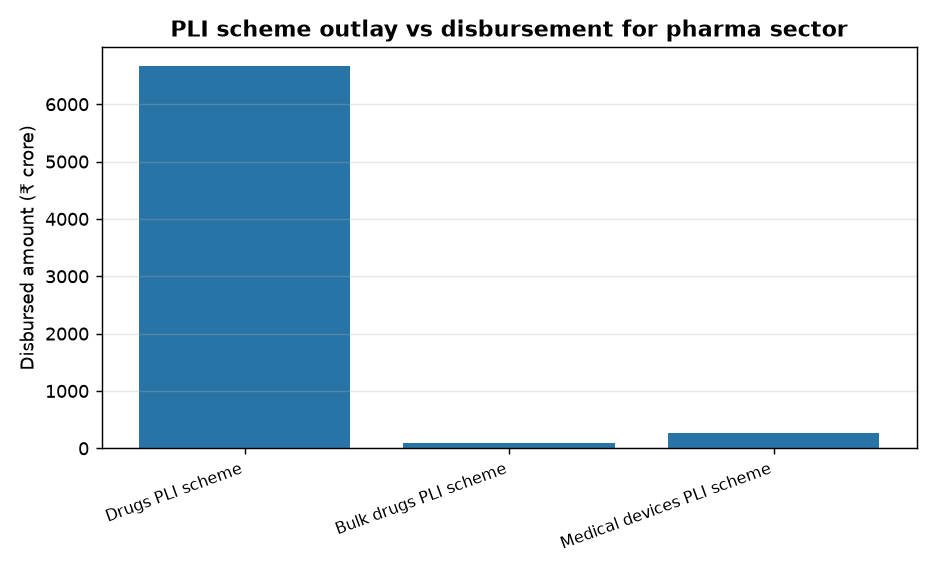
✎ The PLI scheme for pharmaceuticals incentivizes domestic production of drugs, bulk drugs (APIs), and medical devices through performance-linked financial support, with ₹6,659 crore disbursed for drugs and ₹87.70 crore for bulk…
Subject Relevance — Where This Topic Fits
- GS Paper III — Economy: Government Budgeting, Manufacturing Sector Policies, and Industrial Development
- Prelims: Production-Linked Incentive (PLI) Scheme, Pharmaceutical Sector, Self-Reliance in Pharmaceuticals (Atmanirbhar Bharat), Fermentation-based bulk drugs, Environmental Clearances, Land Acquisition, Component-Linked Incentive (CLI)
- Essay: The Role of Government Incentives in Achieving Self-Reliance in Critical Sectors, Balancing Industrial Growth with Environmental and Social Governance in India
Quick Revision: The PLI scheme for pharmaceuticals incentivizes domestic production of drugs, bulk drugs (APIs), and medical devices through performance-linked financial support, with ₹6,659 crore disbursed for drugs and ₹87.70 crore for bulk drugs as of March 2026, despite implementation challenges such as regulatory delays and production bottlenecks.
Why is this in the news?
The Press Information Bureau (PIB) released a written response by the Minister of State for Chemicals and Fertilizers on August 7, 2026, detailing the progress of the Production-Linked Incentive (PLI) schemes for the pharmaceutical sector. The update highlights the disbursement of ₹6,659 crore under the PLI scheme for drugs and ₹87.70 crore under the PLI scheme for bulk drugs as of March 2026, while also underscoring implementation challenges such as delays in land acquisition, environmental clearances, and the prolonged production cycles for fermentation-based bulk drugs. This underscores the need for a nuanced evaluation of the PLI framework in achieving the twin objectives of self-reliance and global competitiveness in the pharmaceutical sector.
Background
- The PLI scheme for the pharmaceutical sector was launched in FY 2022-23 with a total financial outlay of ₹15,000 crore, aiming to enhance domestic manufacturing capabilities and reduce import dependence in critical drugs and medical devices.
- The scheme is a component of the broader Atmanirbhar Bharat initiative, which seeks to promote self-reliance across strategic sectors, including pharmaceuticals, by incentivizing domestic production and innovation.
- India is the world’s largest provider of generic drugs, supplying over 50% of global vaccine demand and 20% of generic medicines globally, but remains dependent on imports for key active pharmaceutical ingredients (APIs) and bulk drugs.
- The PLI scheme for bulk drugs, with a financial outlay of ₹6,940 crore, specifically targets the production of fermentation-based and chemically synthesized bulk drugs to reduce import dependency.
What is the Production-Linked Incentive (PLI) Scheme for the Pharmaceutical Sector?
- The PLI scheme for pharmaceuticals is a performance-based incentive mechanism designed to encourage domestic manufacturing of drugs, bulk drugs (APIs), and medical devices by providing financial incentives linked to incremental sales and production.
- The scheme operates on a multi-year framework, with incentives disbursed over a five-year period, contingent upon the achievement of specified production targets and sales milestones.
- For drugs, the PLI scheme offers incentives ranging from 10% to 20% of incremental sales, depending on the category of drugs produced (e.g., biopharmaceuticals, complex generics, or patented medicines).
- The bulk drugs PLI scheme targets fermentation-based and chemically synthesized APIs, with incentives structured to support high-cost, long-lead-time projects, such as those involving fermentation processes, which are critical for reducing import dependency.
- The scheme is administered by the Department of Pharmaceuticals under the Ministry of Chemicals and Fertilizers, with oversight from the Empowered Group of Secretaries (EGoS) to ensure alignment with national priorities.
- Incentives are disbursed post-facto, based on verified sales data, to ensure accountability and prevent misuse of public funds.
- The PLI scheme for pharmaceuticals is complemented by other initiatives such as the Promotion of Research and Innovation in Pharma-MedTech Sector (PRIP) scheme, which aims to foster R&D and innovation in the sector.
Key Features
| Feature | Significance |
|---|---|
| Production-Linked Incentive (PLI) Scheme for Pharmaceuticals | Aims to enhance domestic manufacturing capacity, reduce import dependence, and promote self-reliance in critical pharmaceutical products. |
| Financial Outlay of ₹15,000 crore | Provides substantial fiscal support to incentivize large-scale investments in pharmaceutical production. |
| Incentive Disbursement Mechanism | Links subsidy release to actual sales of manufactured products, ensuring performance-based allocation. |
| Dual PLI Schemes for Drugs and Bulk Drugs | Separate incentives for finished formulations and bulk drugs to address distinct industrial challenges. |
| Component-Linked Incentives in Medical Devices PLI | Adopts a hybrid incentive model to attract diverse manufacturing segments in the medical devices sector. |
Why it Matters
Economic Implications
- Boosts domestic pharmaceutical manufacturing, reducing import bills for critical drugs and bulk pharmaceuticals.
- Enhances export competitiveness by incentivizing high-value drug production.
- Stimulates ancillary industries such as packaging, logistics, and R&D in the pharmaceutical ecosystem.
- Encourages large-scale investments in greenfield and brownfield projects, creating employment opportunities.
Strategic Importance
- Reduces reliance on imported active pharmaceutical ingredients (APIs) and key starting materials (KSMs).
- Strengthens India’s position as a global pharmaceutical hub, particularly in generics and biosimilars.
- Supports India’s Atmanirbhar Bharat initiative by fostering self-sufficiency in essential medicines.
- Aligns with the National Pharmaceutical Policy 2023 to enhance drug security and affordability.
Industrial Development
- Promotes technological upgradation and adoption of advanced manufacturing processes in the pharmaceutical sector.
- Encourages research and innovation in fermentation-based drug production, a critical area for biosimilars.
- Facilitates the development of a robust supply chain for bulk drugs, reducing dependency on China for APIs.
- Supports the growth of MSMEs in the pharmaceutical sector by providing scalable incentives.
Challenges
1. Implementation Bottlenecks in Bulk Drug PLI
- Lengthy land acquisition processes delay project execution, particularly in industrial corridors.
- Environmental clearances and regulatory hurdles slow down project approvals and compliance.
- High utility costs, including energy and water, increase operational expenses for fermentation-based units.
- Prolonged fermentation cycles for biological processes extend project timelines and delay revenue generation.
- Performance-linked disbursement of incentives creates cash-flow constraints for new entrants.
UPSC Link: GS3: Industrial Policy & Challenges
2. Differential Performance Across PLI Schemes
- Disparity in disbursement between drugs (₹6,659 crore) and bulk drugs (₹87.70 crore) indicates uneven progress.
- Medical devices PLI shows moderate disbursement (₹266.64 crore), reflecting sector-specific challenges.
- Lack of a unified incentive framework for medical devices hampers cohesive growth in the sector.
UPSC Link: GS3: Sectoral Development
3. Technological and Process Constraints
- Fermentation-based production relies on biological processes, which are inherently slower than chemical synthesis.
- Limited domestic capacity for high-end fermentation technologies increases reliance on imported know-how.
- Scalability issues in fermentation units pose challenges for large-scale commercial production.
UPSC Link: GS3: Science & Technology
4. Regulatory and Compliance Hurdles
- Stringent environmental and safety regulations increase compliance costs for pharmaceutical units.
- Delays in obtaining statutory clearances (e.g., from the Central Pollution Control Board) stall projects.
- Inconsistent state-level policies on land use and industrial zoning create operational uncertainties.
UPSC Link: GS2: Governance & Policies
Challenges — UPSC Perspective
| Issue | Concern |
|---|---|
| Land Acquisition Delays | Prolongs project initiation, particularly in bulk drug manufacturing hubs. |
| Environmental Clearances | Creates regulatory bottlenecks due to overlapping approvals and compliance requirements. |
| High Utility Costs | Increases operational expenditure, reducing profit margins for fermentation-based units. |
| Fermentation Cycle Length | Extends project payback periods, delaying incentive disbursement tied to sales. |
| Performance-Linked Disbursement | Creates cash-flow constraints for new entrants awaiting sales-based payouts. |
| Sectoral Imbalance in Incentives | Bulk drugs lag behind finished formulations in disbursement, indicating uneven sectoral progress. |
Government Initiatives — Must-Memorise for Prelims
- {‘name’: ‘Production-Linked Incentive (PLI) Scheme for Pharmaceuticals’, ‘description’: ‘A central sector scheme to incentivize domestic manufacturing of pharmaceuticals and bulk drugs.’}
- {‘name’: ‘National Pharmaceutical Policy 2023’, ‘description’: ‘A policy framework to enhance drug security, affordability, and self-reliance in pharmaceuticals.’}
Way Forward
- Streamline land acquisition processes through single-window clearance mechanisms under the Real Estate (Regulation and Development) Act, 2016.
- Accelerate environmental clearances by integrating digital platforms for real-time tracking of approvals.
- Introduce targeted subsidies for utility costs in fermentation-based units to offset high operational expenses.
- Develop dedicated industrial corridors for bulk drug manufacturing with pre-cleared land and infrastructure.
- Enhance R&D support for fermentation technologies through collaboration with CSIR and academic institutions.
- Establish a performance-based disbursement model with staggered incentives to ease cash-flow constraints.
- Promote public-private partnerships (PPPs) for shared infrastructure in bulk drug parks to reduce capital costs.
- Strengthen state-level coordination to harmonize industrial policies and reduce regulatory inconsistencies.
UPSC Value Addition
Keywords for Mains Answer-Writing
Production Linked Incentive Scheme · Pharmaceutical sector · PLI for bulk drugs · Fermentation-based pharmaceuticals · Land acquisition delays · Environmental clearances · Component-linked incentive · Medical devices PLI · Atmanirbhar Bharat · Pharmaceutical Policy 2023 · Public procurement orders · Drug price control
Concept Flow
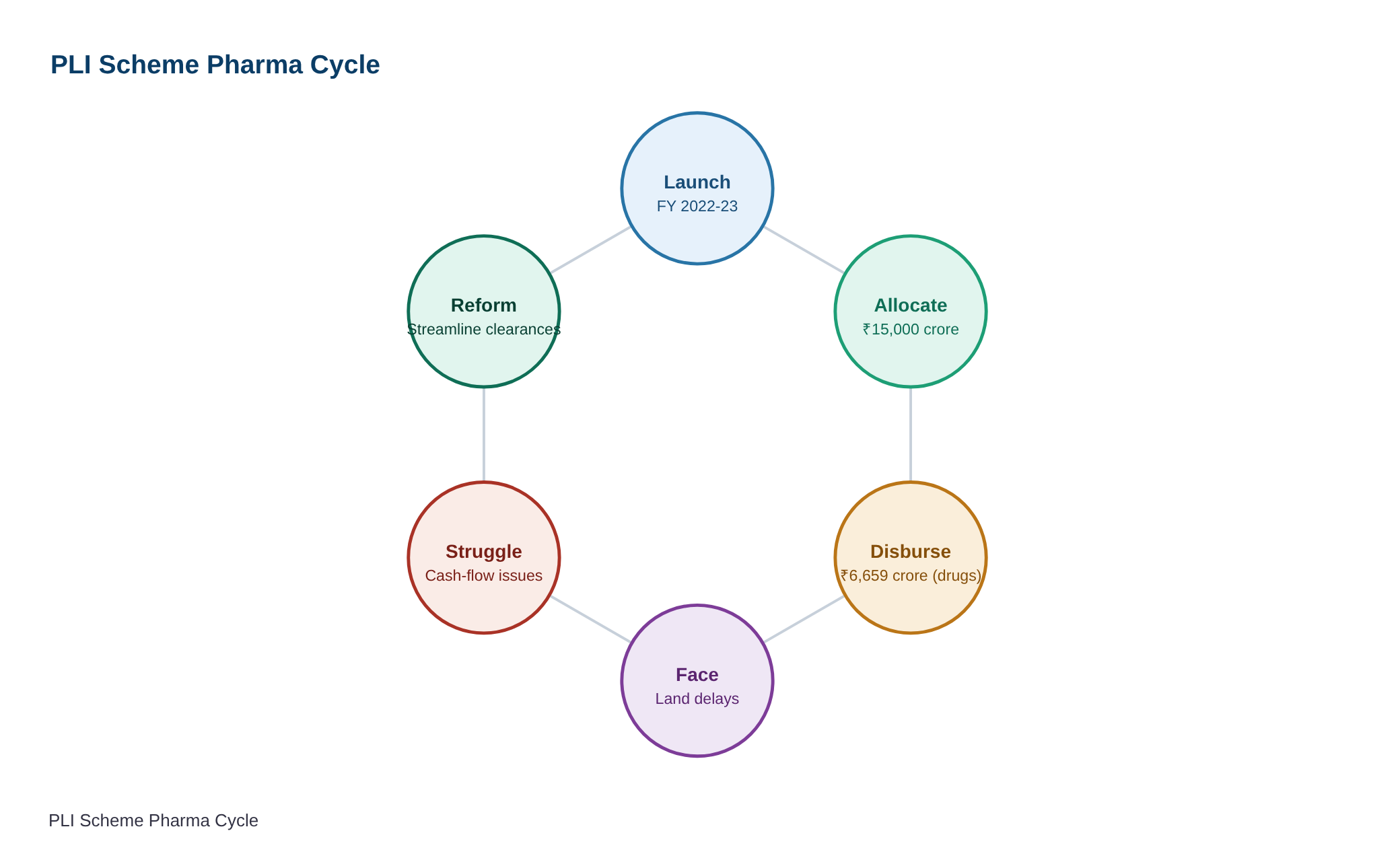
Inception of PLI Scheme for Pharmaceuticals (FY 2022-23) → Allocation of ₹15,000 crore financial outlay → Disbursement of incentives linked to sales performance → Implementation challenges in bulk drug sector (land acquisition, environmental clearances) → Delay in project execution and cash-flow constraints → Uneven disbursement across sectors (drugs vs. bulk drugs) → Strategic need for self-reliance in APIs and KSMs → Policy reforms for streamlined clearances and infrastructure support → Enhanced domestic manufacturing capacity and export competitiveness.
Prelims Practice Questions
Q1. Consider the following statements regarding the Production Linked Incentive (PLI) Scheme for the pharmaceutical sector in India:
1. The PLI Scheme for pharmaceuticals was launched in the financial year 2022-23.
2. Under the PLI Scheme for bulk drugs, a total financial outlay of ₹6,940 crore has been approved.
3. The PLI Scheme for medical devices follows a component-linked incentive framework.
4. The PLI Scheme for pharmaceuticals aims to reduce the reliance on imported active pharmaceutical ingredients (APIs).
How many of the above statements are correct?
- Only one
- Only two
- Only three
- All four
Answer: All four — Statements 1, 2, and 4 are correct. Statement 3 is incorrect as the PLI Scheme for medical devices does not follow a component-linked incentive framework; it continues under the standard PLI structure.
Q2. Assertion (A): Fermentation-based pharmaceutical production relies on the biological activity of living cells, which inherently limits the speed of manufacturing.
Reason (R): The growth rate of living cells in fermentation processes is governed by natural biological constraints and cannot be artificially accelerated.
Code:
A. Both A and R are true, and R is the correct explanation of A.
B. Both A and R are true, but R is NOT the correct explanation of A.
C. A is true, but R is false.
D. A is false, but R is true.
- A
- B
- C
- D
Answer: B — Both the assertion and reason are true, and the reason correctly explains the assertion. Fermentation-based production depends on the natural and slow growth of living cells, which inherently limits manufacturing speed.
Mains Practice Question
✍ The implementation of the Production Linked Incentive (PLI) Scheme for the pharmaceutical sector has faced significant delays, particularly in fermentation-based bulk drug manufacturing. Critically analyse the structural, regulatory, and operational challenges confronting the PLI Scheme for bulk drugs. Also, evaluate the efficacy of the PLI framework in achieving the objectives of self-reliance in critical pharmaceutical inputs. (15 Marks)
Approach: MODEL-ANSWER SKELETON:
1. **Introduction (2 Marks)**
– Define the PLI Scheme and its objectives in the pharmaceutical sector, particularly for bulk drugs.
– Highlight the significance of fermentation-based pharmaceuticals in India’s pharmaceutical value chain.
2. **Structural Challenges (4 Marks)**
– **Biological constraints**: Explain the inherent limitations of fermentation processes (e.g., slow growth of living cells, dependency on natural biological activity).
– **Technological and infrastructure gaps**: Discuss the lack of advanced fermentation infrastructure and skilled workforce in India.
– **Supply chain bottlenecks**: Highlight issues such as import dependence for key inputs (e.g., fermentation media, enzymes).
3. **Regulatory and Operational Bottlenecks (4 Marks)**
– **Land acquisition delays**: Analyse the impact of prolonged land acquisition processes on project timelines.
– **Environmental clearances**: Discuss the procedural delays in obtaining environmental approvals for bulk drug manufacturing units.
– **Utility costs**: Explain the burden of high electricity, water, and other utility costs on the competitiveness of fermentation-based units.
4. **Efficacy of the PLI Framework (3 Marks)**
– **Financial disbursement mechanism**: Critique the PLI disbursement model, which is linked to sales, and its impact on delayed incentives.
– **Comparison with chemical synthesis**: Highlight the advantages of chemical synthesis over fermentation in terms of speed and scalability.
– **Policy gaps**: Discuss whether the PLI Scheme adequately addresses the unique challenges of fermentation-based manufacturing.
5. **Pathways for Improvement (2 Marks)**
– **Policy interventions**: Suggest measures such as streamlined environmental clearances, financial incentives for infrastructure development, and R&D support.
– **Public-private partnerships**: Propose collaborations with research institutions (e.g., CSIR, IITs) to enhance technological capabilities.
– **Long-term vision**: Emphasise the need for a multi-year roadmap to achieve self-reliance in bulk drugs, aligning with the objectives of Atmanirbhar Bharat.
Source: PIB (Press Information Bureau)
Generated by AanyaAi for educational purpose.

- राजस्थान पंचायत चुनाव 2026: सरपंच-वार्ड पदों की आरक्षण लॉटरी आज, जानिए आरक्षण तय करने की प्रक्रिया - September 24, 2026
- Rajasthan Panchayat Polls 2026: Reservation Lottery for Sarpanch & Ward Panch Seats Today - September 24, 2026
- यूपी में पहली बार तेंदुओं का बधियाकरण: मानव-वन्यजीव संघर्ष रोकेगा अभियान - September 24, 2026

No Comments