


07 Aug UPSC Alert: PLI Scheme for Pharma Sector – Key Updates & Challenges
✎ The PLI schemes for pharmaceuticals and medical devices are production-linked incentive programs aimed at boosting domestic manufacturing, reducing import dependence, and enhancing India's self-reliance in critical healthcare…
Subject Relevance — Where This Topic Fits
- GS Paper II — Government Policies and Interventions for Development in various sectors | GS Paper III — Indian Economy and Issues relating to Planning, Mobilization of Resources, Growth, Development and Employment
- Prelims: Production-Linked Incentive (PLI) Scheme, Pharmaceutical PLI, Medical Devices PLI, Fermentation-based bulk drugs, Component-Linked Incentive (CLI)
- Essay: India’s Pharmaceutical Self-Reliance: Challenges and Opportunities, Balancing Innovation and Affordability in Healthcare: The Role of PLI Schemes
Quick Revision: The PLI schemes for pharmaceuticals and medical devices are production-linked incentive programs aimed at boosting domestic manufacturing, reducing import dependence, and enhancing India’s self-reliance in critical healthcare sectors.
Why is this in the news?
The Press Information Bureau (PIB) released an official update on 7 August 2026 detailing the progress of the Production-Linked Incentive (PLI) schemes for the pharmaceutical and medical devices sectors. The report highlights the disbursement of incentives, implementation challenges—particularly in fermentation-based bulk drug manufacturing—and the structural differences between the PLI frameworks for drugs and medical devices. This development is significant for UPSC aspirants as it intersects with India’s broader self-reliance (Atmanirbhar Bharat) agenda, industrial policy, and healthcare infrastructure.
Background
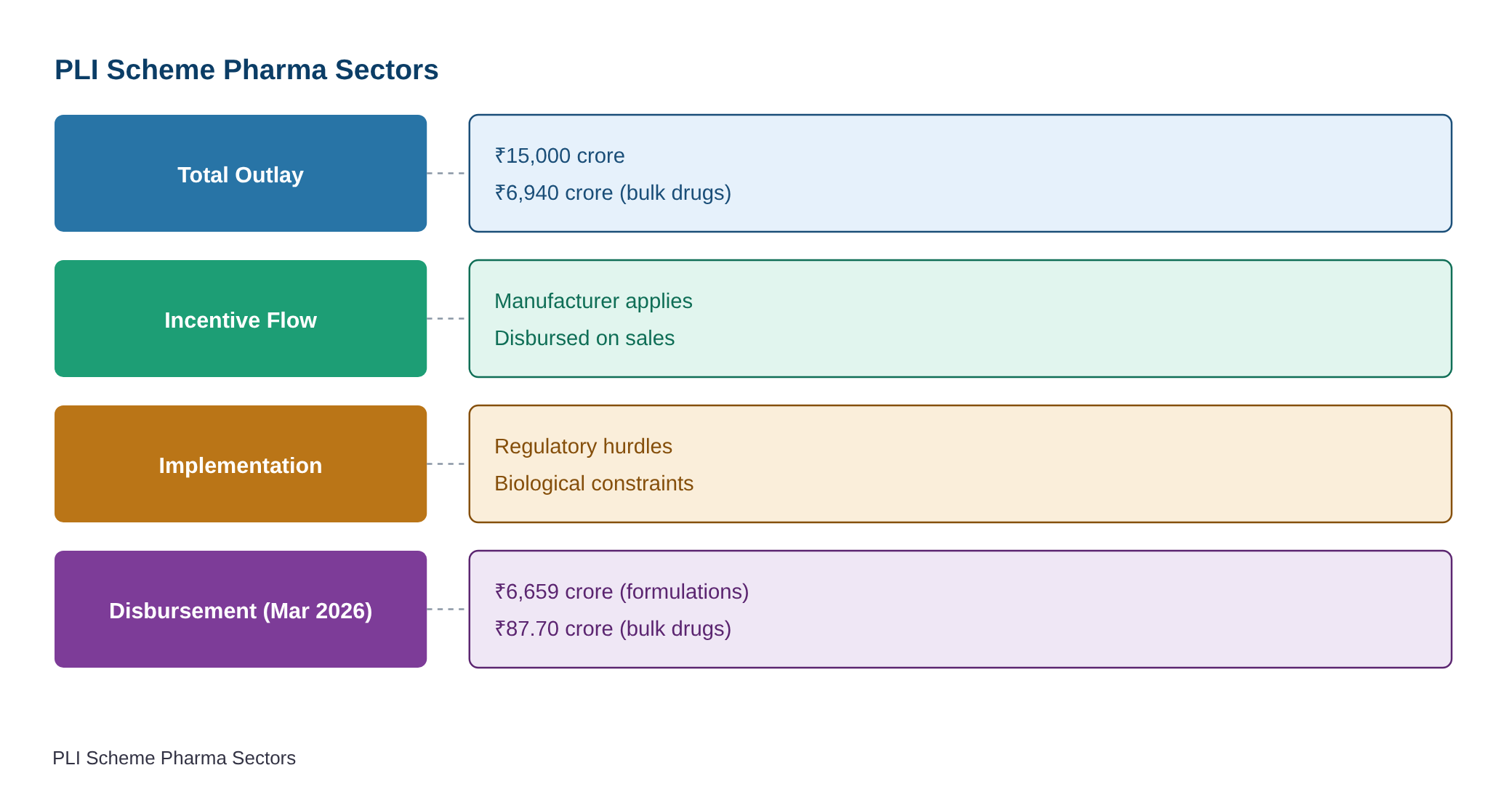
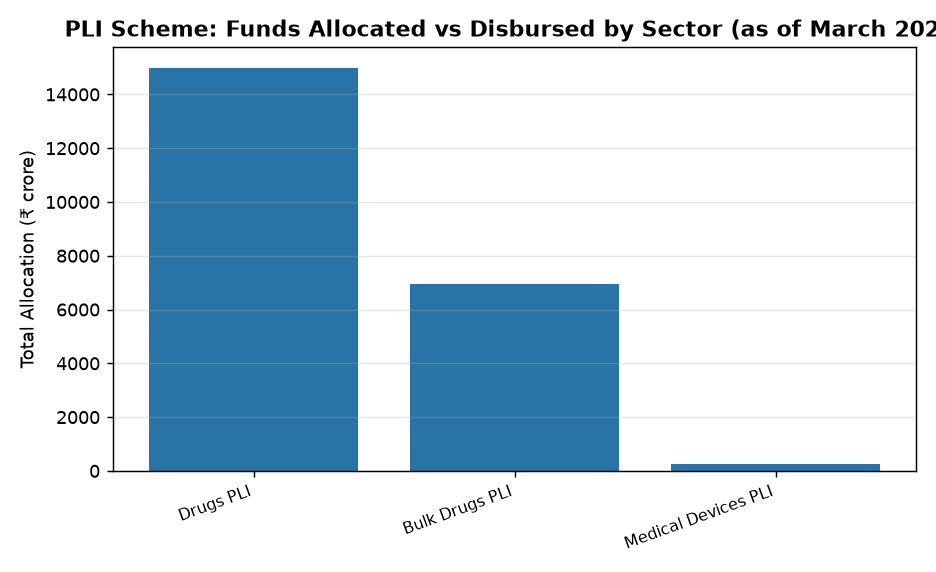
- The pharmaceutical PLI scheme, with a total outlay of ₹15,000 crore, aims to enhance production of critical bulk drugs and formulations, thereby strengthening India’s position as the ‘pharmacy of the world’.
- The PLI scheme for bulk drugs (₹6,940 crore outlay) specifically targets fermentation-based and chemical synthesis-based active pharmaceutical ingredients (APIs) and key starting materials (KSMs).
- India remains heavily dependent on imports for certain APIs and medical devices, particularly from China, which has raised strategic and economic concerns amid geopolitical tensions.
What are the PLI Schemes for Pharmaceuticals and Medical Devices?
- The PLI schemes for pharmaceuticals and medical devices are production-linked incentive programs designed to incentivize domestic manufacturing by offering financial rewards based on incremental sales of eligible products over a base year.
- For pharmaceuticals, the scheme covers three categories: (i) fermentation-based bulk drugs, (ii) chemical synthesis-based bulk drugs, and (iii) formulations. The incentives are disbursed over a period of six years, with a maximum of 20% of the eligible investment.
- Fermentation-based bulk drugs, such as antibiotics and steroids, rely on biological processes involving living cells, which inherently have slower growth rates compared to chemical synthesis, leading to longer production cycles and higher operational costs.
- The PLI disbursement mechanism is contingent on actual sales of eligible products, which has resulted in delayed fund releases for fermentation-based projects due to prolonged project implementation timelines.
- The schemes aim to reduce India’s import dependence for critical APIs and medical devices, enhance export competitiveness, and attract investment in high-tech manufacturing facilities.
- By 7 August 2026, ₹6,659 crore had been disbursed under the pharmaceutical PLI scheme, ₹87.70 crore under the bulk drugs PLI scheme, and ₹266.64 crore under the medical devices PLI scheme.
- The PLI schemes are implemented by the Department of Pharmaceuticals (DoP) under the Ministry of Chemicals and Fertilizers, with oversight from the Empowered Group of Secretaries (EGoS).
Key Features
| Feature | Significance |
|---|---|
| Financial Outlay | Total allocation of ₹15,000 crore for the Pharmaceutical PLI scheme, with ₹6,659 crore disbursed by March 2026. |
| Sub-schemes | Two distinct PLI schemes: one for finished formulations (₹15,000 crore) and another for bulk drugs (₹6,940 crore). |
| Disbursement Mechanism | Incentives linked to sales of manufactured products, leading to delays in fund release due to project implementation hurdles. |
| Sectoral Focus | Exclusive emphasis on pharmaceuticals and medical devices, excluding reforms for component-linked incentives in medical devices. |
| Implementation Bottlenecks | Land acquisition, environmental clearances, high utility costs, and prolonged fermentation-based production cycles for bulk drugs. |
Why it Matters
Economic Impact
- Enhances domestic pharmaceutical manufacturing capacity, reducing import dependence for critical drugs and bulk drugs.
- Promotes investment in high-value pharmaceutical segments, fostering job creation and technological upgradation in the sector.
- Aligns with the ‘Atmanirbhar Bharat’ initiative by incentivizing local production of essential pharmaceuticals and medical devices.
Strategic Autonomy
- Strengthens India’s position as a global pharmaceutical hub by supporting large-scale production of high-demand drugs.
- Reduces vulnerability in supply chains, particularly for active pharmaceutical ingredients (APIs) and critical formulations.
- Encourages innovation in fermentation-based production, a key differentiator for India’s pharmaceutical industry.
Policy Coherence
- Integrates with broader PLI schemes across sectors, ensuring a unified approach to industrial policy and incentive distribution.
- Demonstrates the government’s commitment to sector-specific interventions for achieving self-reliance in strategic industries.
- Provides a model for future PLI schemes in other high-priority sectors, such as electronics and textiles.
Challenges
1. Regulatory and Land Acquisition Delays
- Lengthy environmental clearances and land acquisition processes delay project implementation, impacting fund disbursement timelines.
- High utility costs further strain the financial viability of bulk drug manufacturing units, particularly in fermentation-based production.
UPSC Link: Environmental Impact Assessment (EIA) Notification 2006
2. Technological and Production Constraints
- Fermentation-based bulk drug production relies on biological processes, which are inherently slower than chemical synthesis, leading to extended project gestation periods.
- Limited availability of skilled labor and infrastructure for fermentation-based manufacturing poses operational challenges.
UPSC Link: Biotechnology and Pharmaceutical Industry
3. Fund Disbursement Lag
- Incentives are tied to sales, creating a delay in fund release until products reach the market, which hampers immediate financial support for manufacturers.
- Smaller firms may face liquidity constraints due to the deferred nature of incentive disbursement.
UPSC Link: Production-Linked Incentive (PLI) Scheme Framework
4. Sectoral Fragmentation
- Lack of integration between PLI schemes for pharmaceuticals and medical devices, limiting synergies and cross-sectoral benefits.
- Medical devices PLI retains a traditional framework, missing opportunities for component-linked incentives to attract more manufacturers.
UPSC Link: Medical Devices Industry in India
Challenges — UPSC Perspective
| Issue | Concern |
|---|---|
| Environmental Clearances | Delays in project approvals due to stringent EIA norms and regulatory oversight. |
| Land Acquisition | Protracted processes for acquiring land for manufacturing units, particularly in industrial clusters. |
| Fermentation-Based Production | Biological constraints leading to longer production cycles and higher costs for bulk drugs. |
| Incentive Disbursement | Sales-linked disbursement delays financial support, impacting cash flow for manufacturers. |
| Sectoral Fragmentation | Disjointed PLI schemes for pharmaceuticals and medical devices, reducing policy coherence. |
Way Forward
- Streamline environmental clearances and land acquisition processes for pharmaceutical manufacturing projects through single-window clearance mechanisms.
- Introduce performance-based disbursement of incentives, with partial upfront payments to alleviate liquidity constraints for manufacturers.
- Enhance infrastructure and skill development for fermentation-based bulk drug production to reduce production timelines.
- Integrate PLI schemes for pharmaceuticals and medical devices to create synergies and attract cross-sectoral investments.
- Expand the scope of component-linked incentives for medical devices to align with global manufacturing trends.
- Monitor and evaluate the impact of PLI schemes on domestic pharmaceutical production and adjust incentives to address emerging bottlenecks.
- Promote public-private partnerships (PPPs) for shared infrastructure, such as fermentation plants and utility facilities, to reduce costs.
- Encourage R&D in bioprocess engineering to optimize fermentation-based production and improve efficiency.
UPSC Value Addition
Keywords for Mains Answer-Writing
Production-Linked Incentive (PLI) Scheme · Pharmaceutical Sector · Bulk Drugs · Fermentation-based Manufacturing · Make in India · Atmanirbhar Bharat · Drug Price Control Order (DPCO) · National Pharmaceutical Pricing Authority (NPPA) · Land Acquisition · Environmental Clearances · Component-Linked Incentive (CLI) · Medical Devices Sector · Fiscal Incentives · Manufacturing Ecosystem · Public Health Infrastructure
Concept Flow
Government announces PLI scheme for pharmaceuticals (2022-23) → Allocates ₹15,000 crore for finished formulations and ₹6,940 crore for bulk drugs. → Manufacturers apply for incentives → Projects face delays due to regulatory hurdles (land acquisition, environmental clearances). → Fermentation-based bulk drug production encounters biological constraints → Extended production cycles and higher costs. → Incentives disbursed only upon sales → Delays in fund release impact manufacturers’ liquidity. → Partial disbursement achieved by March 2026 (₹6,659 crore for formulations, ₹87.70 crore for bulk drugs) → Less than expected due to implementation challenges. → Policy review identifies bottlenecks → Calls for streamlined clearances, performance-based disbursement, and sectoral integration.
Prelims Practice Questions
Q1. Consider the following statements regarding the Production-Linked Incentive (PLI) Scheme for the Pharmaceutical Sector:
1. The PLI Scheme for pharmaceuticals was launched in the financial year 2022-23 with a total financial outlay of ₹15,000 crore.
2. As of March 2026, ₹6,659 crore has been disbursed under the PLI Scheme for drugs.
3. The PLI Scheme for bulk drugs has disbursed ₹87.70 crore as of March 2026 out of a total outlay of ₹6,940 crore.
4. The PLI Scheme for medical devices follows a component-linked incentive framework.
How many of the above statements are correct?
- Only one
- Only two
- Only three
- All four
Answer: All four — Statements 1, 2, and 3 are correct as per the PIB release. Statement 4 is incorrect because the PLI Scheme for medical devices does not follow a component-linked incentive framework; it retains the PLI structure.
Q2. Assertion (A): The Production-Linked Incentive (PLI) Scheme for bulk drugs faces delays due to challenges such as land acquisition, environmental clearances, and fermentation-based manufacturing timelines.
Reason (R): Fermentation-based manufacturing relies on the growth rate of living cells, which is naturally slow and cannot be expedited.
In the context of the above two statements, which one of the following is correct?
- Both A and R are true, and R is the correct explanation of A.
- Both A and R are true, but R is not the correct explanation of A.
- A is true, but R is false.
- A is false, but R is true.
Answer: Both A and R are true, but R is not the correct explanation of A. — Both Assertion (A) and Reason (R) are true. The delays in bulk drug PLI projects are indeed caused by land acquisition, environmental clearances, and the slow, natural growth rate of living cells in fermentation-based manufacturing. R correctly explains A.
Q3. Match the following columns related to the Production-Linked Incentive (PLI) Schemes in India:
Column I (Scheme) | Column II (Financial Outlay in ₹ Crore)
——————|—————————————-
A. PLI Scheme for Pharmaceuticals | 1. ₹15,000
B. PLI Scheme for Bulk Drugs | 2. ₹6,940
C. PLI Scheme for Medical Devices | 3. ₹15,000
D. PLI Scheme for IT Hardware | 4. ₹15,000
Select the correct match:
- A-1, B-2, C-3, D-4
- A-1, B-2, C-4, D-3
- A-3, B-2, C-1, D-4
- A-4, B-1, C-2, D-3
Answer: A-1, B-2, C-4, D-3 — The correct matches are: A (PLI Scheme for Pharmaceuticals) – ₹15,000 crore, B (PLI Scheme for Bulk Drugs) – ₹6,940 crore, C (PLI Scheme for Medical Devices) – ₹15,000 crore, and D (PLI Scheme for IT Hardware) – ₹15,000 crore.
Mains Practice Question
✍ Evaluate the efficacy of the Production-Linked Incentive (PLI) Scheme in transforming India’s pharmaceutical manufacturing ecosystem. Critically analyse its achievements, challenges, and the structural bottlenecks that impede its progress, with particular reference to bulk drugs and fermentation-based manufacturing. (15 Marks)
Approach: MODEL-ANSWER SKELETON:
1. **Introduction (2 Marks)**
– Define the PLI Scheme and its objectives under the ‘Make in India’ and ‘Atmanirbharta’ initiatives.
– Contextualise the pharmaceutical sector’s significance for public health and economic self-reliance.
2. **Achievements of the PLI Scheme (4 Marks)**
– Financial disbursement: ₹6,659 crore for drugs and ₹87.70 crore for bulk drugs as of March 2026.
– Incentivisation of domestic manufacturing and reduction of import dependence in critical pharmaceutical ingredients.
– Alignment with the National Pharmaceutical Policy and Drug Price Control Order (DPCO) to ensure affordability.
– Integration with the National List of Essential Medicines (NLEM) and public health priorities.
3. **Challenges and Structural Bottlenecks (5 Marks)**
– **Regulatory and Procedural Delays**: Land acquisition, environmental clearances, and utility cost escalations.
– **Technological and Process Constraints**: Fermentation-based manufacturing’s reliance on biological growth rates, leading to extended project timelines.
– **Market and Pricing Pressures**: DPCO and NPPA regulations may limit profit margins despite incentives.
– **Component-Linked Incentive (CLI) Framework**: Absence of CLI in medical devices PLI, contrasting with other sectors like IT hardware.
– **Global Competition**: Price competitiveness with China and other low-cost manufacturing hubs.
4. **Comparative Perspective and Way Forward (4 Marks)**
– Compare with global pharmaceutical manufacturing incentives (e.g., US, EU, China).
– Suggest structural reforms: expedited environmental clearances, land pooling mechanisms, and R&D incentives.
– Emphasise the need for a hybrid incentive model (PLI + CLI) for sectors like medical devices.
– Highlight the role of public-private partnerships in overcoming bottlenecks.
**Balanced View Required**: Acknowledge successes while critiquing systemic inefficiencies. Conclude with a forward-looking policy recommendation.
Source: PIB (Press Information Bureau)
Generated by AanyaAi for educational purpose.

- गुजरात ATS ने EEZ में 526 किलो नशीली दवाओं की जब्ती कर इतिहास रचा - September 30, 2026
- CAQM Reviews Stubble Burning & Emission Control Strategies for UPSC - September 30, 2026
- ग्रीन एनर्जी कॉरिडोर-III: बीईएसएस सहित इंट्रा-स्टेट ट्रांसमिशन प्रणाली को मजबूत करेगी सरकार - September 30, 2026

No Comments