


08 Aug AI in Minority Welfare: Lok Sabha MP Raises Critical Questions on Governance & Data Safety
✎ AI in minority welfare schemes must balance innovation with ethical safeguards, ensuring data privacy, algorithmic fairness, and citizen rights under the IndiaAI Mission and Digital Personal Data Protection Act, 2023.
Subject Relevance — Where This Topic Fits
- GS Paper II — Governance, Transparency and Accountability | GS Paper III — Science and Technology, Digital Governance
- Prelims: Artificial Intelligence (AI), IndiaAI Mission, Digital Personal Data Protection Act 2023, AI Governance Guidelines 2025, Minority Welfare Schemes, Haj Suvidha App, Multilingual AI Chatbots
- Essay: Technology and Governance: Balancing Innovation with Ethical Responsibility, Digital Inclusion: Bridging the Divide in Welfare Delivery
Quick Revision: AI in minority welfare schemes must balance innovation with ethical safeguards, ensuring data privacy, algorithmic fairness, and citizen rights under the IndiaAI Mission and Digital Personal Data Protection Act, 2023.
Why is this in the news?
The issue has gained prominence following the Lok Sabha MP Yaduveer Krishnadatta Chamaraja Wadiyar’s intervention on the integration of Artificial Intelligence (AI) in Minority Affairs schemes. The query underscores critical concerns regarding the objectives, safeguards, and accountability mechanisms in deploying AI for welfare governance, reflecting broader debates on digital governance, data privacy, and algorithmic fairness in public service delivery.
Background
- The Ministry of Minority Affairs has been progressively adopting digital governance tools to enhance service delivery, including the Haj Suvidha App and multilingual AI chatbots.
- The India AI Governance Guidelines (November 2025) establish principles for responsible, fair, and safe AI use, including transparency and accountability in algorithmic decision-making.
- Concerns over algorithmic bias, data privacy, and citizen rights have intensified with the increasing reliance on AI in welfare schemes, necessitating robust safeguards.
- The Haj Suvidha App exemplifies AI-driven governance in minority welfare, offering streamlined services for Haj pilgrims through digital platforms.
What is Artificial Intelligence in the Context of Minority Welfare Schemes?
- AI in welfare schemes refers to the deployment of machine learning, natural language processing, and automation to enhance service delivery, eligibility determination, and grievance redressal.
- Key applications include AI-driven chatbots for multilingual assistance, virtual assistants for citizen queries, and predictive analytics for resource allocation in minority welfare programs.
- The IndiaAI Mission serves as the nodal initiative to integrate AI across sectors, including minority affairs, with a focus on indigenous AI development and ethical governance.
- AI systems in welfare schemes must comply with the Digital Personal Data Protection Act, 2023, ensuring data minimization, consent-based processing, and stringent security protocols.
- The India AI Governance Guidelines (2025) provide a regulatory framework for AI deployment, emphasizing fairness, transparency, accountability, and human oversight in decision-making.
- Algorithmic fairness is a critical concern, as biased data or models could exacerbate existing inequalities in welfare access, necessitating regular audits and bias mitigation strategies.
- Citizen-centric AI applications, such as the Haj Suvidha App, demonstrate the potential of AI to improve efficiency and accessibility in minority-specific services.
- Independent evaluation mechanisms, including third-party audits and public feedback loops, are essential to monitor AI performance, address grievances, and ensure continuous improvement.
Key Features
| Feature | Significance |
|---|---|
| AI-based digital platforms (e.g., multilingual AI chatbots, virtual assistants) | Enhances accessibility of minority welfare services by providing real-time, multilingual support to citizens, reducing linguistic barriers in service delivery. |
| Haj Suvidha app | Facilitates streamlined and transparent provision of Haj-related services, improving efficiency in pilgrimage management under the Ministry of Minority Affairs. |
| IndiaAI Mission | Aims to integrate AI technologies across governance sectors, including minority welfare, to improve service delivery and policy implementation through domestic AI institutions. |
| India AI Governance Guidelines (November 2025) | Provides a regulatory framework for ethical, fair, and responsible AI deployment, ensuring alignment with national digital governance standards. |
| Digital Personal Data Protection Act, 2023 | Mandates strict safeguards for personal data privacy and security, ensuring compliance in AI-driven minority welfare schemes to prevent misuse or breaches. |
Why it Matters
Governance and Service Delivery
- AI integration in minority welfare schemes represents a paradigm shift towards data-driven, citizen-centric governance, reducing bureaucratic delays and improving service efficiency.
- Multilingual AI tools democratise access to welfare services, particularly for linguistic minorities, ensuring inclusivity in service delivery.
- Automation of routine tasks (e.g., grievance redressal via AI chatbots) reduces administrative burden, allowing human resources to focus on complex policy interventions.
Technological Advancement and Innovation
- The adoption of AI in minority welfare schemes aligns with India’s broader push for digital transformation, leveraging indigenous AI capabilities under the IndiaAI Mission.
- AI-driven platforms (e.g., Haj Suvidha) set a precedent for scalable, tech-enabled solutions in public service delivery, potentially replicable across other welfare domains.
- Collaboration with domestic AI institutions fosters self-reliance in AI technology, reducing dependence on foreign solutions and enhancing national cybersecurity.
Data Privacy and Ethical Considerations
- The use of AI necessitates robust data protection mechanisms to prevent surveillance, discrimination, or misuse of sensitive personal data of minority communities.
- Compliance with the Digital Personal Data Protection Act, 2023, ensures that AI deployments in welfare schemes adhere to legal standards for privacy and consent.
- Independent evaluation mechanisms are critical to audit AI systems for bias, particularly in schemes targeting marginalised groups, ensuring equitable outcomes.
Policy and Regulatory Framework
- The India AI Governance Guidelines (2025) provide a structured approach to AI deployment, balancing innovation with ethical and legal safeguards.
- The Ministry of Minority Affairs’ response highlights the need for inter-ministerial coordination to align AI policies with broader digital governance initiatives.
Challenges
1. Data Privacy and Security Risks
- AI systems handling personal data of minority communities may be vulnerable to cyberattacks or unauthorised access, risking identity theft or profiling.
- Inadequate anonymisation in AI datasets could lead to re-identification of individuals, violating privacy norms under the Digital Personal Data Protection Act.
- Lack of awareness among beneficiaries about data rights may result in consent-related ambiguities, undermining trust in AI-driven services.
UPSC Link: GS-II: Governance, GS-III: Science & Tech
2. Algorithmic Bias and Discrimination
- AI models trained on biased datasets may perpetuate or amplify existing social inequalities, particularly in minority welfare schemes where historical marginalisation exists.
- Absence of diverse representation in AI development teams can lead to blind spots in algorithmic design, disproportionately affecting certain minority groups.
- Real-time decision-making by AI (e.g., eligibility assessments) may inadvertently exclude eligible beneficiaries due to flawed criteria.
UPSC Link: GS-II: Social Justice, GS-IV: Ethics
3. Digital Divide and Accessibility Gaps
- Reliance on AI-driven platforms assumes universal digital literacy, which may exclude elderly or economically disadvantaged minority groups from accessing services.
- Limited internet penetration and device accessibility in rural or remote minority-dominated areas could render AI tools ineffective for intended beneficiaries.
- Language barriers persist despite multilingual AI tools, as dialects and regional nuances may not be adequately captured in training datasets.
UPSC Link: GS-II: Social Justice, GS-I: Society
4. Regulatory and Compliance Challenges
- The rapid pace of AI innovation outstrips the evolution of governance frameworks, creating gaps in accountability for AI-driven policy failures.
- Inter-ministerial coordination is essential but often lacking, leading to fragmented implementation of AI guidelines across welfare schemes.
- Independent audits of AI systems are resource-intensive and may face resistance from implementing agencies due to transparency concerns.
UPSC Link: GS-II: Governance, GS-III: Science & Tech
5. Public Trust and Acceptance
- Skepticism towards AI-driven governance, particularly among minority communities with historical grievances, may hinder adoption and cooperation.
- Lack of transparency in AI decision-making processes can erode public confidence, especially when outcomes are perceived as opaque or unfair.
- Misinformation or fear of surveillance may lead to resistance against AI integration in welfare schemes, necessitating robust public awareness campaigns.
UPSC Link: GS-II: Governance, GS-IV: Ethics
Challenges — UPSC Perspective
| Issue | Concern |
|---|---|
| Data Privacy | Risk of unauthorised access or misuse of sensitive personal data of minority beneficiaries under AI-driven welfare schemes. |
| Algorithmic Bias | Potential for AI models to reinforce existing social inequalities, leading to discriminatory outcomes in service delivery. |
| Digital Divide | Exclusion of marginalised minority groups due to limited digital literacy, internet access, or device ownership. |
| Regulatory Gaps | Lack of synchronised policies across ministries, leading to inconsistent implementation of AI governance guidelines. |
| Public Trust | Low acceptance of AI-driven services due to perceived opacity, surveillance risks, or historical distrust in government initiatives. |
| Resource Constraints | High costs associated with developing, auditing, and maintaining AI systems, particularly for state-level minority welfare schemes. |
Government Initiatives — Must-Memorise for Prelims
- Haj Suvidha app
Way Forward
- Establish a dedicated AI ethics review board under the Ministry of Minority Affairs to audit algorithms for bias and fairness, ensuring compliance with the India AI Governance Guidelines.
- Develop multilingual AI training datasets that include regional dialects and minority languages to enhance inclusivity and reduce linguistic barriers.
- Launch targeted digital literacy programmes in minority-dominated districts to bridge the digital divide and improve AI tool adoption.
- Implement a phased rollout of AI-driven services with robust grievance redressal mechanisms, including human oversight for appeals and corrections.
- Strengthen inter-ministerial coordination to align AI policies across welfare schemes, ensuring consistency in data governance and ethical standards.
- Conduct periodic impact assessments of AI deployments in minority welfare schemes to measure efficacy, equity, and public trust outcomes.
- Enhance transparency by publishing AI decision-making frameworks and anonymised datasets (where feasible) to build public confidence.
- Invest in capacity-building for minority communities to participate in AI governance, including training in data rights and digital advocacy.
UPSC Value Addition
Keywords for Mains Answer-Writing
Artificial Intelligence in governance · Ministry of Minority Affairs schemes · IndiaAI Mission · Digital Personal Data Protection Act, 2023 · AI Governance Guidelines 2025 · AI-based citizen services · Multilingual AI chatbots · Haj Suvidha app · Ethical AI deployment · Data privacy safeguards · Discrimination prevention in AI · Independent evaluation of AI systems · Digital governance and transparency
Constitutional & Policy Linkages
- Article 15 (Prohibition of discrimination)
- Article 16 (Equality of opportunity in public employment)
- Article 21 (Right to life and personal liberty, including privacy)
Concept Flow
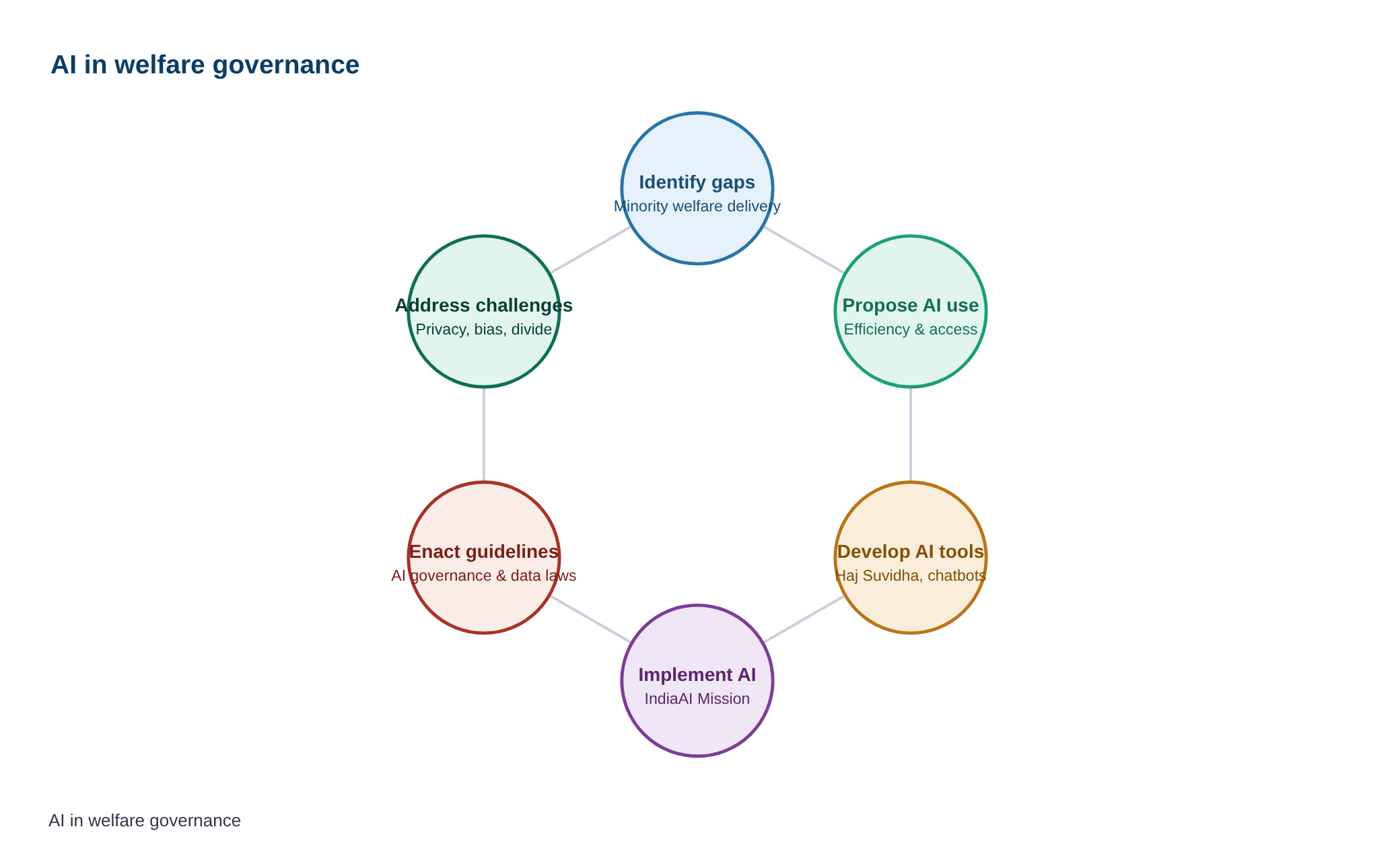
Identification of gaps in minority welfare service delivery → → Proposal for AI integration to enhance efficiency and accessibility → → Development of AI-driven platforms (e.g., Haj Suvidha, multilingual chatbots) → → Implementation under IndiaAI Mission with domestic AI institutions → → Enactment of India AI Governance Guidelines (2025) and Digital Personal Data Protection Act (2023) → → Addressing challenges: data privacy, algorithmic bias, digital divide → → Ensuring constitutional safeguards (Articles 15, 16, 21) and ethical compliance → → Public trust-building through transparency and grievance redressal mechanisms
Prelims Practice Questions
Q1. Consider the following statements regarding the IndiaAI Mission:
1. It is a government initiative to promote the use of AI in governance.
2. It mandates the use of AI in all welfare schemes without exception.
3. It operates under the Ministry of Electronics and Information Technology.
4. The IndiaAI Governance Guidelines, 2025, provide a framework for responsible AI use.
How many of the above statements are correct?
- Only one
- Only two
- Only three
- All
Answer: Only three — Statements 1, 3, and 4 are correct. Statement 2 is incorrect as the IndiaAI Mission promotes AI use but does not mandate it in all schemes.
Q2. Assertion (A): The Digital Personal Data Protection Act, 2023, provides a legal framework for safeguarding personal data in AI-driven governance.
Reason (R): The Act mandates data localisation for all AI applications used in government schemes.
Options:
A. Both A and R are true, and R is the correct explanation of A.
B. Both A and R are true, but R is not the correct explanation of A.
C. A is true, but R is false.
D. A is false, but R is true.
Answer: ? — Assertion (A) is true as the Act provides a legal framework for data protection. Reason (R) is false because the Act does not mandate data localisation; it focuses on consent, purpose limitation, and data security.
Q3. Which of the following AI-based initiatives has been developed by the Ministry of Minority Affairs to enhance citizen services?
- A. MyGov Chatbot
- B. Haj Suvidha app
- C. UMANG portal
- D. Digital India portal
Answer: B. Haj Suvidha app — The Haj Suvidha app is specifically mentioned as an AI-based initiative by the Ministry of Minority Affairs to facilitate citizen services.
Mains Practice Question
✍ The integration of Artificial Intelligence (AI) in the implementation of welfare schemes, particularly those under the Ministry of Minority Affairs, presents both opportunities and challenges. Critically analyse the ethical, legal, and governance implications of deploying AI in such schemes. Also, assess the adequacy of existing safeguards, including the Digital Personal Data Protection Act, 2023, and the IndiaAI Governance Guidelines, 2025, in addressing these concerns. (15 Marks)
Approach: Introduction: Define AI in governance and its relevance to welfare schemes (1 mark). Opportunities: Discuss efficiency, transparency, and accessibility improvements in service delivery (2 marks). Ethical Implications: Examine risks of algorithmic bias, discrimination, and exclusion of marginalised groups (3 marks). Legal Safeguards: Analyse the Digital Personal Data Protection Act, 2023, and its limitations in AI contexts (3 marks). Governance Frameworks: Evaluate the IndiaAI Governance Guidelines, 2025, and their provisions for fairness, accountability, and grievance redressal (3 marks). Conclusion: Synthesise findings and propose measures for balanced AI deployment, such as independent audits and participatory design (3 marks).
Source: The Hindu
Generated by AanyaAi for educational purpose.

- एल नीनो: दुनिया के सामने जलवायु अनुकूलन की चुनौती - September 23, 2026
- El Niño 2026: A Critical Test for Climate Adaptation in UPSC Mains - September 23, 2026
- हिमाचल में आयुष चिकित्सा का बढ़ता प्रचलन: 57.2% लोगों ने अपनाई आयुष पद्धतियाँ, जानें कारण - September 23, 2026

No Comments