


08 Aug APSRTC Employees Demand Higher Pension from EPFO: Key Issues Explained for UPSC
✎ Implementation challenges persist due to administrative bottlenecks, the ‘Roorkee Formula’ controversy, and dual pension systems like CPS in states.
Subject Relevance — Where This Topic Fits
- GS Paper II — Government Policies and Interventions for Development in various sectors | GS Paper III — Issues related to Direct and Indirect Farm Subsidies and Minimum Support Prices | GS Paper III — Indian Economy and issues relating to Planning, Mobilisation of Resources, Growth, Development and Employment
- Prelims: EPFO, EPS, EPF, Roorkee Formula, Supreme Court Judgment on EPFO Pension (2019), Contributory Pension Scheme (CPS), Andhra Pradesh Reorganisation Act 2014, Regional Provident Fund Commissioner, Dearness Allowance, Pay Revision Commissions (PRCs), Joint Option Applications, PF Account Transfers
- Essay: Pension reforms and social security: Balancing fiscal sustainability with employee welfare, The role of judicial interventions in shaping economic policies and public sector governance
Quick Revision: Implementation challenges persist due to administrative bottlenecks, the ‘Roorkee Formula’ controversy, and dual pension systems like CPS in states.
Why is this in the news?
The Employees’ Provident Fund Organisation (EPFO) is facing renewed pressure from employees of the Andhra Pradesh State Road Transport Corporation (APSRTC) to resolve long-standing issues related to higher pension benefits, pending claims, and procedural delays. The delegation, led by APSRTC’s Managing Director, met the Regional Provident Fund Commissioner to demand the approval of joint option applications for higher pension, recalculation of pensions based on revised salaries, and rectification of the ‘Double Slab (Roorkee Formula)’ anomaly, which has allegedly reduced pension benefits by 30–40% for many employees. The episode underscores broader challenges in the implementation of pension reforms, judicial directives, and administrative efficiency within India’s social security framework.
Background
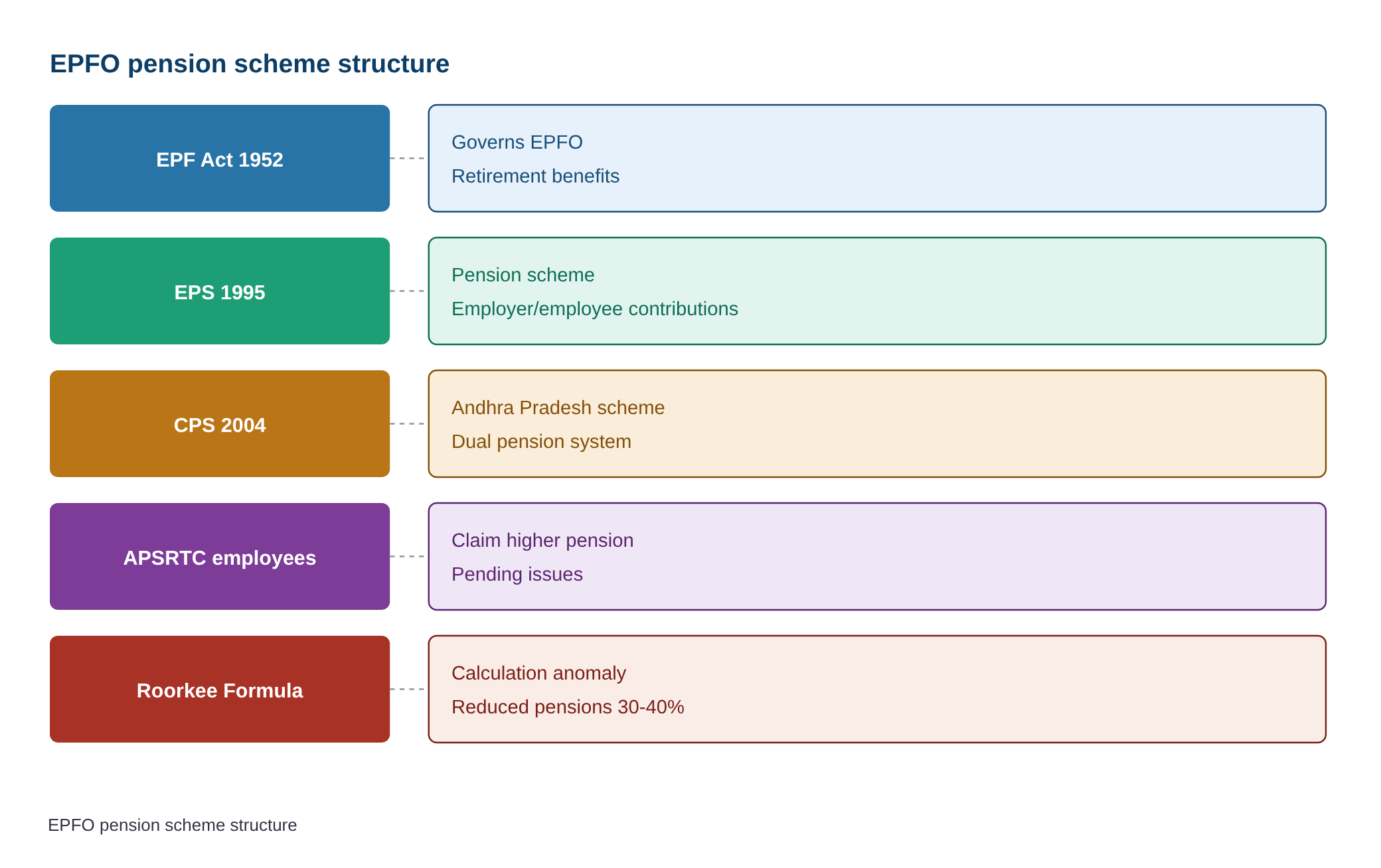
- The Employees’ Provident Fund and Miscellaneous Provisions Act, 1952, governs the EPFO, which administers the Employees’ Provident Fund (EPF) and EPS, providing retirement, pension, and insurance benefits to organised sector employees.
- The Employees’ Pension Scheme (EPS), 1995, was introduced to provide pension benefits to employees covered under the EPF Act, with contributions from employers and employees. However, the scheme has faced implementation challenges, including delays in processing applications and disputes over calculation methods.
- The Andhra Pradesh Reorganisation Act, 2014, led to the bifurcation of the erstwhile Andhra Pradesh State Road Transport Corporation (APSRTC) and Telangana State Road Transport Corporation (TSRTC). This has created administrative complexities, including the allocation of PF codes and transfer of pension liabilities.
- The Employees’ Contributory Pension Scheme (CPS) was introduced in Andhra Pradesh in 2004. This has created dual systems of pension entitlements within the state, complicating the EPFO’s role in ensuring parity.
What is the Employees’ Provident Fund Organisation (EPFO) and its Pension Framework?
- The EPFO is a statutory body under the Ministry of Labour and Employment, established under the Employees’ Provident Fund and Miscellaneous Provisions Act, 1952, to administer provident fund, pension, and insurance schemes for organised sector employees in India.
- The Employees’ Pension Scheme (EPS), 1995, is a key component of the EPFO’s mandate, providing monthly pension to employees after retirement, based on their salary and years of service. Contributions to the EPS are made by employers (1.16% of wages) and the central government (1.16% of wages), with employees contributing 12% of their wages to the EPF.
- The EPFO faces significant administrative challenges, including delays in processing pension claims, technical glitches in the online portal, and disputes over the calculation of higher pensions. These issues have been exacerbated by the sheer volume of applications and the complexity of the pension framework.
- The Employees’ Contributory Pension Scheme (CPS), introduced in Andhra Pradesh in 2004, is a defined contribution scheme for new recruits. This has created a dual pension system, complicating the EPFO’s role in ensuring equitable benefits for all employees.
- The EPFO’s administrative structure includes Regional Provident Fund Commissioners (RPFCs) at the zonal level, who oversee the implementation of EPF and EPS schemes. The RPFCs play a critical role in resolving disputes, approving joint option applications, and ensuring compliance with the EPF Act.
Key Features
| Feature | Significance |
|---|---|
| Higher pension under EPS-1995 | Directly affects retirement income of ~14,000 APSRTC employees; Supreme Court’s 2019 judgment mandates higher pension for eligible subscribers. |
| Joint Option Applications for Higher Pension | Allows employees to opt for higher pension by contributing additional 1.16% of salary; ~6,000 applications pending approval. |
| Pay Revision Commissions (PRCs) of 2013 & 2017 | Revised salaries and dearness allowance (DA) must be factored into pension calculations; current implementation excludes these, reducing benefits by 30-40%. |
| Double Slab (Roorkee Formula) vs Single Slab | Double Slab reduces pension by 30-40% for many; Single Slab aligns with Supreme Court’s directive for equitable pension computation. |
| PF Account Transfers and Pending Claims | Technical glitches and delays in EPFO portal disrupt seamless transfers; ~35 crore refund pending for employees who continued service post-58 years. |
Why it Matters
Economic
- Pension liabilities for APSRTC employees constitute a significant fiscal burden on the state exchequer; unresolved issues may lead to long-term financial strain.
- Higher pension payouts could stimulate local consumption in Andhra Pradesh, given the large workforce dependent on APSRTC.
- EPFO’s role in pension administration directly impacts the retirement security of ~6 crore subscribers nationwide, making this a systemic issue.
Legal-Judicial
- Supreme Court’s 2019 judgment in *Employees Provident Fund Organisation vs. Sunil Kumar B.* (2019) 4 SCC 52) mandates higher pension for eligible subscribers, binding EPFO to comply.
- Failure to implement the judgment uniformly across states (e.g., Andhra Pradesh vs. Telangana) raises questions of equity and federalism.
- Pending legal disputes over pension calculations (e.g., Double Slab vs. Single Slab) highlight the need for judicial clarity.
Administrative
- EPFO’s operational inefficiencies (e.g., delayed demand notices, portal glitches) undermine trust in social security institutions.
- State-level agencies (APSRTC) lack autonomy in PF code allocation, leading to administrative bottlenecks (e.g., shared PF code with TSRTC).
- Bureaucratic delays in sanctioning pensions for deceased/retired employees exacerbate financial distress among families.
Social
- APSRTC workforce (~14,000 employees) faces existential uncertainty due to unresolved pension issues, affecting morale and productivity.
- Pension shortfalls disproportionately impact lower-income employees, who rely heavily on EPFO benefits for post-retirement sustenance.
- Families of deceased employees face prolonged delays in pension claims, creating humanitarian crises.
Challenges
1. Implementation of Supreme Court Judgment
- EPFO’s selective compliance with the 2019 judgment (e.g., excluding PRCs of 2013/2017) violates judicial directives.
- Double Slab (Roorkee Formula) reduces pension by 30-40%, contradicting the Supreme Court’s emphasis on equity.
- Lack of uniform implementation across states (AP vs. Telangana) creates disparities in pension benefits.
UPSC Link: GS-II: Judiciary and its role in governance
2. Operational Inefficiencies in EPFO
- Delayed demand notices and portal glitches prevent ~8,000 employees from remitting required amounts for higher pension.
- Technical issues in EPFO’s IT infrastructure disrupt PF account transfers and claim processing.
- Bureaucratic inertia in sanctioning pensions for deceased/retired employees exacerbates financial distress.
UPSC Link: GS-II: Government policies and interventions
3. Fiscal Burden on State Exchequer
- Unresolved pension issues may lead to retrospective liabilities, straining Andhra Pradesh’s finances.
- Higher pension payouts could increase the state’s pension bill, competing with other developmental expenditures.
- Refund of ~₹35 crore to employees who continued service post-58 years adds to fiscal pressure.
UPSC Link: GS-III: Indian Economy and issues relating to planning, mobilization of resources
4. Federalism and Administrative Autonomy
- Shared PF code between APSRTC and TSRTC (post-bifurcation) creates administrative confusion and delays.
- State governments lack autonomy in PF code allocation, despite operational control over RTCs.
- Centre-state coordination failures in resolving pension disputes highlight systemic gaps in cooperative federalism.
UPSC Link: GS-II: Federalism, Centre-State relations
5. Legal Ambiguity in Pension Calculations
- Dispute over Double Slab vs. Single Slab formula lacks clarity, leading to inconsistent pension computations.
- EPFO’s interpretation of PRCs (2013/2017) excludes revised salaries/DA, reducing benefits arbitrarily.
- Pending legal challenges over pension calculations may lead to prolonged litigation.
UPSC Link: GS-II: Judiciary and its role in governance
Challenges — UPSC Perspective
| Issue | Concern |
|---|---|
| Non-compliance with Supreme Court Judgment | EPFO’s selective implementation of higher pension directives violates judicial orders. |
| Double Slab (Roorkee Formula) | Reduces pension by 30-40% for many employees, contrary to Supreme Court’s directive. |
| Delayed Demand Notices and Portal Glitches | Prevents ~8,000 employees from remitting required amounts for higher pension. |
| Shared PF Code with TSRTC | Creates administrative bottlenecks and delays in PF claims for APSRTC employees. |
| Pending Pension Claims for Deceased/Retired Employees | Exacerbates financial distress among families and violates EPFO’s timelines. |
| Exclusion of PRCs (2013/2017) in Pension Calculations | Arbitrarily reduces pension benefits by excluding revised salaries/DA. |
Way Forward
- EPFO must issue a time-bound circular to approve ~6,000 pending joint option applications for higher pension, aligning with the Supreme Court’s judgment.
- Constitute a high-level committee (Centre + State + EPFO) to recalculate pensions using the Single Slab formula and include PRCs (2013/2017) in computations.
- Launch a special drive to clear all pending PF claims, account transfers, and pension applications within 3 months, with a grievance redressal portal for real-time tracking.
- Allocate a separate PF code to APSRTC under the Andhra Pradesh Reorganisation Act to streamline administrative processes.
- EPFO must rectify portal glitches and ensure timely demand notices to allow ~8,000 employees to remit required amounts for higher pension.
- State government should expedite refunds of ~₹35 crore to employees who continued service post-58 years, as per EPFO norms.
- EPFO and APSRTC should conduct awareness campaigns to educate employees on higher pension options, PRCs, and claim processes.
- Parliament should consider amending the Employees’ Provident Funds and Miscellaneous Provisions Act, 1952, to clarify pension calculation methods and ensure uniformity.
UPSC Value Addition
Keywords for Mains Answer-Writing
Employees’ Provident Fund Organisation (EPFO) · Employees’ Pension Scheme (EPS) 1995 · Supreme Court judgment on higher pension · Roorkee Formula (Double Slab) vs Single Slab · Employees’ Provident Fund and Miscellaneous Provisions Act, 1952 · Pension reforms in India · Contributory Pension Scheme (CPS) · Regional Provident Fund Commissioner (RPFC) · Andhra Pradesh State Road Transport Corporation (APSRTC) · Pay Revision Commissions (PRCs) 2013 & 2017 · Dearness Allowance (DA) · Joint Option Scheme under EPS
Constitutional & Policy Linkages
- [‘Article 14’, ‘Equality before law; EPFO’s arbitrary pension calculations violate this principle.’]
- [‘Article 21’, ‘Right to life includes dignified retirement; delayed pensions infringe this right.’]
- [‘Article 39(d)’, ‘Equal pay for equal work; pension disparities violate this directive principle.’]
Concept Flow
Supreme Court’s 2019 judgment mandates higher pension for eligible EPFO subscribers → EPFO’s selective implementation excludes PRCs (2013/2017) and uses Double Slab formula → APSRTC employees face 30-40% pension reduction → Employees’ JAC raises demands for Single Slab and PRC inclusion → EPFO’s operational inefficiencies (portal glitches, delayed notices) block ~8,000 joint option applications → State exchequer faces retrospective liabilities → Families of deceased/retired employees suffer financial distress → Need for Centre-State coordination and judicial clarity emerges.
Prelims Practice Questions
Q1. Consider the following statements regarding the Employees’ Provident Fund Organisation (EPFO):
1. The EPFO is a statutory body established under the Employees’ Provident Fund and Miscellaneous Provisions Act, 1952.
2. The EPFO administers three schemes: Employees’ Provident Fund Scheme (EPFS), Employees’ Pension Scheme (EPS), and Employees’ Deposit-Linked Insurance Scheme (EDLIS).
3. The EPFO is under the administrative control of the Ministry of Labour and Employment, Government of India.
4. The EPFO allows employees to opt for higher pension under the EPS only if they contribute 1.16 times the employer’s contribution.
How many of the above statements are correct?
- Only one
- Only two
- Only three
- All four
Answer: All four — Statements 1, 2, and 3 are correct. Statement 4 is incorrect as the EPFO does not mandate a 1.16 times contribution for opting for higher pension under the EPS.
Q2. Assertion (A): The Supreme Court of India, in its judgment on higher pension under the Employees’ Pension Scheme (EPS), 1995, directed the EPFO to allow employees to opt for higher pension even if they missed the earlier deadline.
Reason (R): The Supreme Court held that the EPFO’s denial of the joint option scheme to eligible employees violated their fundamental rights under Article 14 and Article 21 of the Constitution.
Options:
A. Both A and R are true, and R is the correct explanation of A.
B. Both A and R are true, but R is not the correct explanation of A.
C. A is true, but R is false.
D. A is false, but R is true.
Answer: ? — Both Assertion (A) and Reason (R) are true, and the Supreme Court’s judgment in the case of Employees’ Provident Fund Organisation vs. Sunil Kumar B. & Ors. (2022) explicitly directed the EPFO to allow employees to opt for higher pension, citing violations of Articles 14 and 21.
Q3. Match the following provisions of the Employees’ Provident Fund and Miscellaneous Provisions Act, 1952 with their corresponding schemes:
Column I (Provisions)
1. Section 6: Contributions
2. Section 7: Determination of moneys due from employers
3. Section 17: Exemptions
4. Section 5: Employees’ Pension Scheme
Column II (Schemes/Provisions)
A. Employees’ Provident Fund Scheme
B. Employees’ Pension Scheme
C. Contributions to EPF, EPS, and EDLIS
D. Exemptions to establishments from EPF provisions
Options:
A. 1-A, 2-C, 3-D, 4-B
B. 1-C, 2-A, 3-B, 4-D
C. 1-B, 2-D, 3-C, 4-A
D. 1-D, 2-B, 3-A, 4-C
Answer: ? — The correct match is: 1-C (Section 6 pertains to contributions to EPF, EPS, and EDLIS), 2-A (Section 7 pertains to determination of moneys due from employers under EPF), 3-D (Section 17 pertains to exemptions from EPF provisions), 4-B (Section 5 pertains to the Employees’ Pension Scheme).
Mains Practice Question
✍ The Employees’ Provident Fund Organisation (EPFO) has been at the centre of a prolonged legal and administrative dispute regarding the implementation of higher pension under the Employees’ Pension Scheme (EPS), 1995. Critically examine the legal and policy challenges in the EPFO’s administration of higher pension, with particular reference to the Supreme Court’s directives and the ‘Roorkee Formula’ (Double Slab) versus the Single Slab method of pension calculation. Also, analyse the implications of these disputes for the social security framework in India. (15 Marks)
Approach: MODEL-ANSWER SKELETON:
1. **Legal Framework and Supreme Court Directives**:
– Briefly explain the Employees’ Provident Fund and Miscellaneous Provisions Act, 1952, and the EPS, 1995.
– Discuss the Supreme Court’s judgment in the case of Employees’ Provident Fund Organisation vs. Sunil Kumar B. & Ors. (2022), which directed the EPFO to allow employees to opt for higher pension even if they missed the earlier deadline.
– Highlight the Court’s observations on the violation of Articles 14 (Right to Equality) and 21 (Right to Life and Personal Liberty).
2. **Roorkee Formula (Double Slab) vs. Single Slab**:
– Define the ‘Roorkee Formula’ (Double Slab) and the Single Slab method of pension calculation.
– Explain how the Double Slab method reduces pension benefits by 30-40% for many employees, as alleged by APSRTC employees.
– Discuss the Supreme Court’s stance on the Double Slab method and whether it aligns with the spirit of the EPS, 1995.
3. **Administrative and Policy Challenges**:
– Outline the administrative hurdles faced by the EPFO, including technical glitches in the portal, delayed demand notices, and lack of awareness among employees.
– Discuss the role of Pay Revision Commissions (PRCs) 2013 and 2017 in revising salaries and dearness allowance (DA), and their impact on pension calculations.
– Explain the demand for recalculating higher pension based on revised salaries and DA.
4. **Social Security Implications**:
– Analyse how the disputes over higher pension affect the social security framework in India, particularly for employees in the organised sector.
– Discuss the broader implications for the EPFO’s credibility and the trust of employees in the pension system.
– Highlight the need for reforms in the EPFO’s administrative processes to ensure timely resolution of disputes and transparency.
5. **Conclusion**:
– Summarise the key challenges and propose a balanced approach to address the disputes, ensuring that the social security framework remains robust and equitable.
Source: The Hindu
Generated by AanyaAi for educational purpose.


No Comments