


08 Aug Andhra Pradesh Faces 52.4% Rainfall Deficit: Drought Looms for UPSC 2026
✎ A 52.4% rainfall deficit in Andhra Pradesh by July-end 2026, driven by El Niño, necessitates immediate drought mitigation measures, including the declaration of drought-hit mandals, implementation of relief schemes, and long-term…
Subject Relevance — Where This Topic Fits
- GS Paper I — Geography (Monsoon Variability, Drought Conditions) | GS Paper III — Agriculture (Agricultural Drought, Crop Insurance, Farmer Welfare) | GS Paper III — Environment (Climate Change, El Niño-Southern Oscillation, Water Scarcity) | GS Paper III — Disaster Management (Drought Mitigation, Relief Measures)
- Prelims: Southwest Monsoon, El Niño, IMD, Rainfall Deficit, Drought, Crop Insurance Scheme (PMFBY), National Disaster Response Fund (NDRF), Andhra Pradesh Economic Survey, Rayalaseema, Coastal Andhra Pradesh
- Essay: Climate Change and the Future of Indian Agriculture: Challenges and Adaptation Strategies, Water Security in India: Balancing Demand, Supply, and Equity in a Changing Climate
Quick Revision: A 52.4% rainfall deficit in Andhra Pradesh by July-end 2026, driven by El Niño, necessitates immediate drought mitigation measures, including the declaration of drought-hit mandals, implementation of relief schemes, and long-term climate adaptation strategies to safeguard agriculture and water security.
Why is this in the news?
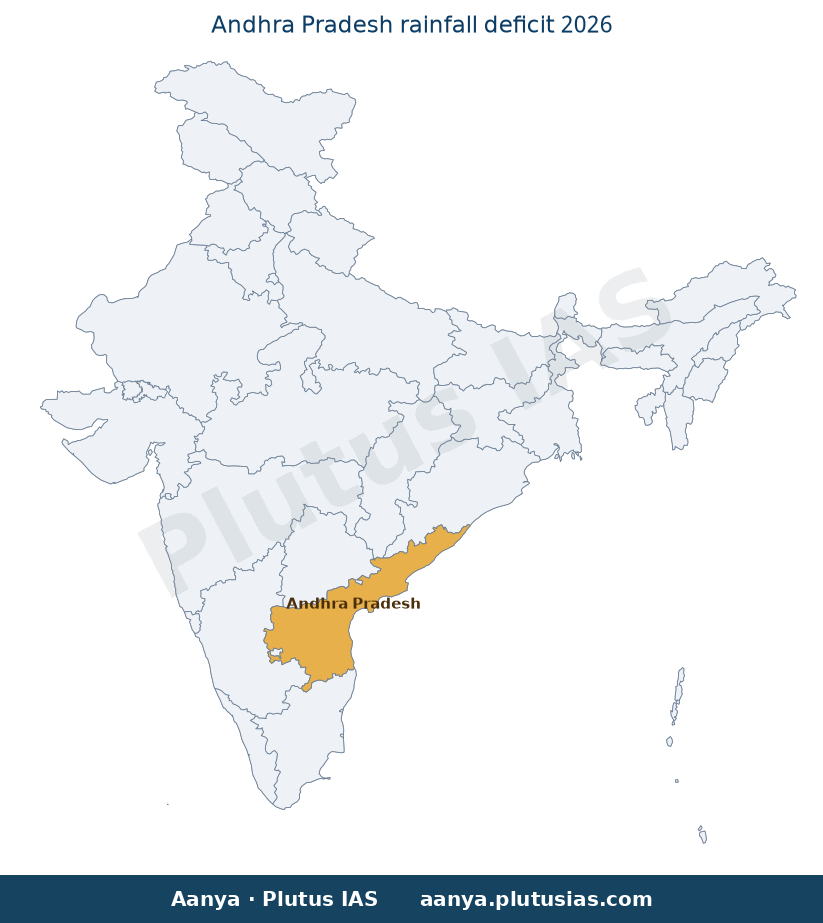
The report that all districts in Andhra Pradesh have experienced deficient rainfall, with a cumulative deficit of 52.4% by July-end 2026, has significant implications for the state’s agricultural sector, water resource management, and disaster preparedness. This situation, exacerbated by the El Niño phenomenon, necessitates an urgent review of drought mitigation strategies, including the declaration of drought-hit mandals, implementation of relief measures, and long-term climate adaptation policies. The political and administrative responses, such as directives from the Chief Minister and demands from opposition parties, underscore the urgency of the issue.
Background
- Andhra Pradesh, a predominantly agrarian state, is heavily dependent on the Southwest Monsoon for its annual rainfall, which is critical for kharif crops such as rice, maize, and pulses.
- The Southwest Monsoon typically accounts for 75-80% of the state’s annual rainfall, with the monsoon season spanning from June to September.
- The El Niño-Southern Oscillation (ENSO) phenomenon is a key driver of interannual variability in the Indian monsoon, with El Niño events often associated with below-normal rainfall over India, including Andhra Pradesh.
- The state’s vulnerability to drought is compounded by factors such as over-extraction of groundwater, inefficient irrigation practices, and the increasing frequency of extreme weather events due to climate change.
- Historically, Andhra Pradesh has faced severe droughts in 2002, 2009, 2015, and 2018, leading to significant agricultural losses and economic disruptions.
- The India Meteorological Department (IMD) classifies rainfall as ‘deficient’ when it is 20-59% below the long-period average (LPA) and ‘large deficient’ when it is 60% or more below the LPA.
Understanding Rainfall Deficit, Drought, and El Niño in the Context of Andhra Pradesh
- Rainfall Deficit: A meteorological term referring to the shortfall in actual rainfall compared to the long-period average (LPA) for a given period. In Andhra Pradesh, a 52.4% deficit by July-end indicates a severe shortfall, with no district reporting normal rainfall.
- Drought: A prolonged period of abnormally low rainfall leading to a shortage of water, which adversely affects agriculture, water supply, and livelihoods. Droughts are classified as meteorological (based on rainfall deficit), hydrological (based on water storage levels), agricultural (based on soil moisture and crop conditions), and socio-economic (based on impact on people and the economy).
- El Niño: A climate phenomenon characterized by the warming of sea surface temperatures in the central and eastern tropical Pacific Ocean. El Niño events are associated with a weakening of the Indian Summer Monsoon, leading to reduced rainfall over India, including Andhra Pradesh.
- Monsoon Variability: The Southwest Monsoon is influenced by multiple factors, including El Niño, La Niña, the Indian Ocean Dipole (IOD), and the Madden-Julian Oscillation (MJO). These factors contribute to the year-to-year variability in monsoon rainfall.
- Impact on Agriculture: Kharif crops, which are sown during the monsoon season, are particularly vulnerable to deficient rainfall. Crops such as rice, maize, and pulses may experience stunted growth, reduced yields, or complete failure, leading to economic losses for farmers.
- Water Resource Management: Deficient rainfall reduces water availability in reservoirs, rivers, and groundwater aquifers, exacerbating water scarcity. This can lead to conflicts over water allocation, increased dependence on groundwater, and environmental degradation.
- Disaster Management: Droughts are classified as slow-onset disasters, requiring proactive measures such as drought monitoring, early warning systems, and relief measures. The National Disaster Management Authority (NDMA) and state governments play a crucial role in mitigating the impact of droughts.
- Policy Responses: The Government of India and state governments implement various schemes to mitigate the impact of droughts, including the Pradhan Mantri Fasal Bima Yojana (PMFBY) for crop insurance, the National Disaster Response Fund (NDRF) for relief, and the Mahatma Gandhi National Rural Employment Guarantee Scheme (MGNREGS) for employment generation.
Key Features
| Feature | Significance |
|---|---|
| Rainfall Deficit of 52.4% (as of July 30, 2026) | Indicates severe hydrological stress, disrupting agricultural cycles, groundwater recharge, and rural livelihoods across all districts of Andhra Pradesh. |
| Large Deficit in Prakasam, East Godavari, Visakhapatnam, Annamayya, and Chittoor | Highlights regional vulnerability, particularly in deltaic and coastal districts critical for paddy cultivation and aquaculture. |
| El Niño Threat (IMD Forecast) | Increases probability of prolonged dry spells, exacerbating the deficit and complicating monsoon recovery strategies for the state. |
| Light Showers (<22 mm in Marripudi, Prakasam) | Insufficient to mitigate the deficit; underscores the inefficacy of sporadic rainfall in addressing systemic water scarcity. |
| Surface Winds (40–50 kmph) in Coastal Andhra & Rayalaseema | Induces evapotranspiration, accelerating soil moisture depletion and stressing crops already facing water deficit. |
Why it Matters
Economic
- Agricultural output decline: Paddy, groundnut, and sugarcane—key crops in Andhra Pradesh—face yield reduction due to water stress, threatening food security and rural incomes.
- Aquaculture vulnerability: Coastal districts like East Godavari and Visakhapatnam, reliant on brackish water aquaculture, may experience reduced productivity due to salinity intrusion from low freshwater inflow.
- Input cost escalation: Farmers may resort to expensive groundwater extraction or diesel pumps, increasing operational costs and debt burdens.
- Inflationary pressure: Reduced agricultural supply could contribute to food inflation, particularly for staples like rice and edible oils.
- Fiscal strain on state exchequer: Anticipated drought relief measures, including subsidies and loan waivers, may strain the state budget, diverting funds from developmental projects.
Environmental
- Groundwater depletion: Prolonged deficit accelerates over-extraction of aquifers, risking long-term water security and ecosystem degradation.
- Soil degradation: Reduced moisture content increases susceptibility to wind erosion and salinisation, particularly in Rayalaseema’s arid tracts.
- Biodiversity impact: Wetland-dependent species and migratory birds face habitat loss, disrupting ecological balance in regions like Kolleru Lake.
- Climate feedback loop: Persistent dry conditions may reinforce localised warming, exacerbating heat stress and further reducing rainfall probability.
Social
- Rural distress: Migration from drought-affected villages to urban centres may surge, straining urban infrastructure and social services.
- Nutritional insecurity: Declining agricultural output could reduce household access to nutritious food, particularly in tribal and marginalised communities.
- Water conflicts: Competition over dwindling water resources may escalate into intra-village or inter-community disputes, necessitating administrative intervention.
Administrative
- Resource allocation challenges: State agencies must prioritise water distribution, fodder supply, and relief measures amid competing demands.
- Data-driven governance: Real-time monitoring of rainfall, soil moisture, and crop health becomes critical for targeted interventions.
- Coordination gaps: Inter-departmental synergy between agriculture, irrigation, and disaster management is essential to mitigate cascading impacts.
Challenges
1. Agricultural Productivity Decline
- Delayed sowing of kharif crops due to dry spell, reducing crop duration and yield potential.
- Increased pest infestations (e.g., stem borer in paddy) in water-stressed fields.
- Livestock mortality risk: Reduced fodder availability may force distress sales or culling of cattle.
- Seed and fertiliser wastage: Farmers may incur sunk costs on inputs for failed crops.
UPSC Link: GS3: Agricultural productivity and water management
2. Groundwater Over-Exploitation
- Unregulated extraction in districts like Chittoor and Anantapur may deplete aquifers beyond sustainable levels.
- High arsenic and fluoride contamination risk in overexploited aquifers, posing health hazards.
- Energy subsidy burden: Increased electricity consumption for groundwater pumping strains state finances.
- Long-term water security threat: Aquifer recharge may take decades, even with normal rainfall.
UPSC Link: GS3: Groundwater depletion and sustainable management
3. Food and Nutritional Security
- Reduced market arrivals of staples may trigger price volatility, disproportionately affecting the poor.
- Malnutrition risks for children and pregnant women in drought-affected regions.
- Disruption in Public Distribution System (PDS) supply chains due to logistical challenges.
- Dependence on imports: State may need to procure foodgrains from other regions, increasing fiscal strain.
UPSC Link: GS2: Food security and PDS
4. Disaster Risk Management
- Delayed drought declaration may hinder timely relief distribution and compensation disbursement.
- Inadequate preparedness for El Niño-induced prolonged dry spells in subsequent monsoon months.
- Limited capacity of local bodies to implement drought mitigation measures (e.g., water harvesting, crop diversification).
- Risk of secondary disasters: Forest fires and dust storms may escalate in dry conditions.
UPSC Link: GS3: Disaster management and climate resilience
5. Economic Diversification Constraints
- Over-reliance on agriculture limits resilience; non-farm sectors (e.g., textiles, IT) may also face indirect impacts.
- Reduced rural purchasing power may dampen demand for industrial goods and services.
- Investor confidence erosion: Persistent droughts may deter agri-based industries (e.g., food processing) from setting up operations.
- Tourism sector vulnerability: Water scarcity may deter visitors to coastal and heritage destinations.
UPSC Link: GS3: Economic diversification and industrial policy
Challenges — UPSC Perspective
| Issue | Concern |
|---|---|
| Delayed monsoon recovery | Prolonged water stress may push farmers into debt traps and force distress migration. |
| El Niño persistence | Increases likelihood of below-normal rainfall in August-September, compounding deficits. |
| Aquifer depletion | Irreversible damage to groundwater resources, threatening future agricultural and domestic supply. |
| PDS supply chain disruptions | Risk of stockouts and price spikes for essential commodities in drought-affected areas. |
| Inter-state water disputes | Potential conflicts with neighbouring states over sharing of Krishna and Godavari waters. |
| Climate-vulnerable cropping patterns | Traditional crops (e.g., paddy) may become unsustainable, necessitating crop shifts. |
Way Forward
- Implement real-time agro-meteorological advisories via mobile platforms to guide farmers on sowing timings and water-efficient practices.
- Accelerate construction and revival of minor irrigation projects (e.g., check dams, farm ponds) to enhance local water storage.
- Promote drought-resistant crop varieties (e.g., millets, pulses) and agroforestry models to reduce water dependency.
- Strengthen the Mahatma Gandhi National Rural Employment Guarantee Scheme (MGNREGS) for water conservation works (e.g., watershed development, afforestation).
- Enhance groundwater regulation through the Andhra Pradesh Water Resources Act, 2022, with stricter monitoring of borewell permits.
- Expand fodder banks and subsidised cattle feed distribution to prevent livestock mortality in drought-affected regions.
- Leverage remote sensing and GIS for precision drought monitoring, enabling targeted relief and resource allocation.
- Foster public-private partnerships for desalination plants in coastal districts to supplement freshwater supply.
UPSC Value Addition
Keywords for Mains Answer-Writing
Andhra Pradesh rainfall deficit · Southwest Monsoon variability · El Niño-Southern Oscillation (ENSO) · Drought management in India · Agricultural distress · India Meteorological Department (IMD) · Climate change and monsoon patterns · Disaster management framework · Agricultural insurance schemes · Water resource management · State-level climate adaptation · Monsoon depression dynamics · Bay of Bengal cyclonic activity · Rayalaseema and Coastal Andhra Pradesh rainfall patterns · National Disaster Response Fund (NDRF)
Constitutional & Policy Linkages
- [‘Article 21: Right to Life (includes right to water and health)’]
- [‘Article 39(b): Directive Principle of State Policy (equitable distribution of resources)’]
Concept Flow
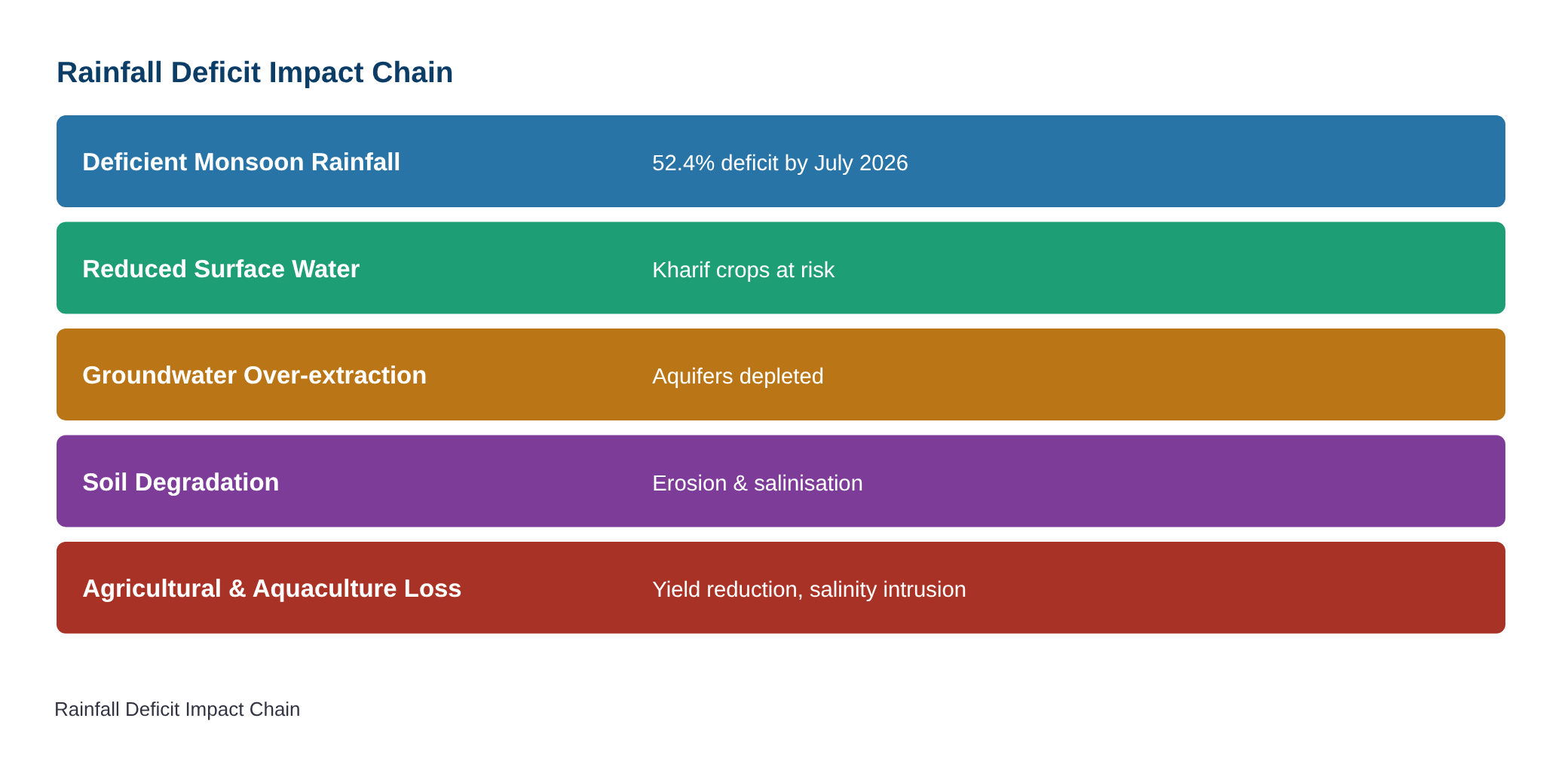
Deficient monsoon rainfall → Reduced surface water availability → Groundwater over-extraction → Soil moisture depletion → Crop yield decline → Rural income loss → Migration and food insecurity → Fiscal strain on state exchequer → Policy interventions (relief, subsidies) → Long-term climate adaptation strategies.
Prelims Practice Questions
Q1. Consider the following statements regarding the South-West Monsoon in India:
1. The South-West Monsoon is primarily caused by the differential heating of land and sea during summer.
2. The Andaman and Nicobar Islands receive the first monsoon showers in India.
3. The withdrawal of the South-West Monsoon from India is a gradual process beginning from the northwestern parts.
4. The El Niño-Southern Oscillation (ENSO) phase directly influences the intensity and distribution of the South-West Monsoon.
How many of the above statements are correct?
- Only one
- Only two
- Only three
- All
Answer: All — Statements 1, 3, and 4 are correct. Statement 2 is incorrect as the first monsoon showers are received in Kerala, not the Andaman and Nicobar Islands.
Q2. Assertion (A): The India Meteorological Department (IMD) has forecasted that Andhra Pradesh will not receive significant rainfall until August 3, 2026.
Reason (R): The deep depression over western parts of central Chhattisgarh and Madhya Pradesh moved southwestwards, weakening into a depression and further into a low-pressure area.
In the context of the above two statements, which one of the following is correct?
- Both A and R are true, and R is the correct explanation of A.
- Both A and R are true, but R is not the correct explanation of A.
- A is true, but R is false.
- A is false, but R is true.
Answer: Both A and R are true, but R is not the correct explanation of A. — Both the Assertion (A) and Reason (R) are true, and the Reason (R) correctly explains the Assertion (A) as the movement and weakening of the depression limits rainfall prospects for Andhra Pradesh.
Q3. Match the following pairs related to monsoon depressions and their impacts on Indian subcontinent:
Column I
A. Monsoon Depression
B. El Niño
C. Bay of Bengal Cyclone
D. Western Disturbances
Column II
1. Disrupts the normal monsoon flow
2. Brings heavy rainfall to coastal regions
3. Originates over the Mediterranean region
4. Associated with warm ocean temperatures in the Pacific
5. Leads to deficient rainfall in India
Select the correct match from the options below:
- A-2, B-4, C-1, D-3
- A-1, B-5, C-2, D-3
- A-5, B-4, C-2, D-1
- A-2, B-5, C-4, D-3
Answer: A-1, B-5, C-2, D-3 — A monsoon depression (A) brings heavy rainfall to coastal regions (2). El Niño (B) is associated with warm ocean temperatures in the Pacific and leads to deficient rainfall in India (4 and 5). A Bay of Bengal cyclone (C) disrupts the normal monsoon flow (1). Western disturbances (D) originate over the Mediterranean region (3).
Mains Practice Question
✍ ‘The current rainfall deficit in Andhra Pradesh underscores the need for a robust, climate-resilient agricultural and water management strategy at the state and national levels.’ Critically analyse this statement with reference to the causes of deficient rainfall, its socio-economic implications, and the policy measures required to mitigate such deficits. (15 Marks)
Approach: MODEL-ANSWER SKELETON:
1. **Causes of Deficient Rainfall in Andhra Pradesh (2 Marks)**
– El Niño-Southern Oscillation (ENSO): Explain the warm phase (El Niño) and its correlation with deficient monsoon rainfall in India.
– Monsoon Depression Dynamics: Describe the movement of the deep depression from the Bay of Bengal to central India, weakening before reaching Andhra Pradesh.
– Climate Change: Highlight the increasing frequency of extreme weather events and their impact on monsoon variability.
2. **Socio-Economic Implications (4 Marks)**
– Agricultural Distress: Discuss the impact on kharif crops (e.g., paddy, groundnut, pulses), farmer incomes, and rural livelihoods.
– Water Scarcity: Explain the strain on irrigation systems (e.g., canals, tanks) and groundwater depletion in Rayalaseema and Coastal Andhra Pradesh.
– Food Security: Analyse the potential impact on foodgrain production and inflation due to reduced agricultural output.
– Migration and Livelihoods: Discuss the socio-economic consequences such as farmer distress, debt cycles, and rural-urban migration.
3. **Policy Measures (6 Marks)**
– **Immediate Relief:** Crop insurance (Pradhan Mantri Fasal Bima Yojana), relief funds (National Disaster Response Fund), and drought declaration for affected mandals.
– **Medium-Term Adaptation:** Promotion of drought-resistant crops (e.g., millets), water conservation techniques (e.g., micro-irrigation, rainwater harvesting), and revival of traditional water bodies.
– **Long-Term Resilience:** Integration of climate-smart agriculture, strengthening of agrometeorological advisory services, and investment in irrigation infrastructure (e.g., Polavaram project).
– **Institutional Mechanisms:** Role of the India Meteorological Department (IMD) in improving monsoon forecasting and the State Disaster Management Authority in coordinating relief efforts.
4. **Conclusion (3 Marks)**
– Emphasise the need for a multi-dimensional approach combining immediate relief, medium-term adaptation, and long-term resilience.
– Highlight the role of cooperative federalism in addressing climate-induced challenges, with the Centre and states working in tandem.
– Conclude with a forward-looking statement on the importance of integrating climate change adaptation into India’s agricultural and water policies.
Source: The Hindu
Generated by AanyaAi for educational purpose.

- हिमाचल में बाल पोषण योजना: अब सप्ताह में दो बार मिलेगा अंडा या फल - September 23, 2026
- Himachal Pradesh’s Nutritious Food Scheme: Eggs/Fruits Twice Weekly for 5.5L Students - September 23, 2026
- रिफाइनरी क्षेत्र के लिए ऊर्जा सुरक्षा और नेट-ज़ीरो लक्ष्य में संतुलन जरूरी: विशेषज्ञ - September 23, 2026

No Comments