


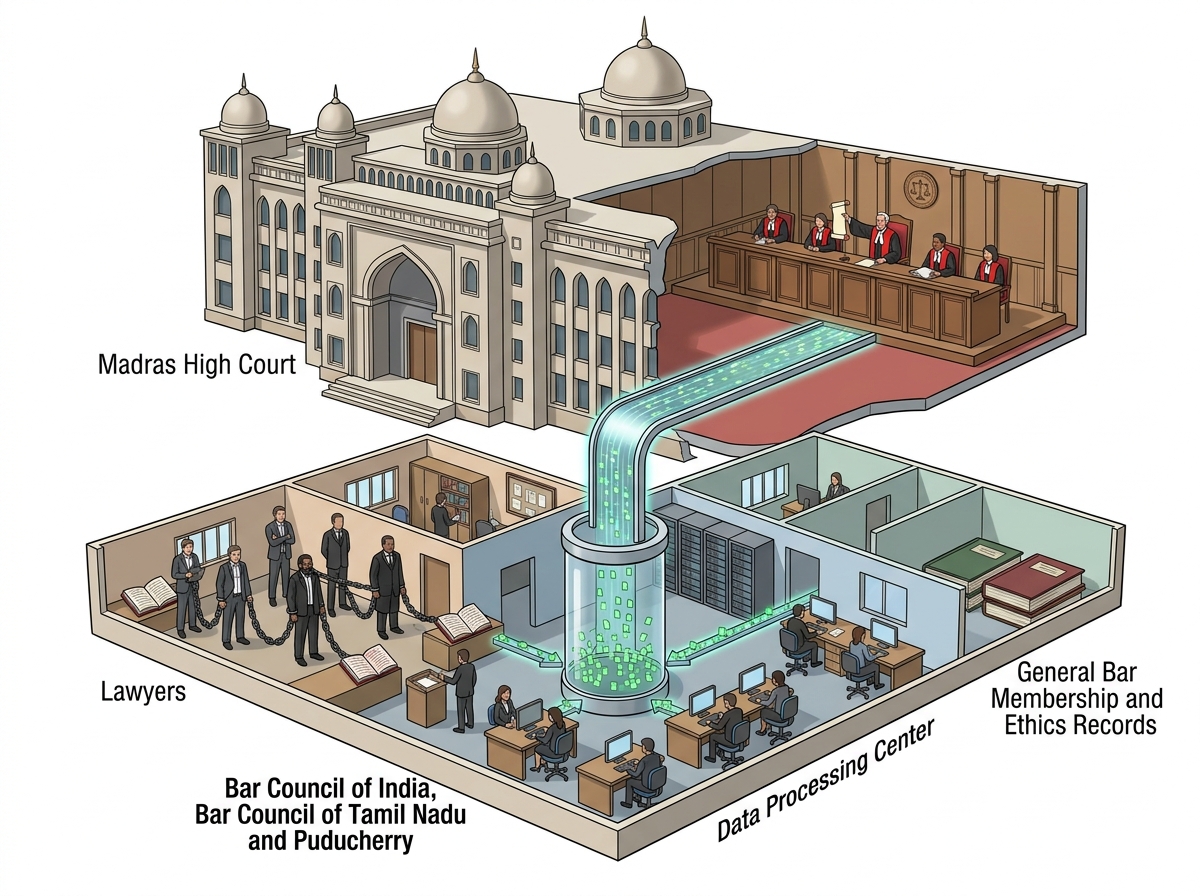
08 Aug Madras HC Orders Bar Councils to Track Lawyers with Criminal Cases
Bar Council of India | Bar Council of Tamil Nadu and PuduAdvocates facing criminal casesJustice delivery systemLegal profession integrity✎ The Advocates Act, 1961, empowers the Bar Council of India and State Bar Councils to regulate the legal profession, including the power to discipline advocates for professional misconduct, but enforcement of rules against…
Subject Relevance — Where This Topic Fits
- GS Paper II — Judiciary and Legal Reforms | GS Paper IV — Ethics in Governance and Professional Conduct
- Prelims: Bar Council of India (BCI), Bar Council of Tamil Nadu and Puducherry (BCTNP), Advocates Act, 1961, Section 24, Section 29, suo motu cognisance, criminalisation of legal profession, judicial ethics, contempt of court, professional misconduct
- Essay: The erosion of institutional credibility: A case study of the legal profession in India, Ethics in governance: Balancing accountability and the right to practice
Quick Revision: The Advocates Act, 1961, empowers the Bar Council of India and State Bar Councils to regulate the legal profession, including the power to discipline advocates for professional misconduct, but enforcement of rules against advocates facing criminal cases remains a challenge.
Why is this in the news?
The Madras High Court, in a suo motu observation, has directed the Bar Council of India (BCI) and the Bar Council of Tamil Nadu and Puducherry (BCTNP) to collect empirical data on advocates facing criminal cases, citing concerns over the rising trend of criminal allegations against practicing lawyers and their potential impact on the integrity of the justice delivery system and the legal profession. The directive underscores the need for systemic reforms to address the institutional credibility of the Bar.
Background
- The legal profession in India is governed by the principles of independence, integrity, and accountability, as enshrined in the Constitution and the Advocates Act, 1961.
- Recent observations by the judiciary have highlighted instances where advocates facing criminal prosecutions have assumed leadership roles in Bar Associations, raising concerns about the potential conflict of interest and the erosion of public trust in the legal system.
- The Supreme Court, in *Bar Council of India v. M.V. Dhabolkar* (1976), emphasised the need for strict adherence to professional ethics and the role of Bar Councils in maintaining the dignity of the profession.
- The BCI has, in the past, issued guidelines to Bar Councils to ensure that advocates with criminal antecedents do not occupy positions of influence, but enforcement remains a challenge.
- The Madras High Court’s directive is part of a broader judicial trend to address systemic issues within the legal profession, including corruption, unethical practices, and the criminalisation of the Bar.
What is the Legal Profession’s Regulatory Framework in India?
- The Advocates Act, 1961, is the primary legislation governing the legal profession in India, establishing the BCI as the apex regulatory body and State Bar Councils for each state and union territory.
- Section 24 of the Advocates Act, 1961, outlines the qualifications for enrolment as an advocate, focusing on age, citizenship, law degree, and enrolment fee.
- State Bar Councils are responsible for enrolling advocates, maintaining the roll of advocates, and disciplining advocates for professional misconduct under the supervision of the BCI.
- The judiciary, through suo motu proceedings and public interest litigations, has increasingly intervened to address systemic issues within the legal profession, including the criminalisation of advocates.
- The Bar Council of India (BCI) and State Bar Councils are statutory bodies established under the Advocates Act, 1961, and their decisions are subject to judicial review by the High Courts and the Supreme Court.
Key Features
| Feature | Significance |
|---|---|
| Empirical data collection mandate | Ensures evidence-based regulation of the legal profession by quantifying criminal cases among advocates. |
| Suo motu judicial intervention | Demonstrates proactive judicial oversight to uphold institutional integrity in the absence of statutory action. |
| Focus on leadership positions in Bar Associations | Highlights systemic risk where criminally accused individuals may influence collective legal governance. |
| Concerns over justice delivery credibility | Raises questions about the profession’s ability to safeguard client interests and uphold judicial values. |
| Statutory responsibility of BCI/BCTNP | Reinforces the constitutional duty of regulatory bodies to maintain professional standards. |
Why it Matters
Institutional Integrity
- The ruling underscores the judiciary’s role in preserving the moral authority of the legal profession, a cornerstone of the justice system.
- Collective data on criminal cases among advocates is critical to preempt reputational damage to the Bar Council and the judiciary.
- The observation that criminally accused advocates may ascend to leadership roles in Bar Associations necessitates preventive governance.
Rule of Law
- The judgment aligns with the principle that legal practitioners, as officers of the court, must exemplify ethical conduct to maintain public trust.
- Systemic failure to address criminality among advocates risks eroding the perceived neutrality and impartiality of the legal system.
- The court’s directive to the BCI/BCTNP to formulate policy reflects a judicial expectation of proactive statutory compliance.
Judicial Governance
- Suo motu intervention by the High Court demonstrates judicial activism in addressing lacunae in professional regulation.
- The emphasis on empirical data collection indicates a shift toward data-driven policymaking in legal governance.
- The ruling reinforces the judiciary’s supervisory role over statutory bodies like the Bar Council.
Challenges
1. Data Collection and Transparency
- Lack of a centralised, real-time database of criminal cases against advocates hampers regulatory oversight.
- Voluntary reporting by Bar Councils may lead to underreporting due to vested interests or systemic inertia.
- Ensuring objectivity in data compilation to avoid bias or selective reporting by regulatory bodies.
UPSC Link: GS-II: Judiciary & Legal Services
2. Conflict of Interest in Bar Leadership
- Criminally accused advocates occupying leadership roles in Bar Associations may influence disciplinary proceedings against peers.
- Potential for conflicts between professional ethics and group solidarity within Bar Associations.
- Risk of political or extraneous influences seeping into professional governance structures.
UPSC Link: GS-II: Pressure Groups & Associations
3. Judicial Credibility and Public Trust
- Perception of the legal profession as compromised undermines confidence in the justice delivery system.
- Media scrutiny of such cases may lead to sensationalism, further damaging the Bar’s reputation.
- Need for the judiciary to balance transparency with fairness to avoid stigmatising advocates prematurely.
UPSC Link: GS-II: Judiciary & Public Trust
4. Statutory and Administrative Delays
- BCI/BCTNP may face logistical or political hurdles in implementing data collection mechanisms promptly.
- Lack of enforcement powers to debar or discipline advocates with criminal records may render data collection futile.
- Coordination challenges between central (BCI) and state (BCTNP) bodies in standardising reporting protocols.
UPSC Link: GS-II: Statutory Bodies & Coordination
Challenges — UPSC Perspective
| Issue | Concern |
|---|---|
| Underreporting of criminal cases | Regulatory bodies may lack mechanisms to verify or mandate disclosure by advocates. |
| Leadership capture by criminally accused advocates | Bar Associations may prioritise solidarity over professional ethics. |
| Judicial delays in disciplinary actions | Prolonged litigation may dilute the deterrent effect of regulations. |
| Public perception and media bias | Sensational reporting may unfairly tarnish the entire legal profession. |
| Lack of uniform data standards | Inconsistent reporting across states hinders national-level analysis. |
| Political interference in Bar governance | Elected Bar Association leaders may prioritise vested interests over reform. |
Way Forward
- BCI and BCTNP must collaborate to establish a centralised, digital database of criminal cases against advocates, with mandatory periodic reporting.
- The Bar Council should formulate a clear policy on disqualification or suspension of advocates facing serious criminal charges, aligned with the Advocates Act, 1961.
- Judicial officers and Bar Associations should conduct periodic sensitisation programmes on professional ethics and the consequences of criminal involvement.
- The High Court may direct the creation of a dedicated wing within the BCTNP to monitor and investigate allegations against advocates.
- Advocates facing criminal charges should be required to disclose their status to clients and the court, ensuring transparency in legal representation.
- The BCI should explore amendments to the Bar Council of India Rules to include stricter provisions for advocates with criminal records.
- State Bar Councils must publish annual reports on disciplinary actions taken against advocates, including those with criminal cases.
- The judiciary should consider suo motu monitoring of such cases to ensure timely action by regulatory bodies.
UPSC Value Addition
Keywords for Mains Answer-Writing
Madras High Court · Bar Council of India · Bar Council of Tamil Nadu and Puducherry · criminalisation of legal profession · advocates facing criminal cases · Bar Associations leadership · justice delivery system integrity · empirical data collection · regulatory oversight of legal profession · professional ethics in legal practice
Constitutional & Policy Linkages
- [‘Article 14 (Equality before Law)’, ‘Ensures uniform standards for all advocates.’]
- [‘Article 19(1)(g) (Freedom of Profession)’, ‘Balances professional rights with regulatory oversight.’]
- [‘Article 226 (Writs by High Courts)’, ‘Empowers judiciary to intervene in governance lapses.’]
- [‘Article 51A (Fundamental Duties)’, ‘Imposes collective responsibility on legal fraternity.’]
Concept Flow
Increasing criminal cases among advocates → Perceived erosion of professional integrity → Judicial observation on systemic risk → Mandate for empirical data collection → Policy formulation by BCI/BCTNP → Enforcement of ethical standards → Restoration of public trust in the justice system.
Prelims Practice Questions
Q1. Consider the following statements regarding the Bar Council of India (BCI) and the Bar Council of Tamil Nadu and Puducherry (BCTNP):
1. The BCI is a statutory body established under the Advocates Act, 1961.
2. The BCTNP is empowered to regulate the legal profession exclusively in the state of Tamil Nadu.
3. The BCI and BCTNP are mandated to collect data on advocates facing criminal cases as per the Madras High Court’s recent directive.
How many of the above statements are correct?
- Only one
- Only two
- All three
- None
Answer: All three — Statements 1 and 3 are correct. Statement 2 is incorrect as the BCTNP regulates the legal profession in Tamil Nadu and Puducherry, not exclusively in Tamil Nadu.
Q2. Assertion (A): The Madras High Court has suo motu impleaded the Bar Council of India (BCI) and the Bar Council of Tamil Nadu and Puducherry (BCTNP) to gather empirical data on advocates facing criminal cases.
Reason (R): The court observed that the increasing trend of criminal cases involving practicing advocates poses a threat to the integrity of the justice delivery system.
Code:
- Both A and R are true, and R is the correct explanation of A.
- Both A and R are true, but R is not the correct explanation of A.
- A is true, but R is false.
- A is false, but R is true.
Answer: Both A and R are true, and R is the correct explanation of A. — Both the Assertion (A) and Reason (R) are true, and the Reason (R) correctly explains the Assertion (A) as the court’s directive was issued to address the systemic concern highlighted in the Reason.
Q3. Which of the following best describes the primary directive issued by the Madras High Court in the case involving advocates facing criminal cases?
- To immediately suspend all practicing advocates facing criminal cases.
- To collect empirical data on advocates facing criminal cases and submit a report to the court.
- To amend the Advocates Act, 1961, to disqualify advocates facing criminal cases.
- To form a judicial inquiry commission to investigate individual advocates.
Answer: To collect empirical data on advocates facing criminal cases and submit a report to the court. — The primary directive issued by the Madras High Court was to engage competent researchers to collect empirical data regarding the number of advocates facing criminal cases and submit the findings to the court.
Mains Practice Question
✍ The rising trend of advocates facing criminal cases and their subsequent elevation to leadership positions in Bar Associations has eroded public trust in the legal profession and the justice delivery system. Critically examine the institutional and ethical dimensions of this issue, with reference to the role of the Bar Council of India (BCI) and the Bar Council of Tamil Nadu and Puducherry (BCTNP). Also, suggest measures to restore the credibility of the legal profession. (15 Marks)
Approach: MODEL-ANSWER SKELETON:
1. **Institutional Dimensions**:
– Role of BCI and BCTNP under the Advocates Act, 1961 (Sections 7, 28, and 35) in regulating the legal profession and maintaining professional ethics.
– Statutory obligation to ensure that advocates do not engage in criminal activities (Bar Council of India Rules, Part VI, Chapter II).
– Need for empirical data collection as highlighted by the Madras High Court to identify systemic gaps.
2. **Ethical Dimensions**:
– Conflict between professional ethics (Advocates Act, 1961, Section 35) and the conduct of advocates facing criminal cases.
– Impact on the integrity of the justice delivery system when advocates with criminal backgrounds hold leadership positions in Bar Associations.
– Violation of the principle that advocates are ‘officers of the court’ (Supreme Court observations in *Ex-Capt. Harish Uppal v. Union of India*, 2003).
3. **Measures to Restore Credibility**:
– Mandatory disclosure of criminal antecedents by advocates at the time of enrollment and renewal of licenses (as per the Madras High Court’s suggestion).
– Strengthening the disciplinary mechanisms under the Advocates Act, 1961, to include debarment or suspension for advocates convicted of serious offenses.
– Collaboration with law enforcement agencies to ensure transparency in the verification of advocates’ backgrounds.
– Public awareness campaigns to highlight the ethical standards expected of legal professionals.
4. **Balancing Views**:
– Argument for due process: Advocates facing criminal cases are presumed innocent until proven guilty.
– Counter-argument: The legal profession must uphold higher standards of conduct, and systemic reforms are necessary to prevent reputational damage to the judiciary.
Source: The Hindu
Generated by AanyaAi for educational purpose.


No Comments