


08 Aug Madras HC directs BCI to collect data on lawyers with criminal cases
✎ The Madras High Court has directed the BCI and state Bar Councils to collect empirical data on advocates facing criminal cases, emphasizing that the legal profession must uphold institutional integrity and public trust.
Subject Relevance — Where This Topic Fits
- GS Paper II — Judiciary and Constitutional Framework | GS Paper IV — Ethics and Integrity in Governance
- Prelims: Bar Council of India (BCI), Bar Council of Tamil Nadu and Puducherry (BCTNP), Advocates Act, 1961, Section 35, suo motu cognizance, criminal antecedents of lawyers, judicial ethics, contempt of court, professional misconduct, contempt jurisdiction
- Essay: Ethics in the Legal Profession: Balancing Accountability and Fairness, Judicial Activism and Institutional Integrity: The Role of the Higher Judiciary
Quick Revision: The Madras High Court has directed the BCI and state Bar Councils to collect empirical data on advocates facing criminal cases, emphasizing that the legal profession must uphold institutional integrity and public trust.
Why is this in the news?
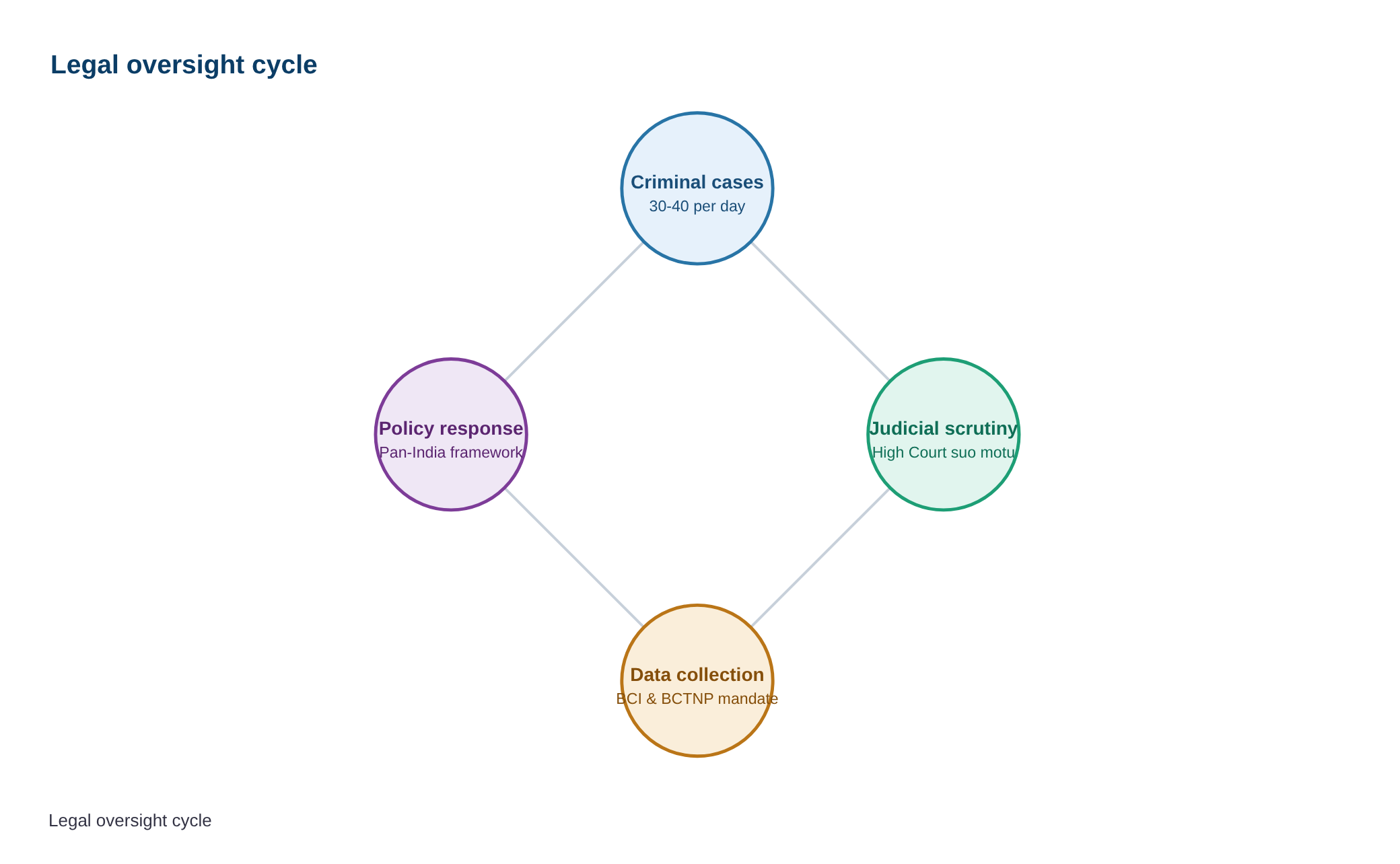
The Madras High Court, in a suo motu observation, has underscored the urgent need for the Bar Council of India (BCI) and the Bar Council of Tamil Nadu and Puducherry (BCTNP) to collect empirical data on advocates facing criminal cases. The court highlighted the alarming frequency of such cases—30 to 40 per working day—raising concerns about the credibility of the legal profession and the justice delivery system. This directive follows observations that advocates with criminal antecedents are increasingly occupying leadership roles in Bar Associations, thereby posing a systemic risk to the integrity of the legal fraternity.
Background
- The Advocates Act, 1961, empowers the Bar Council of India (BCI) and state Bar Councils to regulate the legal profession, including the power to suspend or remove advocates for professional misconduct under Section 35.
- The legal profession in India is governed by a self-regulatory framework, where Bar Councils act as both regulators and representatives of advocates, creating a dual role that demands stringent oversight.
- Recent judicial observations, including those by the Supreme Court, have emphasized the need for transparency and accountability in the legal profession, particularly concerning advocates with criminal records.
- The Madras High Court’s suo motu cognizance reflects growing judicial concern over the erosion of public trust in the legal system due to the involvement of advocates in criminal activities.
- The issue is not isolated to Tamil Nadu; similar concerns have been raised in other states, necessitating a pan-India policy response from the BCI.
- The court’s directive aligns with the broader constitutional mandate to uphold the dignity of the legal profession and ensure the fair administration of justice.
What is the Legal Framework Governing Criminal Antecedents of Advocates?
- The Advocates Act, 1961, is the primary legislation governing the legal profession in India, with the Bar Council of India (BCI) as the apex regulatory body.
- Section 35 of the Advocates Act empowers State Bar Councils to initiate disciplinary proceedings against advocates for professional misconduct, including criminal conduct that tarnishes the profession’s image.
- The BCI has previously issued guidelines prohibiting advocates with criminal records from holding office in Bar Associations, but enforcement remains inconsistent across states.
- The Madras High Court’s observation highlights a systemic gap: the lack of empirical data on the prevalence of criminal cases against advocates, which is essential for evidence-based policymaking.
- The court’s directive to collect data is a judicial intervention to ensure that regulatory bodies discharge their statutory duties effectively.
- The issue intersects with judicial ethics, as advocates are officers of the court and play a pivotal role in the justice delivery system.
- The BCI’s role is not merely regulatory but also pedagogical, requiring it to sensitize the legal fraternity on ethical standards and accountability.
Key Features
| Feature | Significance |
|---|---|
| Empirical data collection mandate | Enables evidence-based regulation of the legal profession by quantifying the scale of criminal cases among advocates. |
| Suo motu judicial intervention | Demonstrates judicial activism in safeguarding the integrity of the justice delivery system and the legal profession. |
| Focus on Bar Associations’ leadership | Highlights systemic risks when individuals with criminal backgrounds occupy influential positions in professional bodies. |
| Institutional concern over credibility | Underscores the potential erosion of public trust in both the Bar and the judiciary due to widespread criminal allegations. |
| Statutory authority involvement | Mandates the Bar Council of India (BCI) and State Bar Councils to proactively address the issue through policy measures. |
Why it Matters
Legal Profession Integrity
- The directive ensures that the legal profession adheres to ethical standards, as advocates are officers of the court and integral to the justice system.
- Prevents the infiltration of criminal elements into professional leadership, which could undermine client representation and public confidence.
Judicial System Credibility
- Rising criminal cases among advocates risk tarnishing the image of the Bar, thereby affecting the perceived fairness and reliability of legal proceedings.
- Judicial scrutiny of such systemic issues reinforces the judiciary’s role as a guardian of institutional integrity.
Regulatory Framework Strengthening
- Empirical data collection is the first step toward formulating targeted policies to regulate entry and conduct within the legal profession.
- Mandates statutory bodies (BCI and State Bar Councils) to adopt proactive measures rather than reactive responses.
Public Trust and Transparency
- Addressing criminal allegations among advocates transparently can restore public faith in the legal system’s ability to self-regulate.
- Demonstrates the judiciary’s commitment to upholding the dignity of the legal profession through institutional accountability.
Challenges
1. Data Collection and Verification
- Ensuring accurate and comprehensive data on criminal cases involving advocates without infringing on privacy rights.
- Overcoming resistance from Bar Associations or individuals who may perceive such scrutiny as an attack on professional autonomy.
UPSC Link: GS Paper 2: Judiciary – Independence and Accountability
2. Systemic Corruption and Nepotism
- Addressing the potential nexus between criminal elements and the legal fraternity, including cases of collusion or protection rackets.
- Preventing the misuse of leadership positions in Bar Associations by individuals with criminal backgrounds.
UPSC Link: GS Paper 4: Ethics – Challenges in Governance
3. Balancing Professional Autonomy and Regulation
- Designing policies that regulate entry into the legal profession without stifling legitimate dissent or undermining the independence of advocates.
- Ensuring that regulatory measures are proportionate and do not disproportionately target specific groups or communities.
UPSC Link: GS Paper 2: Fundamental Rights – Reasonable Restrictions
4. Judicial Overreach vs. Institutional Role
- Clarifying the boundaries of judicial intervention in matters pertaining to the regulation of the legal profession, which is primarily the domain of statutory bodies.
- Avoiding perceptions of judicial overreach that could undermine the autonomy of professional bodies like the BCI.
UPSC Link: GS Paper 2: Separation of Powers
5. Implementation and Enforcement Gaps
- Ensuring that policies framed by the BCI and State Bar Councils are effectively implemented and enforced at the ground level.
- Overcoming bureaucratic inertia or lack of political will in addressing systemic issues within the legal profession.
UPSC Link: GS Paper 2: Role of Statutory Bodies
Challenges — UPSC Perspective
| Issue | Concern |
|---|---|
| Data Accuracy | Risk of incomplete or manipulated data due to lack of standardized reporting mechanisms. |
| Leadership Capture | Criminal elements gaining control over Bar Associations, influencing professional norms and client representation. |
| Public Perception | Erosion of trust in the legal system if the issue is perceived as inadequately addressed. |
| Regulatory Overlap | Potential conflicts between judicial directives and the statutory roles of the BCI and State Bar Councils. |
| Resource Constraints | Limited capacity of Bar Councils to conduct empirical studies or enforce disciplinary measures. |
Way Forward
- The Bar Council of India (BCI) and State Bar Councils should commission independent empirical studies to quantify criminal cases among advocates, ensuring data integrity and transparency.
- Develop a standardized reporting mechanism for criminal cases involving advocates, in collaboration with the judiciary and law enforcement agencies.
- Formulate clear guidelines for the disqualification or suspension of advocates facing serious criminal charges, aligning with ethical standards of the legal profession.
- Conduct periodic audits of Bar Association leadership to prevent individuals with criminal backgrounds from holding influential positions.
- Strengthen the disciplinary mechanisms within the BCI and State Bar Councils to ensure swift action against errant advocates.
- Incorporate mandatory background checks for advocates seeking leadership roles in Bar Associations or professional bodies.
- Launch awareness campaigns to educate the legal fraternity on the ethical obligations and consequences of criminal involvement.
- Establish a grievance redressal mechanism for clients or stakeholders to report unethical conduct by advocates.
UPSC Value Addition
Keywords for Mains Answer-Writing
Madras High Court · Bar Council of India (BCI) · Bar Council of Tamil Nadu and Puducherry (BCTNP) · criminalisation of legal profession · empirical data on advocates · regulatory role of Bar Councils · Bar Associations leadership · justice delivery system integrity · suo motu jurisdiction · statutory regulation of legal profession · professional ethics in legal practice · judicial oversight of legal profession
Constitutional & Policy Linkages
- Article 14: Equality before Law – Ensuring non-discriminatory regulation of the legal profession.
- Article 19(1)(g): Freedom of Profession – Balancing regulation with professional autonomy.
- Article 21: Right to Livelihood – Protecting the rights of advocates while ensuring public trust.
- Article 50: Separation of Judiciary – Upholding the integrity of the justice delivery system.
Concept Flow
Rising criminal cases among advocates → Erosion of public trust in the legal system → Judicial intervention for systemic reform → Mandate for empirical data collection → Policy formulation by statutory bodies (BCI/State Bar Councils) → Implementation of regulatory measures → Strengthening of professional integrity and credibility.
Prelims Practice Questions
Q1. Consider the following statements regarding the Bar Council of India (BCI) and the Bar Council of Tamil Nadu and Puducherry (BCTNP):
1. The BCI is a statutory body established under the Advocates Act, 1961.
2. The BCTNP is empowered to collect data on advocates facing criminal cases suo motu.
3. The BCI and BCTNP are responsible for regulating the legal profession in India.
4. The Madras High Court has directed the BCI and BCTNP to engage researchers for collecting empirical data on advocates facing criminal cases.
How many of the above statements are correct?
- Only one
- Only two
- Only three
- All
Answer: All — Statements 1, 3, and 4 are correct. Statement 2 is incorrect as the BCTNP is not empowered to collect such data suo motu; the Madras High Court has directed them to do so in the context of a specific case.
Q2. Assertion (A): The Madras High Court has observed that advocates facing criminal cases are increasingly occupying leadership positions in Bar Associations.
Reason (R): The court has directed the Bar Council of India (BCI) and the Bar Council of Tamil Nadu and Puducherry (BCTNP) to collect empirical data on advocates facing criminal cases to address this issue.
- Both A and R are true, and R is the correct explanation of A
- Both A and R are true, but R is not the correct explanation of A
- A is true, but R is false
- A is false, but R is true
Answer: Both A and R are true, but R is not the correct explanation of A — Both the Assertion and Reason are true. The court has indeed observed the trend of advocates facing criminal cases occupying leadership roles and has directed the BCI and BCTNP to collect empirical data to address the issue.
Q3. Match the following bodies with their respective roles in regulating the legal profession in India:
Column I
A. Bar Council of India (BCI)
B. Bar Council of Tamil Nadu and Puducherry (BCTNP)
C. State Bar Councils
D. Bar Associations
Column II
1. Regulates the legal profession at the state level
2. Regulates the legal profession at the national level
3. Local bodies representing advocates’ interests
4. Empowered to discipline advocates for professional misconduct
- A-2, B-1, C-4, D-3
- A-1, B-2, C-4, D-3
- A-3, B-1, C-2, D-4
- A-4, B-3, C-1, D-2
Answer: A-2, B-1, C-4, D-3 — A-2 (BCI regulates at the national level), B-1 (BCTNP regulates at the state level), C-4 (State Bar Councils are empowered to discipline advocates), D-3 (Bar Associations are local bodies representing advocates’ interests).
Mains Practice Question
✍ The Madras High Court has observed a disturbing trend of advocates facing criminal cases occupying leadership positions in Bar Associations, thereby raising concerns about the integrity of the justice delivery system. Critically examine the regulatory role of the Bar Council of India (BCI) and State Bar Councils in addressing this issue. Also, analyse the constitutional and statutory provisions that empower these bodies to regulate the legal profession. (15 Marks)
Approach: MODEL-ANSWER SKELETON:
1. **Introduction (1 line)**: Contextualise the issue with reference to the Madras High Court’s observations and the suo motu direction to BCI and BCTNP.
2. **Regulatory Framework (4 points)**:
– **Statutory Basis**: Advocates Act, 1961 (Sections 3, 7, 24, 29, 35, 49) and State Bar Councils’ role.
– **Functions of BCI**: Regulation of legal education, professional standards, and disciplinary jurisdiction (Section 7).
– **Functions of State Bar Councils**: Enrollment, disciplinary jurisdiction (Section 29), and oversight of advocates.
– **Role of Bar Associations**: Voluntary bodies; no statutory power but influence leadership.
3. **Gaps in Regulation (4 points)**:
– **Lack of Empirical Data**: Absence of systematic data collection on criminal cases against advocates.
– **Leadership Selection**: Bar Associations’ election processes not vetted by statutory bodies for criminal antecedents.
– **Disciplinary Gaps**: Delayed or lenient disciplinary action against advocates facing criminal cases.
– **Judicial Oversight**: Courts stepping in via suo motu jurisdiction due to regulatory failures.
4. **Constitutional and Ethical Concerns (3 points)**:
– **Article 14 (Equality)**: Need for uniform standards in admission and discipline.
– **Article 21 (Dignity of Profession)**: Upholding the integrity of the legal profession.
– **Professional Ethics**: Bar Council of India Rules (Part VI, Chapter II) and Advocates’ Code of Conduct.
5. **Recommendations (3 points)**:
– **Data Collection Mechanism**: Mandate BCI and State Bar Councils to maintain a real-time database of criminal cases against advocates.
– **Leadership Vetting**: Require Bar Associations to submit leadership candidates’ criminal records for scrutiny.
– **Stricter Disciplinary Action**: Fast-track disciplinary proceedings against advocates facing serious criminal charges.
6. **Conclusion (1 line)**: Emphasise the need for proactive regulatory measures to restore public trust in the legal profession.
Source: The Hindu
Generated by AanyaAi for educational purpose.

- Trump Defends Iran War at UNGA: Key Implications for UPSC & State PCS - September 22, 2026
- अंडमान-निकोबार के उपराज्यपाल ने प्रधानमंत्री से की बैठक, जानें मुख्य बिंदु - September 22, 2026
- UPSC Alert: Andaman & Nicobar LG Meets PM on 22 Sep 2026 - September 22, 2026

No Comments