


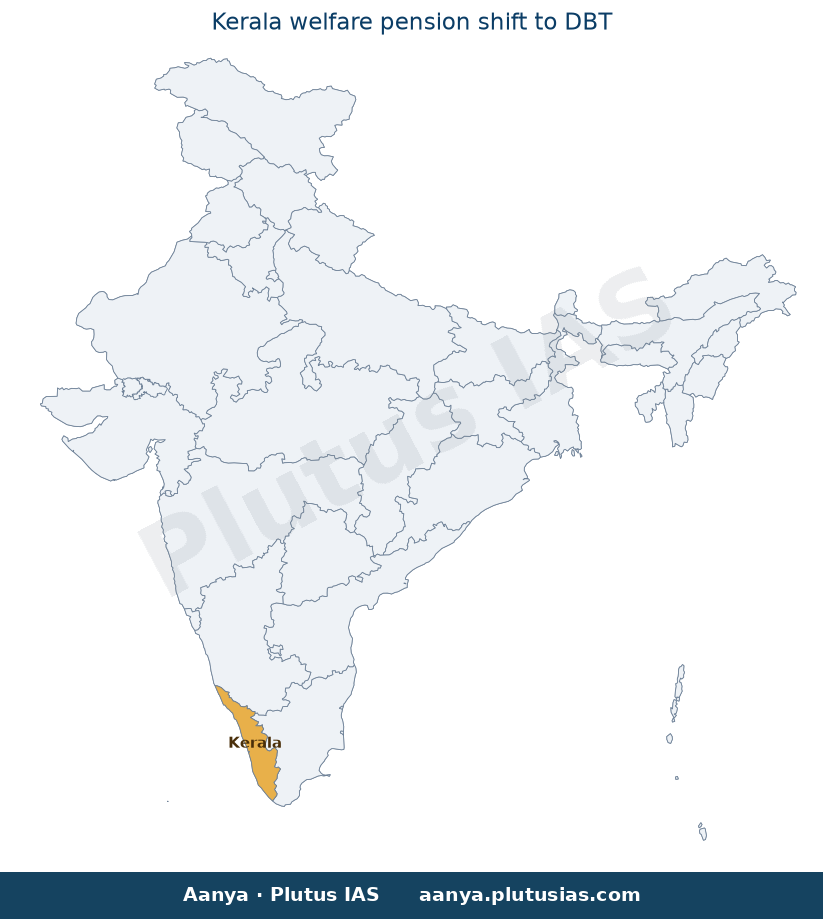
08 Aug Kerala Shifts Welfare Pensions to DBT, Ends Cooperative Bank Role
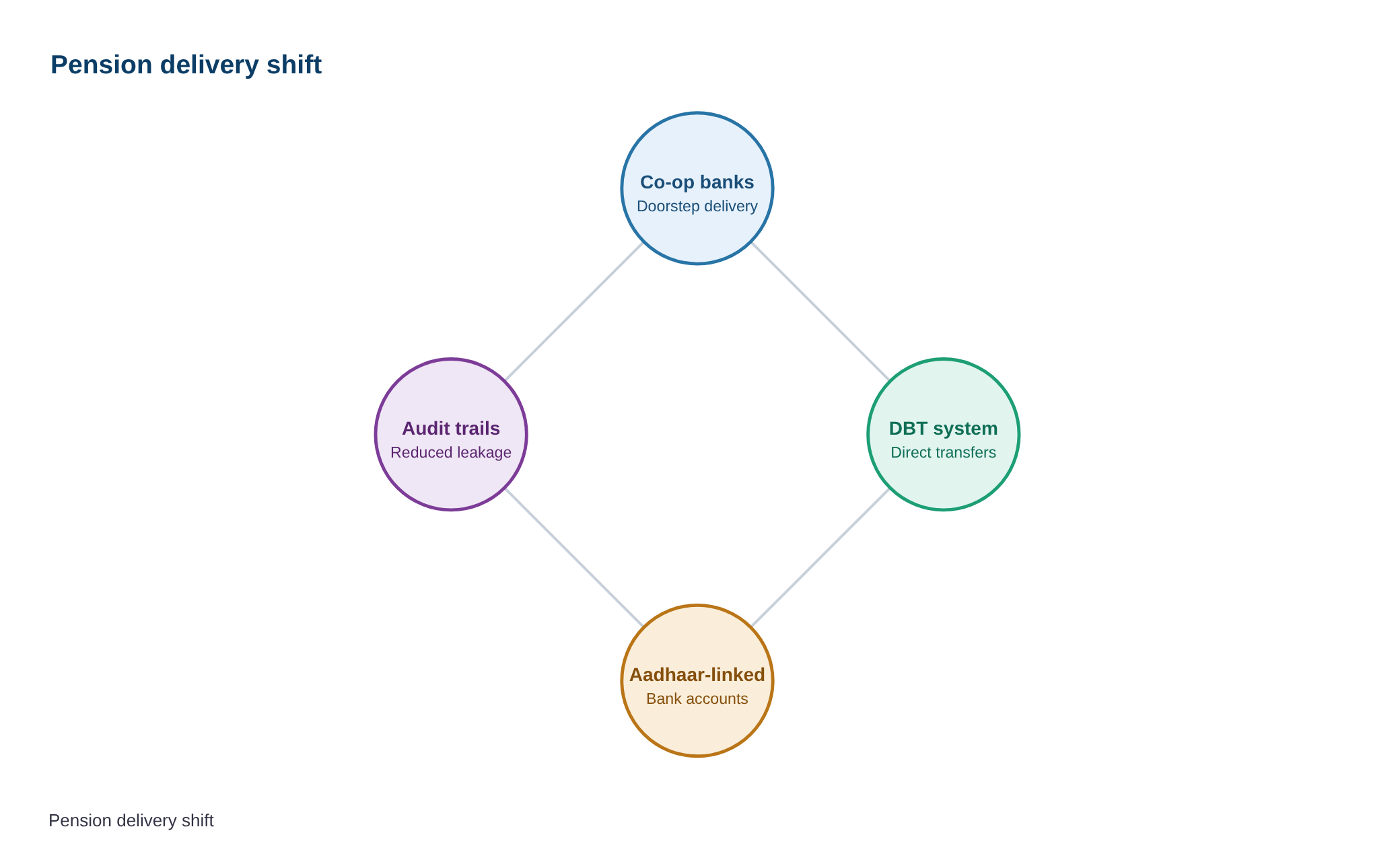
✎ Kerala’s shift from cooperative bank-based pension delivery to DBT underscores the need for transparent, technology-driven welfare systems to eliminate leakages and ensure fiscal efficiency.
Subject Relevance — Where This Topic Fits
- GS Paper II — Governance, Transparency and Accountability | GS Paper III — Public Finance and Direct Benefit Transfers | GS Paper III — Cooperative Societies and Financial Inclusion
- Prelims: Direct Benefit Transfer (DBT), Aadhaar-based payments, cooperative banks, welfare pensions, fiscal federalism, financial inclusion, doorstep delivery, reconciliation issues, undistributed pension amounts, Central financial assistance
- Essay: The role of technology in reducing leakages in welfare delivery systems, Cooperative federalism vs. centralised welfare delivery: Lessons from Kerala’s pension reforms
Quick Revision: Kerala’s shift from cooperative bank-based pension delivery to DBT underscores the need for transparent, technology-driven welfare systems to eliminate leakages and ensure fiscal efficiency.
Why is this in the news?
The Kerala government has issued an order to discontinue the distribution of social security and welfare pensions through cooperative banks, replacing it with Direct Benefit Transfer (DBT) to Aadhaar-linked bank accounts. This decision, driven by systemic inefficiencies such as delays, reconciliation failures, and duplicate payments, marks a significant shift in the state’s welfare delivery mechanism. The move also aligns with broader national efforts to ensure transparency and compliance with DBT norms, while addressing concerns over financial losses and loss of Central assistance due to non-adherence to prescribed standards.
Background
- Kerala has historically utilised cooperative banks for the doorstep delivery of welfare pensions, a system that emerged from the state’s strong cooperative movement and emphasis on grassroots financial inclusion.
- The existing model involved cooperative banks receiving incentives for delivering pensions directly to beneficiaries’ homes, a practice that has faced criticism for inefficiencies, including delayed remittances and incomplete record updates.
- Reports highlighted systemic issues such as undistributed pension amounts, duplicate payments due to inadequate Aadhaar-based verification, and reconciliation challenges, undermining the efficacy of the welfare delivery system.
- The Finance Department’s in-principle approval for DBT-based disbursal reflects a broader policy shift towards digital governance and fiscal accountability, particularly in the context of welfare schemes.
- The decision also underscores the state’s commitment to aligning with national DBT norms to avoid forfeiture of Central financial assistance, which often mandates direct transfers to beneficiaries’ accounts.
- Bedridden beneficiaries and others with mobility constraints will continue to receive pensions at their homes, ensuring inclusivity in the transition.
What is Direct Benefit Transfer (DBT) and its significance in welfare delivery?
- DBT is a mechanism where welfare benefits are transferred directly to the bank accounts of beneficiaries, eliminating intermediaries and reducing leakages in the delivery system.
- It is a flagship initiative of the Government of India, introduced to enhance transparency, reduce corruption, and ensure timely delivery of subsidies and welfare payments.
- DBT leverages Aadhaar-based authentication to verify beneficiaries, minimise duplication, and streamline the disbursal process, thereby improving fiscal efficiency.
- The system is governed by the Public Financial Management System (PFMS) and Aadhaar Payment Bridge System (APBS), which facilitate real-time tracking and reconciliation of transactions.
- Kerala’s transition to DBT for welfare pensions aligns with the national framework but also addresses state-specific challenges, such as the inefficiencies of cooperative bank-based delivery.
- The move is expected to reduce administrative costs, eliminate incentive payments to cooperative banks, and improve the accuracy of pension disbursals.
- DBT also enhances financial inclusion by encouraging beneficiaries to open and utilise bank accounts, particularly in rural and underserved areas.
- The system’s success depends on robust digital infrastructure, including Aadhaar seeding, bank account linkages, and grievance redressal mechanisms to address beneficiary concerns.
Key Features
| Feature | Significance |
|---|---|
| Mandatory DBT for welfare pensions | Eliminates intermediaries (cooperative banks), reduces leakage, and ensures direct beneficiary access to funds. |
| Exclusion of bedridden beneficiaries | Preserves doorstep delivery for vulnerable groups unable to access bank accounts or ATMs. |
| Aadhaar-linked bank accounts | Enhances transparency, prevents duplication, and aligns with Central DBT norms. |
| Incentive payments to cooperative banks | Highlights inefficiency in the erstwhile system, where banks were paid for doorstep delivery despite systemic delays and reconciliation issues. |
| Central financial assistance compliance | Ensures eligibility for Central funds by adhering to DBT mandates, avoiding loss of fiscal support. |
Why it Matters
Economic
- Reduces fiscal leakage in welfare expenditure by ensuring direct and traceable fund transfers.
- Optimises public expenditure by eliminating incentive payments to cooperative banks for doorstep delivery.
- Enhances fiscal federalism by aligning State-level welfare distribution with Central DBT frameworks, potentially unlocking additional Central funds.
Administrative
- Streamlines pension disbursement by removing multi-layered intermediaries, reducing delays and reconciliation errors.
- Improves accountability through Aadhaar-linked transactions, which provide audit trails and reduce ghost beneficiaries.
- Simplifies administrative processes by centralising disbursement mechanisms under DBT, reducing bureaucratic overhead.
Social
- Ensures timely and equitable access to welfare pensions for the majority of beneficiaries, particularly the elderly and disabled.
- Maintains inclusivity by retaining doorstep delivery for bedridden beneficiaries, addressing accessibility concerns.
- Reduces corruption and patronage in welfare delivery by minimising human intervention in fund distribution.
Technological
- Leverages Aadhaar-enabled Payment System (AePS) and DBT infrastructure to ensure seamless, real-time fund transfers.
- Facilitates integration with banking and financial inclusion initiatives, such as Jan Dhan Yojana, for marginalised groups.
Challenges
1. Digital Divide and Financial Exclusion
- Risk of exclusion of beneficiaries without Aadhaar-linked bank accounts or those unfamiliar with digital transactions.
- Potential barriers for elderly or differently-abled individuals in accessing ATMs or bank branches.
UPSC Link: GS-II: Welfare Schemes
2. Operational and Logistical Hurdles
- Ensuring last-mile connectivity for beneficiaries in remote or underserved areas to access funds via ATMs or banking correspondents.
- Addressing technical glitches in Aadhaar authentication or banking systems that may disrupt disbursements.
UPSC Link: GS-III: Technology Missions
3. Data Privacy and Security
- Risk of data breaches or misuse of Aadhaar-linked financial data, necessitating robust cybersecurity measures.
- Need for strict compliance with data protection norms to prevent unauthorised access to beneficiary information.
UPSC Link: GS-II: Governance
4. Resistance from Stakeholders
- Potential pushback from cooperative banks or employees whose roles are being phased out, requiring careful transition management.
- Addressing concerns of beneficiaries accustomed to doorstep delivery, particularly in rural areas.
UPSC Link: GS-II: Cooperative Societies
5. Monitoring and Grievance Redressal
- Establishing efficient grievance redressal mechanisms to address delays or errors in DBT disbursements.
- Ensuring real-time monitoring of pension disbursements to prevent duplication or non-payment.
UPSC Link: GS-II: Social Sector Services
Challenges — UPSC Perspective
| Issue | Concern |
|---|---|
| Aadhaar linkage gaps | Exclusion of beneficiaries without Aadhaar or linked bank accounts. |
| Digital literacy | Difficulty for elderly or rural beneficiaries in navigating digital payment systems. |
| Last-mile delivery | Ensuring access to ATMs or banking correspondents in remote areas. |
| Data security | Risk of unauthorised access or misuse of Aadhaar-linked financial data. |
| Stakeholder resistance | Potential opposition from cooperative banks or beneficiaries accustomed to doorstep delivery. |
| Grievance redressal | Need for robust mechanisms to address delays or errors in disbursements. |
Way Forward
- Conduct targeted awareness campaigns to educate beneficiaries on DBT and Aadhaar-linked banking, with special focus on elderly and rural populations.
- Expand banking correspondent networks in underserved areas to ensure last-mile connectivity for fund access.
- Strengthen cybersecurity frameworks to safeguard Aadhaar-linked financial data and prevent fraud.
- Establish a real-time grievance redressal system with multi-channel support (helpline, local offices, digital portals).
- Phase out cooperative bank involvement gradually to minimise disruption and address stakeholder concerns.
- Integrate DBT with Jan Dhan Yojana to ensure universal access to bank accounts for marginalised groups.
- Pilot the DBT system in select districts to identify and resolve operational challenges before statewide rollout.
- Monitor and publish quarterly reports on pension disbursement efficiency, leakage reduction, and beneficiary satisfaction.
UPSC Value Addition
Keywords for Mains Answer-Writing
Direct Benefit Transfer (DBT) · Aadhaar-linked bank accounts · cooperative banks · welfare pensions · Kerala social security reforms · doorstep delivery of pensions · Aadhaar-based payments · Direct Benefit Transfer norms · bedridden beneficiaries · Central financial assistance · LSGD department Kerala · Aadhaar seeding
Concept Flow
Kerala’s welfare pension delivery via cooperative banks faced systemic issues: delays, reconciliation errors, and duplication. → Government reviewed the system and identified non-compliance with Central DBT norms, risking loss of financial assistance. → Decision to shift to mandatory DBT for Aadhaar-linked bank accounts, except for bedridden beneficiaries. → Implementation requires addressing digital divide, last-mile delivery, and stakeholder resistance. → Successful transition will enhance transparency, reduce leakage, and align with Central welfare distribution frameworks. → Long-term impact includes improved fiscal efficiency, beneficiary trust, and alignment with national digital governance goals.
Prelims Practice Questions
Q1. Consider the following statements about the Direct Benefit Transfer (DBT) system in India:
1. DBT ensures that welfare benefits are transferred directly to the bank accounts of beneficiaries.
2. The system mandates the use of Aadhaar-linked bank accounts for all beneficiaries.
3. DBT eliminates the need for doorstep delivery of welfare pensions.
4. The Kerala government has recently decided to discontinue the doorstep delivery of welfare pensions through cooperative banks.
How many of the above statements are correct?
- Only one
- Only two
- Only three
- All
Answer: All — Statements 1, 2, and 4 are correct. Statement 3 is incorrect because DBT does not eliminate doorstep delivery entirely; it continues for bedridden beneficiaries.
Q2. Assertion (A): The Kerala government has decided to shift the distribution of welfare pensions from cooperative banks to Direct Benefit Transfer (DBT) to Aadhaar-linked bank accounts.
Reason (R): The existing system through cooperative banks was marred by delays, reconciliation issues, and non-compliance with DBT norms, risking loss of Central financial assistance.
In the context of the above two statements, which one of the following is correct?
- Both A and R are true, and R is the correct explanation of A
- Both A and R are true, but R is not the correct explanation of A
- A is true, but R is false
- A is false, but R is true
Answer: Both A and R are true, and R is the correct explanation of A — Both A and R are true, and R correctly explains why the Kerala government decided to shift to DBT.
Q3. Match the following welfare delivery mechanisms with their respective characteristics:
Column I (Mechanism)
A. Direct Benefit Transfer (DBT)
B. Doorstep delivery through cooperative banks
C. Aadhaar-based payments
D. Central financial assistance
Column II (Characteristic)
1. Direct transfer of funds to beneficiary accounts without intermediaries
2. Physical delivery of welfare amounts to beneficiaries’ homes
3. Mandatory linkage of bank accounts with Aadhaar for transparency
4. Financial support from the Central government to states for welfare schemes
Select the correct match:
- A-1, B-2, C-3, D-4
- A-2, B-1, C-4, D-3
- A-3, B-4, C-1, D-2
- A-4, B-3, C-2, D-1
Answer: A-1, B-2, C-3, D-4 — A-1 (DBT transfers funds directly to accounts), B-2 (doorstep delivery involves physical handover), C-3 (Aadhaar-based payments require Aadhaar linkage), D-4 (Central financial assistance refers to funds provided by the Centre).
Mains Practice Question
✍ The Kerala government’s decision to discontinue the doorstep delivery of welfare pensions through cooperative banks and transition to Direct Benefit Transfer (DBT) to Aadhaar-linked bank accounts marks a significant shift in social security administration. Critically examine the rationale behind this reform and its implications for fiscal federalism, transparency, and beneficiary welfare. (15 Marks)
Approach: Introduction: Define DBT and its constitutional/statutory basis (Article 266(2) of the Constitution, DBT Mission under NITI Aayog). Rationale for the reform: 1. Elimination of inefficiencies: Delays in remittance, reconciliation issues, and duplicate payments (cite Kerala’s LSGD order). 2. Compliance with DBT norms: Avoid loss of Central financial assistance; align with the Centre’s DBT guidelines (PM-KISAN, Ujjwala Yojana). 3. Fiscal prudence: Incentive payments to cooperative banks were an avoidable expenditure. 4. Transparency and accountability: Aadhaar seeding reduces leakages and ghost beneficiaries (cite Rangarajan Committee 2014 on leakages). Implications for fiscal federalism: 1. Centre-State dynamics: States’ autonomy in welfare delivery vs. Centre’s conditionalities (DBT norms as a ‘one-size-fits-all’ approach). 2. Role of cooperative banks: Their constitutional status (97th Amendment Act, 2011) and their role in financial inclusion (Kudumbashree model in Kerala). 3. Federal tensions: Potential resistance from state-level cooperative institutions and political economy considerations. Beneficiary welfare: 1. Exclusion risks: Bedridden beneficiaries and those without Aadhaar-linked accounts (highlight Kerala’s exception for bedridden patients). 2. Digital divide: Access to banking infrastructure in rural Kerala (Kerala’s high banking density vs. last-mile connectivity issues). 3. Gender and social equity: Ensuring women, elderly, and marginalised groups are not left behind (link to NITI Aayog’s Aspirational Districts Programme). Conclusion: Weigh the reform’s benefits (efficiency, transparency) against its risks (exclusion, federal friction). Suggest a balanced approach: phased transition, grievance redressal mechanisms, and digital literacy campaigns.
Source: The Hindu
Generated by AanyaAi for educational purpose.

- केरल में एंटीमाइक्रोबियल रेजिस्टेंस: सरकारी रिपोर्ट में चौंकाने वाले आँकड़े सामने - September 23, 2026
- Kerala’s AMR Crisis: Rising Drug Resistance Threatens Public Health in 2025 - September 23, 2026
- सुप्रीम कोर्ट ने दवाओं की ऊंची कीमतों को ‘लूट’ बताया, सरकार से पूछा- क्या है कानून? - September 23, 2026

No Comments