


08 Aug Article 371(J) Implementation: Why Kalyana Karnataka Demands Justice After 13 Years
✎ Article 371(J) mandates the establishment of the Kalyana Karnataka Regional Development Board (KKRDB) with a dedicated budget to address regional imbalances, including reservations in education, employment, and local bodies…
Subject Relevance — Where This Topic Fits
- GS Paper II — Constitutional and Non-Constitutional Bodies (Special Provisions for States) | GS Paper III — Issues Relating to Development and Management of Social Sector/Services relating to Health, Education, Human Resources
- Prelims: Article 371(J), Kalyana Karnataka Regional Development Board (KKRDB), Hyderabad Karnataka Horata Samiti, Vaijnath Patil, Rajyotsava Awards, KIADB, Basava Kalyana, Kavirajamarga
- Essay: Regional Disparities and Constitutional Safeguards: The Case of Article 371(J) in Kalyana Karnataka, Equitable Development: Balancing Constitutional Provisions and Ground Realities
Quick Revision: Article 371(J) mandates the establishment of the Kalyana Karnataka Regional Development Board (KKRDB) with a dedicated budget to address regional imbalances, including reservations in education, employment, and local bodies, while empowering the Governor to ensure its implementation.
Why is this in the news?
The Hyderabad Karnataka Horata Samiti, through a convention held on the birth anniversary of former Minister Vaijnath Patil, has renewed demands for the effective implementation of Article 371(J) of the Constitution. Speakers highlighted that despite 13 years since the provision’s enactment, its intended benefits—beyond education and public employment—remain largely unfulfilled in the Kalyana Karnataka region, necessitating a renewed focus on agriculture, irrigation, industry, culture, and overall regional development.
Background
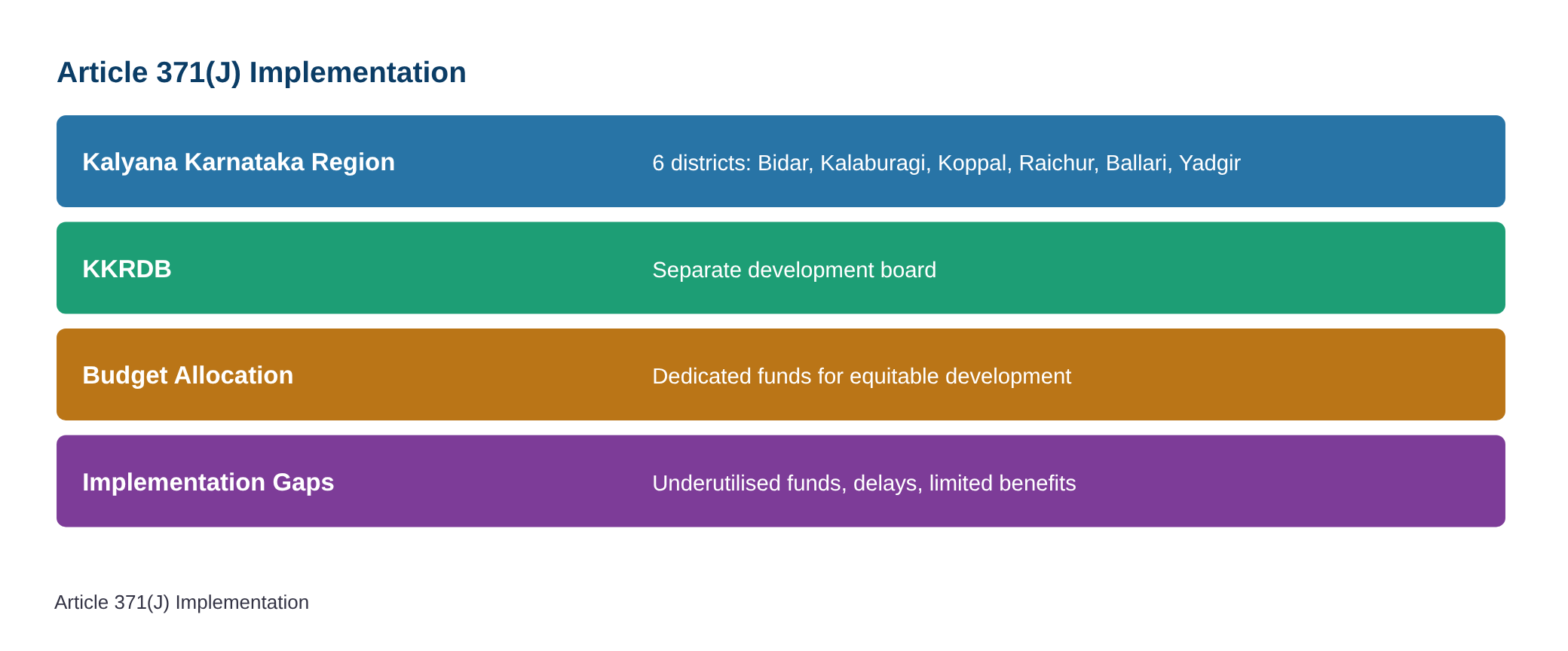
- Article 371(J) was inserted into the Constitution via the 98th Amendment Act, 2012, to address historical regional imbalances in the Hyderabad-Karnataka region (comprising six districts: Bidar, Kalaburagi, Koppal, Raichur, Ballari, and Yadgir).
- The provision mandates the establishment of a separate development board—the Kalyana Karnataka Regional Development Board (KKRDB)—for the region, with a dedicated budget allocation to ensure equitable development.
- The movement for special status gained momentum under the leadership of Vaijnath Patil, a former Minister from the region, who advocated for constitutional safeguards to address decades of neglect.
- The region has historically faced socio-economic disparities, including lower literacy rates, limited industrial growth, and inadequate infrastructure compared to other parts of Karnataka.
- Despite the constitutional provision, concerns persist regarding the underutilisation of funds, delays in project execution, and the lack of tangible benefits in sectors beyond education and employment.
- The Hyderabad Karnataka Horata Samiti continues to serve as a vocal platform for demanding the full implementation of Article 371(J), citing the region’s rich cultural and literary heritage as a justification for greater recognition and development.
What is Article 371(J)?
- Article 371(J) is a special provision under Part XXI of the Indian Constitution, inserted by the 98th Amendment Act, 2012, to address the developmental deficits in the Hyderabad-Karnataka region.
- It empowers the Governor of Karnataka to establish a separate development board—the Kalyana Karnataka Regional Development Board (KKRDB)—for the region, with a dedicated budget allocation.
- The provision mandates the reservation of seats in educational institutions and public employment for local candidates, with a focus on ensuring equitable opportunities.
- Article 371(J) also allows for the reservation of seats in local bodies (Panchayats and Municipalities) for the region, ensuring political representation.
- The Governor is vested with special responsibilities, including the power to direct the state government to allocate funds for the development of the region and to ensure the implementation of the board’s recommendations.
- The provision aims to promote the region’s cultural heritage, including institutions like the Basava Kalyana (associated with Basaveshwara’s social reform movement) and the earliest Kannada literary work, Kavirajamarga.
- Despite its constitutional status, the effective implementation of Article 371(J) has been hindered by bureaucratic delays, underutilisation of funds, and a lack of political will.
- The Hyderabad Karnataka Horata Samiti and other regional organisations continue to advocate for the full realisation of the provision’s objectives, citing persistent disparities in agriculture, irrigation, industry, and education.
Key Features
| Feature of Article 371(J) | Significance for Kalyana Karnataka |
|---|---|
| Special Status under Article 371(J) | Constitutional provision granting unique administrative, economic, and developmental autonomy to the Hyderabad-Karnataka region (comprising six districts: Bidar, Kalaburagi, Yadgir, Raichur, Koppal, Ballari). |
| Reservation in Education and Employment | Ensures 70% reservation in public employment and 75% in educational institutions for local candidates, aiming to address historical underrepresentation. |
| Kalyana Karnataka Regional Development Board (KKRDB) | Statutory body tasked with planning and executing development schemes, ensuring equitable resource allocation and project implementation in the region. |
| Separate Budget Allocation | Mandates a dedicated budget for the region to fund infrastructure, irrigation, agriculture, and social welfare projects, reducing dependence on general state allocations. |
| Cultural and Educational Autonomy | Promotes preservation and promotion of local languages (Kannada dialects), literature, and cultural heritage, including recognition in state-level awards and programmes. |
Why it Matters
Economic
- Article 371(J) aims to correct historical economic neglect by prioritising agriculture, irrigation, and industrial development in the Kalyana Karnataka region, which has lagged in growth compared to southern Karnataka.
- Limited industrialisation despite availability of land under Karnataka Industrial Areas Development Board (KIADB), necessitating targeted policy interventions to attract investment.
- Agricultural productivity remains suboptimal due to inadequate irrigation infrastructure, with only a fraction of cultivable land under assured water supply.
Social
- Historical socio-economic disparities have led to underrepresentation of local communities in education and employment, necessitating affirmative action through reservations.
- Cultural marginalisation persists, with demands for greater representation in state-level cultural programmes (e.g., Rajyotsava Awards, Mysuru Dasara) and academic institutions.
Administrative
- The Kalyana Karnataka Regional Development Board (KKRDB) serves as a nodal agency for planning and monitoring development projects, but faces challenges in fund utilisation and transparency.
- Delays in preparing annual action plans and executing projects undermine the efficacy of the constitutional provision.
Strategic
- The region’s proximity to national highways and railway networks (e.g., NH-44, NH-150A) makes it strategically important for inter-state connectivity and economic integration, necessitating focused infrastructure development.
Challenges
1. Inadequate Implementation of Constitutional Provisions
- Despite over 13 years since the enactment of Article 371(J), only 15–20% of intended benefits have reached the people, indicating systemic gaps in execution.
- Lack of political will and bureaucratic inertia hinder the translation of constitutional guarantees into tangible outcomes for the region.
UPSC Link: GS-II: Federalism, Centre-State Relations
2. Regional Disparities in Resource Allocation
- The Kalyana Karnataka region continues to face neglect in budgetary allocations, with funds under the KKRDB often diverted or underutilised due to procedural delays.
- Inequitable distribution of resources exacerbates socio-economic disparities between the Hyderabad-Karnataka region and the rest of Karnataka.
UPSC Link: GS-II: Regionalism, Inclusive Growth
3. Agricultural and Irrigation Backlog
- Incomplete irrigation projects (e.g., Upper Krishna Project Phase-II, Tunga-Bhadra High-Level Canal) have left large tracts of land rain-fed, limiting agricultural productivity.
- Multi-cropping potential remains untapped due to inadequate water storage and distribution infrastructure.
UPSC Link: GS-III: Agriculture, Water Resources
4. Industrialisation Lag and Land Utilisation Issues
- Despite availability of KIADB land, industrial growth has been limited due to policy bottlenecks, lack of investor confidence, and inadequate infrastructure linkages.
- Closure and merger of government schools in the region further constrain human capital development and local employment opportunities.
UPSC Link: GS-III: Industrial Policy, Employment
5. Transparency and Accountability in Fund Utilisation
- Allegations of fund mismanagement and delays in project execution plague the Kalyana Karnataka Regional Development Board (KKRDB), necessitating stricter oversight mechanisms.
- Annual action plans are often prepared belatedly, leading to suboptimal utilisation of allocated funds.
UPSC Link: GS-II: Governance, Accountability
Challenges — UPSC Perspective
| Challenge | Impact on Article 371(J) Implementation |
|---|---|
| Underutilisation of constitutional provisions | Erodes trust in the constitutional framework and exacerbates regional grievances. |
| Delays in irrigation and infrastructure projects | Perpetuates agricultural stagnation and rural-urban migration. |
| Limited industrial growth despite land availability | Fails to create employment opportunities, undermining the region’s economic potential. |
| Lack of transparency in KKRDB fund utilisation | Leads to misallocation of resources and public discontent. |
| Cultural marginalisation in state-level programmes | Undermines the preservation and promotion of local heritage and identity. |
Way Forward
- Strengthen the mandate and autonomy of the Kalyana Karnataka Regional Development Board (KKRDB) to ensure timely execution of projects and transparent fund utilisation.
- Accelerate completion of pending irrigation projects (e.g., Upper Krishna Project Phase-II, Tunga-Bhadra High-Level Canal) to enhance agricultural productivity and rural incomes.
- Implement a dedicated industrial policy for Kalyana Karnataka, leveraging KIADB land and incentivising private investment through tax breaks and infrastructure support.
- Enhance representation of the region in state-level cultural and educational programmes (e.g., Rajyotsava Awards, Mysuru Dasara, university vice-chancellorships) to promote cultural identity and pride.
- Establish a real-time monitoring mechanism for fund utilisation under Article 371(J), with third-party audits and public disclosure of progress reports.
- Promote multi-cropping and allied agricultural activities through subsidies, training, and market linkages to diversify livelihoods and reduce dependence on monsoon.
- Conduct periodic socio-economic impact assessments of Article 371(J) to identify gaps and recalibrate policies for equitable development.
- Foster public-private partnerships (PPPs) for infrastructure development, including roads, power, and digital connectivity, to improve regional competitiveness.
UPSC Value Addition
Keywords for Mains Answer-Writing
Article 371(J) · Kalyana Karnataka Region · Special Category Status · Regional Development Boards · Constitutional Asymmetry · Federalism in India · Kalyana Karnataka Regional Development Board (KKRDB) · Regional Disparities · Constitutional Provisions for Backward Regions · Public Movements and Constitutional Amendments · Implementation Gaps in Special Provisions · Cultural and Economic Development of Backward Regions
Constitutional & Policy Linkages
- Article 371(J) of the Constitution of India — Special provisions for the Hyderabad-Karnataka region
- Seventh Schedule of the Constitution — Distribution of legislative powers between the Union and the States
Concept Flow
Historical neglect of Hyderabad-Karnataka region → Mobilisation of local communities (e.g., Vaijnath Patil’s movement) → Enactment of Article 371(J) (2013) → Constitutional guarantees (reservations, development board, budget) → Inadequate implementation (bureaucratic delays, fund mismanagement) → Renewed public demand for effective execution → Renewed calls for transparency, accountability, and accelerated development → Policy recalibration and stricter oversight mechanisms
Prelims Practice Questions
Q1. Consider the following statements regarding Article 371(J) of the Constitution of India:
1. Article 371(J) was inserted by the Constitution (Ninety-eighth Amendment) Act, 2012.
2. It provides for a separate development board for the Hyderabad-Karnataka region.
3. The provision mandates reservation in education and public employment for the region.
4. The Governor of Karnataka is empowered to provide for equitable allocation of funds for the development of the region.
How many of the above statements are correct?
- Only one
- Only two
- Only three
- All four
Answer: All four — Statements 1, 2, and 3 are correct. Statement 4 is incorrect as the Governor is not directly empowered to allocate funds; the Kalyana Karnataka Regional Development Board (KKRDB) is responsible for fund allocation and development planning.
Q2. Assertion (A): The Kalyana Karnataka Regional Development Board (KKRDB) was established under Article 371(J) to address regional disparities.
Reason (R): Article 371(J) mandates the formation of a separate board for the Hyderabad-Karnataka region to ensure equitable development.
Code:
- Both A and R are true, and R is the correct explanation of A
- Both A and R are true, but R is not the correct explanation of A
- A is true, but R is false
- A is false, but R is true
Answer: Both A and R are true, and R is the correct explanation of A — Both Assertion (A) and Reason (R) are true, and R correctly explains A. The KKRDB was indeed established under Article 371(J) to ensure equitable development in the Hyderabad-Karnataka region.
Q3. Which of the following regions is covered under the provisions of Article 371(J)?
- Vidarbha region in Maharashtra
- Bodoland Territorial Region in Assam
- Hyderabad-Karnataka region
- Bundelkhand region in Uttar Pradesh
Answer: Hyderabad-Karnataka region — Article 371(J) specifically applies to the Hyderabad-Karnataka region, which includes districts such as Kalaburagi, Bidar, Raichur, Yadgir, and Koppal in Karnataka.
Mains Practice Question
✍ Article 371(J) was intended to address historical injustices and promote balanced regional development in the Hyderabad-Karnataka region. Critically examine the extent to which this constitutional provision has succeeded in achieving its objectives. Also, analyse the challenges in its implementation and suggest measures for effective realization of its provisions. (15 Marks)
Approach: MODEL-ANSWER SKELETON:
1. **Introduction (2 marks)**:
– Brief background of Article 371(J): Inserted by the Constitution (Ninety-eighth Amendment) Act, 2012, to address regional imbalances in the Hyderabad-Karnataka region.
– Objectives: Special provisions for education, employment, agriculture, irrigation, industry, and cultural development.
2. **Successes of Article 371(J) (4 marks)**:
– **Education and Employment**: Reservation in education and public employment for local candidates.
– **Institutional Mechanisms**: Establishment of the Kalyana Karnataka Regional Development Board (KKRDB) for planning and fund allocation.
– **Cultural Recognition**: Efforts to promote the region’s literary and cultural heritage (e.g., recognition of Kavirajamarga and Basava Kalyana).
– **Legal Safeguards**: Governor’s role in ensuring equitable allocation of funds and development projects.
3. **Challenges in Implementation (5 marks)**:
– **Underutilization of Funds**: Allegations of only 15-20% of intended benefits reaching the people (e.g., delays in irrigation projects, limited industrial growth despite KIADB land availability).
– **Bureaucratic Delays**: Slow preparation of annual action plans and lack of transparency in fund utilization (e.g., concerns raised by Basavaraj Kamanur and Jagannath Shegji).
– **Regional Disparities**: Persistent neglect despite constitutional provisions; limited growth in agriculture, industry, and infrastructure.
– **Political and Administrative Will**: Lack of sustained political commitment and public participation in monitoring implementation.
4. **Measures for Effective Implementation (4 marks)**:
– **Strengthening KKRDB**: Enhancing transparency, accountability, and capacity of the KKRDB in fund allocation and project execution.
– **Separate Budgetary Allocation**: Dedicated budget for the Kalyana Karnataka region to ensure focused development.
– **Public Awareness and Participation**: Mobilizing civil society, media, and local leaders to demand accountability (e.g., role of Hyderabad Karnataka Horata Samiti).
– **Multi-Sectoral Development**: Expanding benefits beyond education and employment to agriculture, irrigation, industry, and culture.
– **Judicial and Legislative Oversight**: Strengthening judicial review and parliamentary scrutiny to ensure compliance with Article 371(J).
5. **Conclusion (2 marks)**:
– Article 371(J) remains a critical tool for addressing regional imbalances, but its success hinges on political will, administrative efficiency, and public participation. Without these, the constitutional provision risks becoming a symbolic gesture rather than a transformative mechanism.
Source: The Hindu
Generated by AanyaAi for educational purpose.

- आपातकाल में ‘गायब’ शाह आयोग रिपोर्ट का रहस्यमयी पुनर्प्राप्ति - September 23, 2026
- What happened to the Shah Commission report on Emergency? UPSC analysis - September 23, 2026
- तमिलनाडु के लिए क्या है ‘एल नीनो’ और उत्तर-पूर्वी मानसून का खतरा? - September 23, 2026

No Comments