


08 Aug SHRC directs strict mangrove, wetland protection in Kannur for UPSC
✎ The constitutional right to a clean and healthy environment under Article 21 of the Indian Constitution imposes a positive obligation on the state to protect and restore mangroves and wetlands, as reiterated by the State Human…
Subject Relevance — Where This Topic Fits
- GS Paper II — Governance, Constitution, Polity, Social Justice and International Relations (Environmental Governance) | GS Paper III — Environment and Ecology (Conservation, Environmental Pollution and Degradation)
- Prelims: Mangroves (Ecosystem Services, Carbon Sequestration), Wetlands (Ramsar Convention, Montreux Record), State Human Rights Commission (SHRC), Constitutional Right to Clean Environment (Article 21), Environmental Impact Assessment (EIA) 2006, Coastal Regulation Zone (CRZ) Notification 2019, Kerala State Biodiversity Board, National Green Tribunal (NGT), Environmental Protection Act 1986
- Essay: Environmental Conservation: Balancing Development and Ecological Integrity, Judicial Activism in Safeguarding Constitutional Rights
Quick Revision: The constitutional right to a clean and healthy environment under Article 21 of the Indian Constitution imposes a positive obligation on the state to protect and restore mangroves and wetlands, as reiterated by the State Human Rights Commission in its directive to Kannur authorities.
Why is this in the news?
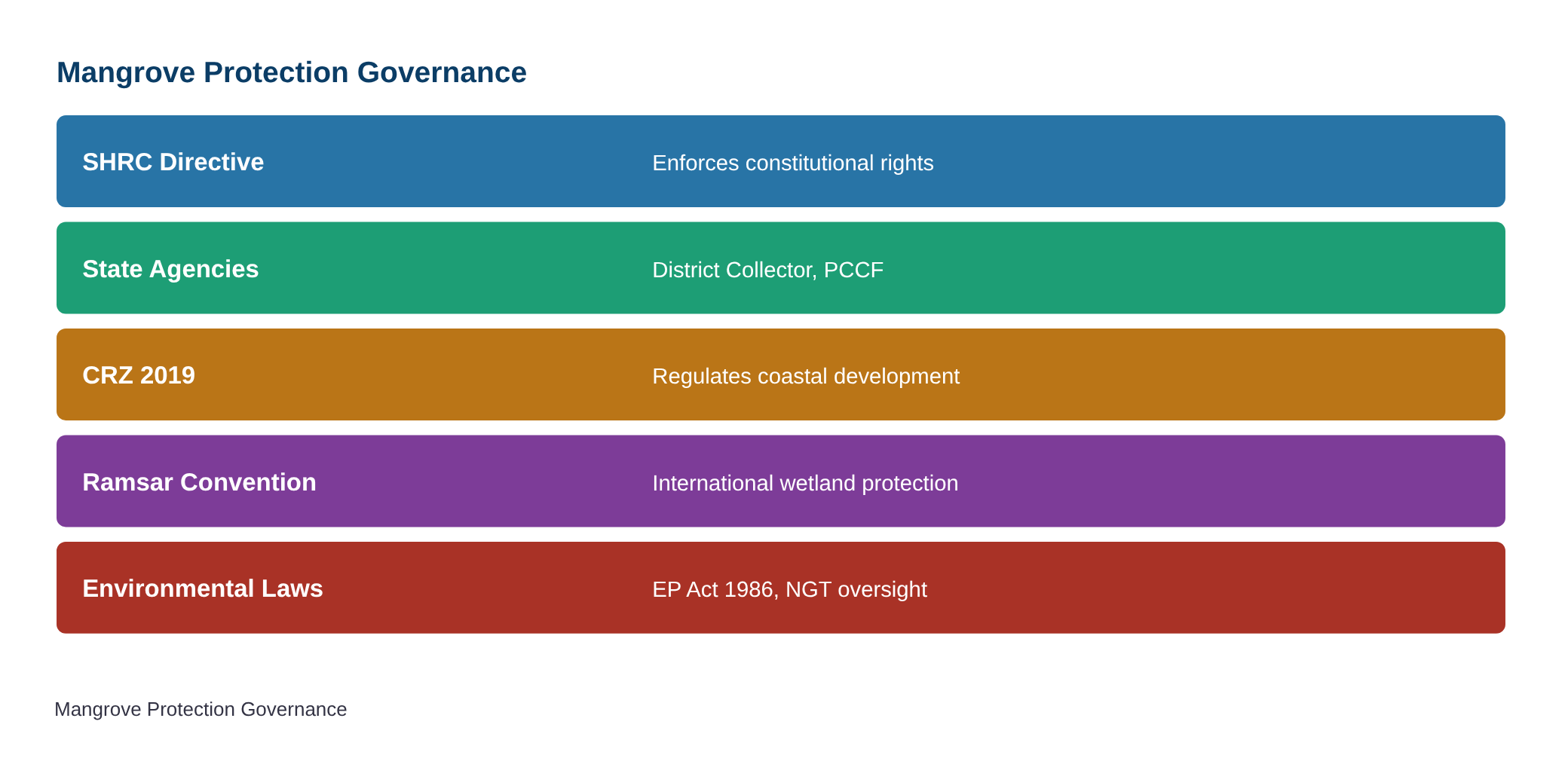
The State Human Rights Commission (SHRC) has issued a directive to the District Collector and Principal Chief Conservator of Forests in Kannur, Kerala, mandating strict enforcement of existing environmental laws to protect mangroves, wetlands, and riverbank ecosystems. The order follows a complaint highlighting unscientific dumping of construction debris and encroachments in ecologically sensitive areas, underscoring the constitutional obligation of the state to uphold citizens’ right to a healthy environment under Article 21 of the Constitution.
Background
- Mangroves and wetlands are critical ecosystems that provide essential services such as carbon sequestration, flood mitigation, groundwater recharge, and biodiversity conservation.
- Kerala, with its extensive coastline, hosts a significant proportion of India’s mangrove forests, including species like *Avicennia marina* and *Rhizophora mucronata*, which are adapted to saline conditions.
- The Coastal Regulation Zone (CRZ) Notification 2019 regulates developmental activities in coastal areas, including mangroves and wetlands, to prevent ecological degradation.
- The Ramsar Convention, to which India is a signatory, designates wetlands of international importance.
- The Environmental Protection Act 1986 empowers the central government to take measures to protect and improve the environment, while state agencies enforce local regulations.
- The National Green Tribunal (NGT) and State Human Rights Commissions play a pivotal role in adjudicating environmental disputes and ensuring compliance with environmental laws.
What are Mangroves and Wetlands, and Why Are They Protected?
- Mangroves are salt-tolerant forests found in tropical and subtropical coastal regions, acting as natural barriers against cyclones, storm surges, and coastal erosion.
- Wetlands are transitional zones between terrestrial and aquatic ecosystems, including marshes, swamps, and peatlands, which regulate water flow, purify water, and support diverse flora and fauna.
- Both ecosystems are protected under the Coastal Regulation Zone (CRZ) Notification 2019, which prohibits activities like dumping waste, land reclamation, and construction within designated zones.
- The Environmental Protection Act 1986 and the Water (Prevention and Control of Pollution) Act 1974 provide legal frameworks for their conservation, with state agencies responsible for enforcement.
- Mangroves and wetlands are biodiversity hotspots, supporting species such as the Indian python, mugger crocodile, and numerous migratory birds, including the vulnerable lesser adjutant stork.
- They play a crucial role in climate change mitigation by sequestering carbon at rates up to four times higher than tropical rainforests, thereby contributing to India’s Nationally Determined Contributions (NDCs).
- The Kerala State Biodiversity Board and the Kerala Forest Department are key stakeholders in implementing conservation measures, including afforestation and community-based monitoring.
- Judicial interventions, such as those by the National Green Tribunal (NGT) and State Human Rights Commissions, have been instrumental in addressing encroachments and enforcing environmental laws.
Key Features
| Feature | Significance |
|---|---|
| Constitutional obligation to protect environment (Article 21 read with Article 48A) | Ensures that the state must safeguard the right to a healthy environment as part of fundamental rights. |
| Strict enforcement of existing rules (Kannur district) | Prevents unscientific development activities that degrade mangroves and wetlands. |
| Coordination between Collector and Principal Chief Conservator of Forests | Ensures integrated governance for conservation and restoration of ecosystems. |
| Periodic review and monitoring mechanisms | Facilitates timely corrective actions and accountability in conservation efforts. |
| Time-bound investigation of complaints | Reduces delays in addressing illegal activities like encroachments and waste dumping. |
Why it Matters
Environmental Conservation
- Mangroves and wetlands act as natural barriers against cyclones and coastal erosion, protecting human settlements.
- They serve as carbon sinks, mitigating climate change impacts by sequestering atmospheric CO₂.
- These ecosystems support biodiversity, including endangered species, and maintain ecological balance.
- Riverbank ecosystems regulate water flow, prevent flooding, and improve water quality through natural filtration.
Legal and Governance Framework
- The directive reinforces the role of State Human Rights Commissions in environmental protection under constitutional provisions.
- It underscores the need for inter-departmental coordination to address fragmented governance in environmental management.
- Strengthens the implementation of the Wetlands (Conservation and Management) Rules, 2017, and the Coastal Regulation Zone (CRZ) Notification, 2019.
Public Health and Livelihoods
- Healthy mangroves and wetlands reduce the risk of waterborne diseases by preventing pollution of water sources.
- They support fisheries and tourism, providing livelihoods to local communities.
- Preservation of these ecosystems enhances resilience to climate-induced disasters, safeguarding lives and property.
Challenges
1. Unscientific Development Activities
- Illegal dumping of construction debris and plastic waste in wetlands and mangrove areas disrupts ecological functions.
- Encroachments for urban expansion and infrastructure projects lead to habitat loss and fragmentation.
- Lack of awareness among stakeholders exacerbates illegal activities and resistance to conservation measures.
UPSC Link: Environmental Pollution and Degradation
2. Fragmented Governance and Enforcement Gaps
- Multiple departments with overlapping jurisdictions create inefficiencies in environmental protection.
- Inadequate monitoring mechanisms result in delayed responses to violations of environmental norms.
- Weak inter-agency coordination hinders the implementation of conservation policies and restoration plans.
UPSC Link: Environmental Governance
3. Climate Change and Anthropogenic Pressures
- Rising sea levels and increased frequency of extreme weather events threaten the survival of mangroves and wetlands.
- Urbanisation and industrialisation exert pressure on limited land resources, leading to habitat degradation.
- Pollution from agricultural runoff and industrial effluents degrades water quality in these ecosystems.
UPSC Link: Climate Change and Environmental Degradation
Challenges — UPSC Perspective
| Issue | Concern |
|---|---|
| Illegal dumping of construction waste | Leads to soil and water contamination, disrupting ecological balance. |
| Encroachments for infrastructure projects | Results in loss of critical habitats and biodiversity. |
| Lack of public awareness and participation | Reduces community support for conservation initiatives. |
| Inadequate inter-departmental coordination | Causes delays in enforcement and restoration efforts. |
| Climate-induced pressures (e.g., sea-level rise) | Threatens the long-term survival of mangrove and wetland ecosystems. |
Way Forward
- Strengthen inter-departmental coordination by establishing a dedicated task force for mangrove and wetland conservation in Kannur.
- Conduct regular audits and monitoring of conservation measures to ensure compliance with environmental norms.
- Launch awareness campaigns to educate local communities, industries, and developers on the ecological and economic importance of mangroves and wetlands.
- Enforce strict penalties for illegal dumping and encroachments, including fines, restoration orders, and criminal prosecution where necessary.
- Invest in research and technology to assess the health of mangroves and wetlands and identify restoration priorities.
- Integrate climate change adaptation strategies into wetland management plans to enhance resilience against environmental stressors.
- Encourage community-based conservation initiatives by involving local stakeholders in monitoring and protection efforts.
UPSC Value Addition
Keywords for Mains Answer-Writing
State Human Rights Commission (SHRC) · mangrove ecosystems · wetland conservation · environmental governance · constitutional obligation to environment · Kannur district · illegal dumping of construction waste · riverbank ecosystems · Right to healthy environment · inter-departmental coordination · environmental monitoring · constitutional provisions on environment · environmental jurisprudence · ecosystem restoration · environmental justice · sustainable development
Constitutional & Policy Linkages
- Article 21 (Right to Life and Personal Liberty) — Right to a healthy environment.
- Article 48A (Directive Principles of State Policy) — Protection and improvement of environment and safeguarding of forests and wildlife.
Concept Flow
Unscientific development activities (e.g., illegal dumping) degrade mangroves and wetlands. → Degradation of ecosystems leads to loss of ecological functions (e.g., flood control, biodiversity support). → Loss of ecological functions threatens public health, livelihoods, and climate resilience. → State Human Rights Commission intervenes to enforce constitutional obligations under Article 21 and Article 48A. → Directive to enforce existing rules and coordinate governance to restore and protect ecosystems. → Implementation of conservation measures through inter-departmental coordination and community participation. → Long-term outcomes: sustainable ecosystems, enhanced climate resilience, and safeguarded fundamental rights.
Prelims Practice Questions
Q1. Consider the following statements regarding the State Human Rights Commission (SHRC) in India:
1. The SHRC is a constitutional body established under Article 218 of the Constitution of India.
2. The SHRC can investigate complaints related to violations of human rights, including environmental degradation.
3. The SHRC has the power to issue binding orders for the enforcement of its recommendations.
4. The SHRC is empowered to take suo motu cognizance of human rights violations.
How many of the above statements are correct?
- Only one
- Only two
- Only three
- All
Answer: Only three — Statements 2 and 4 are correct. The SHRC is not a constitutional body (it is statutory under State Human Rights Commission Act, 1993). Statement 3 is incorrect as SHRC recommendations are not binding. Statement 1 is factually wrong as Article 218 pertains to the Supreme Court.
Q2. Assertion (A): Mangroves act as natural barriers against coastal erosion and storm surges.
Reason (R): Mangrove roots stabilize sediments and reduce wave energy, thereby protecting shorelines.
Options:
A. Both A and R are true, and R is the correct explanation of A.
B. Both A and R are true, but R is NOT the correct explanation of A.
C. A is true, but R is false.
D. A is false, but R is true.
Answer: ? — Both Assertion (A) and Reason (R) are true, and Reason (R) correctly explains Assertion (A). Mangroves provide ecosystem services such as coastal protection, carbon sequestration, and biodiversity support.
Q3. Match the following environmental legislations with their respective primary objectives:
Column I (Legislation)
1. Environment Protection Act, 1986
2. Water (Prevention and Control of Pollution) Act, 1974
3. Forest (Conservation) Act, 1980
4. Wetlands (Conservation and Management) Rules, 2017
Column II (Primary Objective)
A. Regulation of water pollution and maintenance of water quality
B. Conservation and management of wetlands in India
C. Comprehensive framework for environmental protection and pollution control
D. Regulation of diversion of forest lands for non-forest purposes
Select the correct match:
- 1-C, 2-A, 3-D, 4-B
- 1-A, 2-C, 3-B, 4-D
- 1-D, 2-B, 3-A, 4-C
- 1-B, 2-D, 3-C, 4-A
Answer: 1-C, 2-A, 3-D, 4-B — Correct matches are: 1-C (Environment Protection Act, 1986), 2-A (Water Act, 1974), 3-D (Forest Conservation Act, 1980), 4-B (Wetlands Rules, 2017).
Mains Practice Question
✍ The State Human Rights Commission (SHRC) has directed the district administration of Kannur to enforce existing environmental laws strictly to protect mangroves, wetlands, and riverbank ecosystems. In this context, critically examine the constitutional and legal framework for environmental protection in India. Also, assess the role of statutory bodies like the SHRC in ensuring environmental justice. (15 Marks)
Approach: MODEL-ANSWER SKELETON:
1. Constitutional Framework:
– Article 21 (Right to Life and Personal Liberty) interpreted to include the right to a healthy environment (Subhash Kumar v. State of Bihar, 1991).
– Article 48A (Directive Principle of State Policy) and Article 51A(g) (Fundamental Duty) emphasize environmental protection.
– Article 253 empowers Parliament to legislate on matters of international concern, including environmental protection.
2. Legislative Framework:
– Environment Protection Act, 1986: Framework for environmental protection and pollution control.
– Water (Prevention and Control of Pollution) Act, 1974: Regulation of water pollution.
– Forest (Conservation) Act, 1980: Regulation of forest land diversion.
– Wetlands (Conservation and Management) Rules, 2017: Specific rules for wetland protection.
– Coastal Regulation Zone (CRZ) Notification, 2019: Regulation of activities in coastal zones.
3. Role of Statutory Bodies:
– State Human Rights Commission (SHRC): Investigates complaints, recommends actions, and can issue directives for environmental justice.
– National Green Tribunal (NGT): Adjudicates environmental disputes and ensures compliance with environmental laws.
– State Pollution Control Boards (SPCBs): Monitor and enforce environmental regulations at the state level.
4. Challenges and Gaps:
– Fragmented enforcement due to overlapping jurisdictions.
– Lack of coordination among departments (e.g., Collector, Forest Department, Pollution Control Board).
– Delayed implementation of environmental laws and weak monitoring mechanisms.
– Encroachments and illegal activities continue due to weak deterrence.
5. Role of SHRC in Environmental Justice:
– SHRC can take suo motu cognizance of environmental violations.
– Directs authorities to enforce environmental laws and restore ecosystems.
– Provides a platform for citizens to seek redressal for environmental grievances.
– However, SHRC recommendations are not legally binding, limiting their effectiveness.
6. Way Forward:
– Strengthen inter-departmental coordination for effective enforcement.
– Empower SHRC with binding powers to ensure compliance.
– Enhance public awareness and participation in environmental conservation.
– Strengthen monitoring and periodic review mechanisms to prevent illegal activities.
Source: The Hindu
Generated by AanyaAi for educational purpose.

- केरल में एंटीमाइक्रोबियल रेजिस्टेंस: सरकारी रिपोर्ट में चौंकाने वाले आँकड़े सामने - September 23, 2026
- Kerala’s AMR Crisis: Rising Drug Resistance Threatens Public Health in 2025 - September 23, 2026
- सुप्रीम कोर्ट ने दवाओं की ऊंची कीमतों को ‘लूट’ बताया, सरकार से पूछा- क्या है कानून? - September 23, 2026

No Comments