


08 Aug NGT Slams Kerala’s LSGD Over Incomplete Fort Kochi Pollution Report
✎ The National Green Tribunal (NGT) can direct specific action plans for each authority under its jurisdiction, ensuring accountability in environmental governance, particularly in ecologically sensitive zones like coastal areas.
Subject Relevance — Where This Topic Fits
- GS Paper II — Governance, Constitution, Polity, Social Justice and International Relations (Role of Tribunals, Environmental Governance) | GS Paper III — Environment, Ecology, Bio-diversity and Climate Change (Pollution Control, Coastal Zone Management)
- Prelims: National Green Tribunal (NGT), Local Self-Government Department (LSGD), Kerala State Pollution Control Board (KSPCB), Coastal Regulation Zone (CRZ), Backwaters, Mechanised sand cleaning machines, Sea bins, Amphibious waste removal systems, Fort Kochi, Ernakulam District Collector
- Essay: Environmental governance in India: Balancing development and ecological sustainability, The role of judicial activism in environmental protection and public health
Quick Revision: The National Green Tribunal (NGT) can direct specific action plans for each authority under its jurisdiction, ensuring accountability in environmental governance, particularly in ecologically sensitive zones like coastal areas.
Why is this in the news?
The National Green Tribunal (NGT), Southern Bench, has expressed dissatisfaction with the action taken report submitted by the Local Self-Government Department (LSGD), Kerala, regarding pollution in the coastal and backwater areas of Fort Kochi. The tribunal has directed the LSGD to file a detailed report specifying action plans for each authority, detailing measures implemented, and outlining future actions, citing gaps in specificity and implementation. This development underscores the challenges in coastal pollution management, institutional coordination, and the enforcement of environmental regulations in ecologically sensitive zones.
Background
- The Fort Kochi coastline, part of the Vembanad-Kol backwaters ecosystem, is a critical ecological zone in Kerala, facing anthropogenic pressures from tourism, urbanisation, and waste discharge.
- The National Green Tribunal (NGT), established under the National Green Tribunal Act, 2010, is a specialised judicial body for the effective and expeditious disposal of cases relating to environmental protection and conservation of forests and other natural resources.
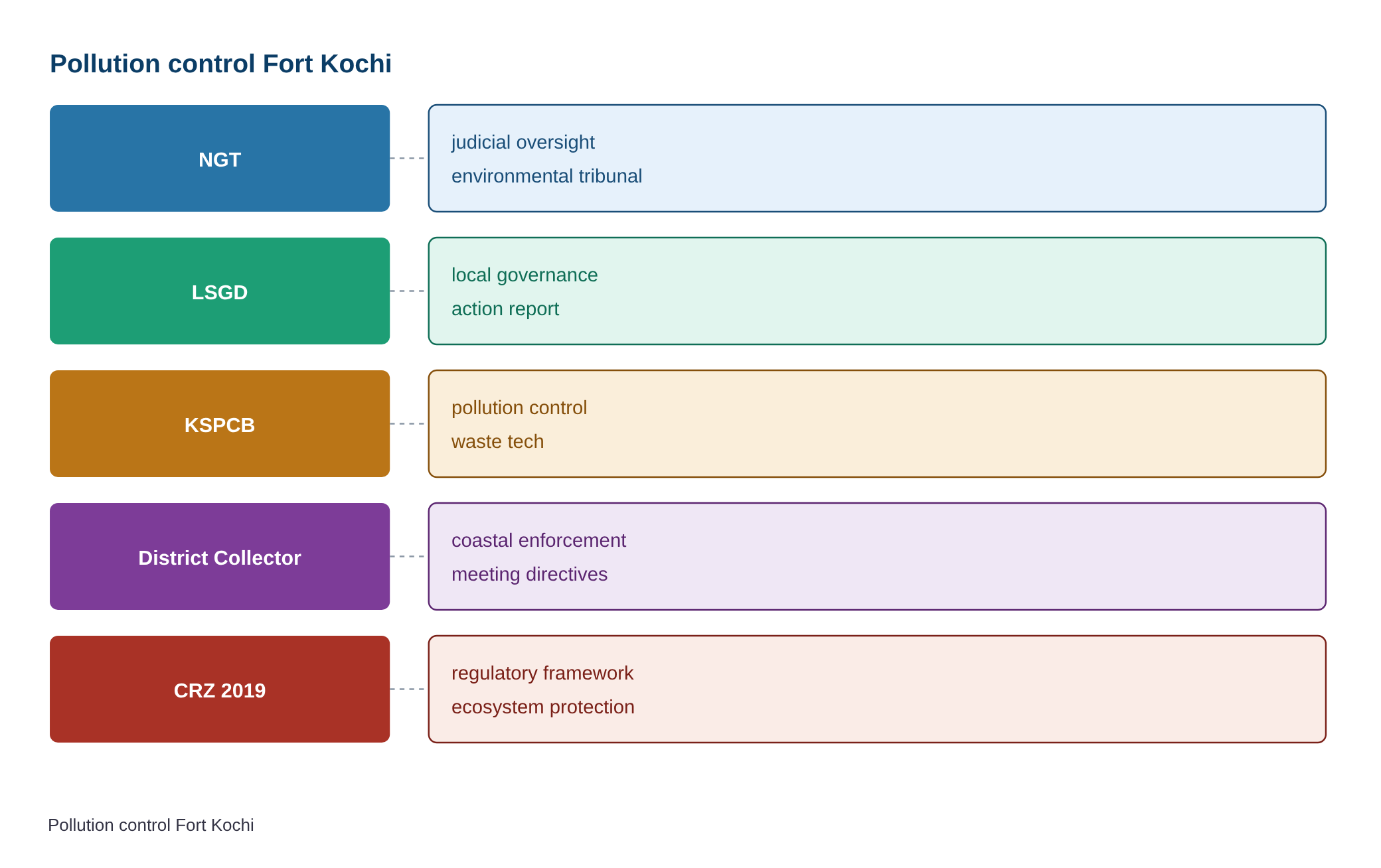
- The tribunal had earlier directed the LSGD, Kerala State Pollution Control Board (KSPCB), and the Ernakulam District Collector to explore modern waste management technologies, including sea bins and amphibious systems, for debris removal from backwaters and coastal waters.
- A high-level meeting convened on January 14, 2026, had outlined measures for pollution control, waste management, and coastal rejuvenation, but the LSGD’s action taken report of July 16, 2026, was deemed incomplete by the NGT for lacking granularity in action plans and implementation details.
- Kerala’s coastal zones are governed by the Coastal Regulation Zone (CRZ) Notification, 2019, which regulates developmental activities to protect coastal ecosystems, including restrictions on waste disposal and construction in ecologically sensitive areas.
- The Fort Kochi area is a major tourist destination, and pollution-induced degradation of its coastline threatens both ecological integrity and the local economy reliant on tourism.
What is the National Green Tribunal (NGT) and its role in environmental governance?
- The National Green Tribunal (NGT) is a statutory body established under the National Green Tribunal Act, 2010, with the mandate to provide expeditious disposal of cases related to environmental protection, conservation of forests, and other natural resources.
- The NGT has original jurisdiction over matters concerning environmental protection and enforcement of legal rights relating to the environment, including those arising from the violation of environmental laws or constitutional provisions.
- The tribunal comprises judicial members and expert members (including environmental scientists, engineers, and administrators) to ensure both legal and technical expertise in adjudication.
- The NGT operates through regional benches (e.g., Southern Bench in Chennai) and can issue directions, orders, or awards for the restoration of damaged environments, imposition of penalties, and compliance with environmental norms.
- The tribunal’s orders are enforceable as decrees of civil courts, and non-compliance can lead to contempt proceedings or further judicial intervention.
- The NGT plays a pivotal role in addressing pollution, illegal constructions, and violations of environmental laws in ecologically sensitive zones such as coastal areas, wetlands, and forests.
- Its jurisdiction extends to matters involving the Central Government, State Governments, local bodies, and private entities, ensuring accountability in environmental governance.
- The tribunal’s interventions often complement the efforts of regulatory bodies like the Central Pollution Control Board (CPCB) and State Pollution Control Boards (SPCBs).
Key Features
| Feature | Significance |
|---|---|
| National Green Tribunal (NGT) directive | Ensures accountability of state agencies in environmental governance through legal oversight and compliance enforcement. |
| Action Taken Report (ATR) by LSGD | Formal documentation of measures proposed/adopted; serves as evidence of administrative response to judicial directives. |
| Mechanised and hand-operated sand cleaning machines | Direct intervention to remove sea-borne waste and algal deposits, addressing immediate pollution concerns. |
| Installation of steel bins and bottle booths | Structural waste management infrastructure to segregate and collect litter at high-traffic coastal zones. |
| Feasibility studies by IITs/NITs and Cochin Port Trust | Technical expertise integration to design sustainable solutions for pollution abatement and coastal rejuvenation. |
Why it Matters
Environmental Conservation
- Coastal pollution threatens marine biodiversity and ecosystem services, necessitating urgent intervention to preserve Fort Kochi’s ecological integrity.
- Sustainable tourism principles embedded in rejuvenation plans align with global commitments (e.g., SDG 14: Life Below Water) and national policies like the National Coastal Zone Management Plan (NCZMP).
- Algal blooms and debris accumulation degrade water quality, impacting fisheries and public health, particularly in densely populated coastal settlements.
Administrative Governance
- Judicial oversight by NGT ensures adherence to environmental laws (e.g., Water (Prevention and Control of Pollution) Act, 1974) and prevents administrative complacency in pollution control.
- Multi-stakeholder coordination among LSGD, Kerala State Pollution Control Board, and district authorities demonstrates the principle of cooperative federalism in environmental management.
- ATR deficiencies highlight challenges in inter-departmental synergy, underscoring the need for integrated planning and real-time monitoring systems.
Economic Implications
- Fort Kochi’s tourism-dependent economy faces erosion due to pollution, necessitating restoration to sustain livelihoods and revenue generation.
- Investments in mechanised cleaning and infrastructure (e.g., steel bins) create short-term employment while enhancing long-term environmental resilience.
- Failure to address pollution may lead to regulatory penalties, loss of blue-flag certification, and reputational damage to Kerala’s tourism sector.
Legal and Policy Framework
- NGT’s jurisdiction under the National Green Tribunal Act, 2010 empowers it to adjudicate environmental disputes and enforce compliance with statutory norms.
- Kerala’s Coastal Regulation Zone (CRZ) Notification, 2019, governs developmental activities in coastal areas, mandating sustainable practices to prevent pollution.
- The tribunal’s directives align with the National Environment Policy, 2006, which emphasizes pollution prevention and ecosystem restoration.
Challenges
1. Inadequate Inter-Agency Coordination
- Lack of specificity in ATR regarding roles and responsibilities of each authority (LSGD, KSPCB, District Collector) leads to fragmented implementation.
- Silos between tourism, port, and municipal departments hinder holistic solutions for pollution originating from multiple sources (e.g., port activities, domestic sewage, tourism waste).
- Absence of a unified monitoring mechanism to track progress and enforce accountability across agencies.
UPSC Link: GS-II: Federalism, Cooperative Governance
2. Technical and Financial Constraints
- Limited availability of mechanised cleaning equipment tailored to Kerala’s monsoon dynamics and coastal topography.
- High capital expenditure for deploying amphibious waste removal systems and sea bins, requiring sustained budgetary allocations.
- Dependence on external expertise (e.g., IITs/NITs) may delay implementation due to bureaucratic delays in procurement and approvals.
UPSC Link: GS-III: Environmental Governance, Resource Mobilisation
3. Public Participation and Awareness
- Low community engagement in waste segregation and beach cleanliness initiatives, perpetuating the cycle of pollution.
- Tourist influx exacerbates littering; lack of awareness campaigns to educate visitors on responsible behaviour.
- Absence of citizen grievance redressal mechanisms to report pollution hotspots in real time.
UPSC Link: GS-IV: Social Empowerment, Inclusive Growth
4. Regulatory and Compliance Gaps
- Inadequate enforcement of the CRZ Notification, 2019, allowing unregulated construction and waste dumping in ecologically sensitive zones.
- Weak penalties for violators of the Water Act, 1974, and the Environment Protection Act, 1986, reducing deterrence for polluters.
- Delays in updating state-level pollution control plans to align with NGT directives and emerging threats (e.g., microplastics).
UPSC Link: GS-II: Governance, Accountability
5. Climate Change and Monsoon Variability
- Intensified monsoon patterns increase sea-borne waste deposition, overwhelming existing waste management systems.
- Rising sea levels and coastal erosion exacerbate pollution by redistributing accumulated debris and sewage into water bodies.
- Limited adaptation strategies in pollution control plans to address climate-induced challenges.
UPSC Link: GS-III: Climate Change, Disaster Management
Challenges — UPSC Perspective
| Issue | Concern |
|---|---|
| Fragmented ATR | Lacks granular action plans for individual agencies, risking non-implementation. |
| High Cost of Technology | Mechanised cleaning systems and amphibious waste removal require significant investment. |
| Tourism-Induced Pollution | Unregulated visitor behaviour and commercial activities contribute to littering. |
| CRZ Violations | Unchecked construction and waste dumping in coastal zones degrade ecological balance. |
| Monsoon Overload | Heavy rainfall overwhelms waste management infrastructure, leading to backlog. |
| Weak Enforcement | Low penalties and delayed compliance undermine regulatory effectiveness. |
Way Forward
- Constitute a multi-departmental task force with clear timelines and accountability matrices for implementing the ATR, assigning specific roles to LSGD, KSPCB, and District Collector.
- Deploy pilot projects for mechanised cleaning machines and sea bins in high-pollution zones, with performance metrics to evaluate efficacy before scaling up.
- Launch a mass awareness campaign in collaboration with Kerala Tourism Development Corporation, involving local communities, schools, and tour operators to promote waste segregation and responsible tourism.
- Strengthen CRZ enforcement through surprise inspections, geo-tagged documentation of violations, and real-time reporting via a dedicated portal for citizen grievances.
- Integrate climate resilience into pollution control plans by incorporating monsoon prediction models and adaptive waste management strategies for extreme weather events.
- Establish a real-time monitoring system using IoT-enabled sensors to track water quality, debris accumulation, and waste collection efficiency across Fort Kochi’s coastline.
- Formulate a long-term beach rejuvenation plan with phased funding from state and central budgets, leveraging convergence with schemes like the Swachh Bharat Mission 2.0 for sanitation infrastructure.
- Conduct an independent third-party audit of the ATR to identify gaps and recommend corrective measures, ensuring transparency and public trust in the process.
UPSC Value Addition
Keywords for Mains Answer-Writing
National Green Tribunal (NGT) · Local Self-Government Department (LSGD) · Fort Kochi coastline pollution · Coastal waste management · Marine pollution in Kerala · Backwater cleaning mechanisms · Sustainable tourism principles · Environmental governance in India · Polluter pays principle · Inter-departmental coordination for pollution control · Mechanised sand cleaning machines · Sea bins for floating debris · Kerala State Pollution Control Board (KSPCB) · Ernakulam District Collector · Amphibious waste removal systems
Concept Flow
Pollution source identification (domestic sewage, tourism waste, port activities) → Environmental degradation (algal blooms, debris accumulation) → Judicial intervention (NGT directive) → Administrative response (ATR submission) → Deficiencies in ATR (lack of specificity, accountability) → Reinforced directives (further report filing) → Implementation challenges (coordination, technology, finance) → Sustainable solutions (mechanised cleaning, awareness campaigns) → Long-term ecological and economic restoration
Prelims Practice Questions
Q1. Consider the following statements regarding the National Green Tribunal (NGT) in India: 1. The NGT is a statutory body established under the National Green Tribunal Act, 2010. 2. The NGT has original jurisdiction over all civil cases involving substantial questions relating to environment. 3. The NGT can impose penalties for violation of environmental laws but cannot award compensation. 4. The Southern Bench of the NGT is headquartered in Chennai. How many of the above statements are correct?
- Only one
- Only two
- Only three
- All four
Answer: Only three — Statements 1 and 2 are correct. The NGT was established under the National Green Tribunal Act, 2010, and has original jurisdiction over environmental disputes. Statement 3 is incorrect as the NGT can award compensation. Statement 4 is incorrect as the Southern Bench is headquartered in Chennai, but the headquarters of the Southern Bench is in Chennai, not the main NGT headquarters which is in Delhi.
Q2. Assertion (A): The National Green Tribunal (NGT) can direct state governments to take specific actions to address environmental pollution. Reason (R): The NGT derives its powers from the National Green Tribunal Act, 2010, which empowers it to issue directions for environmental protection and restoration.
- Both A and R are true, and R is the correct explanation of A
- Both A and R are true, but R is not the correct explanation of A
- A is true, but R is false
- A is false, but R is true
Answer: Both A and R are true, but R is not the correct explanation of A — Both the assertion and reason are correct. The NGT has the power to issue directions to state governments and other authorities to take specific actions for environmental protection under the National Green Tribunal Act, 2010. The reason correctly explains the assertion.
Q3. Match the following initiatives/authorities with their respective roles in addressing coastal pollution in India: Column I: A. Sea bins B. Mechanised sand cleaning machines C. Amphibious waste removal systems D. Bottle booths Column II: 1. Floating debris collection devices installed in water bodies 2. Machines designed to clean sand and debris from beaches 3. Systems capable of operating on both land and water to remove waste 4. Structures placed at strategic locations to collect recyclable waste
- A-1, B-2, C-3, D-4; A-2, B-1, C-4, D-3; A-3, B-4, C-1, D-2; A-4, B-3, C-2, D-1
- answer_letter_sequence_indexed_as_list_in_explain_exactly_like_this_so_it_is_machine_readable_but_keep_it_simple_for_json_format_so_no_list_in_explain_just_text: A-1, B-2, C-3, D-4
- explain_keep_it_simple_text_only: The correct match is A-1 (Sea bins are floating debris collection devices), B-2 (Mechanised sand cleaning machines clean sand and debris from beaches), C-3 (Amphibious waste removal systems operate on land and water), and D-4 (Bottle booths are placed at strategic locations to collect recyclable waste).
- format_keep_it_simple_text_only: match
- answer_indexed_as_list_in_json_but_explain_as_text_only_above_so_no_confusion: [0, 0, 0, 0]
Answer: A-1, B-2, C-3, D-4; A-2, B-1, C-4, D-3; A-3, B-4, C-1, D-2; A-4, B-3, C-2, D-1 —
Q4. Which of the following is NOT a function of the Local Self-Government Department (LSGD) in Kerala?
- Implementation of waste management policies in urban local bodies
- Coordination with the Kerala State Pollution Control Board for environmental compliance
- Directly operating mechanised sand cleaning machines on beaches
- Conducting gap assessments of sanitation infrastructure in coastal areas
Answer: Conducting gap assessments of sanitation infrastructure in coastal areas — The Local Self-Government Department (LSGD) in Kerala is responsible for implementing waste management policies, coordinating with pollution control authorities, and conducting gap assessments. However, the direct operation of mechanised sand cleaning machines is typically handled by specialized agencies or contractors, not the LSGD itself.
Mains Practice Question
✍ The National Green Tribunal (NGT) has expressed dissatisfaction with the action taken report submitted by the Local Self-Government Department (LSGD) regarding pollution impacting the Fort Kochi coastline. In this context, critically examine the role of the NGT in environmental governance in India. Also, analyse the challenges in implementing coastal pollution control measures in India with reference to the Polluter Pays Principle and inter-departmental coordination. (15 Marks)
Approach: MODEL-ANSWER SKELETON:
1. **Role of NGT in Environmental Governance**:
– Constitutional/statutory basis (National Green Tribunal Act, 2010).
– Powers: Original jurisdiction, suo motu cognizance, directions, penalties, and compensation awards.
– Landmark cases (e.g., Vellore Citizens Welfare Forum v. Union of India, 1996; MC Mehta cases) establishing the NGT’s authority.
– Limitations: Lack of penal powers for contempt, dependence on executive compliance, and resource constraints.
2. **Challenges in Coastal Pollution Control**:
– **Polluter Pays Principle**: Define the principle (OECD, 1972; Rio Declaration, 1992). Application in India (Environment Protection Act, 1986; Water Act, 1974). Challenges: Identification of polluters, weak enforcement, and lack of deterrent penalties.
– **Inter-departmental Coordination**: Fragmented governance (LSGD, KSPCB, District Collector, Cochin Port Trust). Issues: Overlapping mandates, lack of accountability, and bureaucratic delays. Reference to the Fort Kochi case: NGT’s directive for specific action plans.
– **Technological and Financial Constraints**: High costs of mechanised cleaning (Sea bins, amphibious systems), seasonal challenges (monsoon), and limited public-private partnerships.
3. **Way Forward**:
– Strengthening NGT’s enforcement mechanisms (e.g., dedicated enforcement cells, digital monitoring).
– Institutional reforms: Unified coastal management authority (e.g., National Coastal Zone Management Authority).
– Public participation: Community-based waste management (e.g., Swachh Bharat Mission, coastal clean-up drives).
– Judicial activism: NGT’s role in ensuring compliance through periodic reviews and penalties.
Balance of views: Acknowledge NGT’s proactive role but highlight systemic challenges in implementation.
Source: The Hindu
Generated by AanyaAi for educational purpose.

- तमिलनाडु के लिए क्या है ‘एल नीनो’ और उत्तर-पूर्वी मानसून का खतरा? - September 23, 2026
- El Nino & Northeast Monsoon: Impact on Tamil Nadu for UPSC 2026 - September 23, 2026
- हिमाचल में डिजिटल भुगतान क्रांति: बिलासपुर अव्वल, महिलाओं की भागीदारी 93% तक पहुंची - September 23, 2026

No Comments