


08 Aug Defence Ministry’s Move to Join 6th-Gen Fighter Programme: Key for UPSC 2026
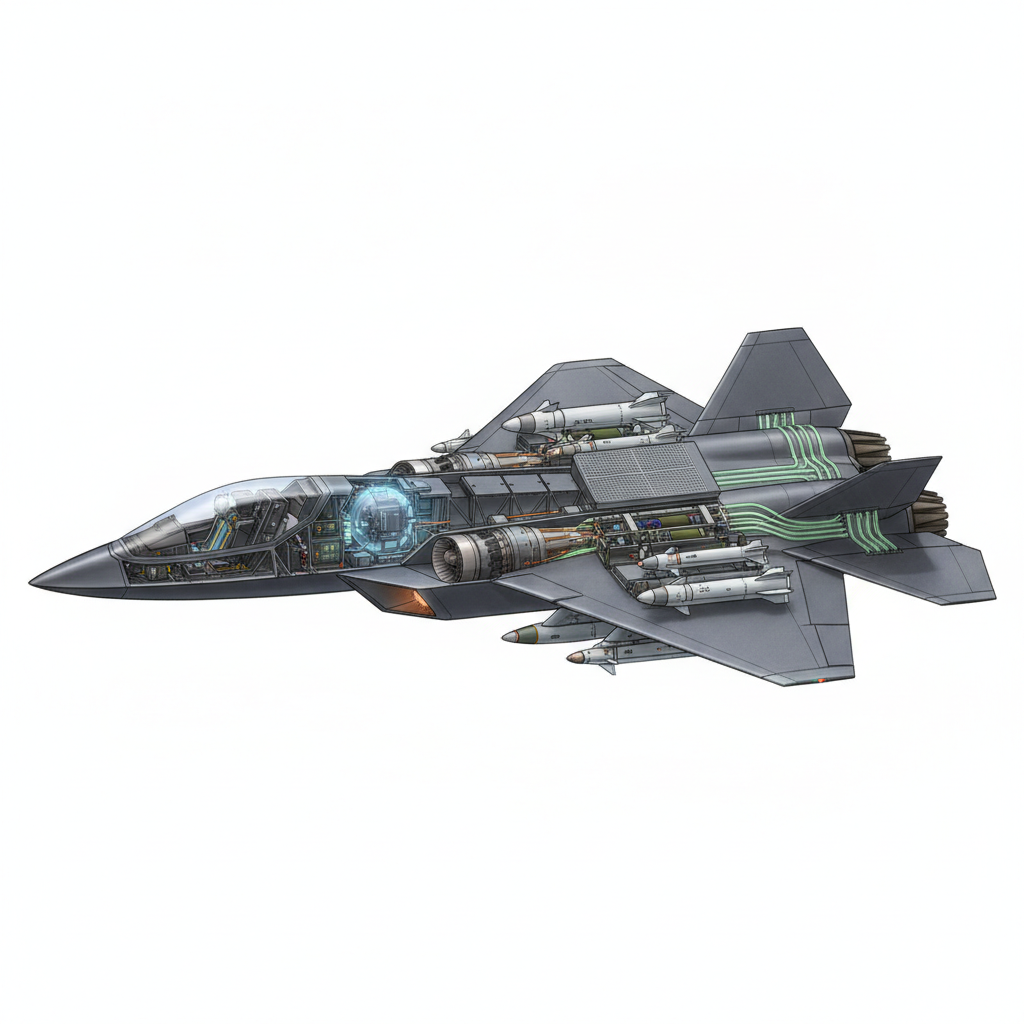
✎ Sixth-generation fighter aircraft programmes like FCAS and GCAP represent a fusion of AI, directed energy weapons, and network-centric warfare, necessitating India’s proactive engagement to bridge the capability gap in air…
Subject Relevance — Where This Topic Fits
- GS Paper II — International Relations (Defence Cooperation, Strategic Alliances) | GS Paper III — Science and Technology (Defence Technology, Indigenous Development)
- Prelims: Sixth-Generation Fighter Aircraft, Future Combat Air System (FCAS), Advanced Medium Combat Aircraft (AMCA), Defence Acquisition Council (DAC), Strategic Partnership Model, Make in India in Defence, Indigenous Defence Production, Aeronautical Development Agency (ADA), Defence Research and Development Organisation (DRDO), Strategic Partnership Policy
- Essay: India’s Defence Modernisation: Balancing Strategic Autonomy and Global Partnerships, The Role of Technology in National Security: Challenges and Opportunities for India
Quick Revision: Sixth-generation fighter aircraft programmes like FCAS and GCAP represent a fusion of AI, directed energy weapons, and network-centric warfare, necessitating India’s proactive engagement to bridge the capability gap in air dominance.
Why is this in the news?
The Ministry of Defence has informed a Parliamentary panel that it has initiated efforts to formally join the sixth-generation fighter aircraft development programme, specifically the Future Combat Air System (FCAS) led by France. This development assumes significance against the backdrop of India’s ongoing indigenous Advanced Medium Combat Aircraft (AMCA) programme and the need to enhance the Indian Air Force’s (IAF) combat capabilities in an era of rapidly evolving aerial warfare technology. The parliamentary committee has recommended expediting planning for the acquisition of such advanced platforms to ensure India does not lag behind global peers in air domain superiority.
Background
- The development of sixth-generation fighter aircraft represents a paradigm shift in aerial warfare, integrating artificial intelligence, directed energy weapons, advanced stealth, hypersonic speed, and network-centric warfare capabilities.
- India’s indigenous Advanced Medium Combat Aircraft (AMCA) programme, being developed by the Aeronautical Development Agency (ADA) under DRDO, is designed as a fifth-generation-plus platform with stealth and supercruise capabilities, intended to bridge the gap until sixth-generation technologies mature.
- The IAF’s requirement for advanced fighter aircraft is underscored by its ageing fleet, the phasing out of older platforms, and the need to counter emerging threats from peer adversaries equipped with next-generation capabilities.
- India’s defence procurement strategy has increasingly emphasised strategic partnerships with foreign OEMs (Original Equipment Manufacturers) while simultaneously fostering indigenous defence manufacturing under the ‘Make in India’ initiative.
- The Defence Acquisition Council (DAC) and the Strategic Partnership Policy (SPP) framework provide the institutional mechanism for such collaborations, enabling technology transfer and co-development.
What is the Future Combat Air System (FCAS) and Sixth-Generation Fighter Aircraft?
- Sixth-generation fighter aircraft are conceptualised as multi-role platforms integrating next-generation technologies such as artificial intelligence-driven autonomous systems, directed energy weapons (e.g., laser and microwave systems), advanced stealth with reduced radar cross-section, hypersonic speed (Mach 5+), and network-centric warfare capabilities with seamless integration into a broader combat ecosystem.
- The Global Combat Air Programme (GCAP), led by the UK, Italy, and Japan, is another major sixth-generation initiative, with Japan’s Mitsubishi Heavy Industries and Italy’s Leonardo as key partners, targeting operational deployment by 2035.
- These programmes are not merely aircraft development efforts but represent holistic combat systems, including unmanned loyal wingmen, swarming drones, and integrated command-and-control architectures.
- The FCAS programme is structured around a ‘system of systems’ approach, where the manned sixth-generation fighter (Next Generation Fighter, or NGF) operates as the central node, supported by unmanned platforms, sensors, and AI-driven decision support systems.
- India’s potential participation in FCAS would align with its broader strategy of leveraging international partnerships to accelerate defence modernisation while maintaining strategic autonomy.
- The FCAS programme also includes a ‘Remote Carrier’ concept, where unmanned platforms act as force multipliers, extending the reach and lethality of the manned fighter.
- The technological leap from fifth-generation to sixth-generation platforms involves not just platform capabilities but also the integration of quantum computing, advanced materials (e.g., metamaterials for stealth), and cyber-resilient architectures.
Key Features
| Feature | Significance |
|---|---|
| Future Combat Air System (FCAS) | A sixth-generation fighter programme led by France and Germany, representing cutting-edge aerospace technology with potential for India’s strategic autonomy in combat aviation. |
| Advanced Medium Combat Aircraft (AMCA) | India’s indigenous fifth-generation fighter programme, serving as a stepping stone for future sixth-generation capabilities and reducing reliance on foreign platforms. |
| Multi-national consortia (UK-Italy-Japan & France-Germany) | Global collaborations pooling technological expertise, financial resources, and industrial capacity to develop next-generation fighter aircraft. |
| Parliamentary Standing Committee on Defence | Constitutional body providing oversight, recommendations, and strategic direction for defence acquisitions and indigenous development programmes. |
| Indigenous development trajectory | A phased approach prioritising domestic design, development, and manufacturing to enhance long-term defence self-sufficiency and technological sovereignty. |
Why it Matters
Strategic Autonomy
- Reduces dependence on foreign defence imports by fostering indigenous and collaborative sixth-generation fighter development.
- Enhances India’s geopolitical leverage through participation in advanced aerospace programmes with leading defence partners.
- Strengthens deterrence capabilities by ensuring access to state-of-the-art combat aircraft technology.
Technological Advancement
- Accelerates India’s transition to sixth-generation fighter aircraft, aligning with global military aviation trends.
- Leverages multi-national expertise to bridge technological gaps in indigenous programmes like AMCA.
- Promotes research and development in aerospace, avionics, and stealth technologies.
Operational Preparedness
- Ensures the Indian Air Force maintains qualitative superiority in air-centric warfare scenarios.
- Facilitates timely induction of advanced platforms to counter evolving threats in the Indo-Pacific and beyond.
- Supports the modernisation of the IAF’s fleet with platforms capable of network-centric operations.
Economic Implications
- Stimulates domestic defence manufacturing and ancillary industries through collaborative and indigenous programmes.
- Creates high-skilled employment opportunities in aerospace engineering, R&D, and defence production.
- Potential for technology transfer and offset agreements to boost India’s defence export capabilities.
Challenges
1. Technological Gap
- India currently lacks the indigenous capability to develop a sixth-generation fighter entirely on its own.
- Dependence on foreign technology transfers and collaborations may introduce delays or restrictions.
- Integration of advanced systems (AI, directed energy weapons, hypersonic propulsion) poses significant R&D challenges.
UPSC Link: Science & Tech – Defence Tech Indigenisation
2. Financial Constraints
- High development and acquisition costs for sixth-generation platforms may strain defence budgets.
- Competition for funding between indigenous programmes (AMCA) and collaborative projects (FCAS).
- Need for sustained investment in R&D infrastructure and human capital.
UPSC Link: Economy – Defence Expenditure & Fiscal Policy
3. Geopolitical Risks
- Potential for technology denial or conditional access in collaborative programmes with foreign partners.
- Alignment with specific consortia may limit strategic flexibility or entangle India in regional tensions.
- Balancing partnerships with multiple defence suppliers to avoid over-dependence on a single bloc.
UPSC Link: International Relations – Defence Diplomacy
4. Industrial Base Limitations
- India’s defence manufacturing ecosystem requires significant scaling to support sixth-generation aircraft production.
- Shortages in critical components, materials, and skilled labour may hinder indigenous development.
- Need for public-private partnerships and foreign direct investment in aerospace manufacturing.
UPSC Link: Economy – Make in India & Defence Production
5. Operational Integration
- Ensuring seamless integration of sixth-generation platforms with existing IAF assets and command structures.
- Developing doctrines, training, and maintenance frameworks for advanced aircraft.
- Addressing cybersecurity and electronic warfare vulnerabilities in networked combat systems.
UPSC Link: Defence – Jointness & Theatre Commands
Challenges — UPSC Perspective
| Issue | Concern |
|---|---|
| Technology Transfer | Risk of incomplete or conditional transfer of critical technologies from foreign partners. |
| Cost Escalation | Potential for budget overruns due to prolonged R&D cycles and inflation in defence procurement. |
| Supply Chain Vulnerabilities | Dependence on foreign suppliers for critical materials and components. |
| Skill Shortages | Insufficient domestic talent pool for advanced aerospace engineering and avionics. |
| Regulatory Hurdles | Complexities in defence procurement policies and compliance with international agreements. |
| Strategic Alignment | Balancing partnerships with multiple consortia to avoid geopolitical entanglements. |
Way Forward
- Finalise India’s strategic objectives for sixth-generation fighter acquisition, balancing indigenous development with collaborative partnerships.
- Accelerate the AMCA programme to bridge the technological gap and serve as a precursor to sixth-generation capabilities.
- Conduct a comprehensive cost-benefit analysis for collaborative versus indigenous development pathways.
- Strengthen domestic R&D infrastructure through increased funding for DRDO, HAL, and private sector aerospace firms.
- Negotiate robust technology transfer agreements with foreign consortia to ensure long-term self-sufficiency.
- Develop a phased induction roadmap for sixth-generation aircraft, aligning with the IAF’s modernisation timeline.
- Enhance public-private partnerships to scale up defence manufacturing and reduce reliance on imports.
- Establish a dedicated aerospace innovation ecosystem with academia, industry, and defence establishments.
UPSC Value Addition
Keywords for Mains Answer-Writing
Future Combat Air System (FCAS) · sixth-generation fighter aircraft · Advanced Medium Combat Aircraft (AMCA) · Defence Acquisition Council (DAC) · Parliamentary Standing Committee on Defence · India-France defence cooperation · air superiority · defence indigenisation · strategic partnerships in defence · aerospace technology · Make in India in defence · defence modernisation roadmap
Concept Flow
Global emergence of sixth-generation fighter aircraft programmes (e.g., FCAS, GCAP) → → India’s strategic imperative to maintain air combat superiority → → Parliamentary oversight through Standing Committee on Defence → → Defence Ministry’s initiative to co-join FCAS or develop indigenous AMCA → → Technological and financial challenges in realising sixth-generation capabilities → → Operational integration of advanced platforms into IAF’s combat doctrine → → Enhanced strategic autonomy, deterrence, and defence preparedness.
Prelims Practice Questions
Q1. Consider the following statements regarding the Future Combat Air System (FCAS):
1. FCAS is a sixth-generation fighter aircraft programme spearheaded by the French government.
2. The programme includes a consortium of France and Germany.
3. India has already finalised its participation in the FCAS programme.
4. The Indian Air Force is developing its own sixth-generation aircraft independently.
How many of the above statements are correct?
- Only one
- Only two
- Only three
- All four
Answer: Only three — Statements 1 and 2 are correct as FCAS is led by France and includes Germany. Statement 3 is incorrect as India has only initiated efforts to join the programme. Statement 4 is incorrect as the IAF is considering joining an existing consortium rather than developing an independent programme.
Q2. Assertion (A): The Advanced Medium Combat Aircraft (AMCA) is India’s indigenous fifth-generation fighter aircraft programme.
Reason (R): The AMCA is being developed to bridge the gap between the current fourth-generation fighters and future sixth-generation aircraft.
In the context of the above two statements, which one of the following is correct?
- Both A and R are true, and R is the correct explanation of A.
- Both A and R are true, but R is not the correct explanation of A.
- A is true, but R is false.
- A is false, but R is true.
Answer: A is true, but R is false. — Assertion (A) is false because the AMCA is a fifth-generation fighter programme, not sixth-generation. Reason (R) is true as the AMCA is intended to bridge the technological gap between existing fourth-generation fighters and future sixth-generation aircraft.
Q3. Match the following consortia with their respective sixth-generation fighter aircraft programmes:
Column I (Consortium) | Column II (Programme)
1. France and Germany | A. Global Combat Air Programme (GCAP)
2. UK, Italy, and Japan | B. Future Combat Air System (FCAS)
Choose the correct match:
- 1-B, 2-A; 1-A, 2-B; 1-A, 2-A; 1-B, 2-B
- answer_explain_pairing_list_1_2_1_B_2_A
- answer_explain_pairing_list_2_2_1_A_2_B
- answer_explain_pairing_list_3_2_1_A_2_A
- answer_explain_pairing_list_4_2_1_B_2_B
Answer: ? — The consortium of France and Germany is developing the Future Combat Air System (FCAS), while the consortium of the UK, Italy, and Japan is developing the Global Combat Air Programme (GCAP).
Mains Practice Question
✍ The Ministry of Defence has initiated efforts to co-join the sixth-generation fighter aircraft development programme, Future Combat Air System (FCAS), spearheaded by France. In this context, critically examine India’s strategic imperatives for acquiring sixth-generation fighter aircraft and the challenges in integrating such advanced systems into its defence architecture. (15 Marks)
Approach: MODEL-ANSWER SKELETON:
1. **Strategic Imperatives for Sixth-Generation Aircraft (6G):**
– **Air Superiority and Technological Edge:** Highlight the need for India to maintain air superiority in the face of evolving threats, including China’s J-20 and Pakistan’s JF-17 upgrades.
– **Deterrence and Strategic Autonomy:** Emphasise the role of 6G aircraft in enhancing India’s deterrence posture and reducing dependence on foreign defence platforms.
– **Indigenisation and Make in India:** Discuss the alignment with India’s defence indigenisation goals under the ‘Atmanirbhar Bharat’ initiative and the potential for technology transfer.
– **Joint Operations and Network-Centric Warfare:** Explain how 6G aircraft integrate with India’s evolving network-centric warfare capabilities and joint operations doctrine.
2. **Challenges in Integration:**
– **Technological Complexity and Cost:** Outline the high costs, technological hurdles, and long development cycles associated with 6G aircraft.
– **Indigenous Development vs. Foreign Collaboration:** Weigh the pros and cons of India’s potential collaboration with the FCAS consortium versus accelerating its indigenous Advanced Medium Combat Aircraft (AMCA) programme.
– **Operational Readiness and Training:** Discuss the challenges in training pilots and ground crew for 6G aircraft, which require advanced skill sets.
– **Logistical and Maintenance Infrastructure:** Highlight the need for robust maintenance, repair, and overhaul (MRO) infrastructure to support 6G aircraft.
3. **Balancing Act:**
– **Defence Acquisition Council (DAC) and Strategic Partnership Model:** Explain how the DAC’s role in defence acquisitions and the Strategic Partnership Model (SPM) can facilitate the integration of 6G aircraft.
– **Parliamentary Oversight:** Reference the recommendations of the Parliamentary Standing Committee on Defence for a clear roadmap and sustained budgetary allocation.
– **International Relations:** Discuss the geopolitical implications of India’s choice of consortium (France vs. UK-Italy-Japan) and its impact on India’s strategic partnerships.
4. **Conclusion:**
– Take a reasoned position on whether India should prioritise immediate collaboration with the FCAS consortium or accelerate its indigenous AMCA programme, while balancing cost, technology, and strategic autonomy.
Source: Mint
Generated by AanyaAi for educational purpose.

- बिहार सरकार का बड़ा फैसला: कारोबार शुरू करने में होगी आसानी, जानिए कैसे मिलेगा फायदा - September 23, 2026
- Bihar Launches Single Window Portal for 62 Business Services: UPSC & PCS Guide - September 23, 2026
- ग्रीनलैंड समझौता: अमेरिका को मिले अतिरिक्त रक्षा क्षेत्र, जानिए पूरा मामला - September 23, 2026

No Comments