


08 Aug AI4Bharat’s Mission: Teaching AI to Understand India’s Linguistic Diversity
✎ AI4Bharat at IIT Madras is pioneering the development of AI systems for India’s low-resource languages by collecting field-based linguistic data, thereby enabling digital inclusion and supporting government initiatives like…
Subject Relevance — Where This Topic Fits
- GS Paper II — Governance, Constitution, Polity, Social Justice and International Relations (Digital Governance, AI Policy) | GS Paper III — Science and Technology (Emerging Technologies, AI, Data Governance)
- Prelims: Natural Language Processing (NLP), Low-resource languages, AI4Bharat, IIT Madras, UNESCO Atlas of the World’s Languages in Danger, Bhashini Initiative, Digital Public Infrastructure (DPI), Indic NLP corpus
- Essay: The Role of Technology in Bridging Linguistic Divides: A Case for Inclusive AI, India’s Multilingual Democracy: Challenges and Opportunities in the Digital Age
Quick Revision: AI4Bharat at IIT Madras is pioneering the development of AI systems for India’s low-resource languages by collecting field-based linguistic data, thereby enabling digital inclusion and supporting government initiatives like Bhashini.
Why is this in the news?
The article highlights the pioneering work of AI4Bharat at IIT Madras in addressing the critical challenge of training Artificial Intelligence (AI) systems to comprehend India’s vast linguistic diversity. It underscores the inadequacy of digital data for many Indian languages, particularly low-resource and oral dialects, and demonstrates the necessity of field-based data collection to enable AI to understand and respond to India’s linguistic nuances. This development is significant for India’s digital governance agenda, as it directly supports initiatives like the Bhashini platform and aligns with the broader goal of linguistic inclusion in the digital ecosystem.
Background
- India is one of the most linguistically diverse nations globally.
- The digital divide in India is exacerbated by the lack of sufficient textual and audio data for many Indian languages, particularly those spoken by marginalised communities, leading to their classification as ‘low-resource languages’ in AI training datasets.
- The Government of India’s Bhashini Initiative aims to develop an AI-enabled language translation platform to break language barriers in digital governance and public service delivery.
- IIT Madras, through its AI4Bharat research lab, has emerged as a key player in developing indigenous AI models tailored to India’s linguistic landscape, in collaboration with academic and industry partners.
What is AI4Bharat and its Role in Teaching AI to Speak India?
- AI4Bharat is a research lab affiliated with the Indian Institute of Technology Madras (IIT Madras), focused on developing AI models that can understand, translate, and generate Indian languages, particularly low-resource and oral dialects.
- The lab’s primary objective is to bridge the digital data gap for Indian languages by collecting diverse linguistic data, including spoken forms, dialects, and regional variations, to train AI systems effectively.
- AI4Bharat employs a multi-modal approach, combining text, audio, and contextual data to train AI models, ensuring they can interpret the richness of India’s linguistic diversity, including code-mixing (e.g., Hinglish) and regional accents.
- The research involves extensive fieldwork across India, where teams record native speakers, document dialects, and capture the nuances of everyday speech, including informal and unscripted conversations.
- AI4Bharat collaborates with government initiatives like Bhashini and other academic institutions to create open-source datasets and AI models that can be deployed for public and private sector applications.
- The lab’s work is critical for enabling AI-driven services such as voice assistants, translation tools, and automated customer support in Indian languages, thereby promoting digital inclusion.
- AI4Bharat’s efforts align with India’s broader push for a ‘Digital Public Infrastructure (DPI)’ that prioritises accessibility, equity, and localisation in technology adoption.
- The research also contributes to the preservation of endangered languages by digitising oral traditions, folklore, and regional expressions that are not formally documented.
Key Features
| Feature | Significance |
|---|---|
| Multilingual AI Training | Enables AI systems to process, understand, and generate responses in India’s diverse linguistic landscape, bridging the digital divide for non-English speakers. |
| Low-Resource Language Data Collection | Addresses the scarcity of digital corpora for Indian languages by systematically documenting spoken and written forms, including dialects and accents. |
| Accent and Dialect Normalisation | Trains AI to recognise regional variations in pronunciation, vocabulary, and syntax, ensuring robustness across linguistic micro-regions. |
| Preservation of Endangered Languages | Captures oral traditions, idioms, and colloquialisms before they vanish, contributing to cultural and linguistic heritage conservation. |
| Real-Time Speech-to-Text and Translation | Facilitates seamless human-AI interaction in local languages, enhancing accessibility for rural and marginalised communities. |
Why it Matters
Economic
- Expands the digital economy by integrating non-English-speaking populations into AI-driven services, e-commerce, and governance platforms.
- Reduces dependency on English-centric AI tools, fostering indigenous innovation and reducing import costs for language processing technologies.
- Enhances productivity in sectors like healthcare, education, and customer support by enabling AI-driven multilingual automation.
Technological
- Advances India’s position in the global AI landscape by addressing a critical gap in multilingual AI development.
- Drives research in natural language processing (NLP) tailored to agglutinative and morphologically rich languages like those in India.
- Promotes open-source AI models, democratising access to language technologies for startups and academic institutions.
Social
- Democratises access to digital services by ensuring AI tools are usable in regional languages, reducing digital exclusion.
- Preserves linguistic diversity by documenting dialects and oral traditions, countering homogenisation pressures from dominant languages.
- Empowers marginalised communities, including tribal and rural populations, by providing AI interfaces in their native tongues.
Governance
- Supports the Digital India initiative by enabling AI-driven public service delivery in local languages, improving citizen engagement.
- Facilitates the implementation of the National Education Policy (NEP) 2020 by developing AI tools for multilingual education.
- Enhances the effectiveness of government schemes and grievance redressal systems through AI-powered language processing.
Challenges
1. Data Scarcity for Low-Resource Languages
- Insufficient digitised corpora for many Indian languages, particularly those spoken by smaller communities or in oral traditions.
- Lack of standardised orthographies for dialects, complicating AI training and model generalisation.
- High cost and logistical challenges in collecting authentic, representative speech samples across diverse regions.
UPSC Link: GS3: Science & Tech, IPR
2. Linguistic Diversity and Regional Variations
- Extreme fragmentation in dialects and accents, even within the same language family, posing challenges for model robustness.
- Code-switching (mixing languages) and code-mixing (mixing scripts) in urban and semi-urban areas complicates AI comprehension.
- Cultural nuances, idioms, and proverbs lack direct translations, requiring contextual understanding beyond literal meaning.
UPSC Link: GS1: Indian Society
3. Computational and Algorithmic Limitations
- Existing NLP models are optimised for high-resource languages like English, requiring significant customisation for Indian languages.
- Limited computational resources in academia and public institutions hinder large-scale data processing and model training.
- Bias in pre-trained models towards dominant languages may lead to poor performance in low-resource languages.
UPSC Link: GS3: Science & Tech
4. Ethical and Privacy Concerns
- Collection of voice data raises issues of consent, data sovereignty, and potential misuse in surveillance or profiling.
- Anonymisation of speech samples is challenging due to unique accent and dialect markers, risking re-identification of speakers.
- Commercialisation of AI tools may exclude marginalised communities if access is monetised or restricted.
UPSC Link: GS4: Ethics
5. Standardisation and Interoperability
- Absence of unified linguistic standards for Indian languages complicates AI model development and interoperability across platforms.
- Lack of integration between AI tools and existing digital infrastructure (e.g., government portals, educational platforms).
- Fragmentation in development efforts across institutions and private entities leads to redundant or incompatible solutions.
UPSC Link: GS2: Governance
Challenges — UPSC Perspective
| Issue | Concern |
|---|---|
| Data Scarcity | Inadequate digital corpora for many Indian languages, particularly oral and tribal dialects. |
| Dialectal Fragmentation | Extreme regional variations in pronunciation, vocabulary, and syntax within the same language. |
| Code-Mixing | Frequent mixing of languages/scripts in urban speech, complicating AI comprehension. |
| Computational Bias | Pre-trained models favour high-resource languages, leading to poor performance in low-resource contexts. |
| Ethical Risks | Voice data collection raises consent, privacy, and surveillance concerns. |
| Standardisation Gaps | Absence of unified linguistic standards hinders AI model development and interoperability. |
Way Forward
- Strengthen public-private partnerships to scale data collection efforts, leveraging institutions like IITs, universities, and NGOs for grassroots outreach.
- Develop open-source, India-specific NLP models tailored to low-resource languages, with government funding and incentives for research.
- Establish a national linguistic data repository under the Ministry of Electronics and Information Technology (MeitY) to standardise and share datasets.
- Integrate AI language tools into government digital platforms (e.g., UMANG, Diksha) to ensure equitable access and real-world validation.
- Promote multilingual AI literacy through school and university curricula, fostering a pipeline of skilled professionals in NLP and computational linguistics.
- Encourage private sector investment in language technologies by offering tax incentives and grants for projects aligned with national priorities.
- Collaborate with international bodies (e.g., UNESCO) to document and preserve endangered languages, ensuring global knowledge sharing.
- Pilot region-specific AI deployments in healthcare (e.g., telemedicine) and education (e.g., localised e-learning) to demonstrate impact and gather feedback.
UPSC Value Addition
Keywords for Mains Answer-Writing
Artificial Intelligence · Natural Language Processing · Linguistic Diversity · Low-resource Languages · Digital Divide · AI4Bharat · IIT Madras · AI Ethics · Language Preservation · Digital Public Infrastructure · Inclusive Technology · Multilingual AI Models
Concept Flow
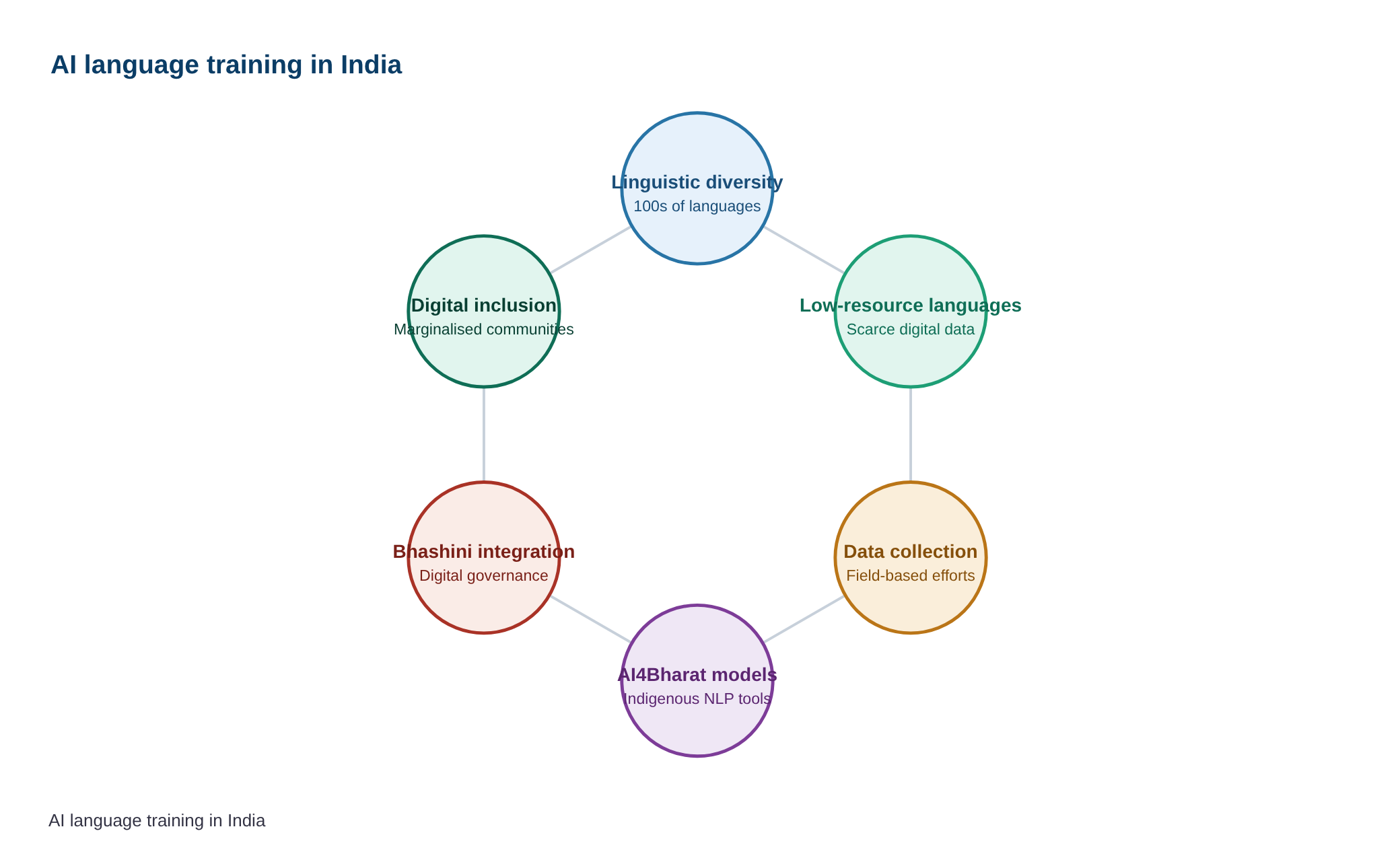
Linguistic Diversity in India → Recognition of low-resource languages and dialects → Scarcity of digital data for AI training → Need for systematic data collection (AI4Bharat initiative) → Development of multilingual AI models → Integration into digital governance and public services → Reduction in digital divide and empowerment of marginalised communities
Prelims Practice Questions
Q1. Consider the following statements regarding the challenges faced by AI in understanding Indian languages:
1. Most AI systems rely heavily on digital data available in English, leading to a disadvantage for low-resource Indian languages.
2. India’s linguistic diversity, including regional accents and dialects, complicates AI language models.
3. AI models require only written text data and do not benefit from spoken language inputs.
4. The term ‘low-resource languages’ refers to languages with limited digital content available for AI training.
How many of the above statements are correct?
- Only one
- Only two
- Only three
- All four
Answer: Only three — Statements 1, 2, and 4 are correct. Statement 3 is incorrect because AI models benefit significantly from spoken language inputs, which is why AI4Bharat collects voice data across India.
Q2. Assertion (A): AI systems trained primarily on English data struggle to understand Indian languages due to insufficient digital content.
Reason (R): India’s linguistic diversity, including regional accents and dialects, further complicates the training of AI language models.
Options:
A. Both A and R are true, and R is the correct explanation of A.
B. Both A and R are true, but R is not the correct explanation of A.
C. A is true, but R is false.
D. A is false, but R is true.
Answer: ? — Both Assertion (A) and Reason (R) are true, and R correctly explains why A is true. AI systems trained on English data lack sufficient data for Indian languages, and India’s linguistic diversity exacerbates this challenge.
Q3. Match the following terms with their correct descriptions:
Column I (Term)
1. AI4Bharat
2. Low-resource languages
3. Multilingual AI Models
4. Digital Public Infrastructure
Column II (Description)
A. AI systems designed to understand and process multiple languages.
B. A research initiative at IIT Madras focused on teaching AI to understand Indian languages.
C. Languages with limited digital content available for AI training.
D. Public digital systems that enable equitable access to technology and services.
Options:
A. 1-B, 2-C, 3-A, 4-D
B. 1-A, 2-B, 3-C, 4-D
C. 1-C, 2-A, 3-B, 4-D
D. 1-D, 2-C, 3-A, 4-B
Answer: ? — The correct match is: 1-B (AI4Bharat is a research initiative at IIT Madras), 2-C (Low-resource languages lack digital content), 3-A (Multilingual AI Models process multiple languages), and 4-D (Digital Public Infrastructure enables equitable access).
Mains Practice Question
✍ The linguistic diversity of India presents both a challenge and an opportunity for the development of Artificial Intelligence. In this context, critically examine the role of initiatives like AI4Bharat in bridging the digital divide and fostering inclusive technology. Also, discuss the ethical implications of developing AI systems that prioritise majority languages over minority languages. (15 Marks)
Approach: MODEL-ANSWER SKELETON:
1. **Introduction (2 marks)**
– Define India’s linguistic diversity and the concept of low-resource languages.
– Highlight the digital divide in AI development, with a focus on English-centric AI models.
2. **Role of AI4Bharat (5 marks)**
– Explain AI4Bharat’s mission at IIT Madras: collecting voice data, preserving dialects, and training AI models.
– Discuss the importance of spoken language inputs in training AI for Indian languages.
– Reference the need for digital public infrastructure to support such initiatives.
– Cite examples of languages like Tulu, Bundeli, Kodava, and Santali being prioritised.
3. **Bridging the Digital Divide (4 marks)**
– Analyse how AI4Bharat’s work addresses the lack of digital content in low-resource languages.
– Discuss the potential of multilingual AI models to democratise access to technology.
– Reference the role of government policies and partnerships with institutions like IITs.
4. **Ethical Implications (4 marks)**
– Critically examine the ethical dilemma of prioritising majority languages (e.g., Hindi, Tamil) over minority languages.
– Discuss the risk of further marginalising smaller linguistic communities.
– Highlight the importance of inclusive AI development to preserve linguistic heritage.
– Reference global precedents, such as UNESCO’s efforts in language preservation.
5. **Conclusion (2 marks)**
– Summarise the significance of initiatives like AI4Bharat in fostering inclusive technology.
– Emphasise the need for a balanced approach that prioritises both majority and minority languages.
Source: The Hindu
Generated by AanyaAi for educational purpose.

- महाराष्ट्र में त्योहार जुलूसों पर बॉम्बे हाईकोर्ट का बड़ा फैसला: पटाखे, लेजर और संगीत पर रोक - September 24, 2026
- Bombay HC Bans Firecrackers, Music in Maharashtra Processions: Key UPSC Analysis - September 24, 2026
- तमिलनाडु में महिला कर्मचारियों के लिए सवैतनिक माहवारी अवकाश नीति पर HC का आदेश - September 24, 2026

No Comments