


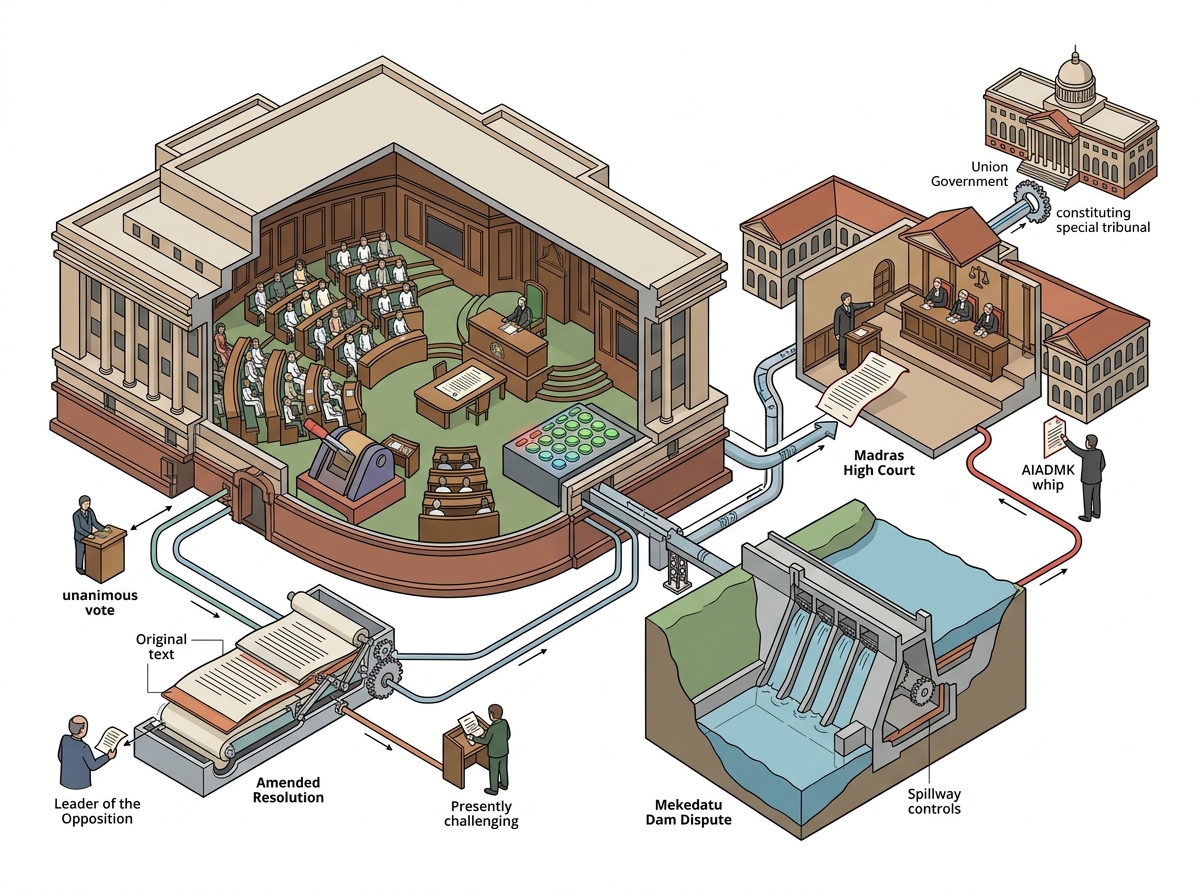
08 Aug Mekedatu Dam: Tamil Nadu Assembly Unanimously Passes Amended Resolution
Legislative AssemblyAmended resolutionMekedatu DamSpecial tribunalMadras High Court✎ The Inter-State River Water Disputes Act, 1956, empowers the Union Government to constitute tribunals under Section 4 to adjudicate inter-state water disputes, but such referrals remain at the Centre’s discretion, often leading…
Subject Relevance — Where This Topic Fits
- GS Paper II — Federalism, Inter-State Relations, and Constitutional Provisions | GS Paper III — Water Resources, Dispute Resolution, and Centre-State Coordination
- Prelims: Inter-State River Water Disputes Act, 1956, Article 262 of the Constitution, Cauvery Water Disputes Tribunal, Special Tribunal under Section 4, Legislative Assembly Resolution, Madras High Court, Union Ministry of Jal Shakti
- Essay: Federalism in India: Balancing State Autonomy and National Integration, Water Governance and Inter-State Disputes: Challenges and Solutions
Quick Revision: The Inter-State River Water Disputes Act, 1956, empowers the Union Government to constitute tribunals under Section 4 to adjudicate inter-state water disputes, but such referrals remain at the Centre’s discretion, often leading to prolonged stalemates.
Why is this in the news?
The Madras High Court is currently adjudicating a writ petition filed by the AIADMK whip challenging the validity of an amended resolution passed unanimously by the Tamil Nadu Legislative Assembly on June 19, 2026. The resolution, amended at the behest of the Leader of the Opposition, urges the Union Government to constitute a special tribunal under Section 4 of the Inter-State River Water Disputes Act, 1956, to exclusively adjudicate the Mekedatu Dam dispute between Karnataka and Tamil Nadu. The case raises critical questions regarding the procedural validity of legislative amendments, the role of the judiciary in reviewing legislative actions, and the constitutional framework governing inter-state water disputes.
Background
- The Mekedatu Dam project, proposed by Karnataka across the River Cauvery, has been a long-standing point of contention between Karnataka and Tamil Nadu, both of which rely heavily on the Cauvery for irrigation and drinking water.
- The Cauvery Water Disputes Tribunal (CWDT), constituted under the Inter-State River Water Disputes Act, 1956, delivered its final award in 2007, allocating water shares between the riparian states. However, disputes over implementation and new projects have persisted.
- Tamil Nadu has consistently opposed the Mekedatu Dam, arguing that it violates the principles of equitable water sharing and undermines the CWDT’s award.
- The Inter-State River Water Disputes Act, 1956, provides for the adjudication of disputes through tribunals, with Section 4 empowering the Union Government to constitute such tribunals upon receipt of a request from a state.
- The Union Ministry of Jal Shakti serves as the nodal authority for inter-state water disputes and is responsible for constituting tribunals under the Act.
- The present case involves a procedural dispute over whether the Tamil Nadu Legislative Assembly’s amendment to its resolution was validly passed and whether the judiciary can intervene in such legislative matters.
What is the Mekedatu Dam Dispute?
- The Mekedatu Dam is a proposed multi-purpose project by Karnataka across the River Cauvery, located near Mekedatu in Ramanagara district, Karnataka.
- Karnataka intends to utilise the dam for drinking water supply to Bengaluru and surrounding areas, as well as for hydroelectric power generation.
- Tamil Nadu opposes the project, contending that it violates the Cauvery Water Disputes Tribunal (CWDT) award of 2007, which allocates specific water shares to each state.
- Tamil Nadu argues that the dam would reduce downstream water flow, adversely affecting its agriculture-dependent districts such as Thanjavur, Trichy, and Nagapattinam.
- The dispute exemplifies the broader challenge of balancing developmental needs with inter-state equity in water-sharing arrangements.
- The Inter-State River Water Disputes Act, 1956, provides the legal framework for resolving such disputes, though its efficacy has been questioned due to delays in tribunal proceedings.
- The Union Government’s role is pivotal, as it is empowered under Section 4 of the Act to constitute a tribunal upon a state’s request, though such referrals are discretionary.
UPSC Value Addition
Keywords for Mains Answer-Writing
Inter-State River Water Disputes Act, 1956 · Mekedatu Dam dispute · Cauvery River water sharing · Special tribunal under Section 4 · Tamil Nadu Legislative Assembly · Madras High Court · Inter-State Water Disputes Tribunal · Constitutional provisions for water disputes · Federalism and centre-state relations · Judicial review of legislative actions
Prelims Practice Questions
Q1. Consider the following statements regarding the Mekedatu Dam dispute:
1. The dispute pertains to the construction of a dam across the River Cauvery by Karnataka.
2. Tamil Nadu has moved a resolution in its Legislative Assembly urging the Centre to constitute a special tribunal under Section 4 of the Inter-State River Water Disputes Act, 1956.
3. The resolution was passed unanimously by the Tamil Nadu Legislative Assembly on June 19, 2026.
4. The dispute is governed exclusively by the provisions of the River Boards Act, 1956.
How many of the above statements are correct?
- Only one
- Only two
- Only three
- All four
Answer: Only three — Statements 1, 2, and 3 are correct. Statement 4 is incorrect as the dispute is governed by the Inter-State River Water Disputes Act, 1956, not the River Boards Act, 1956.
Q2. Assertion (A): The Inter-State River Water Disputes Act, 1956 empowers the Union Government to constitute a tribunal for resolving inter-state water disputes.
Reason (R): The Act provides for the establishment of a tribunal under Section 4 to adjudicate disputes over the use, distribution, or control of inter-state river waters.
- Both A and R are true, and R is the correct explanation of A.
- Both A and R are true, but R is not the correct explanation of A.
- A is true, but R is false.
- A is false, but R is true.
Answer: Both A and R are true, and R is the correct explanation of A. — Both the Assertion and Reason are true, and the Reason correctly explains the Assertion. The Act explicitly empowers the Union Government to constitute tribunals under Section 4 for resolving inter-state water disputes.
Q3. Match the following pairs related to inter-state water disputes in India:
Column I (Provisions/Acts) Column II (Descriptions)
A. Inter-State River Water Disputes Act, 1956 1. Establishes the Cauvery Water Management Authority
B. Cauvery Water Disputes Tribunal 2. Provides for the constitution of tribunals under Section 4
C. Article 262 of the Constitution of India 3. Empowers the Supreme Court to adjudicate disputes
D. River Boards Act, 1956 4. Regulates the development and utilisation of river waters
Select the correct match:
- A-2, B-1, C-3, D-4
- A-1, B-2, C-3, D-4
- A-2, B-3, C-1, D-4
- A-4, B-2, C-3, D-1
Answer: A-2, B-1, C-3, D-4 — Correct matches are: A-2 (Inter-State River Water Disputes Act, 1956 provides for tribunals under Section 4), B-1 (Cauvery Water Disputes Tribunal established under the Act), C-3 (Article 262 empowers the Supreme Court to adjudicate disputes), D-4 (River Boards Act, 1956 regulates river water utilisation).
Mains Practice Question
✍ The recent unanimous passage of an amended resolution in the Tamil Nadu Legislative Assembly, urging the Union Government to constitute a special tribunal under Section 4 of the Inter-State River Water Disputes Act, 1956 for resolving the Mekedatu Dam dispute, raises critical questions about federalism, inter-state relations, and the role of judicial intervention in water-sharing conflicts. Critically examine the constitutional and legal framework governing inter-state river water disputes in India. Also, analyse the implications of such legislative resolutions on centre-state dynamics and judicial review. (15 Marks)
Approach: MODEL-ANSWER SKELETON:
1. **Constitutional Framework**:
– Article 262 of the Constitution of India: Excludes jurisdiction of courts in inter-state water disputes; empowers Parliament to provide for adjudication.
– Inter-State River Water Disputes Act, 1956: Key provisions including Section 4 (constitution of tribunals), Section 5 (reference of disputes), and Section 6 (powers of tribunals).
– Role of the Union Government: Power to constitute tribunals and enforce their awards.
2. **Legal Framework and Precedents**:
– Landmark cases: *Karnataka v. State of Maharashtra* (2019), *State of Karnataka v. State of Tamil Nadu* (2013), and *State of Punjab v. State of Haryana* (2004).
– Principles established: Equitable apportionment, prior appropriation, and the doctrine of riparian rights.
– Recent developments: Establishment of the Cauvery Water Management Authority (CWMA) under the Inter-State River Water Disputes (Amendment) Act, 2019.
3. **Federalism and Centre-State Relations**:
– Tension between state autonomy and Union intervention: States’ rights vs. national interest.
– Role of legislative resolutions: Tamil Nadu’s resolution as a political tool to pressure the Centre.
– Constitutional limits: Can legislatures direct the Union Government to act? (Refer to *State of Bihar v. Union of India*, 2016).
4. **Judicial Review and Legislative Actions**:
– Scope of judicial review: Courts can examine procedural fairness but not substantive merits of legislative actions (Refer to *Kesavananda Bharati v. State of Kerala*, 1973).
– Madras High Court’s role: Notice issued to Assembly Secretary, Chief Secretary, and Union Ministry of Jal Shakti; expected to examine the validity of the amended resolution.
– Implications: Potential for judicial intervention to resolve disputes or defer to legislative/political processes.
5. **Critical Analysis and Way Forward**:
– Strengths: Legal clarity, institutional mechanisms, and judicial oversight.
– Weaknesses: Delays in tribunal formation, lack of enforceability, and political interference.
– Suggested reforms: Strengthening institutional mechanisms (e.g., permanent tribunals), reducing political interference, and ensuring timely adjudication.
6. **Conclusion**:
– Balancing federalism, judicial intervention, and political dynamics is essential for resolving inter-state water disputes. The Mekedatu case exemplifies the need for a robust, time-bound, and politically neutral framework.
Source: The Hindu
Generated by AanyaAi for educational purpose.

- जुलाई 31 तक सीमित समय: रायलसीमा में फसल बीमा के लिए अंतिम प्रयास - August 8, 2026
- July 31 Deadline: Last-Minute Rush for Crop Insurance in Rayalaseema - August 8, 2026
- परंपरागत व्यवसायों को बचाने के लिए नीति समर्थन जरूरी: विशेषज्ञ - August 8, 2026

No Comments