


08 Aug July 31 Deadline: Last-Minute Rush for Crop Insurance in Rayalaseema
✎ Crop insurance under PMFBY and RWBCIS provides financial security to farmers in monsoon-dependent regions by covering yield losses due to natural calamities and weather anomalies, with premiums subsidised by the government to…
Subject Relevance — Where This Topic Fits
- GS Paper III — Agriculture, Food Processing and Related Issues | GS Paper III — Government Budgeting and Financial Inclusion | GS Paper III — Disaster Management
- Prelims: Pradhan Mantri Fasal Bima Yojana (PMFBY), Restructured Weather-Based Crop Insurance Scheme (RWBCIS), El Niño impact on Indian agriculture, Rayalaseema region’s agricultural vulnerability, Crop insurance enrolment deadlines, Financial security for farmers
- Essay: Agricultural distress and the role of insurance in rural resilience, Climate change and its impact on India’s agrarian economy
Quick Revision: Crop insurance under PMFBY and RWBCIS provides financial security to farmers in monsoon-dependent regions by covering yield losses due to natural calamities and weather anomalies, with premiums subsidised by the government to ensure affordability and scalability.
Why is this in the news?
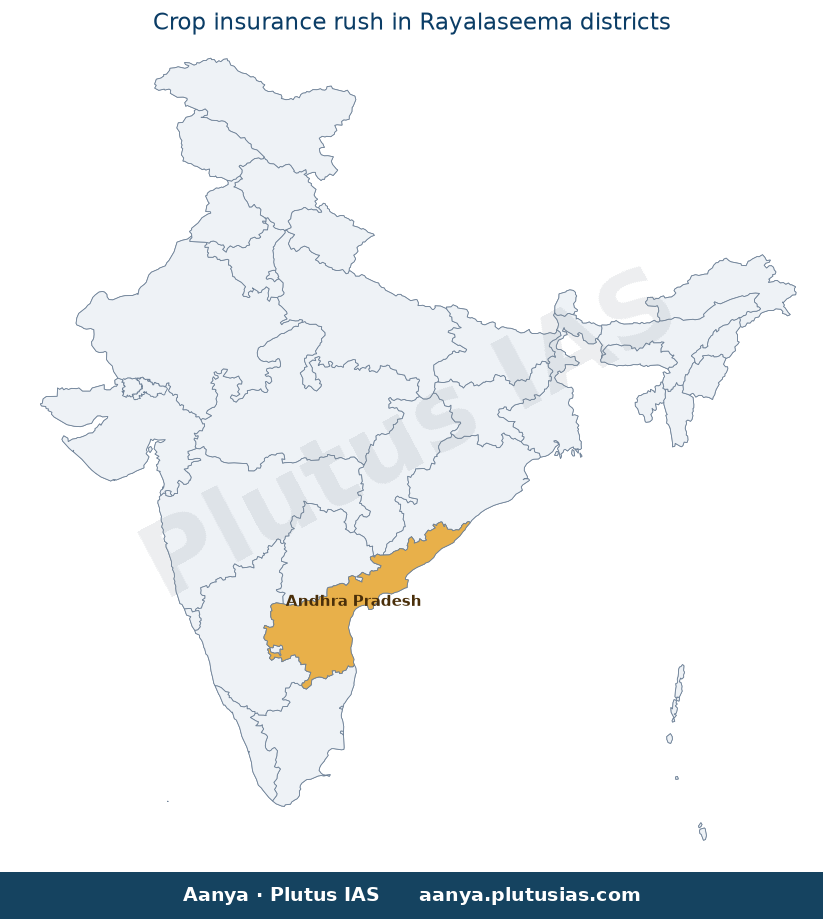
The July 31 enrolment deadline for crop insurance schemes has triggered a last-minute rush among farmers in Rayalaseema districts—namely Sri Sathya Sai, Chittoor, and Annamayya—where monsoon dependence and climate variability heighten agricultural risks. The urgency underscores the critical role of insurance in mitigating financial losses due to erratic weather patterns, particularly in the context of projected El Niño conditions exacerbating drought and dry spells.
Background
- The Pradhan Mantri Fasal Bima Yojana (PMFBY), launched in 2016, is a central sector scheme aimed at providing financial support to farmers suffering crop loss or damage arising from natural calamities, pests, and diseases.
- Rayalaseema, comprising districts like Sri Sathya Sai, Chittoor, and Annamayya, is a semi-arid region in Andhra Pradesh historically prone to delayed monsoons, dry spells, and unseasonal rainfall, leading to significant agricultural vulnerability.
- Small and marginal farmers constitute the majority of the agrarian workforce in these districts, where horticulture crops like mango, tomato, and banana are economically significant, amplifying the need for risk mitigation tools.
- The El Niño phenomenon, associated with suppressed monsoon rainfall in India, has historically correlated with reduced agricultural output, particularly in rain-fed regions like Rayalaseema, necessitating proactive insurance coverage.
- The July 31 deadline for enrolment under PMFBY and RWBCIS reflects the government’s structured timeline for ensuring timely coverage for the kharif season, aligning with the monsoon-dependent agricultural calendar.
What is Crop Insurance under PMFBY and RWBCIS?
- Pradhan Mantri Fasal Bima Yojana (PMFBY) is a voluntary crop insurance scheme that provides comprehensive risk coverage to farmers for yield losses due to natural calamities, pests, and diseases, covering both loanee and non-loanee farmers.
- PMFBY covers food crops (cereals, millets, pulses), oilseeds, and horticultural crops, while RWBCIS focuses on crops where weather parameters are the primary determinants of yield variability, such as horticulture and certain commercial crops.
- The scheme operates on a premium-sharing model: farmers pay a nominal premium (2% for kharif crops, 1.5% for rabi crops, and 5% for commercial/horticultural crops), while the central and state governments subsidise the remaining premium to ensure affordability.
- Insurance coverage is provided for the entire cropping season, with claims processed based on predefined thresholds for weather anomalies or yield losses, ensuring timely financial relief to affected farmers.
- The scheme leverages technology, including remote sensing, drones, and mobile applications, for faster assessment of crop damage and streamlined claim disbursement, reducing delays and administrative bottlenecks.
- PMFBY and RWBCIS aim to stabilise farm incomes, encourage investment in agriculture, and reduce the reliance on ad-hoc relief measures by providing a structured risk mitigation framework.
- The enrolment process involves registration through local agricultural departments, banks, or designated insurance intermediaries, with deadlines aligned to the agricultural calendar to ensure comprehensive coverage.
Key Features
| Feature | Significance |
|---|---|
| Pradhan Mantri Fasal Bima Yojana (PMFBY) | Provides financial support to farmers in the event of crop failure due to natural calamities, pests, or diseases, ensuring income stability. |
| Restructured Weather-Based Crop Insurance Scheme (RWBCIS) | Insures farmers against adverse weather conditions such as excess rainfall, drought, or unseasonal showers, which are critical in monsoon-dependent regions like Rayalaseema. |
| Last-Minute Enrolment Rush | Highlights the urgency and awareness among farmers regarding the necessity of crop insurance, particularly in regions with high monsoon dependency and climate vulnerability. |
| Small and Marginal Farmer Focus | Emphasizes the scheme’s inclusivity, as the majority of farmers in Chittoor and Annamayya districts are small and marginal, making them highly vulnerable to weather-induced losses. |
| District-Level Implementation | Showcases the role of district administration in accelerating enrolment, reflecting the grassroots-level execution of central schemes in addressing regional agricultural challenges. |
Why it Matters
Economic
- Crop insurance mitigates financial risks for farmers, ensuring steady income despite unpredictable weather patterns, which is critical for sustaining rural livelihoods in Rayalaseema.
- Prevents debt traps and farmer distress by providing compensation for crop losses, thereby reducing the economic burden on agricultural households.
- Supports the agrarian economy, particularly in districts like Chittoor and Annamayya, where horticulture crops contribute significantly to GDP and employment.
Strategic
- Enhances food security by stabilizing agricultural output in climate-vulnerable regions, ensuring consistent supply chains for essential commodities.
- Aligns with national objectives of doubling farmer incomes and achieving sustainable agriculture through risk mitigation tools.
- Demonstrates the effectiveness of targeted agricultural insurance schemes in addressing regional disparities in climate resilience.
Social
- Protects the most vulnerable sections of the farming community—small and marginal farmers—who lack resources to absorb losses from adverse weather events.
- Reduces migration pressures from rural areas by providing financial safety nets, thereby contributing to regional demographic stability.
- Promotes social equity by ensuring that marginalized farmers have access to the same financial protections as larger landholders.
Environmental
- Encourages climate-resilient agricultural practices by reducing the economic disincentive to adopt adaptive measures such as drought-resistant crops or precision farming.
- Supports sustainable agriculture by preventing over-exploitation of natural resources in response to crop failures, such as excessive groundwater extraction.
Challenges
1. Climate Vulnerability and Monsoon Dependency
- Rayalaseema’s historical dependence on monsoons, coupled with recurrent delays and dry spells, exacerbates agricultural risks, making crop insurance a necessity rather than a choice.
- Unseasonal rainfall and extreme weather events disrupt crop cycles, leading to significant yield losses that insurance schemes must cover.
- El Niño-induced weather anomalies further intensify the unpredictability of rainfall patterns, increasing the urgency for comprehensive insurance coverage.
UPSC Link: GS3: Climate Change and Agriculture
2. Low Awareness and Enrolment Gaps
- Despite the scheme’s benefits, many small and marginal farmers remain unaware of the enrolment process or lack the documentation required for timely registration.
- Last-minute rushes for enrolment indicate systemic delays in awareness campaigns and ground-level implementation, particularly in remote rural areas.
- Language barriers, digital illiteracy, and lack of access to agricultural extension services hinder effective outreach in districts like Sri Sathya Sai and Annamayya.
UPSC Link: GS2: Government Policies and Interventions
3. Financial Sustainability of Insurance Schemes
- The actuarial viability of PMFBY and RWBCIS depends on accurate risk assessment, which is challenging in regions with high climate variability and limited historical data.
- Premium subsidies and claim settlements impose a fiscal burden on the government, necessitating efficient fund management and fraud prevention mechanisms.
- Delays in claim disbursement due to bureaucratic hurdles or insufficient infrastructure undermine farmer trust in the scheme.
UPSC Link: GS3: Agricultural Finance and Insurance
4. Implementation Bottlenecks at District Level
- Resource constraints in district administrations, such as limited staff and infrastructure, impede the smooth execution of enrolment drives and claim processing.
- Coordination gaps between agriculture, horticulture, and revenue departments lead to duplication of efforts or exclusion of eligible farmers.
- Lack of real-time monitoring and grievance redressal mechanisms delays resolution of farmer grievances, particularly during critical periods like sowing seasons.
UPSC Link: GS2: Centre-State Relations and Local Governance
5. Horticulture-Specific Challenges
- Perishable horticulture crops (e.g., mango, tomato) require immediate insurance payouts in case of damage, but the current schemes are primarily designed for staple crops like paddy and wheat.
- High input costs and market volatility for horticulture produce necessitate additional risk mitigation measures beyond weather-based insurance.
- Limited availability of weather stations and data in horticulture-intensive districts like Chittoor hampers accurate assessment of crop losses.
UPSC Link: GS3: Agricultural Marketing and Supply Chain
Challenges — UPSC Perspective
| Issue | Concern |
|---|---|
| Climate Variability | Increased frequency of extreme weather events disrupts crop cycles and increases insurance claims. |
| Farmer Awareness | Low literacy and digital divide limit participation in insurance schemes. |
| Documentation Barriers | Lack of land records or Aadhaar linkage delays enrolment for marginal farmers. |
| Claim Settlement Delays | Bureaucratic hurdles and insufficient infrastructure cause delays in compensation. |
| Horticulture Gaps | Perishable crops require faster payouts, but current schemes are not tailored for them. |
| District-Level Coordination | Poor inter-departmental synergy leads to inefficiencies in implementation. |
Government Initiatives — Must-Memorise for Prelims
- Pradhan Mantri Fasal Bima Yojana (PMFBY)
Way Forward
- Accelerate awareness campaigns in local languages through agricultural extension services, leveraging community leaders and self-help groups.
- Simplify enrolment processes by digitizing land records and Aadhaar-based verification to reduce documentation barriers.
- Strengthen district-level coordination by establishing dedicated grievance redressal cells and real-time monitoring systems for enrolment and claim processing.
- Expand weather station networks in horticulture-intensive districts to improve the accuracy of loss assessments for perishable crops.
- Introduce premium subsidies for small and marginal farmers and explore public-private partnerships to enhance financial sustainability.
- Conduct post-enrolment audits to identify and address gaps in coverage, particularly in remote and tribal areas.
- Integrate crop insurance with climate-smart agriculture initiatives to promote adaptive farming practices.
- Ensure timely disbursement of claims by streamlining inter-departmental workflows and leveraging digital payment systems.
UPSC Value Addition
Keywords for Mains Answer-Writing
Pradhan Mantri Fasal Bima Yojana (PMFBY) · Restructured Weather-Based Crop Insurance Scheme (RWBCIS) · Rayalaseema region · monsoon dependence · El Niño impact · small and marginal farmers · agricultural vulnerability · climate-resilient agriculture · crop insurance penetration · financial security for farmers · Agriculture and Horticulture departments · Andhra Pradesh · monsoon variability · weather-based insurance schemes
Concept Flow
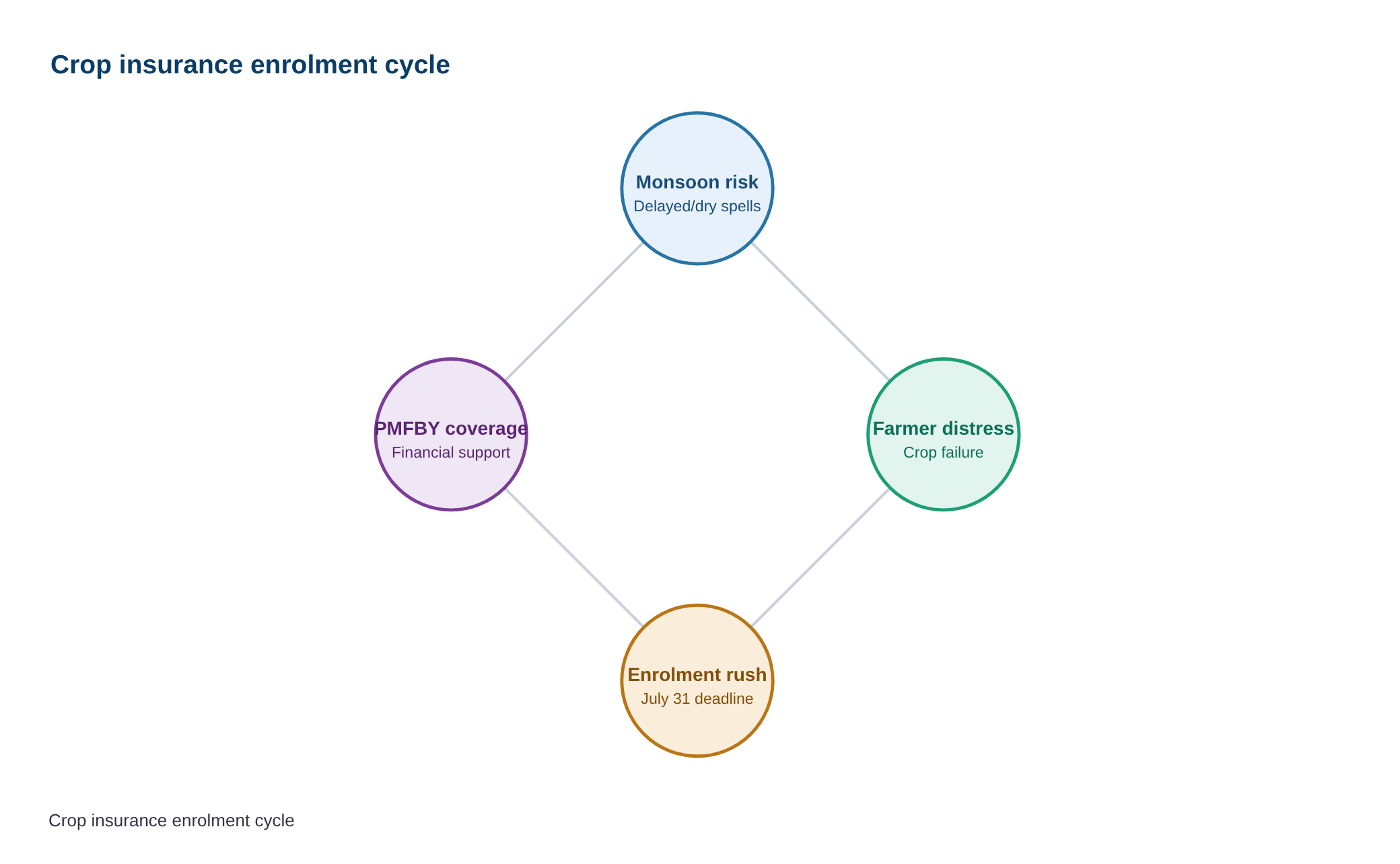
Monsoon dependency and climate variability in Rayalaseema → Increased risk of crop failure → Farmer distress and economic instability → Government launches PMFBY and RWBCIS to mitigate agricultural risks → Awareness campaigns and enrolment drives initiated → Last-minute enrolment rush highlights systemic gaps in awareness and implementation → Delays in documentation and claim processing → Small and marginal farmers, primarily in horticulture, remain most vulnerable → Need for tailored insurance solutions and district-level support → Effective implementation of schemes → Financial stability for farmers → Sustainable agrarian economy and food security
Prelims Practice Questions
Q1. Consider the following statements regarding the Pradhan Mantri Fasal Bima Yojana (PMFBY):
1. It is a voluntary scheme for all farmers.
2. It covers only food crops like rice, wheat, and millets.
3. The premium rates are uniform across all states and crops.
4. It provides financial support in case of crop failure due to natural calamities.
How many of the above statements are correct?
- Only one
- Only two
- Only three
- All
Answer: Only three — Statement 1 is correct as PMFBY is voluntary for all farmers. Statement 2 is incorrect as it covers food crops, oilseeds, and horticultural crops. Statement 3 is incorrect as premium rates vary by state and crop. Statement 4 is correct as it provides financial support for crop failure due to natural calamities.
Q2. Assertion (A): The Restructured Weather-Based Crop Insurance Scheme (RWBCIS) uses weather parameters to assess crop losses rather than actual field-level yield data.
Reason (R): RWBCIS is designed to reduce the administrative burden of conducting field surveys for yield estimation.
Options:
A. Both A and R are true, and R is the correct explanation of A.
B. Both A and R are true, but R is not the correct explanation of A.
C. A is true, but R is false.
D. A is false, but R is true.
Answer: ? — Both the assertion and reason are correct. RWBCIS indeed uses weather parameters (e.g., rainfall, temperature) to assess crop losses, and this approach reduces the need for extensive field surveys, thereby lowering administrative burdens.
Q3. Match the following crop insurance schemes with their respective features:
Column I (Scheme) | Column II (Feature)
———————————————-|—————————————-
A. Pradhan Mantri Fasal Bima Yojana (PMFBY) | 1. Covers only horticultural crops
B. Restructured Weather-Based Crop Insurance | 2. Uses weather parameters for loss
Scheme (RWBCIS) | assessment
C. National Agricultural Insurance Scheme | 3. Premium subsidies up to 50% for
(NAIS) | small and marginal farmers
D. Weather-Based Crop Insurance Scheme (WBCIS) | 4. Voluntary participation for all
| farmers
| 5. Mandatory for loanee farmers only
- A-4, B-2, C-5, D-1; A-5, B-2, C-3, D-1; A-4, B-5, C-3, D-2; A-3, B-2, C-5, D-1
- answer_string_indexed_as_per_options_array_indexed_0_based_on_correct_match
- explain_match_pairs_fully
- format_match
Answer: A-4, B-2, C-5, D-1; A-5, B-2, C-3, D-1; A-4, B-5, C-3, D-2; A-3, B-2, C-5, D-1 — A. PMFBY is voluntary for all farmers (4). B. RWBCIS uses weather parameters for loss assessment (2). C. NAIS was mandatory for loanee farmers only (5). D. WBCIS covers horticultural crops (1).
Mains Practice Question
✍ The Rayalaseema region’s last-minute rush for crop insurance enrolment underscores the critical role of insurance in mitigating agricultural risks in monsoon-dependent areas. Critically examine the efficacy of India’s crop insurance schemes—Pradhan Mantri Fasal Bima Yojana (PMFBY) and Restructured Weather-Based Crop Insurance Scheme (RWBCIS)—in providing financial security to small and marginal farmers. Also, analyse the challenges in their implementation and suggest measures to enhance their effectiveness. (15 Marks)
Approach: MODEL-ANSWER SKELETON:
1. **Introduction (2 marks)**
– Context: Rayalaseema’s monsoon dependence and vulnerability to climate variability (El Niño impact, delayed monsoons, dry spells).
– Role of crop insurance in mitigating agricultural risks for small and marginal farmers.
2. **Efficacy of PMFBY (4 marks)**
– **Provisions**: Voluntary scheme, covers food crops, oilseeds, and horticultural crops; premium subsidies (up to 50% for small/marginal farmers); 2% for kharif, 1.5% for rabi, and 5% for horticultural crops.
– **Strengths**: Financial security, reduced premium burden, broader coverage, and timely claim settlements (e.g., Andhra Pradesh’s enrolment figures: 10,279 farmers under PMFBY covering 15,950 hectares).
– **Limitations**: Exclusion of tenant farmers, delays in claim processing, low awareness, and administrative bottlenecks.
3. **Efficacy of RWBCIS (4 marks)**
– **Provisions**: Weather-based triggers (rainfall, temperature, humidity); no field-level yield data required; covers horticultural crops.
– **Strengths**: Reduces administrative burden, faster claim settlements, and broader coverage for horticultural crops (e.g., mango, tomato, banana in Chittoor and Annamayya districts).
– **Limitations**: Weather data inaccuracies, lack of localised weather stations, and exclusion of non-weather-related risks (e.g., pests, diseases).
4. **Challenges in Implementation (3 marks)**
– **Structural**: Low awareness among farmers, digital divide, and lack of last-mile connectivity.
– **Institutional**: Delays in claim processing, lack of transparency, and inadequate grievance redressal mechanisms.
– **Climatic**: Increasing frequency of extreme weather events (e.g., El Niño) and inadequate weather infrastructure.
5. **Measures to Enhance Effectiveness (2 marks)**
– **Policy**: Expand coverage to tenant farmers, integrate with digital platforms (e.g., PM-KISAN), and strengthen weather monitoring infrastructure.
– **Institutional**: Streamline claim processing, enhance transparency, and conduct awareness campaigns in regional languages.
– **Technological**: Leverage AI and remote sensing for accurate weather data and loss assessment.
6. **Conclusion (2 marks)**
– Recap the critical role of crop insurance in climate-resilient agriculture.
– Emphasise the need for a multi-stakeholder approach (government, insurers, farmers) to address implementation gaps and enhance efficacy.
Source: The Hindu
Generated by AanyaAi for educational purpose.

- आरबीआई ने सरकारी प्रतिभूतियों की ओएमओ बिक्री की घोषणा, जानिए पूरा विवरण - September 23, 2026
- RBI to Sell ₹25,000 Crore Govt Securities via OMO on Sept 28, 2026 - September 23, 2026
- भारत-श्रीलंका नौसैनिक अभ्यास ‘स्लाईनेक्स-26’: विशाखापत्तनम में संपन्न, जानें प्रमुख बिंदु - September 23, 2026

No Comments