


08 Aug How IIT Madras is Teaching AI to Understand India’s 121 Languages for UPSC
AI modelsDigital dataLinguistic landscapeRegional languages✎ AI systems must be trained on diverse, region-specific linguistic data to function effectively in India’s multilingual context, necessitating grassroots data collection and collaboration with local communities.
Subject Relevance — Where This Topic Fits
- GS Paper II — Governance, Constitution, Polity, Social Justice and International Relations (Digital Governance, Language Policy) | GS Paper III — Science and Technology (AI, Data Science, Digital Infrastructure)
- Prelims: Natural Language Processing (NLP), Low-resource languages, AI4Bharat, Digital Public Infrastructure (DPI), Bhashini Initiative, Unicode, Speech-to-text systems, Multilingual datasets
- Essay: The Role of Technology in Preserving Cultural Diversity, Linguistic Pluralism and Inclusive Development: Challenges and Opportunities
Quick Revision: AI systems must be trained on diverse, region-specific linguistic data to function effectively in India’s multilingual context, necessitating grassroots data collection and collaboration with local communities.
Why is this in the news?
The initiative by AI4Bharat at IIT Madras to develop AI systems capable of understanding and processing India’s diverse linguistic landscape has gained prominence due to its potential to democratise access to technology. This effort addresses the critical challenge of ‘low-resource languages’ in AI, where insufficient digital data impedes the development of inclusive artificial intelligence systems. The project underscores the necessity of preserving dialects and regional languages, aligning with India’s broader goals of digital inclusion and cultural preservation.
Background
- Most AI models are trained predominantly on English and a few high-resource languages, leaving a vast majority of Indian languages underrepresented in digital ecosystems.
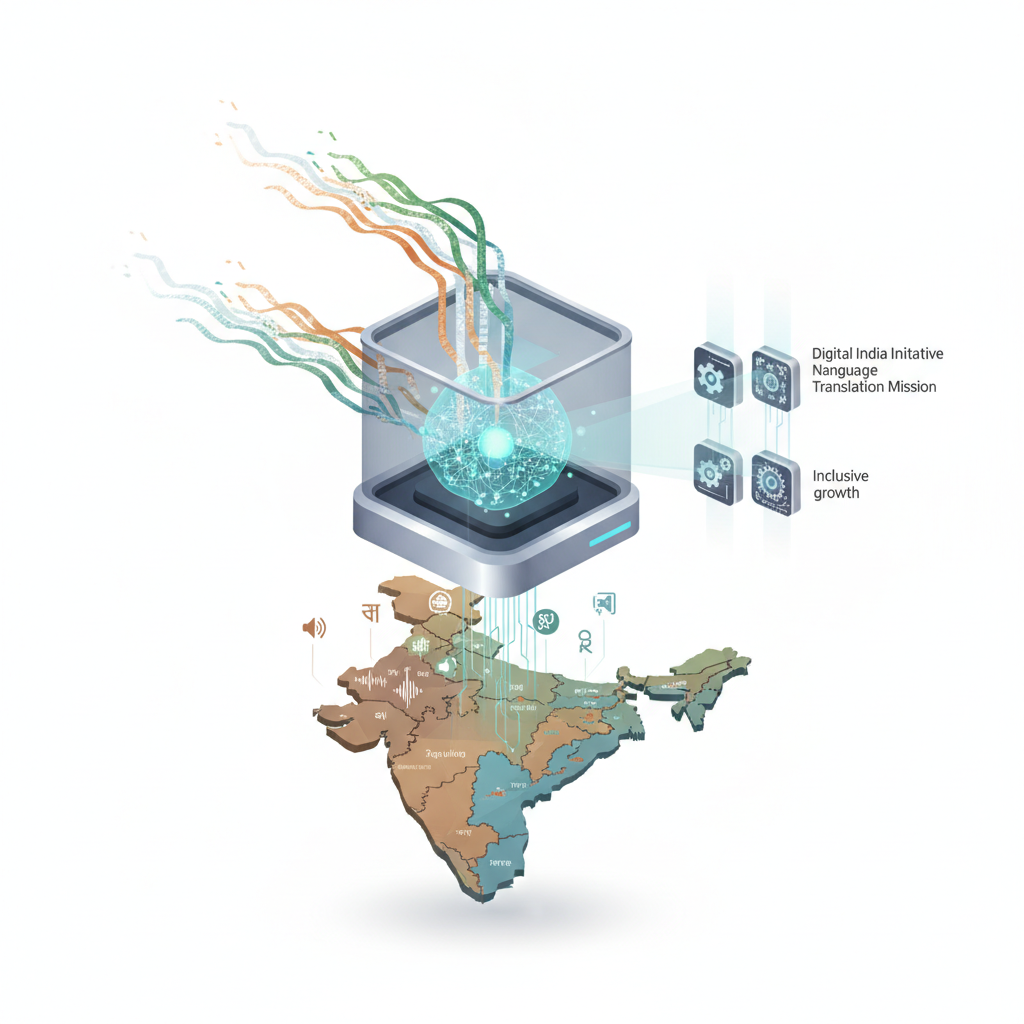
- The Digital India initiative and the National Language Translation Mission aim to leverage technology for inclusive growth, highlighting the need for AI systems that cater to India’s linguistic plurality.
- The lack of standardised written forms for many dialects and the prevalence of oral traditions pose unique challenges for AI training and data collection.
What is AI4Bharat’s Linguistic AI Initiative?
- AI4Bharat, a research lab at IIT Madras, is engaged in a nation-wide effort to collect voice data, dialects, and linguistic nuances to train AI systems to understand India’s diverse languages.
- The project focuses on ‘low-resource languages,’ which lack sufficient digital data for AI training, including languages like Tulu, Bundeli, Kodava, and Santali.
- Researchers are conducting field surveys to record spoken language, preserving dialects that are predominantly oral and have no standardised written form.
- The initiative aims to develop speech-to-text, text-to-speech, and translation systems that can handle regional accents, code-mixing (e.g., Hinglish), and dialectal variations.
- By creating a robust dataset of Indian languages, the project seeks to enable AI assistants, educational tools, and public service applications to function effectively in local languages.
- The effort aligns with the broader goal of reducing the digital divide by making technology accessible to non-English speaking populations across India.
- Collaborations with local communities, linguists, and technologists are critical to ensuring the authenticity and relevance of the collected data.
- The project also contributes to the preservation of intangible cultural heritage by documenting endangered languages and dialects.
Key Features
| Feature | Significance |
|---|---|
| Voice Data Collection | Preserves endangered dialects and accents for AI training, ensuring linguistic diversity is represented in digital systems. |
| Low-Resource Language Focus | Addresses the scarcity of digital data for Indian languages, enabling AI to learn from spoken rather than only written sources. |
| Multilingual Model Development | Trains AI to understand code-mixed languages (e.g., Hinglish) and regional variations, improving accessibility for non-English speakers. |
| Community Engagement | Involves local speakers in data collection, ensuring authenticity and reducing bias in AI training datasets. |
| Real-World Application Testing | Validates AI performance in practical scenarios (e.g., conversational queries) to refine accuracy and usability. |
Why it Matters
Technological Sovereignty
- Reduces dependence on foreign AI models by developing indigenous linguistic datasets, fostering self-reliance in AI technology.
- Enhances India’s position in global AI research by addressing a critical gap in multilingual AI systems.
Digital Inclusion
- Bridges the digital divide by enabling AI tools to serve non-English-speaking populations, particularly in rural and marginalised communities.
- Supports the use of AI in governance, education, and healthcare through local language interfaces.
Cultural Preservation
- Documents and revitalises endangered dialects by incorporating them into AI training, preventing linguistic erosion.
- Promotes intergenerational transmission of indigenous languages through digital platforms.
Economic Impact
- Creates opportunities for local AI startups and researchers by providing foundational datasets and tools.
- Enhances productivity in sectors like customer service, translation, and content creation by automating multilingual tasks.
Policy and Governance
- Aligns with the Digital India initiative by ensuring AI accessibility in regional languages, supporting public service delivery.
- Provides data-driven insights for policymakers to design language-inclusive digital infrastructure.
Challenges
1. Data Scarcity for Low-Resource Languages
- Limited digital text/audio data for many Indian languages, particularly tribal and regional dialects, hinders AI training.
- Lack of standardised orthography for spoken languages complicates data annotation and model development.
UPSC Link: GS3: Science & Tech (AI & Language Processing)
2. Linguistic Diversity and Variability
- High intra-language variability (e.g., dialects, accents) across regions requires extensive and diverse training datasets.
- Code-mixing (e.g., Hinglish) adds complexity, as AI must distinguish between languages and slang in real-time.
UPSC Link: GS1: Society (Language & Cultural Diversity)
3. Bias and Representation Gaps
- Risk of over-representing dominant languages (e.g., Hindi, Tamil) while marginalising smaller languages in AI models.
- Socio-economic biases in data collection may exclude certain communities, leading to skewed AI outputs.
UPSC Link: GS2: Governance (Inclusive Development)
4. Technical Limitations of AI Models
- Current AI architectures (e.g., transformers) struggle with low-resource languages due to insufficient training data.
- Real-time processing of spoken language with high accuracy remains a challenge, especially for under-resourced languages.
UPSC Link: GS3: Science & Tech (AI & Machine Learning)
5. Ethical and Privacy Concerns
- Collecting voice data raises privacy issues, particularly for indigenous communities with oral traditions.
- Potential misuse of recorded voices for surveillance or commercial exploitation without consent.
UPSC Link: GS4: Ethics (AI & Data Privacy)
Challenges — UPSC Perspective
| Issue | Concern |
|---|---|
| Data Paucity | Insufficient digital text/audio data for training AI models in many Indian languages. |
| Dialectal Fragmentation | Extreme variability in accents and dialects within a single language complicates AI learning. |
| Code-Mixing Complexity | Integration of multiple languages (e.g., Hinglish) in speech challenges AI comprehension. |
| Cultural Sensitivity | Risk of misrepresenting or erasing cultural nuances in AI-generated responses. |
| Scalability | High costs and logistical challenges in collecting data from remote and tribal regions. |
| Model Bias | Over-reliance on data from dominant languages may marginalise smaller linguistic communities. |
Way Forward
- Establish a national language data repository under the Ministry of Electronics and Information Technology (MeitY) to centralise and standardise datasets for AI training.
- Incentivise private and public sector collaboration (e.g., via PPP models) to accelerate data collection in low-resource languages.
- Develop open-source AI tools and frameworks tailored for Indian languages, ensuring accessibility for researchers and startups.
- Integrate language preservation efforts with existing schemes like the National Mission for Manuscripts to document oral traditions.
- Conduct pilot projects in education and healthcare to test AI applications in regional languages, refining models based on real-world feedback.
- Strengthen ethical guidelines for AI data collection, ensuring informed consent and data sovereignty for indigenous communities.
- Promote multilingual AI in public service delivery (e.g., e-governance portals, helplines) to enhance citizen engagement.
- Expand funding for interdisciplinary research combining linguistics, computer science, and anthropology to address linguistic diversity.
UPSC Value Addition
Keywords for Mains Answer-Writing
Artificial Intelligence (AI), linguistic diversity of India, low-resource languages, digital language data, AI4Bharat, IIT Madras, natural language processing (NLP), digital divide, multilingualism, language preservation, AI accessibility, digital public infrastructure · AI policy, ethical AI, multilingual AI models, language technology for governance, inclusive technology, digital language resources, India’s linguistic landscape, AI in education · natural language understanding (NLU), speech recognition, machine translation, AI ethics, digital inclusion, low-resource language processing, AI for social good
Concept Flow
Linguistic Diversity in India → Recognition of low-resource languages and dialects → Need for AI accessibility in regional languages → Data Scarcity for Indian Languages → Insufficient digital text/audio datasets → Barrier to AI training and deployment → AI4Bharat’s Voice Data Collection → Fieldwork across regions to record spoken languages → Preservation of endangered dialects → Development of Multilingual AI Models → Training on diverse datasets → Improvement in code-mixing and accent recognition → Integration with Digital Public Infrastructure → Enables AI tools in governance, education, and healthcare → Enhances citizen services → Policy and Ethical Frameworks → Address data privacy and bias concerns → Ensures inclusive and responsible AI adoption → Technological Sovereignty → Reduction of dependence on foreign AI models → Strengthening India’s AI ecosystem
Prelims Practice Questions
Q1. Consider the following statements regarding the linguistic diversity of India and AI’s challenges in understanding Indian languages:
1. India is one of the most linguistically diverse countries in the world, with languages changing significantly even across districts.
2. AI systems trained primarily on English data face difficulties in understanding Indian languages due to the lack of digital resources.
3. The term ‘low-resource languages’ refers exclusively to languages that are no longer spoken by any community.
4. AI4Bharat, a research lab at IIT Madras, is working to collect voice data and preserve dialects to improve AI’s understanding of Indian languages.
How many of the above statements are correct?
- Only one
- Only two
- Only three
- All
Answer: All — Statements 1, 2, and 4 are correct. Statement 3 is incorrect because ‘low-resource languages’ refers to languages with insufficient digital data for AI training, not those that are no longer spoken.
Q2. Assertion (A): Most AI systems today are trained on vast amounts of English-language digital data, which limits their ability to understand Indian languages.
Reason (R): Indian languages, particularly those spoken by smaller communities, lack sufficient digital resources such as books, websites, or conversational data for AI training.
In the context of the above statements, which of the following is correct?
- Both A and R are true, and R is the correct explanation of A.
- Both A and R are true, but R is not the correct explanation of A.
- A is true, but R is false.
- A is false, but R is true.
Answer: Both A and R are true, but R is not the correct explanation of A. — Both the assertion and reason are true, and the reason correctly explains the assertion. AI’s reliance on English data stems from the scarcity of digital resources in Indian languages, especially low-resource ones.
Q3. Match the following Indian languages with their classification based on the availability of digital resources for AI training:
Column I (Language) | Column II (Classification)
——————-|—————————
A. Hindi | 1. High-resource language
B. Tamil | 2. Medium-resource language
C. Santali | 3. Low-resource language
D. English | 4. Extremely high-resource language
- A-4, B-2, C-3, D-1; A-1, B-2, C-3, D-4; A-2, B-1, C-3, D-4; A-3, B-2, C-1, D-4
Answer: ? — Hindi and Tamil are classified as medium-resource languages due to some digital presence, while Santali is a low-resource language with minimal digital data. English, being globally dominant, is an extremely high-resource language for AI.
Mains Practice Question
✍ Artificial Intelligence systems remain largely inaccessible to the majority of India’s population due to their inability to understand the country’s linguistic diversity. Critically analyse the challenges posed by India’s multilingual landscape to the development of inclusive AI technologies. Also, discuss the role of initiatives like AI4Bharat in bridging this digital divide. (15 Marks)
Approach: MODEL-ANSWER SKELETON:
1. **Introduction (2 Marks)**
– Define AI’s dependence on digital language data and its current limitations in India.
– Highlight India’s linguistic diversity (e.g., 121 languages with >10,000 speakers, 19,569 mother-tongue names as per Census 2011) and its implications for AI.
2. **Challenges Posed by India’s Linguistic Landscape (6 Marks)**
– **Data Scarcity**: Most Indian languages are ‘low-resource’ with insufficient digital corpora (books, websites, transcripts) for AI training. Cite examples like Santali, Tulu, or Kodava.
– **Dialectal and Accentual Variations**: Regional dialects and accents (e.g., Bundeli vs. Awadhi, or Malayalam spoken in Kerala vs. Lakshadweep) create variability that AI struggles to model.
– **Oral vs. Written Disparities**: Many languages (e.g., Bhojpuri, Santali) are primarily oral, with no standardised written form, making it difficult to curate training data.
– **Technological Bias**: AI models trained on English or high-resource languages (e.g., Hindi) often perform poorly for low-resource languages due to skewed training datasets.
– **Ethical and Inclusivity Concerns**: Exclusion of marginalised linguistic communities from AI-driven services exacerbates digital divides in education, governance, and healthcare.
3. **Role of AI4Bharat and Similar Initiatives (4 Marks)**
– **Data Collection**: AI4Bharat’s fieldwork in collecting voice samples, preserving dialects, and documenting endangered languages (e.g., Toda, Kurumba).
– **Technology Development**: Building multilingual AI models (e.g., IndicBERT, IndicTrans) tailored for Indian languages using transfer learning and synthetic data augmentation.
– **Community Engagement**: Partnering with local institutions and speakers to ensure linguistic authenticity and cultural sensitivity in AI training.
– **Policy Advocacy**: Pushing for government support (e.g., National Language Technology Mission) to scale language preservation and AI development.
4. **Way Forward and Conclusion (3 Marks)**
– **Collaborative Efforts**: Need for public-private partnerships (e.g., IITs, C-DAC, Microsoft Research India) to pool resources and expertise.
– **Policy Interventions**: Government schemes like the National Language Translation Mission (NLTM) to fund language digitisation and AI tool development.
– **Ethical AI**: Emphasise principles of inclusivity, transparency, and accountability in AI deployment to prevent linguistic marginalisation.
– **Conclusion**: Stress that bridging the digital divide in AI requires a multi-pronged approach combining technology, policy, and community participation.
Source: The Hindu
Generated by AanyaAi for educational purpose.

- केरल लोक सेवा आयोग ने उच्च न्यायालय में दायर किया मामला, सदस्यों के खिलाफ मामला रद्द करने की मांग - September 23, 2026
- KPSC Challenges Prosecution Sanction in Kerala High Court: Key UPSC Polity Insight - September 23, 2026
- केरल में एंटीमाइक्रोबियल रेजिस्टेंस: सरकारी रिपोर्ट में चौंकाने वाले आँकड़े सामने - September 23, 2026

No Comments