


08 Aug Supreme Court’s Historic Verdict on Tamil Nadu’s Super-Speciality Seats: Key Implications for UPSC
✎ The Supreme Court’s 2026 verdict on super-speciality seats in Tamil Nadu mandates that 50% of unfilled seats after percentile reduction in AIQ counselling must revert to the state, ensuring protection for in-service candidates…
Subject Relevance — Where This Topic Fits
- GS Paper II — Governance, Constitution, Polity, Social Justice and International Relations (Judicial Pronouncements and Federalism) | GS Paper III — Science and Technology (Medical Education and Health Infrastructure)
- Prelims: All India Quota (AIQ), NEET-Super-Speciality (SS), DM/MCh seats, Directorate General of Health Services (DGHS), Tamil Nadu Medical Council (TNMC), In-service reservation, Judicial review of medical admissions, Counselling percentile reduction
- Essay: The role of judicial intervention in resolving federal disputes in healthcare governance, Balancing meritocracy and affirmative action in medical education
Quick Revision: The Supreme Court’s 2026 verdict on super-speciality seats in Tamil Nadu mandates that 50% of unfilled seats after percentile reduction in AIQ counselling must revert to the state, ensuring protection for in-service candidates while upholding federal governance in medical education.
Why is this in the news?
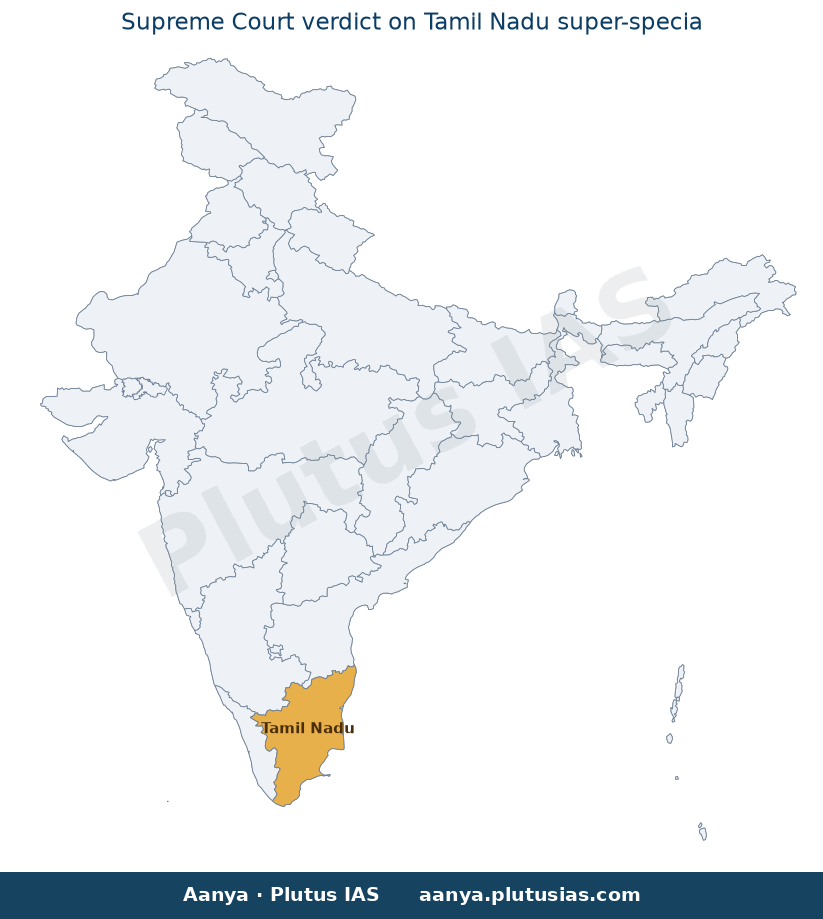
The Supreme Court of India, in a landmark judgment delivered on July 28, 2026, directed Tamil Nadu to surrender 151 unfilled super-speciality medical seats (DM/MCh) to the All India Quota (AIQ) counselling pool, while mandating safeguards for in-service candidates. The verdict, termed ‘historic’ by Tamil Nadu’s Health Minister, addresses longstanding grievances of state-employed doctors regarding seat allocation and reservation policies in super-speciality medical education. The ruling also clarifies the procedural framework for percentile reduction in subsequent counselling rounds, ensuring equitable distribution of vacant seats between the state and the central authority.
Background
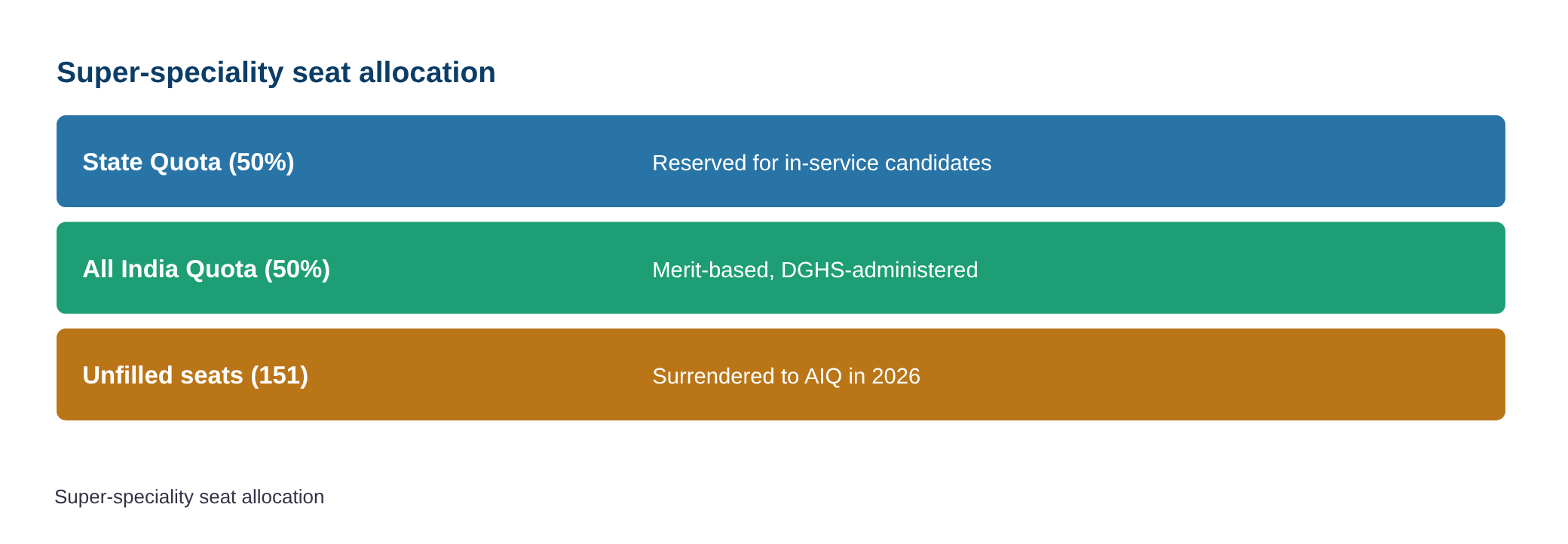
- Tamil Nadu reserves 50% of its DM/MCh super-speciality seats for in-service candidates under the State Quota, a policy aimed at retaining medical talent within the public health system.
- The All India Quota (AIQ) system, administered by the Directorate General of Health Services (DGHS), allocates 50% of super-speciality seats across India for merit-based admissions, including candidates from other states.
- In 2026, Tamil Nadu surrendered 151 unfilled super-speciality seats to the AIQ pool due to inadequate in-service candidate participation, triggering legal and administrative scrutiny.
- Historically, Tamil Nadu has faced challenges in filling super-speciality seats, particularly in high-demand branches such as Cardiology and Surgical Gastroenterology, due to competitive AIQ cut-offs and limited state-specific incentives.
- The State government had filed a writ petition in the Supreme Court, arguing that the surrender of seats without adequate safeguards for in-service candidates violated the principles of federalism and affirmative action.
- The Supreme Court’s intervention underscores the judiciary’s role in resolving disputes between state and central authorities over medical education governance.
What are Super-Speciality Medical Seats and the AIQ System?
- Super-speciality medical seats (DM/MCh) are postgraduate courses in highly specialised branches of medicine, such as Cardiology, Neurosurgery, and Paediatric Surgery, requiring prior MD/MS qualifications.
- The All India Quota (AIQ) system was introduced in 2017 to ensure merit-based admissions to 50% of super-speciality seats in government medical colleges across India, including seats surrendered by states.
- States like Tamil Nadu reserve 50% of super-speciality seats for in-service candidates—doctors already employed in government hospitals—to address manpower shortages and incentivise retention.
- Unfilled in-service seats are typically surrendered to the AIQ pool for general counselling, but the Supreme Court’s 2026 verdict imposes conditions to protect state interests.
- The DGHS conducts counselling for AIQ seats in multiple rounds, with the option to reduce the NEET-SS percentile cut-off in subsequent rounds to fill vacancies, subject to the Supreme Court’s directives.
- The verdict mandates that if the DGHS reduces the percentile after the second round of counselling, 50% of the resulting vacant seats must revert to the state, while the remaining 50% are filled through further counselling by the DGHS.
- The ruling reaffirms the principle that state-specific reservation policies for in-service candidates must be balanced with the centralised merit-based AIQ system.
Key Features
| Feature | Significance |
|---|---|
| Supreme Court Verdict on Super-Speciality Seats | The apex court’s order ensures that unfilled super-speciality seats in Tamil Nadu are managed transparently, preventing unilateral decisions by the DGHS to reduce percentiles without state consultation. |
| 50% Reservation for In-Service Candidates | Tamil Nadu’s policy of reserving 50% of DM/MCh seats for in-service doctors is upheld, ensuring equitable access for state-employed medical professionals to advanced training opportunities. |
| Surrender of Unfilled Seats to AIQ | The directive to surrender 151 unfilled seats to the All India Quota (AIQ) counselling process maintains national uniformity in postgraduate medical admissions while addressing state-specific vacancies. |
| Second Round of AIQ Counselling | The expedited second round of counselling, as mandated by the SC, aims to fill vacancies promptly while preserving the state’s right to reclaim half of the remaining seats if percentiles are adjusted. |
| State Government’s Writ Petition | The timely filing of a writ petition by Tamil Nadu’s government in the Supreme Court facilitated judicial intervention, securing the state’s interests in super-speciality seat allocation. |
Why it Matters
Judicial and Legal
- The verdict establishes a precedent for state governments to challenge arbitrary decisions by central agencies (DGHS) in postgraduate medical admissions, reinforcing federalism in healthcare governance.
- It clarifies the legal framework governing the surrender and reallocation of super-speciality seats, reducing ambiguity in future counselling cycles.
- The order underscores the judiciary’s role in safeguarding equitable access to medical education, particularly for in-service candidates.
Healthcare Governance
- The decision enhances transparency in the allocation of super-speciality seats, reducing the risk of seat wastage and ensuring optimal utilisation of medical training infrastructure.
- It reinforces the principle of state-level autonomy in designing reservation policies for medical education, subject to constitutional and judicial oversight.
- The verdict may incentivise states to strengthen their in-service training programmes to better prepare doctors for super-speciality examinations.
Social and Equity
- The reservation of 50% seats for in-service candidates addresses historical inequities in access to super-speciality training, particularly for doctors serving in rural and underserved areas.
- By preventing unilateral percentile reductions, the order protects the interests of service doctors who may face systemic disadvantages in competitive super-speciality examinations.
- The ruling indirectly supports the goal of reducing regional disparities in healthcare access by ensuring that trained specialists remain within the state.
Challenges
1. Declining Participation of Service Doctors
- The number of in-service doctors appearing for NEET super-speciality examinations has decreased, reflecting systemic issues such as lack of promotional opportunities and reduced availability of super-speciality posts.
- The absence of financial incentives and career progression pathways discourages doctors from pursuing advanced training, exacerbating the shortage of specialists in critical fields like Cardiology and Surgical Gastroenterology.
UPSC Link: GS Paper 2: Governance, Issues relating to Development and Management of Social Sector/Services relating to Health
2. Vacancy Persistence in High-Demand Specialities
- Despite the SC verdict, certain super-speciality branches (e.g., Cardiothoracic Surgery, Paediatric Surgery) continue to face vacancy issues due to the competitive nature of NEET-SS and the limited number of seats.
- The reluctance of service doctors to opt for these branches, coupled with the high cut-off scores, perpetuates the cycle of underutilisation of allocated seats.
UPSC Link: GS Paper 3: Science and Technology, Developments and their Applications and Effects in Everyday Life
3. Coordination Gaps Between State and Central Agencies
- The DGHS’s unilateral decisions on percentile reductions and seat reallocation have historically created friction with state governments, necessitating judicial intervention to resolve disputes.
- The lack of a structured mechanism for consultation between the state and central agencies risks undermining the effectiveness of reservation policies and seat allocation processes.
UPSC Link: GS Paper 2: Functions and Responsibilities of the Union and the States
4. Financial and Infrastructure Constraints
- The state’s ability to provide adequate training infrastructure and financial support for in-service doctors pursuing super-speciality courses remains constrained, limiting the impact of reservation policies.
- The absence of dedicated funding for super-speciality training programmes in government hospitals hampers the state’s capacity to produce and retain specialists.
UPSC Link: GS Paper 3: Indian Economy and Issues relating to Planning, Mobilisation of Resources
5. Public Perception and Political Accountability
- Criticism from opposition parties and medical associations highlights the need for greater transparency and accountability in the state’s handling of super-speciality seat allocation.
- The government’s failure to address recurring vacancies in certain branches may erode public trust in its healthcare policies and reservation frameworks.
UPSC Link: GS Paper 4: Ethics and Human Interface
Challenges — UPSC Perspective
| Issue | Concern |
|---|---|
| Declining NEET-SS Participation | Reduced interest among service doctors due to lack of incentives and career growth opportunities. |
| High Cut-off Scores in Competitive Branches | Persistent vacancies in branches like Cardiology and Surgical Gastroenterology despite SC intervention. |
| Lack of State-Central Coordination | Historical friction in seat allocation processes leading to judicial disputes. |
| Inadequate Training Infrastructure | Limited capacity in government hospitals to support super-speciality training programmes. |
| Public and Political Criticism | Opposition and medical associations questioning the state’s handling of seat allocation and reservation policies. |
Way Forward
- The Tamil Nadu government should expedite the implementation of a state-level super-speciality training policy to incentivise in-service doctors, including financial support and career progression pathways.
- The Directorate General of Health Services (DGHS) must establish a formal consultation mechanism with state governments to address disputes in seat allocation and percentile adjustments.
- The state should conduct a comprehensive review of its in-service reservation policy to identify gaps and propose structural reforms to enhance participation in super-speciality examinations.
- Efforts should be made to expand training infrastructure in government hospitals, particularly in high-demand specialities, through public-private partnerships or central funding schemes.
- The government should launch targeted awareness campaigns to encourage service doctors to pursue super-speciality training, highlighting the benefits of career advancement and financial incentives.
- A monitoring committee comprising representatives from the state health department, medical associations, and the judiciary should be formed to oversee the implementation of the SC verdict and address emerging challenges.
- The state should explore the feasibility of introducing a state-level super-speciality entrance examination to reduce reliance on NEET-SS and improve access for in-service candidates.
- Long-term policy measures, such as increasing the number of super-speciality posts and revising the pay structure for in-service doctors, should be prioritised to address systemic issues.
UPSC Value Addition
Keywords for Mains Answer-Writing
Supreme Court verdict on super-speciality medical seats · All India Quota (AIQ) counselling · DM/MCh super-speciality seats · in-service candidates reservation · Directorate General of Health Services (DGHS) · NEET Super-Speciality Examination · Tamil Nadu Health Minister K.G. Arunraj · 50% reservation for in-service candidates · second round of counselling · cut-off percentile reduction · Cardiology, Surgical Gastroenterology, Vascular Surgery, Nephrology · Cardiothoracic Surgery, Paediatric Surgery · medical education policy · judicial intervention in medical admissions · reservation policy in postgraduate medical education
Constitutional & Policy Linkages
- Article 14: Equality before Law (ensuring fair treatment in seat allocation processes).
- Article 15(4): Special Provisions for Advancement of Backward Classes (reservation for in-service candidates).
- Article 16: Equality of Opportunity in Public Employment (career progression for service doctors).
Concept Flow
Supreme Court verdict upholds Tamil Nadu’s 50% reservation for in-service candidates in super-speciality seats → Unfilled seats (151) are surrendered to AIQ counselling → DGHS conducts second round of counselling → If percentiles are reduced post-counselling, 50% of remaining seats revert to Tamil Nadu → State may utilise these seats to fill vacancies in critical specialities → Addresses systemic issues like declining participation and infrastructure gaps → Enhances equitable access to super-speciality training for service doctors.
Prelims Practice Questions
Q1. Consider the following statements regarding the Supreme Court verdict on super-speciality medical seats in Tamil Nadu:
1. The Supreme Court directed Tamil Nadu to surrender 151 unfilled super-speciality seats to the Directorate General of Health Services (DGHS).
2. The Court ruled that if seats remain vacant after the second round of counselling, the DGHS cannot reduce the percentile without reverting 50% of the seats to the State.
3. The verdict mandates that 50% of the DM/MCh seats in Tamil Nadu must be reserved for in-service candidates.
How many of the above statements are correct?
- Only one
- Only two
- Only three
- All
Answer: Only three — Statement 1 is correct as per the report. Statement 2 is correct as the Court directed 50% of unfilled seats to revert to Tamil Nadu if the percentile is reduced. Statement 3 is incorrect; the verdict does not mandate 50% reservation for in-service candidates but addresses the surrender of unfilled seats.
Q2. Assertion (A): The Supreme Court verdict on super-speciality medical seats empowers the Directorate General of Health Services (DGHS) to unilaterally reduce the cut-off percentile and fill vacant seats in the All India Quota (AIQ) counselling.
Reason (R): The Court directed that if the percentile is reduced after the second round of counselling, 50% of the unfilled seats must revert to the State of Tamil Nadu.
In the context of the above two statements, which one of the following is correct?
- Both A and R are true, and R is the correct explanation of A.
- Both A and R are true, but R is not the correct explanation of A.
- A is true, but R is false.
- A is false, but R is true.
Answer: ? — Assertion (A) is false because the Court did not empower the DGHS to unilaterally reduce the percentile; it imposed conditions. Reason (R) is true as the Court directed the surrender of 50% of unfilled seats to Tamil Nadu if the percentile is reduced.
Q3. Match the following specialities with their respective status in the context of the Supreme Court verdict on super-speciality medical seats in Tamil Nadu:
Column I (Speciality) | Column II (Status)
———————————————–|—————————————-
A. Cardiology | 1. Filled in the All India second round counselling
B. Surgical Gastroenterology | 2. Likely to remain vacant after second round
C. Cardiothoracic Surgery | 3. May be filled if percentile is reduced
D. Paediatric Surgery | 4. Vacant for past few years
Select the correct match:
- A-1, B-1, C-3, D-4
- A-1, B-1, C-4, D-3
- A-2, B-2, C-3, D-4
- A-1, B-2, C-3, D-4
Answer: A-1, B-1, C-4, D-3 — Cardiology and Surgical Gastroenterology are likely to be filled in the All India second round counselling. Cardiothoracic Surgery and Paediatric Surgery may remain vacant or be filled if the percentile is reduced, with some seats having remained vacant in past years.
Mains Practice Question
✍ Critically examine the constitutional and policy dimensions of the Supreme Court’s intervention in the reservation of super-speciality medical seats for in-service candidates in Tamil Nadu. Also, analyse the implications of the Court’s directive on the autonomy of State governments in determining medical education policies. (15 Marks)
Approach: MODEL-ANSWER SKELETON:
1. **Context and Background** (2 marks):
– Briefly explain the reservation policy for in-service candidates in DM/MCh seats in Tamil Nadu (50% reservation).
– Highlight the issue of unfilled seats (151 seats) and the role of the All India Quota (AIQ) counselling.
– Mention the Supreme Court’s directive to surrender unfilled seats and the conditions for percentile reduction.
2. **Constitutional and Legal Framework** (4 marks):
– **Article 14 (Equality)**: Discuss how reservation policies must adhere to the principle of reasonable classification and non-arbitrariness.
– **Article 15(5)**: Examine the scope of reservation in postgraduate medical education under the Constitution (93rd Amendment) Act, 2005.
– **Article 21 (Right to Health)**: Argue the State’s obligation to ensure equitable access to super-speciality healthcare.
– **Judicial Precedents**: Cite relevant cases such as *Indra Sawhney v. Union of India* (1992) on reservation limits and *T.M.A. Pai Foundation v. State of Karnataka* (2002) on minority educational institutions.
3. **Policy and Administrative Implications** (4 marks):
– **State Autonomy vs. Central Control**: Discuss the tension between State autonomy in education policy (State List, 7th Schedule) and the Centre’s role in regulating medical education (Entry 66, Union List).
– **DGHS and AIQ Counselling**: Explain the role of DGHS in conducting AIQ counselling and the implications of the Court’s directive on its functioning.
– **Impact on In-Service Candidates**: Analyse how the verdict affects the career prospects of in-service doctors and the State’s ability to retain medical talent.
4. **Critique and Challenges** (3 marks):
– **Potential for Judicial Overreach**: Discuss whether the Court’s intervention encroaches upon the legislative and executive domains in matters of education policy.
– **Equity vs. Efficiency**: Evaluate the trade-off between ensuring equitable access to super-speciality seats for in-service candidates and the need to fill seats to address healthcare shortages.
– **Implementation Challenges**: Highlight practical difficulties in reverting seats and conducting subsequent rounds of counselling.
5. **Conclusion** (2 marks):
– Summarise the key takeaways from the verdict.
– Offer a balanced view on whether the Court’s intervention strikes a reasonable balance between constitutional principles, State autonomy, and healthcare needs.
Source: The Hindu
Generated by AanyaAi for educational purpose.

- महाराष्ट्र में त्योहार जुलूसों पर बॉम्बे हाईकोर्ट का बड़ा फैसला: पटाखे, लेजर और संगीत पर रोक - September 24, 2026
- Bombay HC Bans Firecrackers, Music in Maharashtra Processions: Key UPSC Analysis - September 24, 2026
- तमिलनाडु में महिला कर्मचारियों के लिए सवैतनिक माहवारी अवकाश नीति पर HC का आदेश - September 24, 2026

No Comments