


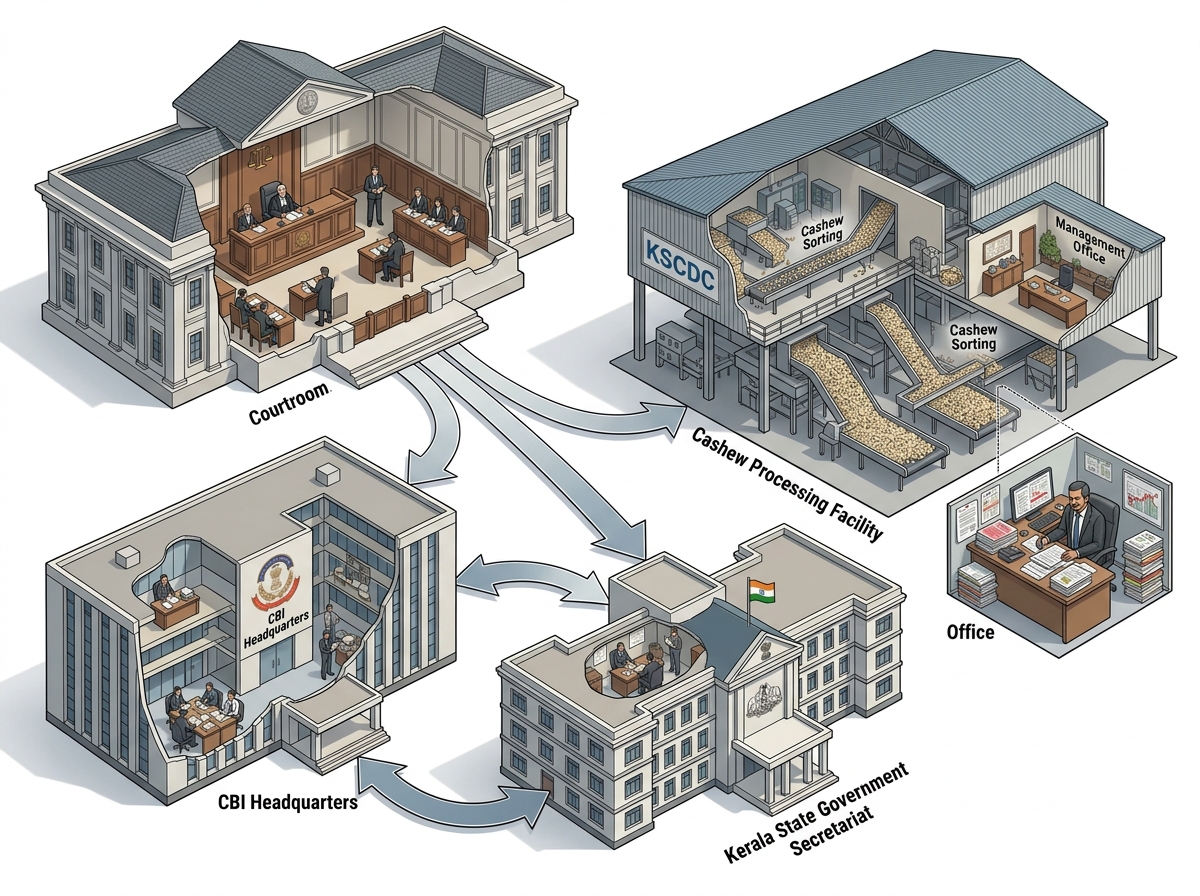
08 Aug Kerala HC seeks CBI, State reply on cashew scam accused’s posts
Kerala High CourtCBIState governmentKSCDC✎ The Kerala Cashew Import Scam exemplifies systemic corruption in public sector undertakings, where financial misappropriation through manipulated tenders results in substantial losses to the exchequer, necessitating robust…
Subject Relevance — Where This Topic Fits
- GS Paper II — Functions and Responsibilities of the Union and the States, Issues and Challenges Pertaining to the Federal Structure | GS Paper III — Issues Relating to Direct and Indirect Farm Subsidies and Minimum Support Prices; Public Distribution System; Issues of Buffer Stocks and Food Security; Land Reforms in India | GS Paper IV — Ethics and Human Interface: Essence, Determinants and Consequences of Ethics in Human Actions; Status and Problems; Ethical Concerns and Dilemmas in Government and Private Institutions; Laws, Rules, Regulations and Conscience as Sources of Ethical Guidance
- Prelims: CBI, Vigilance Commission, Prevention of Corruption Act, 1988, Public Interest Litigation (PIL), Judicial Review, Fundamental Duties, Khadi and Village Industries Board, RUTRONIX, Kerala Khadi Workers’ Welfare Fund Board, Cashew Development Corporation, Import Substitution, Tendering Process, Sanction for Prosecution, Chargesheet, Corruption Scam
- Essay: Ethics in Governance: The Thin Line Between Service and Self-Interest, Judicial Activism and the Fight Against Corruption: Balancing Accountability and Governance
Quick Revision: The Kerala Cashew Import Scam exemplifies systemic corruption in public sector undertakings, where financial misappropriation through manipulated tenders results in substantial losses to the exchequer, necessitating robust vigilance, judicial oversight, and adherence to procurement norms to uphold institutional integrity.
Why is this in the news?
The Kerala High Court’s directive to the CBI and State government to respond to allegations against K.A. Ratheesh, a former managing director of the Kerala State Cashew Development Corporation (KSCDC) accused in a ₹600-crore cashew import scam, underscores critical issues of institutional integrity, judicial oversight in corruption cases, and the ethical obligations of public office holders. The case highlights the intersection of administrative accountability, judicial review, and the enforcement of anti-corruption laws in India, making it a pertinent subject for UPSC Civil Services examination.
Background
- The Kerala State Cashew Development Corporation (KSCDC), a state-owned enterprise, was established to promote cashew cultivation and processing in Kerala, aligning with India’s broader policy of import substitution and agricultural diversification.
- Between 2006 and 2015, the KSCDC allegedly engaged in large-scale financial misappropriation through inflated tenders for raw cashew imports, resulting in an estimated loss of ₹600 crore to the exchequer.
- The CBI filed a chargesheet against K.A. Ratheesh (former MD of KSCDC) and R. Chandrasekharan (former chairman of KSCDC) for dishonestly awarding tenders to private suppliers at inflated rates, bypassing established procurement norms and store purchase rules.
- The case exemplifies systemic corruption in public sector undertakings (PSUs), where regulatory oversight, procurement transparency, and ethical governance are compromised for individual or group gains.
- The petitioner, K.M. Shajahan, a former Additional Private Secretary to the late Chief Minister V.S. Achuthananthan, has invoked public interest to challenge Ratheesh’s continued occupancy of key government posts despite being chargesheeted in a major corruption case.
- The Kerala High Court’s intervention reflects the judiciary’s role in ensuring accountability in governance, particularly when executive and investigative agencies face delays or perceived inaction in high-profile corruption cases.
What is the Kerala Cashew Import Scam?
- The Kerala Cashew Import Scam refers to a financial misappropriation scandal involving the Kerala State Cashew Development Corporation (KSCDC), where officials allegedly awarded tenders for raw cashew imports to private suppliers at inflated rates between 2006 and 2015.
- The scam resulted in an estimated financial loss of ₹600 crore to the state exchequer, as procurement norms and store purchase rules were bypassed to favour specific suppliers.
- Key accused in the case include K.A. Ratheesh (former MD of KSCDC) and R. Chandrasekharan (former chairman of KSCDC), who have been chargesheeted by the CBI for criminal conspiracy, cheating, and forgery under the Indian Penal Code and the Prevention of Corruption Act, 1988.
- The CBI’s investigation revealed that the accused dishonestly manipulated tender processes, leading to undue financial gains for private entities while causing substantial losses to the public sector undertaking.
- The scam highlights systemic vulnerabilities in public procurement processes, particularly in state-owned enterprises, where lack of transparency, weak internal audits, and collusion between officials and private actors enable large-scale corruption.
- The case is emblematic of broader challenges in combating corruption in India, where delays in judicial proceedings, prolonged sanction processes for prosecution, and political interference often impede timely justice.
- The Kerala High Court’s recent directive to the CBI and State government to respond to allegations against Ratheesh underscores the judiciary’s role in ensuring that chargesheeted individuals do not occupy positions of trust in government, pending trial.
- The scam also raises questions about the efficacy of vigilance mechanisms in state PSUs, including the role of the Vigilance Director and the need for proactive measures to prevent financial irregularities.
UPSC Value Addition
Keywords for Mains Answer-Writing
Corruption in Public Sector Undertakings (PSUs) · CBI’s role in investigating economic offences · Public Integrity and Transparency Norms · Vigilance Mechanisms in Government · Appointment of Charged Officials in Government Posts · Economic Offences and Tender Process Irregularities · Kerala State Cashew Development Corporation (KSCDC) Scam · Constitutional Provisions on Public Service Conduct · Judicial Review of Executive Actions · Prevention of Corruption Act, 1988 · Sanction for Prosecution under Criminal Law · Khadi and Village Industries Board (KVIB) Governance · Financial Accountability in Government Boards · Judicial Activism in Corruption Cases · Ethical Governance and Public Trust · Economic Crimes and Institutional Safeguards
Prelims Practice Questions
Q1. Consider the following statements regarding the Prevention of Corruption Act, 1988:
1. It applies to all public servants, including those in PSUs.
2. Sanction for prosecution under the Act is mandatory before initiating criminal proceedings against a public servant.
3. The Act does not cover offences committed by private individuals in collusion with public servants.
4. The Act mandates the CBI to investigate all corruption cases without exception.
How many of the above statements are correct?
- Only one
- Only two
- Only three
- All
Answer: Only three — Statements 1 and 2 are correct. The Act applies to public servants under Section 2(c), and sanction for prosecution is required under Section 19. Statement 3 is incorrect as the Act covers collusion under Section 12. Statement 4 is incorrect as the CBI’s jurisdiction is limited to cases referred by the Central Government or State Governments.
Q2. Assertion (A): The Central Bureau of Investigation (CBI) is a statutory body established under the Delhi Special Police Establishment Act, 1946.
Reason (R): The CBI derives its powers of investigation from the Criminal Procedure Code, 1973, and the Prevention of Corruption Act, 1988.
Options:
A. Both A and R are true, and R is the correct explanation of A.
B. Both A and R are true, but R is not the correct explanation of A.
C. A is true, but R is false.
D. A is false, but R is true.
Answer: ? — Assertion (A) is true as the CBI is constituted under the DSPE Act, 1946. Reason (R) is also true but does not explain the assertion, as the CBI’s powers are derived from the DSPE Act itself, not solely from the CrPC or PCA.
Q3. Match the following Constitutional Provisions with their respective functions:
Column I (Provision) | Column II (Function)
— | —
A. Article 12 | 1. Definition of ‘State’ for Part III of the Constitution
B. Article 16 | 2. Equality of opportunity in public employment
C. Article 309 | 3. Recruitment and conditions of service of persons serving the Union or a State
D. Article 311 | 4. Dismissal, removal or reduction in rank of civil servants
Options:
A. A-1, B-2, C-3, D-4
B. A-2, B-1, C-4, D-3
C. A-3, B-4, C-1, D-2
D. A-4, B-3, C-2, D-1
Answer: ? — A-1 (Article 12 defines ‘State’ for Fundamental Rights), B-2 (Article 16 guarantees equality of opportunity in public employment), C-3 (Article 309 empowers Parliament/State Legislatures to regulate recruitment and service conditions), D-4 (Article 311 protects civil servants from arbitrary dismissal).
Mains Practice Question
✍ The appointment of public servants facing corruption charges to key government posts undermines the foundational principles of public integrity and transparency. Critically examine this proposition with reference to the constitutional framework, statutory provisions, and judicial precedents. Also, analyse the role of vigilance mechanisms in preventing such appointments. (15 Marks)
Approach: MODEL-ANSWER SKELETON:
1. **Introduction (2 marks)**: Define public integrity and transparency as constitutional values (Preamble, Fundamental Duties under Art. 51A). State the proposition with reference to the Kerala cashew scam case.
2. **Constitutional and Statutory Framework (4 marks)**:
– Art. 14 (Equality), Art. 16 (Equality of opportunity in public employment), and Art. 323A (Administrative Tribunals) — right to fair treatment.
– Prevention of Corruption Act, 1988: Section 19 (sanction for prosecution), Section 13 (criminal misconduct by public servants).
– All India Services (Conduct) Rules, 1968: Prohibits appointment of persons facing serious charges.
– Right to Information Act, 2005: Enhances transparency in appointments.
3. **Judicial Precedents (4 marks)**:
– **Union of India v. S. Sundararajan (2015)**: SC held that persons facing serious charges cannot be appointed to sensitive posts.
– **Prakash Singh v. Union of India (2006)**: Directions on police reforms and integrity in public services.
– **Lily Thomas v. Union of India (2013)**: Struck down Section 8(4) of the Representation of the People Act, 1951, allowing convicted legislators to continue in office.
– **Kerala High Court’s role in the present case**: Judicial review of executive actions in appointments.
4. **Vigilance Mechanisms (3 marks)**:
– Central Vigilance Commission (CVC): Advisory role in appointments and disciplinary actions.
– State Vigilance Directorates: Monitoring of corruption cases and recommendations.
– CBI: Investigative role and prosecution sanction.
– Limitations: Delay in sanction, political interference, and lack of suo motu powers in some cases.
5. **Conclusion (2 marks)**:
– Reiterate the proposition: Corruption charges disqualify individuals from key posts.
– Suggest reforms: Mandatory debarment, time-bound investigations, and transparency in appointments.
– Balance between presumption of innocence and public trust.
Source: The Hindu
Generated by AanyaAi for educational purpose.


No Comments