


08 Aug Kerala to Install 60 km Solar Fencing in Wayanad to Tackle Human-Wildlife Conflict
✎ Solar fencing is a non-lethal, solar-powered electrified barrier system used to deter wildlife from entering human settlements, reducing human-wildlife conflict while ensuring ecological sustainability and community safety.
Subject Relevance — Where This Topic Fits
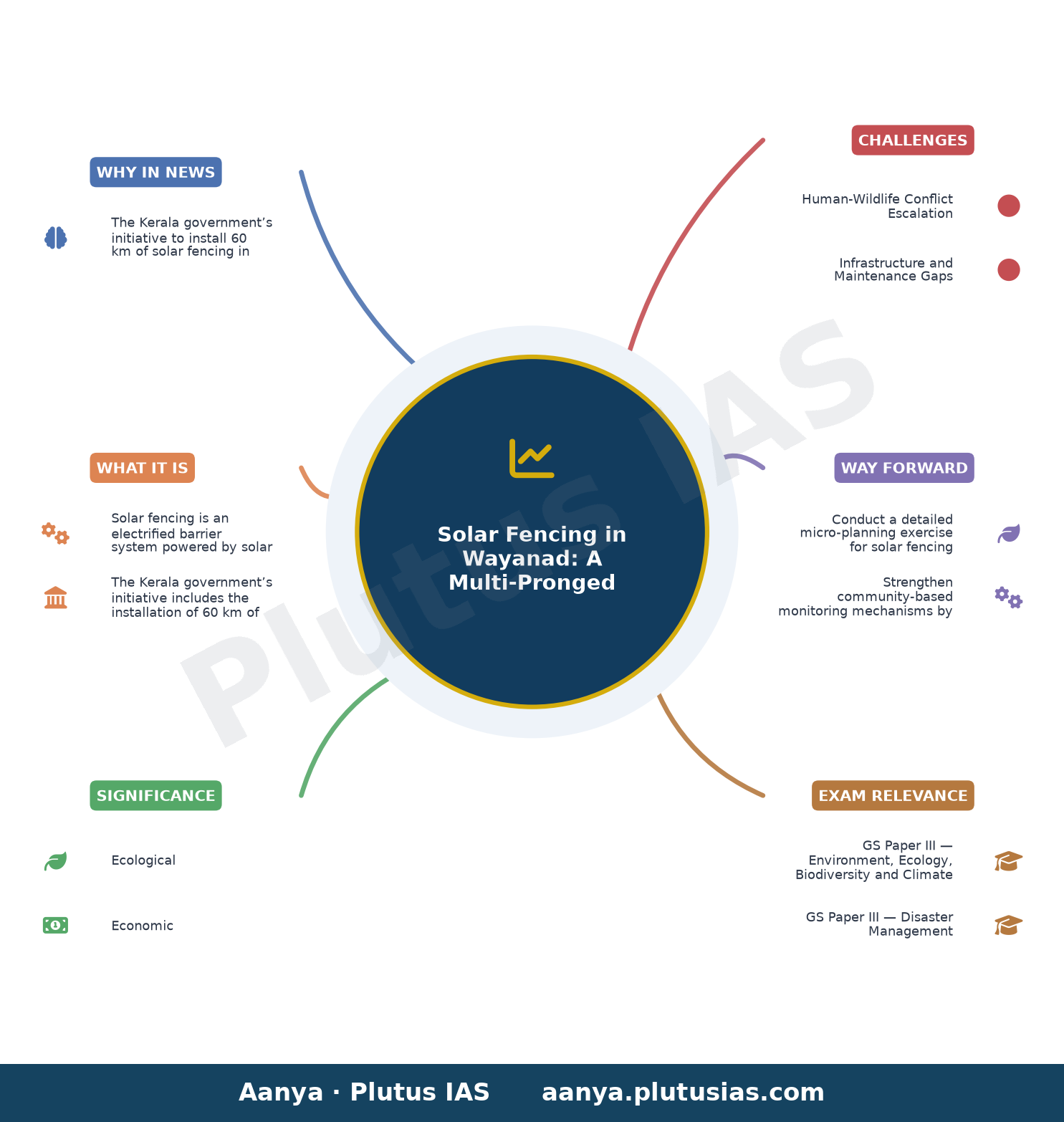
- GS Paper III — Environment, Ecology, Biodiversity and Climate Change | GS Paper III — Disaster Management
- Prelims: Human-Wildlife Conflict (HWC), Solar Fencing, Carrying Capacity, Wildlife Institute of India (WII), Rapid Response Teams, Project Tiger, Project Elephant, Western Ghats, Kerala Forest Department
- Essay: Conservation of Biodiversity vs. Human Development: The Wayanad Dilemma, Technology and Traditional Wisdom in Wildlife Management
Quick Revision: Solar fencing is a non-lethal, solar-powered electrified barrier system used to deter wildlife from entering human settlements, reducing human-wildlife conflict while ensuring ecological sustainability and community safety.
Why is this in the news?
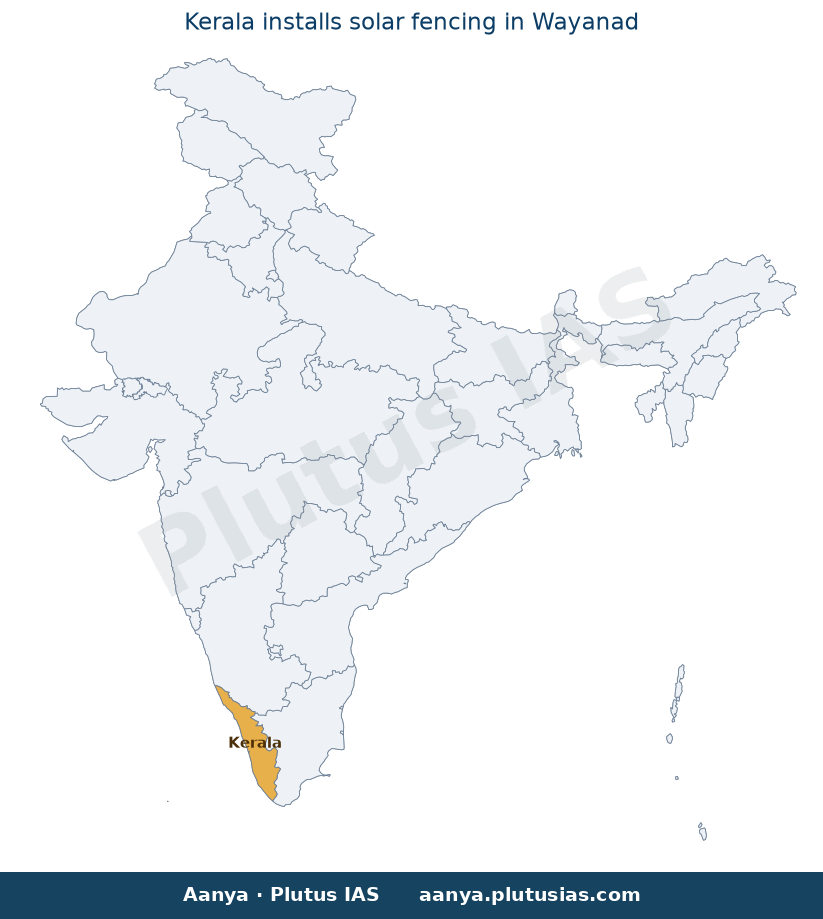
The Kerala government’s initiative to install 60 km of solar fencing in Wayanad district, along with associated measures such as carrying capacity studies and rapid response teams, underscores the escalating human-wildlife conflict (HWC) in the region. This intervention, part of the State’s 100-day action plan, reflects a shift toward technologically advanced and community-inclusive solutions to balance conservation imperatives with agricultural livelihoods in ecologically sensitive zones.
Background
- Wayanad district in Kerala is a critical human-wildlife conflict (HWC) hotspot, particularly due to its proximity to the Western Ghats, a biodiversity-rich region designated as a UNESCO World Heritage Site.
- The district’s forest fringes are populated with human settlements, leading to frequent encounters between humans and wildlife, especially elephants and tigers, resulting in crop raiding, property damage, and human casualties.
- The Wildlife Institute of India (WII), a premier autonomous institution under the Ministry of Environment, Forest and Climate Change (MoEFCC), has been entrusted with conducting a carrying capacity study in Wayanad to assess ecological sustainability.
- Solar fencing has emerged as a non-lethal alternative to traditional physical barriers, reducing the risk of electrocution while deterring wildlife from entering human settlements.
What is Solar Fencing and How Does It Address Human-Wildlife Conflict?
- Solar fencing is an electrified barrier system powered by solar energy, designed to deter wildlife from entering human settlements or agricultural fields without causing harm.
- The Kerala government’s initiative includes the installation of 60 km of new solar fencing and the repair of 25 km of existing fencing, aiming to create a contiguous barrier along forest fringes to reduce incursion by wildlife.
- Solar fencing is complemented by other measures such as rapid response teams, vegetation clearance along forest roads, and community-based vigilance committees to ensure holistic conflict mitigation.
- A key component of the initiative is the carrying capacity study by the Wildlife Institute of India (WII), which will assess the ecological limits of Wayanad’s forests to support wildlife populations without compromising human settlements.
- The study will assess the population of tigers (*Panthera tigris*) and elephants (*Elephas maximus*) in the region.
Key Features
| Feature | Significance |
|---|---|
| Installation of 60 km solar fencing | Creates a non-lethal barrier to deter wildlife entry into human settlements, reducing crop damage and human casualties while ensuring ecological connectivity. |
| Repair of 25 km existing solar fencing | Enhances the efficacy of existing mitigation infrastructure, ensuring continuous protection and reducing maintenance gaps. |
| Carrying capacity study by WII | Scientific assessment of forest ecosystems to determine sustainable limits for wildlife populations, informing long-term conservation and conflict mitigation strategies. |
| Rapid Response Teams deployment | Enables immediate intervention during wildlife incursions, reducing response time and mitigating escalation of conflicts. |
| Vegetation clearance along 100 km forest roads | Improves visibility and mobility for forest personnel, facilitating surveillance and emergency response operations. |
Why it Matters
Ecological
- Balances conservation imperatives with human safety by reducing retaliatory killings of wildlife, particularly elephants and tigers, which are keystone species in Wayanad’s ecosystem.
- Supports the ecological integrity of the Western Ghats by maintaining forest corridors and preventing habitat fragmentation due to human encroachment.
Economic
- Protects agricultural livelihoods in Wayanad, a region heavily dependent on cash crops like coffee, tea, and spices, by minimising crop raiding by wild herbivores.
- Reduces financial burden on the state exchequer by lowering compensation claims for crop damage and human-wildlife conflict incidents.
Administrative
- Demonstrates proactive governance through the 100-day action programme, aligning with the Sustainable Development Goals (SDG 15: Life on Land) and India’s National Wildlife Action Plan.
- Enhances inter-departmental coordination between the Forest Department, local self-government institutions, and public vigilance committees, fostering participatory governance.
Social
- Mitigates socio-economic distress in rural communities by reducing human-wildlife conflict, a critical factor in rural-urban migration and mental health outcomes.
- Strengthens community trust in state-led conservation efforts, encouraging voluntary compliance with wildlife protection norms.
Challenges
1. Human-Wildlife Conflict Escalation
- Intensifying land-use pressures due to agricultural expansion and human settlements encroaching into forest fringes, exacerbating interface zones.
- Climate change-induced shifts in wildlife habitats, leading to increased encounters between humans and megafauna like elephants and tigers.
- Limited public awareness and participation in conflict mitigation strategies, resulting in low adoption of non-lethal deterrents and retaliatory actions.
UPSC Link: GS III: Environment & Ecology – Human-Wildlife Conflict
2. Infrastructure and Maintenance Gaps
- High initial capital expenditure for solar fencing installation and maintenance, requiring sustained budgetary allocations.
- Technical challenges in terrain-specific deployment, including dense vegetation, undulating landscapes, and monsoon-related disruptions.
- Potential for vandalism or theft of solar fencing components, necessitating community engagement and monitoring mechanisms.
UPSC Link: GS III: Infrastructure – Rural & Tribal Development
3. Ecological Sustainability Concerns
- Risk of creating isolated habitat pockets if solar fencing disrupts wildlife movement corridors, leading to genetic isolation and inbreeding in wildlife populations.
- Potential for increased human-wildlife conflict in adjacent regions as displaced wildlife relocates to less protected areas.
- Need for continuous ecological monitoring to assess long-term impacts of fencing on ecosystem dynamics and species behaviour.
UPSC Link: GS III: Environment & Ecology – Conservation Strategies
4. Governance and Implementation Bottlenecks
- Coordination challenges among multiple stakeholders, including forest officials, local communities, and elected representatives, leading to delays in project execution.
- Bureaucratic inertia and procedural delays in land acquisition for fencing, particularly in areas with disputed ownership or encroachment issues.
- Limited capacity of forest watchers and rapid response teams to handle escalating conflict scenarios, necessitating training and resource augmentation.
UPSC Link: GS II: Governance – Public Policy & Administration
Challenges — UPSC Perspective
| Issue | Concern |
|---|---|
| Land-use pressures | Encroachment into forest fringes due to agricultural expansion and human settlements. |
| Climate change impacts | Altered wildlife habitats leading to increased human-wildlife encounters. |
| Public participation | Low awareness and engagement in conflict mitigation strategies. |
| Infrastructure maintenance | High costs and technical challenges in solar fencing deployment. |
| Ecological disruption | Risk of habitat fragmentation and disrupted wildlife corridors. |
| Governance delays | Coordination gaps and bureaucratic hurdles in project implementation. |
Way Forward
- Conduct a detailed micro-planning exercise for solar fencing deployment, prioritising high-conflict zones and ensuring minimal ecological disruption.
- Strengthen community-based monitoring mechanisms by training local vigilance committees in conflict reporting and non-lethal deterrent use.
- Integrate the carrying capacity study outcomes into the State’s wildlife management plan, with periodic reviews to adapt strategies to ecological changes.
- Enhance the capacity of Rapid Response Teams through regular drills, equipping them with advanced tools for conflict resolution and emergency response.
- Launch awareness campaigns in local languages to educate farmers on sustainable agricultural practices that reduce human-wildlife conflict, such as crop diversification.
- Establish a dedicated fund for the maintenance and repair of solar fencing, ensuring year-round functionality and reducing downtime.
- Collaborate with academic institutions and NGOs to conduct research on the long-term ecological impacts of fencing and develop adaptive management strategies.
UPSC Value Addition
Keywords for Mains Answer-Writing
Human-Wildlife Conflict (HWC) · Solar fencing technology · Waynad district · Wildlife Institute of India (WII) · Carrying capacity of forests · Project Tiger · Elephant corridors · 100-day action programme · Rapid Response Teams · Forest Rights Act, 2006 · Wildlife Protection Act, 1972 · Mitigation strategies for HWC
Concept Flow
Expansion of human settlements into forest fringes → Increased human-wildlife encounters → Escalation of crop damage and human casualties. → State intervention through solar fencing installation → Creation of non-lethal barriers to deter wildlife entry. → Conducting carrying capacity study by WII → Assessment of sustainable wildlife populations and habitat limits. → Deployment of Rapid Response Teams → Immediate intervention during conflict incidents to mitigate escalation. → Vegetation clearance along forest roads → Enhanced surveillance and mobility for forest personnel. → Community engagement and awareness campaigns → Promotion of participatory governance and sustainable practices. → Periodic ecological monitoring → Adaptation of strategies to ensure long-term ecological and social balance.
Prelims Practice Questions
Q1. Consider the following statements regarding the Wildlife Protection Act, 1972:
1. It provides for the establishment of Tiger Reserves in India.
2. The Act prohibits the hunting of wild animals except under specific conditions.
3. The Act empowers the State Governments to declare any area as a Sanctuary or National Park.
How many of the above statements are correct?
- Only one
- Only two
- All three
- None
Answer: All three — Statement 1 is correct as the Act provides for the establishment of Tiger Reserves under Project Tiger. Statement 2 is correct as the Act prohibits hunting except under specific conditions like self-defense or under a permit. Statement 3 is correct as the Act empowers State Governments to declare Sanctuaries or National Parks.
Q2. Assertion (A): Solar fencing is an effective non-lethal method to mitigate human-wildlife conflict.
Reason (R): Solar fencing creates a psychological barrier that deters wild animals from entering human settlements without causing physical harm.
Options:
A. Both A and R are true, and R is the correct explanation of A.
B. Both A and R are true, but R is not the correct explanation of A.
C. A is true, but R is false.
D. A is false, but R is true.
- A
- B
- C
- D
Answer: A — Solar fencing is indeed an effective non-lethal method to mitigate human-wildlife conflict as it deters animals without causing harm. The Reason (R) correctly explains why solar fencing works, making both A and R true, and R the correct explanation of A.
Q3. Match the following pairs with their correct descriptions:
Column I (Terms) | Column II (Descriptions)
—————–|—————————-
A. Carrying Capacity | 1. A legal framework for the protection of wildlife in India
B. Project Tiger | 2. The maximum population of a species that an environment can sustainably support
C. Forest Rights Act, 2006 | 3. A centrally sponsored scheme for the conservation of tigers in India
D. Wildlife Protection Act, 1972 | 4. A legislation that recognizes the rights of forest-dwelling communities
Options:
A-2, B-3, C-4, D-1
A-1, B-2, C-3, D-4
A-3, B-1, C-2, D-4
A-4, B-3, C-1, D-2
- A
- B
- C
- D
Answer: A — A. Carrying Capacity (2) refers to the maximum population a habitat can support. B. Project Tiger (3) is a conservation initiative. C. Forest Rights Act, 2006 (4) recognizes forest-dwelling communities’ rights. D. Wildlife Protection Act, 1972 (1) is the legal framework for wildlife protection.
Mains Practice Question
✍ The deployment of solar fencing and rapid response teams in Wayanad to mitigate human-wildlife conflict represents a shift from coercive to cooperative conservation strategies. Critically examine the effectiveness of such measures in addressing the root causes of human-wildlife conflict in India. (15 Marks)
Approach: MODEL-ANSWER SKELETON:
1. **Introduction (2 Marks)**
– Define human-wildlife conflict (HWC) and its socio-economic impacts in India (e.g., crop damage, human casualties, retaliatory killings).
– Cite Wayanad as a microcosm of escalating HWC in India, highlighting the role of habitat fragmentation and encroachment.
2. **Cooperative Conservation Strategies (4 Marks)**
– Explain the rationale behind solar fencing: non-lethal deterrence, community participation, and alignment with the National Wildlife Action Plan (2017-2031).
– Discuss the role of Rapid Response Teams (RRTs) in real-time conflict resolution and their integration with local self-government institutions (Panchayati Raj).
– Reference the Forest Rights Act, 2006, and its potential to reconcile conservation with community livelihoods.
3. **Limitations and Challenges (5 Marks)**
– **Ecological Constraints:** Solar fencing may disrupt wildlife corridors (e.g., elephant corridors in Wayanad) and fail to address habitat degradation.
– **Social Equity:** Risk of marginalizing forest-dependent communities if relocation or compensation is inadequate.
– **Institutional Gaps:** Over-reliance on state-led measures without addressing systemic issues like land-use policies and agricultural expansion.
– **Data Deficit:** Highlight the need for the Wildlife Institute of India’s carrying capacity study to inform long-term strategies.
4. **Comparative Perspective (3 Marks)**
– Contrast Kerala’s approach with other states (e.g., Odisha’s compensation-based model or Maharashtra’s eco-development committees).
– Reference the Supreme Court’s directives in *T.N. Godavarman Thirumulpad v. Union of India* (1996) on forest conservation and community rights.
5. **Conclusion (1 Mark)**
– Argue that cooperative strategies must be complemented by habitat restoration, land-use regulation, and participatory governance to achieve sustainable outcomes.
Source: The Hindu
Generated by AanyaAi for educational purpose.

- यूपी में पहली बार तेंदुओं का बधियाकरण: मानव-वन्यजीव संघर्ष रोकेगा अभियान - September 24, 2026
- UP’s Groundbreaking Leopard Sterilization Plan to Curb Human-Wildlife Conflict - September 24, 2026
- महाराष्ट्र में त्योहार जुलूसों पर बॉम्बे हाईकोर्ट का बड़ा फैसला: पटाखे, लेजर और संगीत पर रोक - September 24, 2026

No Comments