


08 Aug Madras HC Rules: Caste Certificate Verification Permissible Even After Retirement
✎ Fraudulent caste certificates in public employment render appointments *ab initio void*; retirement does not immunise such appointments from verification or retiral benefit forfeiture, as per the Madras High Court’s Full Bench…
Subject Relevance — Where This Topic Fits
- GS Paper II — Constitutional and Non-Constitutional Bodies (Role of Judiciary, Executive-Legislative Relations) | GS Paper IV — Ethics, Integrity and Aptitude (Accountability, Transparency and Ethical Governance)
- Prelims: Community Certificate Verification, Article 14 (Equality before Law), Article 16 (Equality of Opportunity in Public Employment), Kumari Madhuri Patil v. Additional Commissioner, Tribal Development (1994), State Level Scrutiny Committee, Anthropological Expertise in Caste Verification, Ab Initio Void Appointments, Retiral Benefits and Foundational Illegality
- Essay: Ethical Governance and Constitutional Accountability in Public Institutions, Balancing Social Justice and Procedural Fairness in Reservation Policies
Quick Revision: Fraudulent caste certificates in public employment render appointments *ab initio void*; retirement does not immunise such appointments from verification or retiral benefit forfeiture, as per the Madras High Court’s Full Bench ruling.
Why is this in the news?
On 30 July 2026, a Full Bench of the Madras High Court, comprising Chief Justice Sushrut Arvind Dharmadhikari and Justices K. Kumaresh Babu and G. Arul Murugan, delivered a landmark judgment affirming that the verification of the genuineness of community certificates or caste status of government employees remains legally permissible even after their retirement. The ruling resolves conflicting decisions by Division Benches and underscores the constitutional imperative of eliminating fraudulent entries into public service, irrespective of the passage of time. The judgment also directs institutional strengthening of scrutiny mechanisms and expeditious completion of verification processes within the initial years of service.
Background
- The issue arose from conflicting interpretations by Division Benches of the Madras High Court regarding the legality of post-retirement verification of caste certificates used for securing government employment.
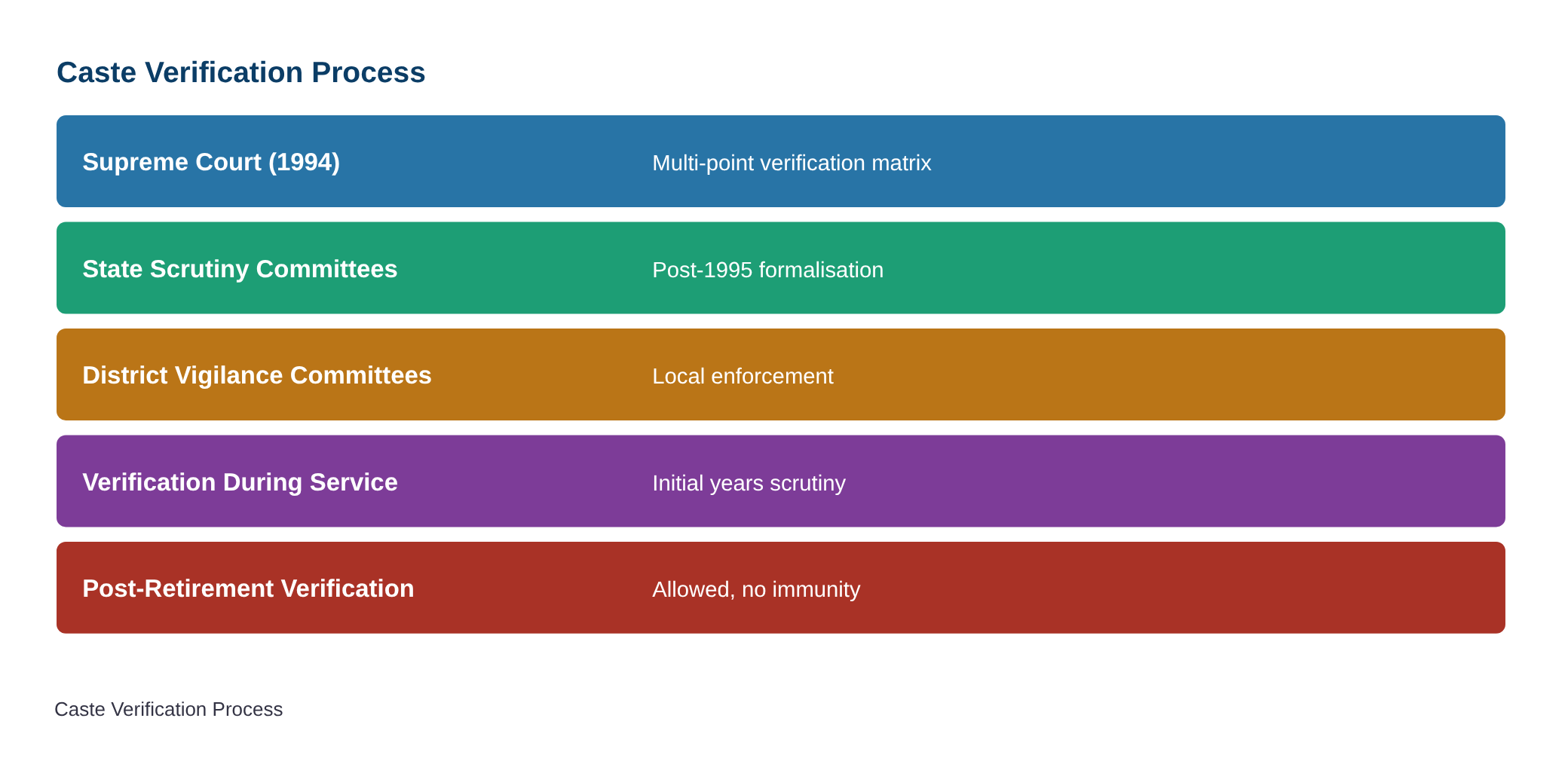
- The Supreme Court’s landmark judgment in *Kumari Madhuri Patil v. Additional Commissioner, Tribal Development* (1994) established a multi-point verification matrix for caste certificates to prevent fraudulent claims in public employment.
- Post-1995, several state governments, including Tamil Nadu, formalised procedures for caste verification through State Level Scrutiny Committees and district-level vigilance committees.
- The persistence of systemic backlogs and delayed verification processes has historically allowed fraudulent appointments to evade scrutiny, undermining the integrity of reservation policies.
- The Constitution (Articles 14, 15, and 16) mandates equality of opportunity in public employment and prohibits discrimination, necessitating rigorous mechanisms to prevent misuse of reservation benefits.
- The judgment responds to the growing concern over ‘foundational illegality’ in appointments secured through forged caste certificates, which cannot be insulated by retirement or retiral benefits.
What is the Legal Framework Governing Caste-Certificate Verification in Public Employment?
- **Constitutional Provisions**: Articles 14, 15(4), and 16(4) of the Constitution empower the state to make special provisions for the advancement of socially and educationally backward classes, including reservations in public employment. These provisions necessitate stringent verification to prevent misuse.
- *Kumari Madhuri Patil Case (1994)*: The Supreme Court laid down a **multi-point verification matrix** for caste certificates, including scrutiny by a **State Level Scrutiny Committee**, field enquiries, and anthropological verification to ensure authenticity. The judgment held that appointments secured through fraudulent caste certificates are *ab initio void*.
- *State-Level Mechanisms*: States like Tamil Nadu have established **State Level Scrutiny Committees** and **District Level Vigilance Committees** to verify caste certificates. These committees are empowered to initiate suo motu or on-referral enquiries into the genuineness of certificates.
- *Verification Process*: The process involves cross-verification with revenue records, caste enumeration data, and field enquiries conducted by anthropological experts to confirm the applicant’s caste claim. The verification must be completed within a reasonable timeframe to prevent dilatory tactics.
- *Foundational Illegality*: An appointment secured through a fraudulent caste certificate is legally void from inception (*ab initio*). Retiral benefits accrued from such appointments cannot be protected, as the foundational illegality taints the entire service period.
- *Post-Retirement Verification*: The Madras High Court’s ruling clarifies that **retirement does not extinguish the state’s power to verify caste certificates** or initiate disciplinary action against found fraudulent appointments. The verification process, if initiated prior to retirement, must be concluded post-retirement to uphold constitutional accountability.
- *Fast-Track Mechanisms*: The court directed public employers to prioritise verification within the **initial years of service** to prevent accumulation of backlogs and to ensure timely detection of fraudulent entries.
Key Features
| Feature | Significance |
|---|---|
| Post-retirement verification of community certificates | Affirms that fraudulent appointments cannot be insulated by retirement, upholding constitutional accountability and administrative integrity. |
| Full Bench ruling on Kumari Madhuri Patil (1994) compliance | Clarifies that procedural mechanics established by the Supreme Court apply universally, irrespective of the certificate’s issuance date or employment tenure. |
| Mandate for institutional strengthening | Directs Tamil Nadu to fortify State and district-level scrutiny committees with manpower and anthropological experts to eliminate systemic backlogs. |
| Timely verification within initial service years | Requires public employers to initiate and complete verification processes early, preventing dilatory tactics and ensuring fairness. |
| Fast-track inquiries post-retirement | Ensures that verification processes initiated before retirement are not abandoned, maintaining constitutional rigour without undue harassment. |
Why it Matters
Constitutional & Legal
- Upholds the principle that appointments secured through fraud are void *ab initio*, rendering retirement irrelevant to legal consequences.
- Reinforces the Supreme Court’s directives in *Kumari Madhuri Patil v. Additional Commissioner* (1994) regarding multi-point verification of caste certificates.
- Prevents misuse of procedural delays to shield illegitimate appointments, ensuring adherence to constitutional morality.
Administrative & Governance
- Mandates institutional capacity-building to address systemic inefficiencies in caste certificate verification processes.
- Promotes transparency and accountability in public employment, particularly in reserved categories.
- Reduces the likelihood of fraudulent claims persisting undetected due to delayed scrutiny.
Social Justice
- Protects the integrity of reservation policies by ensuring only genuine beneficiaries access benefits.
- Balances fairness with rigour, preventing harassment while maintaining strict compliance with verification protocols.
Challenges
1. Systemic Backlogs in Verification
- Inadequate manpower and expertise in scrutiny committees may delay verification processes.
- Risk of prolonged inquiries leading to undue harassment of employees, despite judicial safeguards.
UPSC Link: GS-II: Reservation Policies and Challenges
2. Interpretational Conflicts in Jurisprudence
- Conflicting decisions by Division Benches necessitated a Full Bench ruling to establish clarity.
- Potential for future litigation if lower courts interpret the ruling inconsistently.
UPSC Link: GS-II: Judicial Review and Administrative Law
3. Balancing Fairness and Rigour
- Ensuring verification processes are thorough yet not oppressive, particularly post-retirement.
- Avoiding delays that could render findings inconsequential or complicate retiral benefits.
UPSC Link: GS-II: Administrative Ethics and Procedural Justice
4. Institutional Capacity Constraints
- Limited anthropological expertise in district-level committees may undermine verification quality.
- Need for sustained funding and training to sustain institutional reforms.
UPSC Link: GS-II: Governance and Public Administration
Challenges — UPSC Perspective
| Issue | Concern |
|---|---|
| Manpower shortages in scrutiny committees | Delays in verification processes, undermining timely justice. |
| Potential for harassment in post-retirement inquiries | Risk of procedural overreach despite judicial safeguards. |
| Interpretational ambiguities in caste verification laws | Likelihood of inconsistent application across jurisdictions. |
| Resource constraints in institutional strengthening | Inability to sustain long-term reforms without adequate funding. |
| Balancing constitutional accountability with procedural fairness | Risk of either undermining reservation policies or enabling fraud. |
Way Forward
- State governments must expedite the strengthening of State and district-level scrutiny committees with anthropological experts and administrative staff.
- Public employers should institutionalise early verification of community certificates within the first three years of service for all employees.
- Fast-track mechanisms should be established for post-retirement inquiries to prevent procedural delays.
- Judicial training programmes should be conducted to ensure consistent interpretation of *Kumari Madhuri Patil* guidelines.
- Transparency in verification processes should be enhanced through periodic public reporting of findings.
- Mechanisms for grievance redressal should be created to address concerns of employees subjected to verification.
- Collaboration with academic institutions should be pursued to augment expertise in caste verification methodologies.
UPSC Value Addition
Keywords for Mains Answer-Writing
Community Certificate verification · Madras High Court Full Bench judgment · Caste certification scrutiny · Retirement and legal accountability · Supreme Court’s Kumari Madhuri Patil case · State Level Scrutiny Committee · Constitutional accountability in public employment · Void ab initio appointments · Anthropological verification in caste certification · Procedural fairness in administrative law
Constitutional & Policy Linkages
- [‘Article 14: Equality before law and equal protection’, ‘Ensures non-discriminatory application of verification processes.’]
- [‘Article 16(4): Reservation in public employment’, ‘Upholds the integrity of reservation policies against fraudulent claims.’]
- [‘Article 341: Scheduled Castes and Scheduled Tribes’, ‘Reinforces the need for accurate caste verification.’]
Concept Flow
Appointment secured through fraudulent community certificate → Verification process initiated during service or post-retirement → Full Bench ruling: Fraud vitiates appointment *ab initio*, rendering retirement irrelevant → Judicial direction to complete verification without procedural lapses → Institutional strengthening of scrutiny committees for rigorous compliance → Timely verification within initial service years to prevent dilatory tactics → Constitutional accountability upheld, reservation policies protected
Prelims Practice Questions
Q1. Consider the following statements regarding the verification of community certificates in India:
1. The Supreme Court’s Kumari Madhuri Patil case (1994) established a multi-point verification matrix for caste certificates.
2. The Madras High Court has ruled that verification of community certificates can be initiated even after an employee’s retirement.
3. The verification process must be completed within the initial years of an employee’s service as per the Madras High Court directive.
4. The verification of community certificates is applicable only to appointments made after 1995.
How many of the above statements are correct?
- Only one
- Only two
- Only three
- All
Answer: Only three — Statements 1, 2, and 3 are correct. Statement 4 is incorrect as the Madras High Court held that verification is permissible irrespective of the year of appointment or issuance of the certificate.
Q2. Assertion (A): The Madras High Court Full Bench held that an appointment obtained by fraud is void ab initio and cannot be protected by retirement.
Reason (R): The court ruled that procedural mechanics established by the Supreme Court in Kumari Madhuri Patil’s case do not grant immunity to older deceptions.
Options:
A. Both A and R are true, and R is the correct explanation of A.
B. Both A and R are true, but R is not the correct explanation of A.
C. A is true, but R is false.
D. A is false, but R is true.
- A
- B
- C
- D
Answer: A — Both the Assertion (A) and Reason (R) are true, and R correctly explains A as the court emphasized that fraud has no expiry date and cannot be shielded by retirement.
Q3. Match the following provisions/committees with their respective roles in the verification of community certificates:
Column I (Provision/Committee)
1. Kumari Madhuri Patil case (1994)
2. State Level Scrutiny Committee
3. District Level Vigilance Committees
4. Article 16(4) of the Constitution
Column II (Role)
A. Establishes a multi-point verification matrix for caste certificates
B. Empowered to verify the genuineness of community certificates
C. Ensures compliance with verification protocols at the district level
D. Provides for reservation in public employment for socially and educationally backward classes
Options:
1-A, 2-B, 3-C, 4-D
1-B, 2-A, 3-D, 4-C
1-C, 2-D, 3-A, 4-B
1-D, 2-C, 3-B, 4-A
- 1-A, 2-B, 3-C, 4-D
- 1-B, 2-A, 3-D, 4-C
- 1-C, 2-D, 3-A, 4-B
- 1-D, 2-C, 3-B, 4-A
Answer: 1-A, 2-B, 3-C, 4-D — 1-A: Kumari Madhuri Patil case established the verification matrix. 2-B: State Level Scrutiny Committee verifies community certificates. 3-C: District Level Vigilance Committees ensure compliance at the district level. 4-D: Article 16(4) provides for reservation.
Mains Practice Question
✍ The Madras High Court has recently held that verification of the genuineness of community certificates can be undertaken even after an employee’s retirement, as appointments obtained by fraud are void ab initio. Critically examine the legal and constitutional implications of this judgment with reference to the Supreme Court’s directives in Kumari Madhuri Patil’s case. Also, discuss the institutional mechanisms required to ensure procedural fairness in such verifications. (15 Marks)
Approach: MODEL-ANSWER SKELETON:
1. **Introduction**: Briefly define community certificates and their significance in public employment under Articles 15(4) and 16(4) of the Constitution. Mention the Supreme Court’s Kumari Madhuri Patil case (1994) and its multi-point verification matrix.
2. **Judicial Reasoning in the Madras High Court Judgment**:
– Explain the Full Bench’s reasoning that fraud vitiates appointments ab initio, rendering retirement irrelevant.
– Highlight the court’s emphasis on constitutional accountability and the impermissibility of dilatory tactics.
– Reference the court’s directive to strengthen the State Level Scrutiny Committee and district vigilance committees with anthropological experts.
3. **Legal and Constitutional Implications**:
– **Void Ab Initio Doctrine**: Discuss the legal principle that fraudulent appointments are void from inception, citing relevant case law.
– **Constitutional Accountability**: Explain how the judgment reinforces the principle of equality and non-discrimination under Articles 14 and 16.
– **Retrospective Verification**: Analyze the permissibility of retrospective verification and its impact on retiral benefits.
4. **Institutional Mechanisms for Procedural Fairness**:
– **State Level Scrutiny Committee**: Role in verifying caste certificates and ensuring compliance with the Supreme Court’s directives.
– **District Level Vigilance Committees**: Function in local-level verification and grievance redressal.
– **Anthropological Experts**: Importance of expert involvement in verifying caste claims to prevent misuse.
– **Timelines for Verification**: Discuss the court’s directive to complete verification within the initial years of service.
5. **Challenges and Balancing Fairness**:
– **Potential for Harassment**: Address the court’s concern about delayed procedures being used as tools of harassment.
– **Right to Fair Hearing**: Ensure that employees are given adequate notice and opportunity to present evidence.
– **Data Privacy**: Discuss the need to balance verification with privacy concerns under the Right to Privacy (Puttaswamy judgment).
6. **Conclusion**: Summarize the judgment’s significance in upholding constitutional integrity while ensuring procedural fairness. Emphasize the need for robust institutional mechanisms to prevent fraud in public employment.
Source: The Hindu
Generated by AanyaAi for educational purpose.

- महाराष्ट्र में त्योहार जुलूसों पर बॉम्बे हाईकोर्ट का बड़ा फैसला: पटाखे, लेजर और संगीत पर रोक - September 24, 2026
- Bombay HC Bans Firecrackers, Music in Maharashtra Processions: Key UPSC Analysis - September 24, 2026
- तमिलनाडु में महिला कर्मचारियों के लिए सवैतनिक माहवारी अवकाश नीति पर HC का आदेश - September 24, 2026

No Comments