


08 Aug How IIT Madras is Teaching AI to Understand India’s Languages
AI training datasetsLinguistic diversityDigital inclusionMultilingual modelsPolicy framework✎ AI4Bharat’s initiative underscores the critical need to bridge the digital language divide by developing AI models trained on India’s linguistic diversity, thereby ensuring inclusive technological access and preserving cultural…
Subject Relevance — Where This Topic Fits
- GS Paper II — Governance, Administration and Challenges (Digital Public Infrastructure) | GS Paper III — Science and Technology (AI, Data Governance, and Digital Divide)
- Prelims: AI4Bharat, IIT Madras, low-resource languages, digital language data, linguistic diversity, AI accessibility, natural language processing (NLP), dialect preservation, multilingual AI models
- Essay: The Role of Technology in Bridging Linguistic Divides: A Case for Inclusive AI in India, Preserving Cultural Heritage in the Digital Age: Challenges and Opportunities
Quick Revision: AI4Bharat’s initiative underscores the critical need to bridge the digital language divide by developing AI models trained on India’s linguistic diversity, thereby ensuring inclusive technological access and preserving cultural heritage.
Why is this in the news?
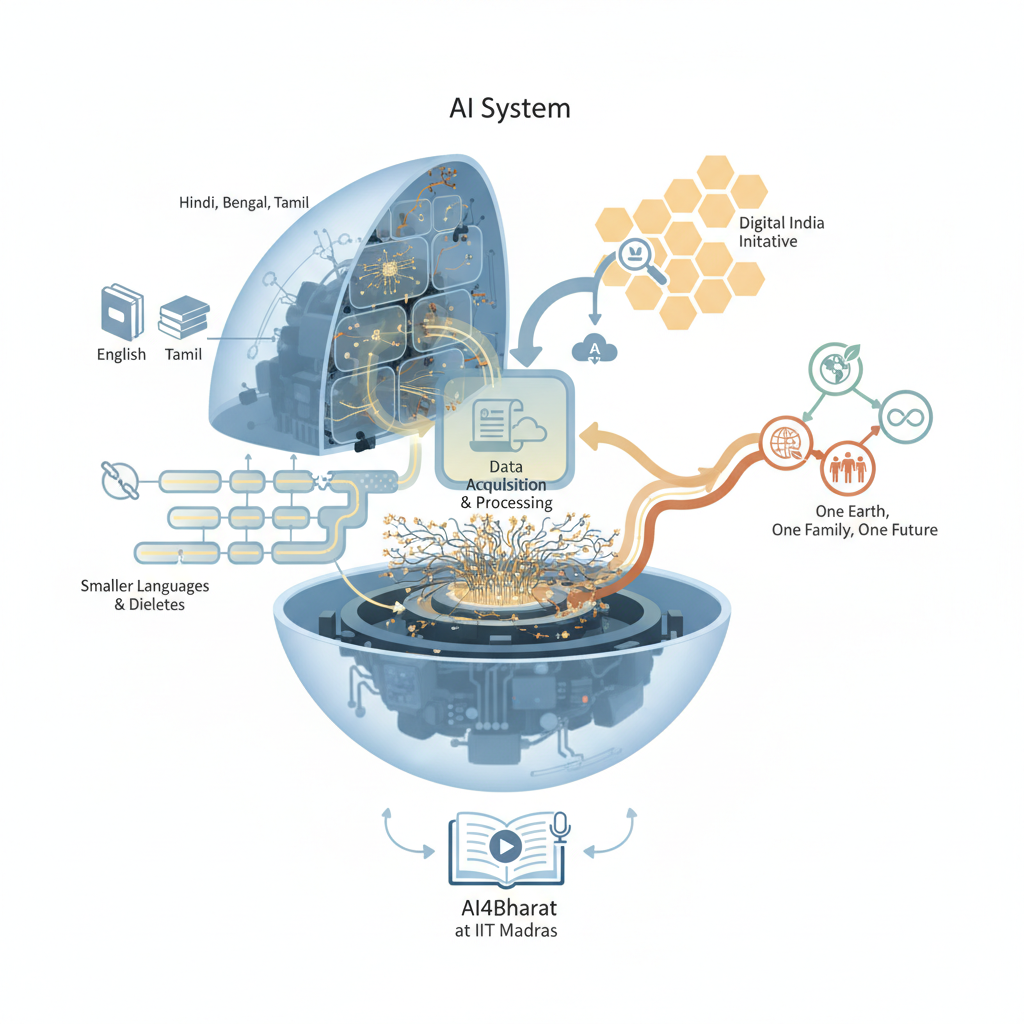
The initiative by AI4Bharat at IIT Madras, aimed at teaching AI systems to understand and process India’s vast linguistic diversity, has gained prominence due to its potential to democratise access to technology. By addressing the scarcity of digital data for many Indian languages, this endeavour aligns with broader goals of linguistic inclusion and digital empowerment, particularly in the context of India’s G20 Presidency theme of ‘One Earth, One Family, One Future,’ which underscores the importance of inclusive growth.
Background
- The dominance of English and a few major Indian languages (e.g., Hindi, Bengali, Tamil) in digital content creates a significant digital divide, leaving smaller languages and dialects underrepresented in AI training datasets.
- The Digital India initiative aims to promote multilingualism and digital inclusion, providing a policy framework for such technological interventions.
- AI systems, including large language models (LLMs), rely heavily on vast textual and audio datasets for training, which are predominantly available in high-resource languages like English, Mandarin, or Spanish.
- The lack of digital data for low-resource languages hinders the development of inclusive AI applications, exacerbating socio-economic disparities in access to technology.
- AI4Bharat, a research lab at IIT Madras, was established to address these gaps by developing AI models tailored to India’s linguistic landscape.
What is AI4Bharat’s approach to teaching AI Indian languages?
- AI4Bharat employs a data-driven methodology to collect and curate linguistic data from across India, including spoken dialects, regional accents, and colloquial expressions that lack standardised written forms.
- The initiative focuses on ‘low-resource languages’—languages with minimal digital presence—by recording native speakers, transcribing conversations, and annotating linguistic nuances to build robust datasets for AI training.
- Researchers utilise a combination of field surveys, community engagement, and crowdsourcing to gather authentic language samples, ensuring representation from marginalised and indigenous communities.
- The project leverages advancements in natural language processing (NLP) and speech recognition technologies to develop AI models capable of understanding and generating speech in diverse Indian languages.
- AI4Bharat’s work extends beyond mere translation; it aims to enable AI systems to comprehend contextual meaning, idiomatic expressions, and cultural references unique to regional languages.
- The initiative collaborates with academic institutions, government agencies, and private sector partners to scale its efforts and integrate its findings into mainstream AI development pipelines.
- A key challenge addressed is the variability in pronunciation, grammar, and vocabulary across dialects, which requires AI models to be trained on region-specific datasets to achieve accuracy.
- The long-term goal is to integrate these AI models into public digital infrastructure, such as government portals, educational platforms, and healthcare services, to enhance accessibility for non-English speakers.
Key Features
| Feature | Significance |
|---|---|
| Multilingual Speech Data Collection | Creates a foundational corpus of spoken and written Indian languages, including low-resource dialects, to train AI models with authentic linguistic diversity. |
| Dialectal and Accent Mapping | Documents regional variations in pronunciation, vocabulary, and syntax, enabling AI to recognise and adapt to India’s linguistic heterogeneity. |
| AI Model Fine-Tuning for Indian Languages | Develops language-specific models that can process colloquial, mixed-language (e.g., Hinglish), and non-standardised speech forms. |
| Preservation of Endangered Languages | Digitises oral traditions and dialects before they vanish, ensuring their inclusion in India’s digital knowledge ecosystem. |
| Real-Time Translation and Speech Synthesis | Enables AI systems to translate and vocalise Indian languages with contextual accuracy, improving accessibility for non-English speakers. |
Why it Matters
Technological Sovereignty
- Reduces dependency on foreign AI models trained predominantly on English and European languages.
- Strengthens India’s position in global AI innovation by developing indigenous language-capable systems.
- Facilitates the creation of India-specific AI applications for governance, education, and commerce.
Digital Inclusion
- Bridges the linguistic divide by making technology accessible to non-English speakers in rural and remote areas.
- Empowers marginalised communities, including tribal and minority language speakers, through culturally relevant AI tools.
- Supports the Digital India mission by ensuring digital services are available in local languages.
Economic Potential
- Unlocks new markets for AI-driven products and services tailored to India’s linguistic diversity.
- Enhances the competitiveness of Indian tech firms in the global AI landscape by offering multilingual solutions.
- Stimulates job creation in AI training, data annotation, and linguistic research.
Cultural Preservation
- Safeguards India’s intangible cultural heritage by documenting and digitising endangered languages and dialects.
- Promotes linguistic diversity as a national asset, aligning with constitutional values of pluralism and inclusivity.
Governance and Public Service Delivery
- Improves the efficiency of citizen-government interactions by enabling AI-driven services in local languages.
- Supports the implementation of schemes like e-gram Swaraj and Ayushman Bharat in linguistically diverse regions.
Challenges
1. Data Scarcity for Low-Resource Languages
- Limited digital text and speech corpora for many Indian languages, particularly tribal and regional dialects.
- High cost and logistical challenges in collecting primary data from remote and underserved communities.
UPSC Link: GS Paper 3: Science & Tech / GS Paper 1: Social Issues
2. Linguistic Heterogeneity
- Extreme variability in pronunciation, vocabulary, and grammar even within the same language across regions.
- Presence of mixed-language forms (e.g., Hinglish, Tanglish) complicates AI training and standardisation.
UPSC Link: GS Paper 1: Indian Society / GS Paper 2: Governance
3. Standardisation vs. Authenticity
- Balancing the need for standardised language models with the preservation of regional authenticity and colloquialisms.
- Risk of over-standardisation eroding linguistic diversity and cultural identity.
UPSC Link: GS Paper 1: Social Justice / GS Paper 4: Ethics
4. Ethical and Privacy Concerns
- Ensuring informed consent and data privacy for speakers of endangered languages during data collection.
- Mitigating biases in AI models that may favour dominant languages or dialects over marginalised ones.
UPSC Link: GS Paper 4: Ethics / GS Paper 2: Fundamental Rights
5. Computational and Infrastructure Constraints
- High computational costs for training multilingual AI models on diverse datasets.
- Limited access to advanced AI infrastructure in academic and research institutions outside major metros.
UPSC Link: GS Paper 3: Science & Tech / GS Paper 2: Governance
6. Policy and Regulatory Gaps
- Lack of clear guidelines on data ownership, usage rights, and intellectual property for language datasets.
- Need for a national framework to coordinate efforts across institutions, states, and private sector stakeholders.
UPSC Link: GS Paper 2: Governance / GS Paper 3: Economy
Challenges — UPSC Perspective
| Issue | Concern |
|---|---|
| Data Availability | Insufficient digital corpora for low-resource languages hinders AI training and accuracy. |
| Regional Variations | Diverse accents, dialects, and mixed-language forms complicate AI comprehension and response generation. |
| Ethical Considerations | Data collection from marginalised communities raises consent, privacy, and bias mitigation challenges. |
| Infrastructure Gaps | Limited computational resources and AI expertise constrain large-scale model development. |
| Policy Ambiguity | Absence of national guidelines on language data ownership and usage creates legal and operational uncertainties. |
| Cultural Sensitivity | Risk of misrepresenting or erasing linguistic nuances when standardising AI models. |
Way Forward
- Establish a National Language Data Repository under aegis of MeitY or UGC to centralise and standardise language datasets for AI training.
- Launch targeted grants and fellowships for linguists, AI researchers, and data annotators to document endangered languages and dialects.
- Develop a National AI Language Mission with multi-stakeholder participation (government, academia, private sector, and civil society) to coordinate efforts.
- Integrate language diversity considerations into the National Education Policy 2020 to promote multilingual AI literacy in schools and higher education.
- Create public-private partnerships to deploy AI language models in governance, healthcare, and education, ensuring equitable access.
- Strengthen computational infrastructure in tier-2 and tier-3 institutions to democratise AI research capabilities.
- Formulate a National Language Data Policy to address ownership, consent, and ethical use of linguistic data in AI development.
- Promote citizen science initiatives where communities contribute to AI training datasets through crowdsourced language documentation.
UPSC Value Addition
Keywords for Mains Answer-Writing
Artificial Intelligence · Natural Language Processing · Digital Divide · Linguistic Diversity · Low-resource Languages · AI4Bharat Initiative · IIT Madras · Digital Public Infrastructure · Language Preservation · AI Ethics · Multilingualism · Data Sovereignty
Constitutional & Policy Linkages
- Article 351: Directive for development and enrichment of the Hindi language and other Indian languages.
Concept Flow
India’s linguistic diversity → Data scarcity for low-resource languages → Need for authentic speech corpora → AI4Bharat’s multilingual data collection → Training of AI models → Development of language-specific algorithms → Deployment in public and private services → Enhanced digital inclusion and technological sovereignty
Prelims Practice Questions
Q1. Consider the following statements about AI4Bharat’s work on Indian languages:
1. AI4Bharat is a research lab at IIT Madras focused on teaching AI to understand Indian languages.
2. The initiative primarily relies on digital content from English-language sources to train AI models.
3. Indian languages with limited digital data are classified as ‘low-resource languages’.
4. The project aims to preserve dialects and accents by collecting voice data across India.
How many of the above statements are correct?
- Only one
- Only two
- Only three
- All four
Answer: All four — Statements 1, 3, and 4 are correct. Statement 2 is incorrect because AI4Bharat collects indigenous language data rather than relying solely on English sources.
Q2. Assertion (A): Most AI systems trained on English-language datasets struggle to understand Indian languages due to their linguistic diversity and limited digital data.
Reason (R): Indian languages often lack standardized written forms, exhibit regional dialects, and have fewer digital resources compared to English.
In the context of the above statements, which of the following is correct?
- Both A and R are true, and R is the correct explanation of A.
- Both A and R are true, but R is not the correct explanation of A.
- A is true, but R is false.
- A is false, but R is true.
Answer: Both A and R are true, and R is the correct explanation of A. — Both the assertion and reason are true, and the reason correctly explains the assertion. AI models trained primarily on English data face challenges with Indian languages due to their diversity and limited digital resources.
Q3. Match the following initiatives with their respective objectives:
Column I (Initiative) | Column II (Objective)
————————————-|—————————————-
1. AI4Bharat | A. Preserving indigenous languages and dialects through voice data collection
2. Digital India Programme | B. Developing AI models for Indian languages
3. National Education Policy 2020 | C. Enhancing digital infrastructure and accessibility
4. Bhasha Sangam Initiative | D. Promoting multilingualism in education
Select the correct match:
- 1-A, 2-C, 3-D, 4-B
- 1-B, 2-C, 3-D, 4-A
- 1-B, 2-A, 3-C, 4-D
- 1-A, 2-D, 3-C, 4-B
Answer: 1-B, 2-C, 3-D, 4-A — 1-B: AI4Bharat focuses on developing AI models for Indian languages. 2-C: Digital India Programme aims to enhance digital infrastructure. 3-D: NEP 2020 promotes multilingualism in education. 4-A: Bhasha Sangam Initiative preserves indigenous languages.
Mains Practice Question
✍ Critically examine the challenges posed by India’s linguistic diversity to the development of Artificial Intelligence systems capable of understanding Indian languages. Also, discuss the role of initiatives like AI4Bharat in addressing these challenges. (15 Marks)
Approach: MODEL-ANSWER SKELETON:
1. **Introduction** (2 marks): Define linguistic diversity in India and its significance; introduce AI and its dependence on data.
2. **Challenges** (6 marks):
– **Low-resource languages**: Lack of digital data (e.g., Santali, Tulu, Kodava) and absence of standardized written forms.
– **Dialectal variations**: Regional accents and dialects (e.g., Bundeli vs. Braj) complicate AI training.
– **Oral traditions**: Many languages are primarily spoken, with no formal grammar or lexicon.
– **Data bias**: Over-reliance on English and Hindi datasets skews AI performance.
3. **AI4Bharat’s Role** (4 marks):
– **Data collection**: Fieldwork to gather voice samples and preserve dialects.
– **Model development**: Training AI on indigenous datasets to improve accuracy.
– **Collaborative approach**: Partnerships with local communities and institutions.
4. **Limitations and Ethical Considerations** (3 marks):
– **Data sovereignty**: Risks of commercial exploitation of indigenous linguistic data.
– **Bias mitigation**: Ensuring representation of marginalized languages and communities.
– **Scalability**: Challenges in extending the model to all 121 languages recognized by the Census.
5. **Conclusion** (2 marks): Balance between technological advancement and cultural preservation; emphasize the need for sustained public investment in digital public infrastructure.
Source: The Hindu
Generated by AanyaAi for educational purpose.

- महाराष्ट्र में त्योहार जुलूसों पर बॉम्बे हाईकोर्ट का बड़ा फैसला: पटाखे, लेजर और संगीत पर रोक - September 24, 2026
- Bombay HC Bans Firecrackers, Music in Maharashtra Processions: Key UPSC Analysis - September 24, 2026
- तमिलनाडु में महिला कर्मचारियों के लिए सवैतनिक माहवारी अवकाश नीति पर HC का आदेश - September 24, 2026

No Comments