


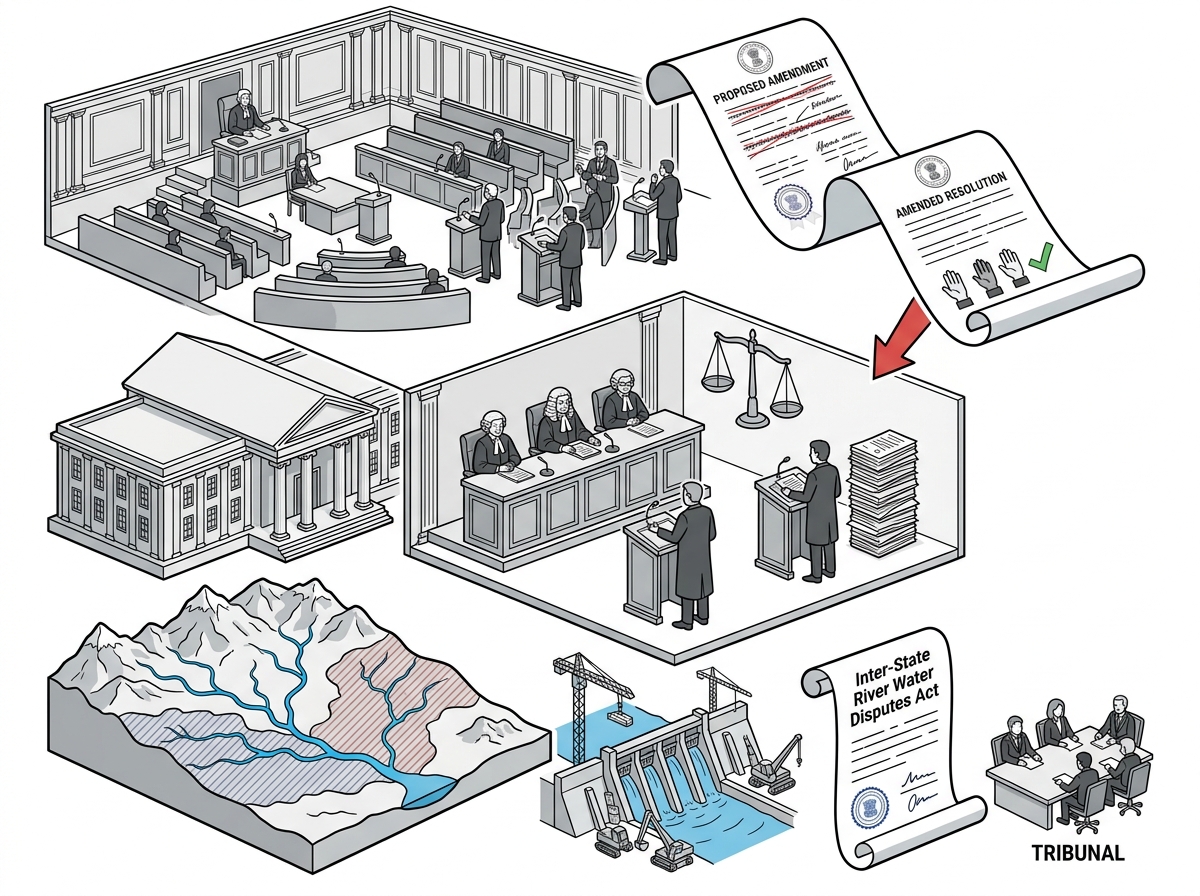
08 Aug Tamil Nadu Assembly Unanimously Passes Mekedatu Dam Resolution
Legislative AssemblyAmended resolutionMekedatu DamSpecial tribunalInter-State River Water Disputes A✎ The Union Government’s power to constitute a special tribunal under Section 4 of the Inter-State River Water Disputes Act, 1956, is discretionary but must be exercised in accordance with constitutional principles of federalism…
Subject Relevance — Where This Topic Fits
- GS Paper II — Functions and Responsibilities of the Union and the States | GS Paper II — Dispute Resolution Mechanisms in Federal Polity | GS Paper III — Water Resources and their Management
- Prelims: Inter-State River Water Disputes Act, 1956, Article 262 of the Constitution, Special Tribunal under Section 4 of the Inter-State River Water Disputes Act, Cauvery Water Disputes Tribunal, River Cauvery, Tamil Nadu Legislative Assembly, Madras High Court, Jal Shakti Ministry
- Essay: Federalism and Centre-State Relations: Balancing Autonomy and Cooperation in Water Governance, Judicial Review vs. Legislative Sovereignty: The Role of Courts in Inter-State Water Disputes
Quick Revision: The Union Government’s power to constitute a special tribunal under Section 4 of the Inter-State River Water Disputes Act, 1956, is discretionary but must be exercised in accordance with constitutional principles of federalism and inter-state equity.
Why is this in the news?
The Madras High Court is currently adjudicating a writ petition challenging the constitutional validity of an amended resolution passed unanimously by the Tamil Nadu Legislative Assembly on June 19, 2026. The resolution, moved by the Chief Minister and amended by the Leader of the Opposition, urges the Union Government to constitute a special tribunal under Section 4 of the Inter-State River Water Disputes Act, 1956 to exclusively adjudicate the Mekedatu Dam dispute between Tamil Nadu and Karnataka. The Advocate General of Tamil Nadu has submitted before the Court that the amended resolution was duly debated and passed, while the petitioner contends it was not debated at all, raising critical questions about legislative procedure, federalism, and the judicial review of legislative actions.
Background
- The Mekedatu Dam project, proposed by Karnataka across the River Cauvery, has been a long-standing inter-state dispute involving Tamil Nadu and Karnataka, with Tamil Nadu opposing the project on grounds of water-sharing violations and ecological concerns.
- The Cauvery Water Disputes Tribunal (CWDT), constituted under the Inter-State River Water Disputes Act, 1956, delivered its final award in 2007, allocating water shares between the riparian states. However, Karnataka’s proposal for the Mekedatu Dam has been contested by Tamil Nadu as a violation of the CWDT award.
- Tamil Nadu has consistently argued that the Mekedatu Dam would reduce downstream water availability, adversely affecting its agriculture and drinking water security, while Karnataka maintains the project is for drinking water and hydroelectric purposes.
- The Inter-State River Water Disputes Act, 1956, provides for the adjudication of inter-state river water disputes through tribunals, with Section 4 empowering the Union Government to constitute such tribunals upon receiving a request from a state government.
- The Union Ministry of Jal Shakti, as the nodal agency for water resources, plays a pivotal role in constituting tribunals and mediating inter-state water disputes.
- The present legal challenge arises in the context of Tamil Nadu’s legislative assertion of its rights over the River Cauvery, juxtaposed against the Union Government’s discretionary powers under the Act.
What is the Mekedatu Dam Dispute?
- The Mekedatu Dam is a proposed multi-purpose project by Karnataka across the River Cauvery, located near the Karnataka-Tamil Nadu border, aimed at supplying drinking water to Bengaluru and generating hydroelectric power.
- Tamil Nadu has opposed the project, contending that it violates the final award of the Cauvery Water Disputes Tribunal (2007), which allocated specific water shares to each riparian state, and that the dam would reduce downstream water availability for Tamil Nadu’s agriculture and drinking water needs.
- The dispute exemplifies the broader challenges of inter-state water governance in India, where competing claims over shared river basins often lead to legal and political conflicts between states.
- The Inter-State River Water Disputes Act, 1956, provides the legal framework for resolving such disputes, empowering the Union Government to constitute tribunals to adjudicate claims and allocate water shares.
- Section 4 of the Act empowers the Union Government to constitute a tribunal upon a request from a state government, which Tamil Nadu has invoked through its legislative resolution.
- The Union Government’s role is critical, as it must balance the demands of the disputing states while ensuring compliance with constitutional provisions and inter-state agreements.
- The dispute also highlights the tension between state autonomy in water resource management and the Union Government’s constitutional responsibility to ensure equitable distribution and prevent inter-state conflicts.
- The legal proceedings in the Madras High Court will determine the procedural validity of Tamil Nadu’s amended resolution and its implications for the Union Government’s discretion in constituting tribunals under the Act.
Key Features
| Feature | Significance |
|---|---|
| Unanimous Assembly Resolution | Demonstrates Tamil Nadu’s unified political stance on the Mekedatu Dam dispute, strengthening the State’s negotiating position with the Centre and Karnataka. |
| Amendment to Resolution | Inclusion of a demand for a special tribunal under Section 4 of the Inter-State River Water Disputes Act, 1956, elevates the dispute to a legal-administrative level, bypassing direct negotiations. |
| Advocate General’s Submission | Provides legal validation to the Assembly’s proceedings, asserting procedural correctness and the Chief Minister’s leadership in pursuing the matter. |
| Judicial Notice to Respondents | Initiates a formal judicial process, requiring counter-affidavits from the Assembly Secretary, Chief Secretary, and Union Ministry of Jal Shakti within a stipulated timeline. |
| Opposition’s Role | Leader of Opposition’s amendment request underscores bipartisan consensus, though procedural disputes remain unresolved in the legal challenge. |
Why it Matters
Inter-State Water Dispute
- The Mekedatu Dam dispute exemplifies the constitutional and administrative challenges in resolving transboundary river water-sharing conflicts under the Inter-State River Water Disputes Act, 1956.
- A special tribunal under Section 4 of the Act is empowered to adjudicate disputes, ensuring a structured legal framework rather than ad-hoc negotiations.
- The dispute highlights the tension between federalism and state autonomy in natural resource management, particularly in river basins shared by multiple states.
Political and Governance Implications
- The unanimous resolution reflects Tamil Nadu’s political unity, which can enhance its bargaining power in inter-state negotiations and legal proceedings.
- The procedural dispute over the amendment’s adoption raises questions about legislative transparency and the role of opposition in state assemblies.
- The Chief Minister’s leadership in convening legal consultations demonstrates proactive governance, though it has invited judicial scrutiny.
Judicial and Legal Dimensions
- The Madras High Court’s intervention underscores the judiciary’s role in resolving disputes that transcend executive and legislative jurisdictions.
- The requirement for counter-affidavits from key administrative and central government authorities indicates the court’s intent to examine the legality and procedural validity of the resolution.
- The dispute may set a precedent for how future inter-state water disputes are framed and adjudicated, balancing legal and political considerations.
Economic and Environmental Concerns
- The Mekedatu Dam, if constructed, could alter the Cauvery river’s flow, impacting irrigation, drinking water supply, and ecological balance in both Karnataka and Tamil Nadu.
- The dispute’s resolution could influence future dam projects in the Cauvery basin, affecting agricultural productivity and hydroelectric power generation.
- Environmental impact assessments and inter-state agreements on water allocation remain critical unresolved issues.
Challenges
1. Procedural Legitimacy of Legislative Amendment
- The AIADMK’s challenge questions whether the amendment was debated and adopted in accordance with legislative rules, raising concerns about transparency and procedural correctness.
- The absence of recorded objections during the vote complicates the legal assessment of the amendment’s validity.
- The court’s scrutiny of the amendment’s adoption process may set standards for future legislative amendments in contentious matters.
UPSC Link: Parliamentary Procedures and State Legislature Rules
2. Federalism and Centre-State Relations
- The Centre’s role in constituting a special tribunal under the 1956 Act is pivotal, but its reluctance or delay could exacerbate inter-state tensions.
- The dispute tests the Centre’s ability to mediate and enforce water-sharing agreements, balancing federal obligations with state demands.
- A lack of consensus on tribunal formation could lead to prolonged legal battles, delaying resolution and exacerbating water scarcity issues.
UPSC Link: Federalism in India
3. Judicial Overreach vs. Legislative Autonomy
- The court’s intervention in a legislative matter risks encroaching on the Assembly’s autonomy, raising constitutional questions about separation of powers.
- Balancing judicial review with respect for legislative processes is essential to maintain democratic governance.
- The outcome may influence how courts handle future disputes involving state legislatures and inter-state conflicts.
UPSC Link: Judicial Review and Separation of Powers
4. Environmental and Ecological Sustainability
- The construction of the Mekedatu Dam could disrupt the Cauvery river’s ecosystem, affecting biodiversity and downstream water availability.
- Inadequate environmental impact assessments and lack of consensus on mitigation measures pose long-term risks to the river basin.
- The dispute highlights the need for integrated water resource management and sustainable development practices in transboundary river basins.
UPSC Link: Environmental Governance and Sustainable Development
5. Political Polarisation and Consensus Building
- While the Assembly passed the resolution unanimously, the AIADMK’s legal challenge indicates underlying political divisions that could hinder consensus-building.
- Bipartisan support in legislative assemblies does not always translate to unified action in legal or administrative forums.
- The Chief Minister’s leadership in pursuing the matter may face opposition scrutiny, potentially delaying or complicating the dispute’s resolution.
UPSC Link: Role of Opposition in Indian Democracy
Challenges — UPSC Perspective
| Issue | Concern |
|---|---|
| Procedural Validity of Amendment | Whether the amendment to the resolution was debated and adopted in accordance with legislative rules, as claimed by the Assembly. |
| Centre’s Role in Tribunal Formation | The Centre’s obligation to constitute a special tribunal under Section 4 of the 1956 Act and its potential reluctance or delay. |
| Judicial Intervention in Legislative Matters | The extent to which the court can scrutinise legislative procedures without encroaching on the Assembly’s autonomy. |
| Environmental Impact of Dam Construction | Potential ecological disruption to the Cauvery river basin and lack of consensus on mitigation measures. |
| Political Consensus and Opposition Scrutiny | The risk of political polarisation undermining bipartisan support for the resolution and its legal pursuits. |
| Inter-State Water Sharing Agreements | The need for a legally binding framework to resolve disputes and prevent future conflicts over river water allocation. |
Way Forward
- The Union Ministry of Jal Shakti must expeditiously constitute the special tribunal under Section 4 of the Inter-State River Water Disputes Act, 1956, to adjudicate the Mekedatu Dam dispute.
- The Tamil Nadu Legislative Assembly should document and formalise its legislative procedures to ensure transparency and procedural correctness in future amendments.
- Both Tamil Nadu and Karnataka must engage in structured negotiations under the tribunal’s aegis to explore mutually acceptable solutions, including alternative water-sharing mechanisms.
- Environmental impact assessments for the Mekedatu Dam must be conducted in consultation with all stakeholders, with a focus on sustainable river basin management.
- The Centre should facilitate a multi-stakeholder dialogue involving state governments, environmental experts, and civil society to address long-term water security and ecological concerns.
- Political parties in Tamil Nadu should maintain bipartisan consensus on the dispute to strengthen the state’s negotiating position and avoid legal and administrative delays.
- Judicial forums should balance their role in dispute resolution with respect for legislative processes to uphold democratic principles and federalism.
- Academic and policy research institutions should analyse the Mekedatu dispute to derive lessons for managing future inter-state water conflicts in India.
UPSC Value Addition
Keywords for Mains Answer-Writing
Inter-State River Water Disputes (Amendment) Act, 2019 · Inter-State River Water Disputes Act, 1956 · Mekedatu Dam dispute · Cauvery River water sharing · Special Tribunal under Section 4 of ISRWD Act, 1956 · Tamil Nadu Legislative Assembly · Madras High Court · Inter-State Water Disputes Tribunal · Constitutional provisions on water disputes · Federalism and Centre-State relations · Judicial review of legislative resolutions · Union Ministry of Jal Shakti
Concept Flow
Tamil Nadu Legislative Assembly passes a resolution opposing the Mekedatu Dam → Leader of Opposition proposes an amendment to demand a special tribunal under the 1956 Act → Chief Minister accepts the amendment, and the Assembly passes the resolution unanimously → AIADMK challenges the amendment’s procedural validity before the Madras High Court → Advocate General submits the Assembly’s stance, asserting the amendment’s legitimacy → Court issues notices to respondents, initiating judicial scrutiny of the dispute → Centre’s decision on tribunal formation and inter-state negotiations determines the dispute’s resolution
Prelims Practice Questions
Q1. Consider the following statements regarding the Inter-State River Water Disputes Act, 1956:
1. The Act empowers the Union Government to constitute a tribunal for resolving inter-state river water disputes.
2. The Act was amended in 2019 to introduce a permanent tribunal for such disputes.
3. The Act mandates that the tribunal’s award shall be final and binding on the parties.
How many of the above statements are correct?
- Only one
- Only two
- All three
- None
Answer: All three — Statements 1 and 2 are correct. Statement 3 is incorrect as the Act does not mandate that the tribunal’s award is final and binding; it can be challenged in the Supreme Court under Article 136.
Q2. Assertion (A): The Mekedatu Dam dispute involves the states of Karnataka and Tamil Nadu over the Cauvery River.
Reason (R): The Cauvery River is governed by the Inter-State River Water Disputes Act, 1956, which provides for the constitution of a tribunal to resolve disputes.
Options:
A. Both A and R are true, and R is the correct explanation of A.
B. Both A and R are true, but R is not the correct explanation of A.
C. A is true, but R is false.
D. A is false, but R is true.
Answer: ? — Both the Assertion (A) and Reason (R) are true. The Mekedatu Dam dispute is indeed between Karnataka and Tamil Nadu over the Cauvery River. The Reason (R) correctly explains the legal framework governing such disputes under the Inter-State River Water Disputes Act, 1956.
Q3. Which of the following is NOT a function of the Union Ministry of Jal Shakti in the context of inter-state river water disputes?
A. Constituting tribunals under the Inter-State River Water Disputes Act, 1956.
B. Implementing the award of tribunals.
B. Mediating between states to reach a negotiated settlement.
D. Enforcing the provisions of the Inter-State River Water Disputes (Amendment) Act, 2019.
- A
- B
- C
- D
Answer: D — The Union Ministry of Jal Shakti does not enforce the provisions of the Inter-State River Water Disputes (Amendment) Act, 2019. Enforcement is a state subject. The Ministry’s role includes constituting tribunals, implementing tribunal awards, and mediating disputes.
Mains Practice Question
✍ The recent unanimous passage of an amended resolution by the Tamil Nadu Legislative Assembly urging the Centre to constitute a special tribunal under Section 4 of the Inter-State River Water Disputes Act, 1956, to resolve the Mekedatu Dam dispute reflects the constitutional and federal dimensions of inter-state water disputes in India. Critically analyse the legal and institutional framework governing such disputes, and evaluate the role of the judiciary in adjudicating these conflicts. (15 Marks)
Approach: MODEL-ANSWER SKELETON:
1. **Constitutional and Legal Framework** (4 points):
– Article 262 of the Constitution empowers Parliament to adjudicate inter-state water disputes.
– Inter-State River Water Disputes Act, 1956 (original) vs. Inter-State River Water Disputes (Amendment) Act, 2019 (permanent tribunal with rotating benches).
– Section 4 of the Act empowers the Union Government to constitute a tribunal upon receipt of a request from a state.
– Role of the Union Ministry of Jal Shakti in constituting tribunals and implementing awards.
2. **Institutional Mechanisms** (4 points):
– Original Act: Ad-hoc tribunals (e.g., Cauvery Water Disputes Tribunal, Krishna Water Disputes Tribunal).
– Amendment Act, 2019: Permanent tribunal with a chairperson, vice-chairperson, and members; time-bound resolution (3 years extendable to 5).
– Role of the Supreme Court: Judicial review under Article 136 and Article 32 for enforcement of tribunal awards.
– Federal tensions: Centre-State relations, cooperative federalism, and the principle of subsidiarity.
3. **Judicial Role and Recent Trends** (4 points):
– Judicial activism in water disputes (e.g., Cauvery case, 2018; Krishna-Godavari disputes).
– Balancing constitutional provisions (Article 262) with fundamental rights (Article 21: right to water).
– Recent Madras High Court order directing notices to the Assembly Secretary, Chief Secretary, and Union Ministry of Jal Shakti in the Mekedatu case.
– Critique: Delay in adjudication, lack of binding enforcement mechanisms, and political interference.
4. **Conclusion and Way Forward** (3 points):
– Need for stronger institutional mechanisms to ensure timely resolution.
– Role of mediation and negotiation alongside adjudication.
– Recommendations: Strengthening the permanent tribunal, ensuring transparency, and reducing political interference.
Source: The Hindu
Generated by AanyaAi for educational purpose.

- RBI to Sell ₹25,000 Crore Govt Securities via OMO on Sept 28, 2026 - September 23, 2026
- भारत-श्रीलंका नौसैनिक अभ्यास ‘स्लाईनेक्स-26’: विशाखापत्तनम में संपन्न, जानें प्रमुख बिंदु - September 23, 2026
- SLINEX-26: India-Sri Lanka Maritime Exercise Enhances Naval Cooperation - September 23, 2026

No Comments