


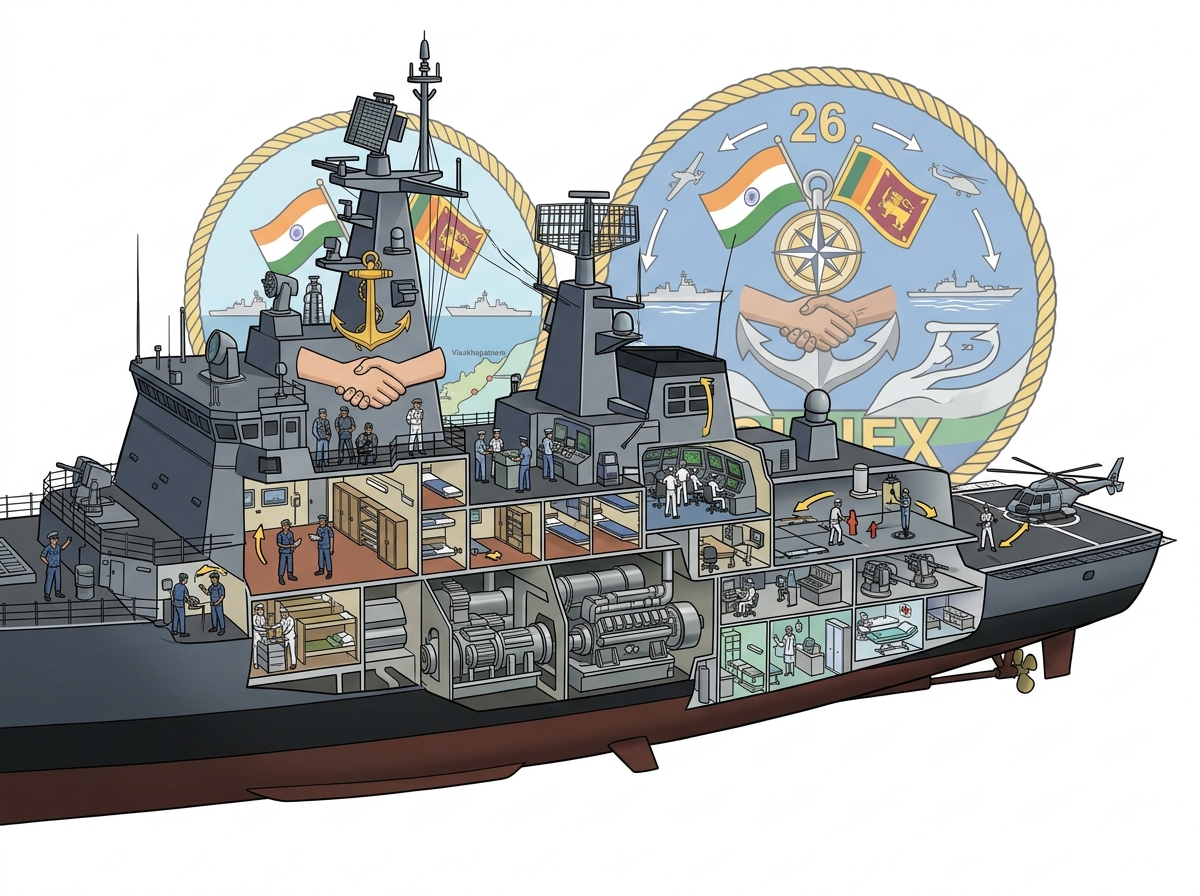
23 Sep SLINEX-26: India-Sri Lanka Maritime Exercise Enhances Naval Cooperation
✎ SLINEX-26 is a biennial India-Sri Lanka maritime exercise enhancing naval interoperability, operational coordination, and regional maritime security in the Indian Ocean Region.
Subject Relevance — Where This Topic Fits
- GS Paper II — International Relations — India and its Neighbourhood, Maritime Security, Regional Cooperation | GS Paper III — Security — Naval Diplomacy, Interoperability, Capacity Building
- Prelims: SLINEX, Vishakhapatnam, maritime exercise, VBSS, interoperability, Indian Ocean Region (IOR), ‘Neighbourhood First’ policy, naval diplomacy
- Essay: India’s Role in Ensuring Maritime Security in the Indian Ocean Region, Regional Cooperation as a Pillar of India’s Foreign Policy
Quick Revision: SLINEX-26 is a biennial India-Sri Lanka maritime exercise enhancing naval interoperability, operational coordination, and regional maritime security in the Indian Ocean Region.
Why is this in the news?
The 13th edition of the India-Sri Lanka bilateral maritime exercise, SLINEX-26, concluded in Vishakhapatnam on 21 September 2026. Conducted from 17 to 21 September 2026, the exercise underscored the operational coordination, interoperability, and shared commitment to maritime security between the Indian Navy and the Sri Lanka Navy. It reflects India’s strategic emphasis on maritime cooperation as a cornerstone of its ‘Neighbourhood First’ policy and broader vision for the Indian Ocean.
Background
- SLINEX (Sri Lanka India Naval Exercise) is a biennial bilateral maritime exercise initiated in 2005 to enhance maritime security cooperation between India and Sri Lanka.
- The exercise alternates between the two countries, with SLINEX-26 being hosted by India in Vishakhapatnam, a key naval base on the eastern coast.
- Maritime security in the Indian Ocean Region (IOR) is critical due to geostrategic significance, trade routes, and emerging non-traditional threats such as piracy and illegal maritime activities.
- India’s ‘Neighbourhood First’ policy prioritises strengthening partnerships with littoral states in the IOR through diplomatic, economic, and defence engagements.
- Sri Lanka’s strategic location in the IOR makes it a key partner for India in ensuring regional maritime stability and countering transnational threats.
What is SLINEX-26?
- SLINEX-26 is the 13th edition of the India-Sri Lanka bilateral maritime exercise, conducted in Vishakhapatnam from 17 to 21 September 2026.
- The exercise comprised two phases: a Harbour Phase (17–19 September) and a Sea Phase (20–21 September), facilitating professional exchanges and operational drills.
- The Harbour Phase included cross-deck visits, professional interactions, sports events, and seminars to foster mutual understanding and best practices.
- The Sea Phase featured coordinated maritime manoeuvres, air operations, night replenishment at sea, and special forces exercises, including Visit, Board, Search, and Seizure (VBSS) and slithering operations.
- VBSS operations are critical for countering piracy, illegal trafficking, and maritime terrorism, enhancing interoperability between the two navies.
- SLINEX-26 reaffirmed the shared commitment of India and Sri Lanka to maritime security, stability, and cooperation in the Indian Ocean Region.
- Such exercises contribute to confidence-building measures, regional stability, and the strengthening of defence diplomacy in the IOR.
Key Features
| Feature | Significance |
|---|---|
| Bilateral maritime exercise SLINEX-26 | Institutionalises regular naval engagement between India and Sri Lanka, enhancing operational synergy |
| Port phase activities (professional exchanges, cross-deck visits, sports) | Facilitates inter-personnel trust-building and cultural understanding through structured interactions |
| Harbour phase (VBSS, slithering operations) | Demonstrates joint capability in maritime security operations, including counter-piracy and anti-smuggling |
| Sea phase (coordinated maritime manoeuvres, night replenishment) | Validates interoperability in complex naval operations under varied conditions |
| 13th edition of SLINEX series | Reinforces long-term commitment to maritime partnership and regional stability |
Why it Matters
Maritime Security Architecture
- Strengthens the Indian Ocean Region’s (IOR) security framework through bilateral naval exercises
- Demonstrates India’s commitment to maritime domain awareness (MDA) as a net security provider
- Enhances collective response capacity to non-traditional threats (piracy, IUU fishing, smuggling)
Indo-Sri Lankan Bilateral Relations
- Serves as a confidence-building measure (CBM) in maritime domain between two littoral states
- Supports the ‘Neighbourhood First’ policy through sustained institutional engagement
- Reinforces maritime boundary agreements and search-and-rescue cooperation
Operational Readiness
- Validates interoperability standards between Indian and Sri Lankan naval platforms
- Exposes participating forces to real-world maritime scenarios, improving tactical readiness
- Facilitates joint training in emerging domains such as special operations and night warfare
Regional Stability
- Projects a unified stance against destabilising activities in the IOR
- Contributes to the SAGAR (Security and Growth for All in the Region) vision of India
- Aligns with regional maritime security initiatives under the Indian Ocean Naval Symposium (IONS)
Challenges
1. Maritime Domain Awareness Gaps
- Limited real-time data sharing infrastructure between coastal states
- Challenges in monitoring vast Exclusive Economic Zones (EEZs)
- Need for integrated surveillance systems across IOR
UPSC Link: GS-3: Security challenges in maritime domain
2. Non-Traditional Threats
- Rising incidents of IUU fishing in shared waters
- Increased piracy and armed robbery in high-traffic routes
- Smuggling of narcotics and arms via maritime routes
UPSC Link: GS-3: Non-traditional security threats
3. Operational Interoperability Constraints
- Differences in naval doctrines and standard operating procedures (SOPs)
- Variations in equipment and communication protocols
- Language and procedural barriers in joint operations
UPSC Link: GS-3: Defence cooperation and interoperability
4. Geopolitical Frictions
- Competing maritime claims in the region
- Influence of extra-regional powers in IOR dynamics
- Balancing bilateral engagements with multilateral obligations
UPSC Link: GS-2: India’s foreign policy and neighbourhood relations
Challenges — UPSC Perspective
| Issue | Concern |
|---|---|
| Limited MDA infrastructure | Inadequate coastal radar and satellite coverage in IOR |
| IUU fishing proliferation | Depletes marine resources and disrupts livelihoods of coastal communities |
| Piracy hotspots | Threatens merchant shipping and regional trade routes |
| Smuggling networks | Facilitates illegal arms and drug trafficking across maritime borders |
| Doctrinal differences | Hampers seamless joint operations between navies |
| Extra-regional interference | Complicates regional security architecture and consensus-building |
Way Forward
- Enhance Maritime Domain Awareness (MDA) through joint surveillance exercises and data-sharing mechanisms
- Develop standardised SOPs for joint naval operations to improve interoperability
- Expand bilateral maritime security dialogues to include non-traditional threats such as IUU fishing and climate-induced migration
- Strengthen port infrastructure and logistics support for naval exercises in partner countries
- Promote capacity-building initiatives for coastal states in maritime law enforcement and search-and-rescue operations
- Integrate SLINEX with broader regional frameworks like IONS and IORA for holistic security governance
- Leverage emerging technologies (AI, drones, satellite imaging) for real-time threat detection and response
UPSC Value Addition
Keywords for Mains Answer-Writing
SAGAR Vision · Neighbourhood First Policy · Indo-Sri Lanka defence cooperation · Maritime security · Indo-Pacific strategy · Vizagapatnam naval base · Maritime domain awareness · Maritime interoperability · Exclusive Economic Zone (EEZ) protection · Regional maritime cooperation · Maritime law enforcement · Blue Economy · HADR operations · Maritime confidence-building measures · Maritime security architecture
Concept Flow
Regional maritime security challenges → Bilateral naval exercises (SLINEX) → Enhanced interoperability → Strengthened maritime domain awareness → Improved regional stability → Alignment with India’s SAGAR vision
Prelims Practice Questions
Q1. Consider the following statements regarding the SLINEX-26 bilateral maritime exercise:
1. SLINEX-26 was conducted exclusively in the port phase with no sea phase activities.
2. The exercise included Visit, Board, Search and Seizure (VBSS) operations.
3. SLINEX-26 was held in the port of Mumbai.
How many of the above statements are correct?
- Only one
- Only two
- All three
- None
Answer: Only two — Statement 1 is incorrect as SLINEX-26 included both port and sea phases. Statement 2 is correct as VBSS operations were part of the exercise. Statement 3 is incorrect as the exercise was held in Visakhapatnam.
Q2. Assertion (A): The SLINEX series of exercises is conducted under the framework of the SAGAR Vision of India.
Reason (R): The SAGAR Vision aims to enhance maritime security and cooperation in the Indian Ocean region.
- Both A and R are true, and R is the correct explanation of A
- Both A and R are true, but R is not the correct explanation of A
- A is true but R is false
- A is false but R is true
Answer: Both A and R are true, and R is the correct explanation of A — The SLINEX series is indeed conducted under the SAGAR Vision, which seeks to promote maritime security and cooperation in the Indian Ocean region. Both the assertion and reason are correct, and the reason correctly explains the assertion.
Q3. Match the following maritime exercises with their respective partner countries:
Column I (Exercise) | Column II (Partner Country)
1. SLINEX | A. India-France
2. SIMBEX | B. India-Sri Lanka
3. Varuna | C. India-Singapore
4. Malabar | D. India-Indonesia
- 1-B, 2-C, 3-A, 4-D; 1-B, 2-A, 3-C, 4-D; 1-D, 2-A, 3-B, 4-C; 1-A, 2-B, 3-D, 4-C
- answer_string_list_indexes_to_match_pairs_correctly
- explain_match_pairs_correctly
- format_match
Answer: 1-B, 2-C, 3-A, 4-D; 1-B, 2-A, 3-C, 4-D; 1-D, 2-A, 3-B, 4-C; 1-A, 2-B, 3-D, 4-C —
Mains Practice Question
✍ The bilateral maritime exercise SLINEX-26 exemplifies India’s commitment to the ‘Neighbourhood First’ policy and the SAGAR Vision. Critically examine the significance of such exercises in enhancing maritime security and interoperability in the Indian Ocean Region. (15 Marks)
Approach: MODEL-ANSWER SKELETON:
1. **Introduction (2 Marks)**
– Define SAGAR Vision: ‘Security and Growth for All in the Region’ — India’s maritime strategy for the Indian Ocean Region (IOR).
– Define ‘Neighbourhood First’ policy: India’s foreign policy approach prioritising engagement with immediate neighbours.
– Mention SLINEX-26: 13th edition, conducted in Visakhapatnam from 17–21 September 2026, involving Indian Navy and Sri Lanka Navy.
2. **Significance of SLINEX-26 in Enhancing Maritime Security (5 Marks)**
– **Maritime Domain Awareness (MDA):** Exercises like SLINEX improve real-time information sharing on maritime threats (piracy, illegal fishing, smuggling).
– **Interoperability:** Joint operations (VBSS, coordinated maritime warfare, night replenishment) enhance operational synergy between navies.
– **Capacity Building:** Training in HADR (Humanitarian Assistance and Disaster Relief) and maritime law enforcement strengthens regional resilience.
– **Deterrence Against Non-State Actors:** Demonstrates India’s capability to counter asymmetric threats in the IOR.
3. **Interoperability and Professional Exchange (4 Marks)**
– **Port Phase Activities:** Professional exchanges, cross-deck visits, and sports cooperation foster trust and mutual understanding.
– **Sea Phase Activities:** Coordinated maritime warfare, aerial operations, and special forces exercises (e.g., slithering operations) test operational readiness.
– **Standard Operating Procedures (SOPs):** Harmonisation of doctrines and communication protocols improves joint response mechanisms.
4. **Broader Implications for the Indian Ocean Region (3 Marks)**
– **Regional Maritime Security Architecture:** Strengthens India’s role as a net security provider in the IOR.
– **Blue Economy:** Ensures safe and secure maritime trade routes, critical for economic growth.
– **Confidence-Building Measures (CBMs):** Reduces mistrust and promotes transparency among littoral states.
5. **Challenges and Limitations (1 Mark)**
– **Resource Constraints:** Limited naval assets may constrain the frequency and scale of such exercises.
– **Geopolitical Rivalries:** Balancing engagements with multiple partners without appearing to take sides in regional disputes.
6. **Conclusion (1 Mark)**
– Reiterate that SLINEX-26 is a strategic tool for enhancing maritime security, interoperability, and regional stability, aligning with India’s SAGAR Vision and ‘Neighbourhood First’ policy.
Source: PIB (Press Information Bureau)
Andhra Pradesh PCS (APPSC) — State PCS Practice
Prelims: Where was the India-Sri Lanka bilateral maritime exercise ‘SLINEX-26’ conducted in 2025?
- A. Chennai
- B. Visakhapatnam
- C. Kochi
- D. Port Blair
Answer: B. Visakhapatnam — The bilateral maritime exercise ‘SLINEX-26’ was conducted in Visakhapatnam, Andhra Pradesh, highlighting the state’s strategic importance in India-Sri Lanka naval cooperation.
Mains: Discuss the significance of Visakhapatnam as a strategic naval base in the context of India-Sri Lanka bilateral maritime exercises like ‘SLINEX-26’. Analyze its role in enhancing regional maritime security and cooperation.
Generated by AanyaAi for educational purpose.
Related guides on our sites
- Best PSIR optional coaching for upsc
- Best PSIR optional teacher for upsc
- Best teacher of PSIR optional for upsc
- Best PSIR optional coaching in delhi for UPSC

- SLINEX-26: India-Sri Lanka Maritime Exercise Enhances Naval Cooperation - September 23, 2026
- चीनी राष्ट्रपति शी जिनपिंग की अमेरिका यात्रा: शी-ट्रम्प शिखर सम्मेलन में वैश्विक मुद्दे होंगे प्रमुख - September 23, 2026
- Xi-Trump Summit 2026: Key Agenda for UPSC & State PCS Aspirants - September 23, 2026

No Comments