


08 Aug Supreme Court Verdict on Super-Speciality Seats: Historic for Tamil Nadu’s Medical Aspirants
✎ The Supreme Court’s verdict ensures that Tamil Nadu’s 50% reservation for in-service candidates in DM/MCh seats is protected even after surrendering unfilled seats to the AIQ, provided the State’s policy aligns with…
Subject Relevance — Where This Topic Fits
- GS Paper II — Constitutional and Statutory Bodies (Supreme Court) | GS Paper II — Functions and Responsibilities of the Union and the States | GS Paper III — Health and Family Welfare
- Prelims: All India Quota (AIQ) counselling, NEET-Super Speciality (SS), DM/MCh seats, Directorate General of Health Services (DGHS), Supreme Court directives on medical admissions
- Essay: The role of judicial intervention in public health policy: Balancing equity and meritocracy, Federalism in healthcare: Centre-State dynamics in medical education admissions
Quick Revision: The Supreme Court’s verdict ensures that Tamil Nadu’s 50% reservation for in-service candidates in DM/MCh seats is protected even after surrendering unfilled seats to the AIQ, provided the State’s policy aligns with constitutional principles of equity and affirmative action.
Why is this in the news?
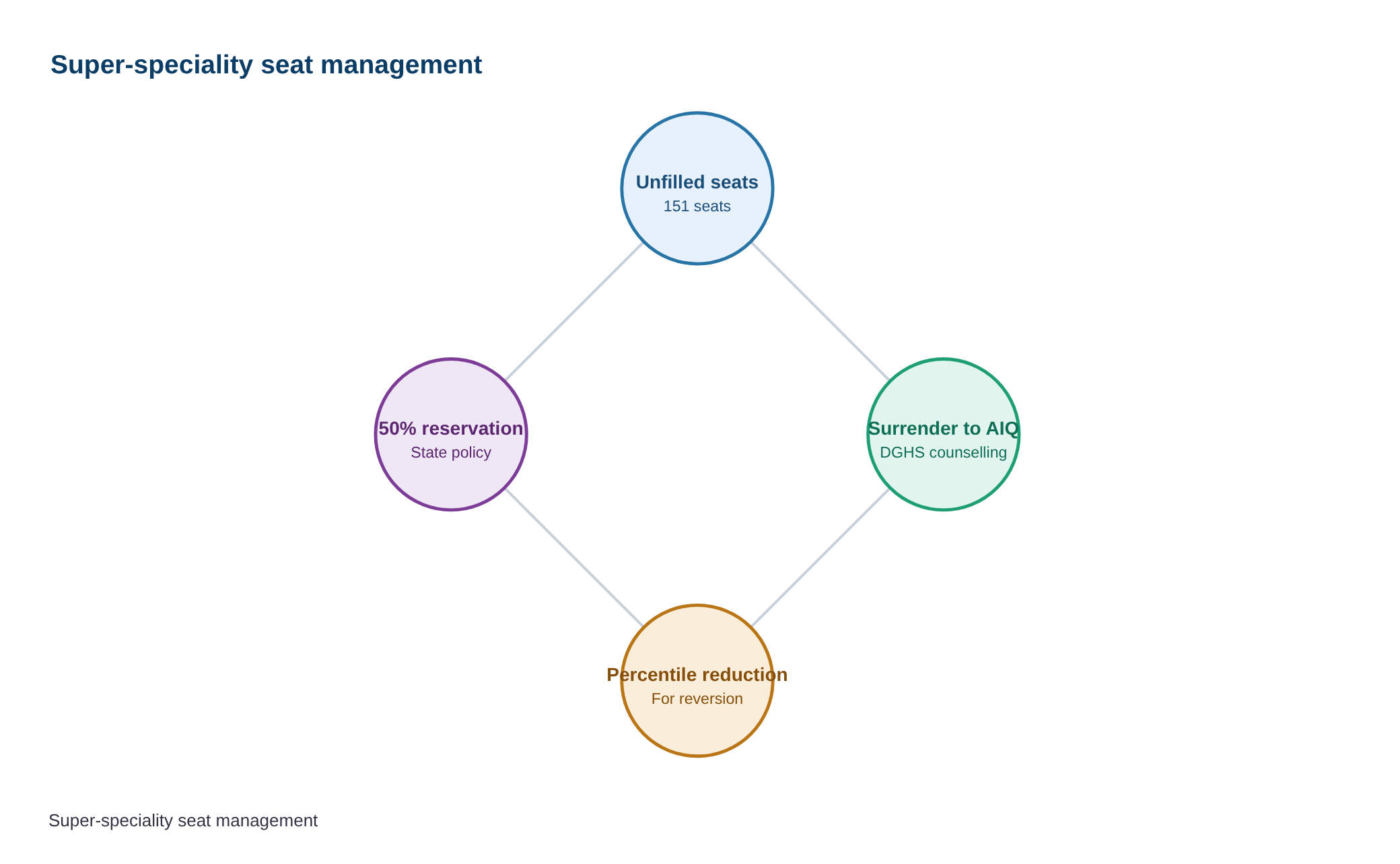
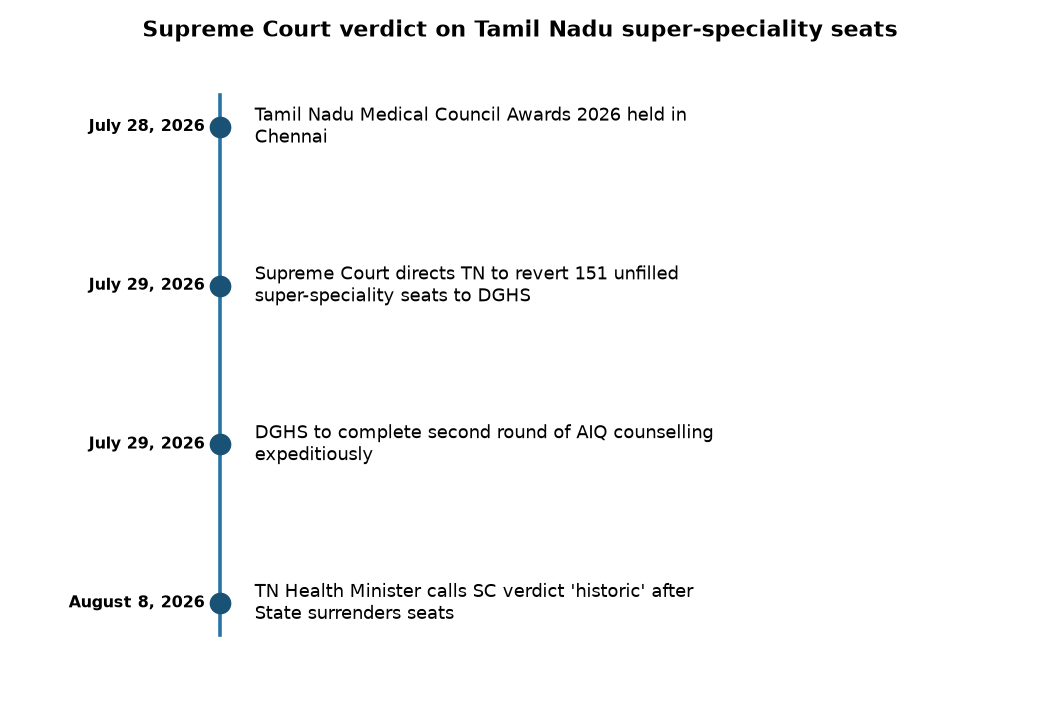
The Supreme Court of India, in a recent verdict, has directed Tamil Nadu to surrender 151 unfilled super-speciality medical seats (DM/MCh) for the All India Quota (AIQ) second round of counselling, with critical conditions on percentile reduction and seat reversion. This directive has significant implications for Tamil Nadu’s 50% reservation policy for in-service candidates in super-speciality courses, prompting both political and professional responses from the State government and medical associations.
Background
- Tamil Nadu reserves 50% of its DM/MCh super-speciality seats for in-service candidates, a policy aimed at retaining medical professionals within the State’s public health system.
- In 2026, 151 super-speciality seats in Tamil Nadu remained unfilled after the first round of counselling, necessitating their surrender to the All India Quota (AIQ) pool managed by the Directorate General of Health Services (DGHS).
- Historically, Tamil Nadu has faced challenges in filling super-speciality seats, particularly in high-demand branches like Cardiology and Surgical Gastroenterology, due to limited availability of in-service candidates and competitive NEET-SS cut-offs.
- The Supreme Court’s order underscores the tension between merit-based admissions (AIQ) and affirmative action policies (State reservations) in medical education.
- The verdict also highlights the broader issue of declining interest among in-service doctors in pursuing super-speciality courses, attributed to factors such as lack of promotional avenues, financial incentives, and post-training employment security.
What are Super-Speciality Medical Seats (DM/MCh) and the All India Quota (AIQ)?
- Super-speciality medical seats (DM/MCh) are postgraduate courses in highly specialised branches of medicine, such as Cardiology, Neurosurgery, and Paediatric Surgery, requiring prior MD/MS qualifications.
- The All India Quota (AIQ) is a counselling mechanism for 50% of undergraduate and postgraduate medical seats in India, managed by the Directorate General of Health Services (DGHS) to ensure national-level merit-based admissions.
- Tamil Nadu reserves 50% of its DM/MCh seats for in-service candidates—doctors already employed in the State’s public health system—to address regional healthcare workforce shortages and incentivise retention.
- Unfilled super-speciality seats under the State quota are surrendered to the AIQ pool for subsequent counselling rounds, where candidates from across India compete based on NEET-SS scores.
- The Supreme Court’s directive mandates that if the DGHS decides to reduce the cut-off to fill vacant seats after the second round of AIQ counselling, 50% of such seats must be reverted to the State for its in-service candidates.
- The verdict reinforces the principle of federalism in medical education, balancing the Centre’s role in national-level admissions with State-level affirmative action policies.
- The policy is designed to prevent the dilution of State-specific healthcare workforce strategies while ensuring that vacant seats do not remain unfilled indefinitely.
Key Features
| Feature | Significance |
|---|---|
| Supreme Court Verdict on Super-Speciality Seats | The apex court’s directive ensures that unfilled super-speciality seats in Tamil Nadu are reverted to the State if the Directorate General of Health Services (DGHS) reduces the percentile after the second round of counselling, safeguarding in-service candidates’ interests. |
| 50% Reservation for In-Service Candidates | Tamil Nadu reserves 50% of its DM/MCh seats for in-service doctors, reflecting a commitment to retaining skilled professionals within the State’s healthcare system. |
| Surrender of 151 Unfilled Seats | The State’s decision to surrender 151 unfilled super-speciality seats for the second round of AIQ counselling demonstrates adherence to the Supreme Court’s order and prioritisation of equitable seat allocation. |
| DGHS Counselling Process | The DGHS is mandated to conduct the second round of counselling expeditiously, ensuring transparency and fairness in the allocation of super-speciality seats. |
| State’s Writ Petition | The timely filing of a writ petition by Tamil Nadu’s government in the Supreme Court played a pivotal role in securing the historic verdict, highlighting the State’s proactive approach to addressing healthcare manpower issues. |
Why it Matters
Healthcare Workforce Management
- The verdict ensures that in-service doctors in Tamil Nadu have a fair chance at securing super-speciality seats, thereby strengthening the State’s healthcare workforce.
- It addresses the issue of vacant seats in critical specialities like Cardiology and Nephrology, which are vital for tertiary healthcare delivery.
- The directive promotes equitable distribution of super-speciality seats between State-quota and All India Quota candidates, reducing disparities in access to advanced medical training.
Judicial Precedent and Policy Impact
- The Supreme Court’s ruling sets a precedent for how unfilled super-speciality seats should be managed across States, ensuring consistency in the counselling process.
- It underscores the judiciary’s role in resolving disputes related to medical education and healthcare workforce policies.
- The verdict reinforces the importance of State-level interventions in healthcare manpower planning, particularly for in-service candidates.
Economic Implications
- Retaining in-service doctors in super-speciality roles reduces the financial burden on the State for recruiting external specialists, optimising healthcare expenditure.
- Filling vacant super-speciality seats enhances the State’s capacity to provide advanced medical services, potentially attracting medical tourism and boosting the healthcare economy.
Social Equity in Medical Education
- The reservation policy for in-service candidates promotes social equity by providing opportunities to doctors who have served the State, particularly those from rural and underserved areas.
- It ensures that the benefits of super-speciality training are not monopolised by candidates from private institutions or urban centres, fostering a more inclusive healthcare workforce.
Challenges
1. Vacancy in Critical Super-Speciality Seats
- Despite the Supreme Court’s directive, critical super-speciality seats such as Cardiology, Surgical Gastroenterology, and Nephrology may still remain vacant after the second round of counselling, limiting access to advanced medical care.
- The reluctance of candidates to opt for difficult branches like Cardiothoracic Surgery and Paediatric Surgery exacerbates the issue, reflecting a lack of promotional opportunities and financial incentives.
UPSC Link: GS Paper 2: Health and Education
2. Reduction in NEET Super-Speciality Applicants
- A declining number of service doctors appearing for NEET super-speciality examinations indicates a systemic issue in motivating in-service doctors to pursue advanced training.
- Factors such as reduced super-speciality posts, lack of career progression, and inadequate financial incentives contribute to this trend, necessitating policy interventions.
UPSC Link: GS Paper 2: Health and Education
3. Implementation of Supreme Court Directives
- Ensuring that the DGHS adheres to the Supreme Court’s order, particularly the reversion of 50% of unfilled seats to the State, requires robust monitoring and coordination between State and central authorities.
- Delays in the counselling process or non-compliance with the verdict could undermine the intended benefits of the ruling.
UPSC Link: GS Paper 2: Judiciary and Governance
4. Balancing State Quota and AIQ Interests
- The State’s reservation policy for in-service candidates must be balanced with the need to fill vacant seats through the AIQ to avoid underutilisation of super-speciality training infrastructure.
- Overemphasis on State quotas may lead to inefficiencies, while excessive reliance on AIQ could marginalise local doctors.
UPSC Link: GS Paper 2: Health and Governance
5. Financial and Infrastructure Constraints
- The State’s ability to retain and train super-speciality doctors is constrained by limited financial resources and inadequate infrastructure in medical colleges.
- Addressing these constraints requires long-term investment in healthcare education and facilities.
UPSC Link: GS Paper 2: Health and Economic Development
Challenges — UPSC Perspective
| Issue | Concern |
|---|---|
| Declining NEET Super-Speciality Applicants | Reduction in the number of in-service doctors opting for advanced training due to lack of incentives and career growth. |
| Vacant Critical Super-Speciality Seats | Persistent unfilled seats in branches like Cardiology and Nephrology, despite Supreme Court directives. |
| Implementation Gaps in Counselling Process | Potential delays or non-compliance by DGHS in adhering to the Supreme Court’s order. |
| Balancing State Quota and AIQ | Risk of underutilising super-speciality seats or marginalising in-service candidates. |
| Financial and Infrastructure Constraints | Limited resources for training and retaining super-speciality doctors, affecting healthcare quality. |
Way Forward
- Conduct a detailed review of the NEET super-speciality examination trends to identify reasons for the decline in in-service candidates and design targeted incentives.
- Strengthen promotional opportunities and financial incentives for in-service doctors pursuing super-speciality training in critical branches.
- Establish a State-level task force to monitor the implementation of the Supreme Court’s verdict and ensure timely reversion of unfilled seats.
- Enhance infrastructure and faculty in medical colleges to support super-speciality training, reducing reliance on external candidates.
- Collaborate with the DGHS to streamline the counselling process and address any procedural bottlenecks.
- Introduce mentorship programmes for in-service doctors to encourage their participation in super-speciality training.
- Develop a State-specific policy for super-speciality seat allocation that balances State quota and AIQ interests without compromising equity.
- Explore public-private partnerships to augment super-speciality training capacity and reduce financial constraints.
UPSC Value Addition
Keywords for Mains Answer-Writing
All India Quota counselling · Supreme Court verdict on super-speciality seats · DM/MCh seats reservation policy · in-service candidates reservation · State surrender of unfilled medical seats · Directorate General of Health Services (DGHS) · NEET Super-Speciality Examination · Medical Council of India (MCI) regulations · Judicial review of medical admissions · Federalism in healthcare governance · Public health administration in Tamil Nadu · Judicial activism in healthcare policy
Concept Flow
Supreme Court’s directive on super-speciality seats → Reversion of unfilled seats to State if percentile reduced → Tamil Nadu’s 50% reservation for in-service candidates → Surrender of 151 seats for AIQ counselling → DGHS conducts second round of counselling → Potential reduction in percentile → 50% of unfilled seats revert to State → State allocates seats to in-service candidates → Strengthening of State’s healthcare workforce → Improved tertiary healthcare delivery.
Prelims Practice Questions
Q1. Consider the following statements regarding the All India Quota (AIQ) counselling for super-speciality medical seats in India:
1. The AIQ counselling is conducted by the Directorate General of Health Services (DGHS).
2. Tamil Nadu reserves 50% of its DM/MCh super-speciality seats for in-service candidates.
3. The Supreme Court has directed that if seats remain vacant after the second round of AIQ counselling, the DGHS cannot reduce the percentile to fill them.
4. The AIQ counselling is exclusively for candidates from Tamil Nadu.
How many of the above statements are correct?
- Only one
- Only two
- Only three
- All
Answer: Only three — Statements 1, 2, and 3 are correct. Statement 4 is incorrect as the AIQ counselling is for candidates from all states, not exclusively Tamil Nadu.
Q2. Assertion (A): The Supreme Court has directed that 50% of unfilled super-speciality seats reverted to the State pool must be filled through subsequent counselling by the DGHS if the percentile is reduced.
Reason (R): The State of Tamil Nadu has historically failed to fill its reserved super-speciality seats for in-service candidates, leading to a judicial intervention.
- Both A and R are true, and R is the correct explanation of A
- Both A and R are true, but R is not the correct explanation of A
- A is true, but R is false
- A is false, but R is true
Answer: A is true, but R is false — Assertion (A) is true as per the Supreme Court’s directive. Reason (R) is true but does not directly explain the assertion, as the directive is a procedural safeguard rather than a consequence of past failures.
Q3. Match the following columns with reference to the Supreme Court verdict on super-speciality seats:
Column I (Speciality) | Column II (Status as per verdict)
— | —
A. Cardiology | 1. Likely to be filled in the second round of AIQ counselling
B. Cardiothoracic Surgery | 2. May remain vacant and revert to State pool if percentile is reduced
C. Paediatric Surgery | 3. Filled through subsequent counselling by DGHS if percentile is reduced
D. Surgical Gastroenterology | 4. Likely to be filled in the first round of AIQ counselling
- A-1, B-2, C-3, D-4
- A-4, B-2, C-3, D-1
- A-4, B-3, C-2, D-1
- A-1, B-3, C-2, D-4
Answer: A-4, B-2, C-3, D-1 — Cardiology and Surgical Gastroenterology are likely to be filled in the second round of AIQ counselling (A-1, D-4). Cardiothoracic Surgery and Paediatric Surgery may remain vacant and revert to the State pool if the percentile is reduced (B-2, C-3).
Mains Practice Question
✍ The Supreme Court’s recent verdict on the surrender of unfilled super-speciality medical seats in Tamil Nadu marks a significant intervention in the governance of medical admissions under the All India Quota (AIQ) system. Critically examine the implications of this judgment for federalism in healthcare governance, the rights of in-service candidates, and the operational autonomy of State governments in public health administration. (15 Marks)
Approach: MODEL-ANSWER SKELETON:
1. **Context of the Judgment**:
– Briefly state the Supreme Court’s directive: surrender of 151 unfilled DM/MCh seats by Tamil Nadu to DGHS, with 50% reverting to the State if percentile is reduced post-second round counselling.
– Reference the reservation policy for in-service candidates (50% of super-speciality seats) and its historical underutilisation.
2. **Federalism in Healthcare Governance**:
– **State Autonomy**: Discuss the tension between State-level reservations (e.g., Tamil Nadu’s in-service quota) and the Centre’s role via DGHS in AIQ counselling.
– **Judicial Role**: Analyse how the Supreme Court’s intervention balances federal principles (Article 246 read with List III, Entry 6) with the need for uniformity in medical admissions.
– **Precedents**: Cite *T.M.A. Pai Foundation v. State of Karnataka* (2002) on State’s role in education vs. *P.A. Inamdar v. State of Maharashtra* (2005) on minority institutions.
3. **Rights of In-Service Candidates**:
– **Constitutional Right to Reservation**: Examine Article 15(4) and 16(4) in the context of super-speciality seats. Discuss whether the judgment safeguards or undermines this right.
– **Operational Challenges**: Highlight issues like lack of promotional opportunities, reduced posts, and financial incentives as systemic barriers (as noted by Tamil Nadu Health Minister).
– **Judicial Activism**: Evaluate if the Court’s directive addresses these structural issues or merely redistributes seats without addressing root causes.
4. **Operational Autonomy of State Governments**:
– **Policy Flexibility**: Discuss how the judgment restricts Tamil Nadu’s ability to manage its own super-speciality seat allocation, particularly for in-service candidates.
– **Consequences of Surrender**: Analyse the impact on State’s healthcare workforce planning, especially in critical specialities like Cardiology or Nephrology.
– **Alternative Approaches**: Suggest mechanisms (e.g., State-level counselling for in-service candidates) that could reconcile federalism with the need for efficient seat utilisation.
5. **Conclusion**:
– Weigh the judgment’s contribution to equity in medical admissions against its potential to erode State autonomy.
– Propose a balanced approach: e.g., Centre-State collaboration in seat allocation while preserving State-level reservations.
Source: The Hindu
Generated by AanyaAi for educational purpose.

- महाराष्ट्र में त्योहार जुलूसों पर बॉम्बे हाईकोर्ट का बड़ा फैसला: पटाखे, लेजर और संगीत पर रोक - September 24, 2026
- Bombay HC Bans Firecrackers, Music in Maharashtra Processions: Key UPSC Analysis - September 24, 2026
- तमिलनाडु में महिला कर्मचारियों के लिए सवैतनिक माहवारी अवकाश नीति पर HC का आदेश - September 24, 2026

No Comments