


08 Aug Supreme Court Verdict on Super-Speciality Seats: Historic Win for Tamil Nadu in AIQ Counselling
✎ The Supreme Court’s verdict ensures that 50% of unfilled super-speciality seats reverted to Tamil Nadu after AIQ counselling if percentile reductions occur, thereby protecting the interests of in-service candidates in reserved…
Subject Relevance — Where This Topic Fits
- GS Paper II — Judiciary and Constitutional Framework | GS Paper III — Issues Relating to Health, Education, Human Resources
- Prelims: All India Quota (AIQ) counselling, NEET Super-Speciality (DM/MCh), Supreme Court jurisdiction in medical admissions, State quota vs. AIQ in medical education, Directorate General of Health Services (DGHS), Reserved seats for in-service candidates
- Essay: The role of judicial intervention in resolving federal disputes in public health governance, Equity in medical education: Balancing state reservations and national merit-based admissions
Quick Revision: The Supreme Court’s verdict ensures that 50% of unfilled super-speciality seats reverted to Tamil Nadu after AIQ counselling if percentile reductions occur, thereby protecting the interests of in-service candidates in reserved categories.
Why is this in the news?
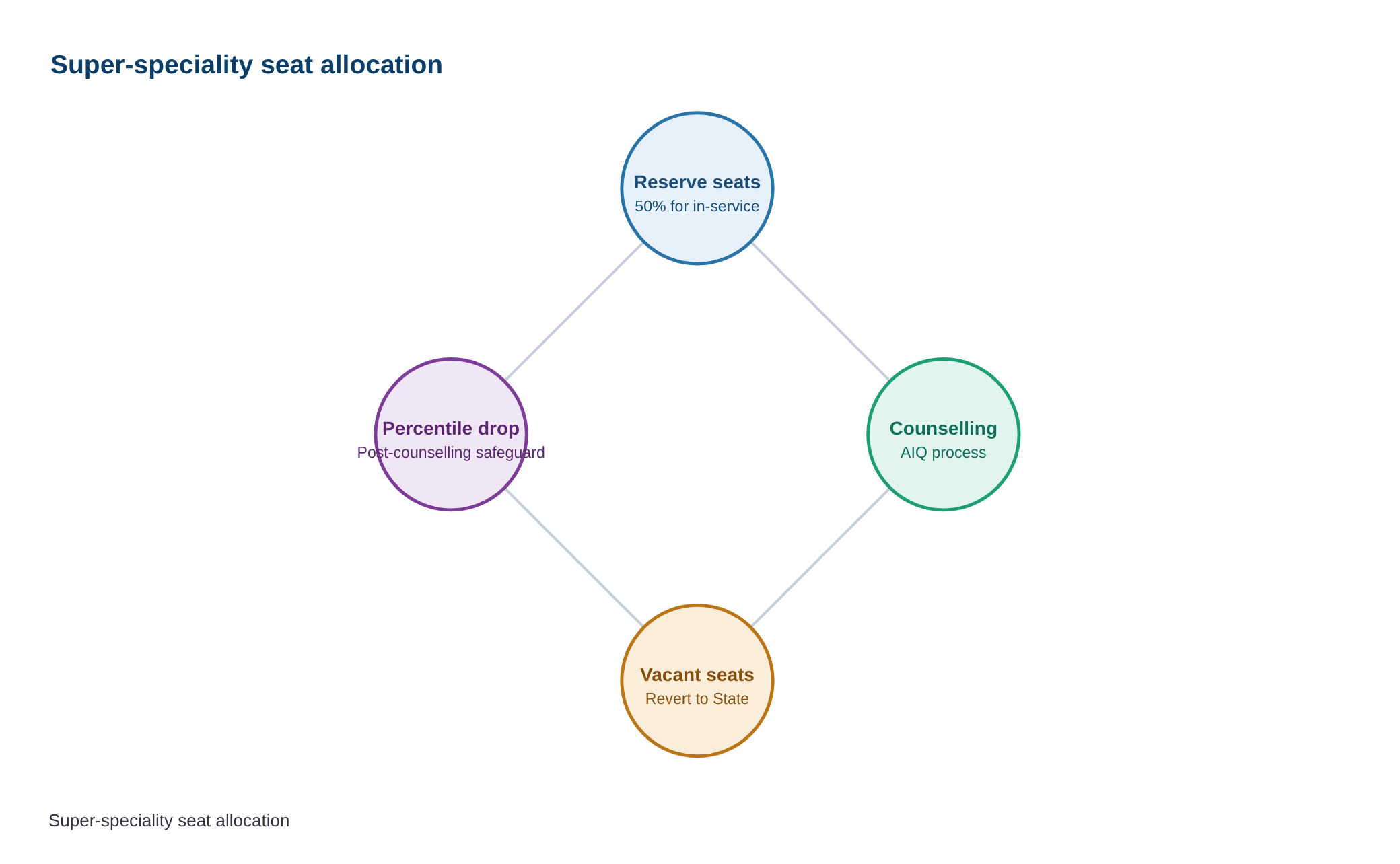
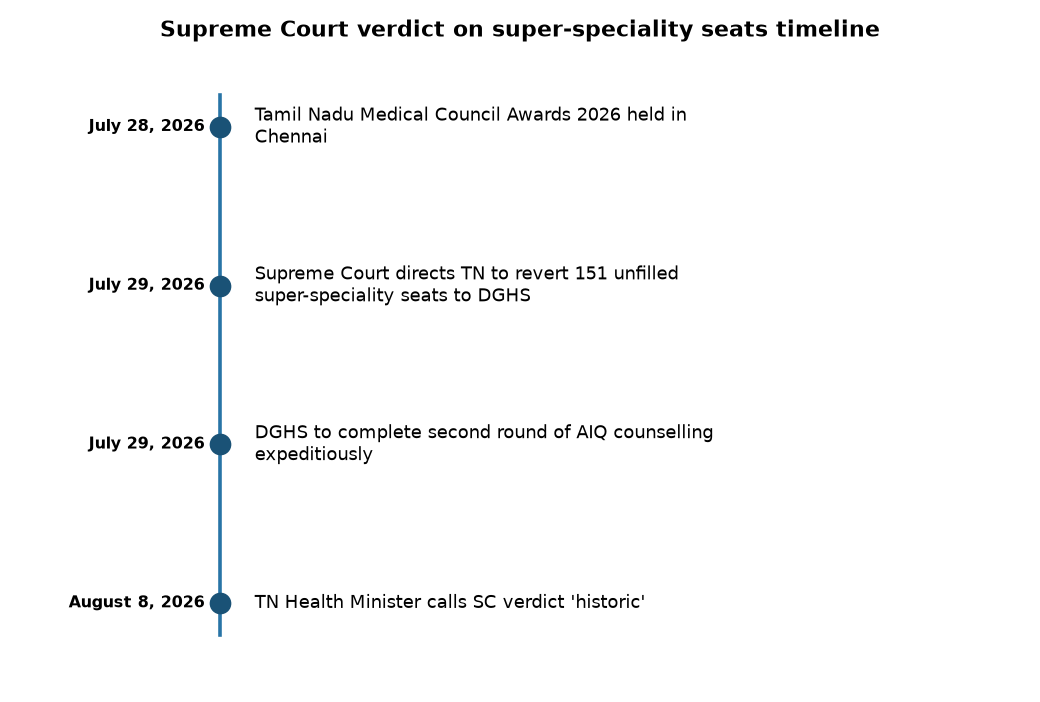
The Supreme Court’s recent verdict on the surrender of unfilled super-speciality medical seats in Tamil Nadu has been hailed as ‘historic’ by the State’s Health Minister. The judgment addresses long-standing disputes over the allocation of super-speciality seats reserved for in-service candidates, particularly in the context of the All India Quota (AIQ) counselling process. The verdict ensures procedural fairness by mandating the reversion of vacant seats to the State if percentile reductions occur post-counselling, thereby safeguarding the interests of service doctors and upholding federal principles in medical education governance.
Background
- The All India Quota (AIQ) system was introduced to ensure equitable distribution of postgraduate medical seats across states, including super-speciality courses (DM/MCh) in disciplines such as Cardiology, Surgical Gastroenterology, and Nephrology.
- Tamil Nadu reserves 50% of its super-speciality seats for in-service candidates (government doctors), a policy aimed at retaining skilled professionals within the State health system.
- In 2026, 151 super-speciality seats in Tamil Nadu remained unfilled, leading to a legal dispute between the State government and the Directorate General of Health Services (DGHS).
- The State government filed a writ petition in the Supreme Court, arguing that the surrender of vacant seats to the AIQ pool without adequate safeguards disadvantaged in-service candidates.
- Historically, Tamil Nadu has faced challenges in filling super-speciality seats due to the competitive nature of NEET Super-Speciality examinations and the limited availability of promotional opportunities for in-service doctors.
- The Supreme Court’s intervention underscores the judiciary’s role in resolving federal disputes in public health governance, particularly concerning state reservations and national merit-based admissions.
What are Super-Speciality Medical Seats and the All India Quota (AIQ) System?
- Super-speciality medical seats (DM/MCh) are postgraduate courses in highly specialised branches of medicine, such as Cardiology, Neurosurgery, and Paediatric Surgery, which require additional years of training beyond a general postgraduate degree.
- The All India Quota (AIQ) system was introduced by the Medical Council of India (now National Medical Commission) to ensure that a portion of postgraduate medical seats (including super-speciality) are allocated through a centralised counselling process, promoting merit-based admissions across states.
- States like Tamil Nadu reserve a percentage of super-speciality seats for in-service candidates (government doctors) to incentivise retention and address critical shortages in specialised healthcare services within the public sector.
- The AIQ counselling process is conducted by the Directorate General of Health Services (DGHS) under the Union Ministry of Health and Family Welfare, with the percentile cut-off determined based on NEET Super-Speciality examination performance.
- Vacant super-speciality seats in the AIQ pool are typically filled in subsequent counselling rounds, but disputes arise when states argue that surrendered seats should be returned to them to accommodate in-service candidates.
- If a decision is taken to reduce the percentile after the second round of counselling, then 50% of such seats should be reverted to T.N., and the remaining 50% seats should be filled through subsequent counselling by the DGHS.
- The judgment also highlights the broader challenge of balancing state-level reservations with national merit-based admissions, a recurring theme in India’s medical education governance.
UPSC Value Addition
Keywords for Mains Answer-Writing
Supreme Court verdict on super-speciality medical seats · All India Quota (AIQ) counselling · DM/MCh super-speciality seats · reservation for in-service candidates · Directorate General of Health Services (DGHS) · NEET Super-Speciality Examination · medical education governance · health sector federalism · judicial intervention in medical admissions · Tamil Nadu Health Minister K.G. Arunraj · Supreme Court directive on percentile reduction · vacant super-speciality seats surrender · medical officers association critique · Cardiology, Surgical Gastroenterology, Vascular Surgery, Nephrology · Cardiothoracic Surgery, Paediatric Surgery · promotional opportunities in medical services · federal-state dynamics in health policy
Prelims Practice Questions
Q1. Consider the following statements regarding the Supreme Court verdict on super-speciality medical seats in Tamil Nadu:
1. The Supreme Court directed Tamil Nadu to surrender 151 unfilled super-speciality seats to the Directorate General of Health Services (DGHS) by a specified deadline.
2. The Court ruled that if seats remain vacant after the second round of AIQ counselling, the DGHS cannot unilaterally reduce the percentile to fill them.
3. The verdict mandates that 50% of any remaining vacant seats after percentile reduction must be reverted to the State pool.
How many of the above statements are correct?
- Only one
- Only two
- All three
- None
Answer: All three — Statements 1 and 3 are correct. Statement 2 is incorrect because the Court allows percentile reduction but imposes conditions on seat reversion to the State.
Q2. Assertion (A): Tamil Nadu reserves 50% of its DM/MCh super-speciality seats for in-service candidates.
Reason (R): The Supreme Court verdict on super-speciality seats upheld the State’s reservation policy for in-service candidates as constitutionally valid.
Options:
A. Both A and R are true, and R is the correct explanation of A.
B. Both A and R are true, but R is not the correct explanation of A.
C. A is true, but R is false.
D. A is false, but R is true.
Answer: ? — A is true as Tamil Nadu reserves 50% of super-speciality seats for in-service candidates. R is false because the Supreme Court did not explicitly validate the State’s reservation policy; it only addressed the surrender and counselling process.
Q3. Match the following pairs related to medical education governance in India:
Column I (Entity/Concept)
A. Directorate General of Health Services (DGHS)
B. All India Quota (AIQ) counselling
C. NEET Super-Speciality Examination
D. Tamil Nadu Medical Council
Column II (Function/Role)
1. Conducts centralized counselling for super-speciality seats under AIQ
2. Regulates medical education and professional standards in Tamil Nadu
3. National-level examination for admission to super-speciality medical courses
4. Central agency under the Ministry of Health and Family Welfare overseeing medical education policies
Select the correct match:
- A-4, B-1, C-3, D-2
- A-1, B-4, C-2, D-3
- A-3, B-2, C-1, D-4
- A-2, B-3, C-4, D-1
Answer: A-4, B-1, C-3, D-2 — Correct matches: A-4 (DGHS is a central agency under the Ministry of Health and Family Welfare), B-1 (AIQ counselling is conducted by DGHS), C-3 (NEET Super-Speciality is the national examination), D-2 (Tamil Nadu Medical Council regulates medical education in the State).
Mains Practice Question
✍ The Supreme Court’s directive in the matter of super-speciality medical seats in Tamil Nadu represents a significant judicial intervention in the governance of medical education. Critically examine the implications of this verdict for federalism in health policy, reservation policies for in-service candidates, and the autonomy of States in managing their medical education systems. (15 Marks)
Approach: MODEL-ANSWER SKELETON:
1. **Judicial Intervention in Medical Education Governance**
– Cite the Supreme Court’s role in directing the surrender of unfilled seats and regulating counselling processes (reference to the 2026 verdict).
– Discuss how judicial intervention can balance equity in medical education while potentially encroaching on State autonomy.
2. **Federalism in Health Policy**
– Explain the constitutional division of powers between the Centre (DGHS, AIQ) and States (reservation policies, in-service quotas).
– Analyse how the verdict reinforces or undermines the federal structure, citing Article 246 and the Seventh Schedule.
3. **Reservation for In-Service Candidates**
– Define the 50% reservation policy for in-service candidates in Tamil Nadu’s DM/MCh seats.
– Examine the rationale behind such reservations (e.g., retaining skilled doctors in public health systems) and the challenges in implementation (e.g., vacant seats, reduced participation).
4. **State Autonomy vs. Centralized Counselling**
– Discuss the tension between State-level policies (reservation, local needs) and centralized AIQ counselling.
– Reference the Supreme Court’s stance on percentile reduction and seat reversion, and its impact on State flexibility.
5. **Broader Implications for Medical Education**
– Highlight the consequences for medical education governance, including potential reforms in NEET Super-Speciality Examination and counselling processes.
– Conclude with a balanced view: the verdict ensures equity but may limit State-level innovations in medical education governance.
Source: The Hindu
Generated by AanyaAi for educational purpose.

- महाराष्ट्र में त्योहार जुलूसों पर बॉम्बे हाईकोर्ट का बड़ा फैसला: पटाखे, लेजर और संगीत पर रोक - September 24, 2026
- Bombay HC Bans Firecrackers, Music in Maharashtra Processions: Key UPSC Analysis - September 24, 2026
- तमिलनाडु में महिला कर्मचारियों के लिए सवैतनिक माहवारी अवकाश नीति पर HC का आदेश - September 24, 2026

No Comments