


08 Aug Supreme Court Verdict on Super-Speciality Seats: Tamil Nadu’s Gain Explained
Supreme CourtSuper-speciality seatsAll India QuotaReservation policiesState autonomyMedical admissions✎ The Supreme Court’s directive on super-speciality seats in Tamil Nadu reaffirms the primacy of meritocracy in medical admissions while allowing conditional flexibility for state-level service quotas, contingent on AIQ counselling…
Subject Relevance — Where This Topic Fits
- GS Paper II — Governance, Constitution, and Polity | GS Paper III — Issues Relating to Health, Education, Human Resources
- Prelims: All India Quota (AIQ) counselling, National Medical Commission (NMC), Supreme Court directives on medical admissions, Service quota in super-speciality seats, Directorate General of Health Services (DGHS), Tamil Nadu Government Doctors Association (TNGDA)
- Essay: The role of judicial intervention in resolving disputes between state autonomy and central policies in healthcare, Ethical considerations in medical education: Meritocracy vs. social justice in super-speciality admissions
Quick Revision: The Supreme Court’s directive on super-speciality seats in Tamil Nadu reaffirms the primacy of meritocracy in medical admissions while allowing conditional flexibility for state-level service quotas, contingent on AIQ counselling outcomes.
Why is this in the news?
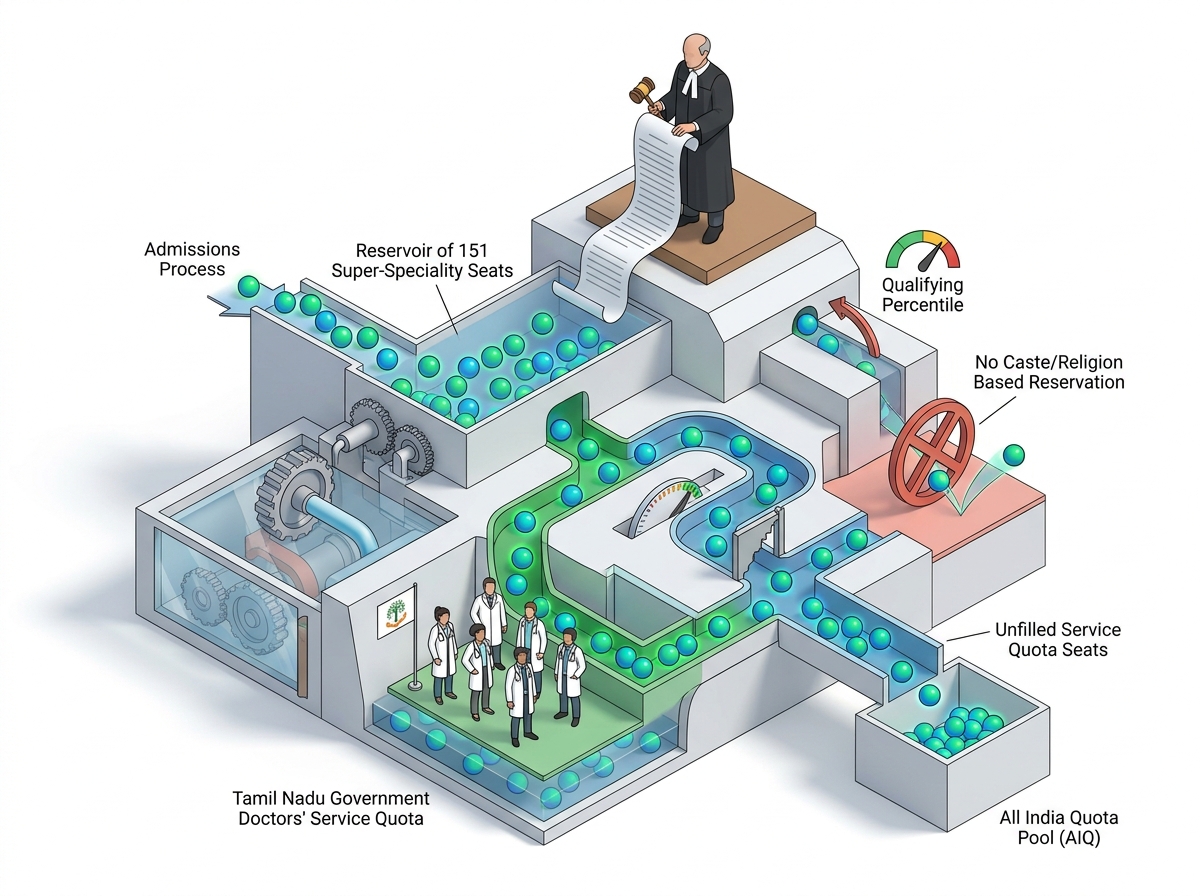
The Supreme Court’s recent order on the allocation of 151 super-speciality medical seats in Tamil Nadu has reignited debates on reservation policies, service quotas, and the balance between state-level autonomy and centralised medical admissions. The Tamil Nadu Government Doctors Association (TNGDA) has welcomed the verdict, which directs the state to surrender unfilled super-speciality seats to the All India Quota (AIQ) pool, while also stipulating a potential reversion of 50% of vacant seats to Tamil Nadu if the qualifying percentile is reduced. This development underscores the ongoing tensions between judicial directives, state policies, and the equitable distribution of medical education opportunities.
Background
- The Supreme Court has consistently ruled against caste or religion-based reservations in super-speciality medical seats, affirming the principle of meritocracy in admissions.
- Tamil Nadu secured a 50% reservation for service candidates in super-speciality seats after a prolonged legal battle, reflecting the state’s emphasis on retaining medical professionals within its public health system.
- The All India Quota (AIQ) system, managed by the Directorate General of Health Services (DGHS), allocates 50% of super-speciality seats in government medical colleges across India to candidates from all states, irrespective of domicile.
- Unfilled super-speciality seats in Tamil Nadu—particularly those reserved for service doctors—have historically been surrendered to the AIQ pool, leading to concerns about the state’s ability to retain medical talent.
- The recent Supreme Court order follows a directive to Tamil Nadu to surrender 151 unfilled super-speciality seats reserved for service candidates to the AIQ, with a conditional clause for potential reversion.
- The Tamil Nadu Government Doctors Association (TNGDA) has hailed the order, while also cautioning against arguments advocating for the outright allocation of all 151 seats to service doctors, citing legal and ethical risks.
What are Super-Speciality Medical Seats and the All India Quota (AIQ) System?
- Super-speciality medical seats refer to postgraduate courses in highly specialised fields such as Cardiology, Neurosurgery, and Paediatric Surgery, typically requiring prior MBBS and MD/MS qualifications.
- The All India Quota (AIQ) system was introduced to ensure equitable distribution of medical education opportunities across states, allocating 50% of seats in government medical colleges to candidates from any state, based on merit and reservation policies.
- Service quotas in super-speciality seats are designed to incentivise doctors to serve in public health systems, particularly in underserved areas, by reserving a portion of seats for in-service candidates (e.g., doctors already employed in government hospitals).
- The National Medical Commission (NMC) regulates medical education and admissions in India, including the implementation of AIQ and reservation policies in super-speciality courses.
- The Directorate General of Health Services (DGHS) conducts AIQ counselling for super-speciality seats, determining qualifying cut-offs and seat allotment based on NEET-SS scores and other criteria.
- Judicial precedents, including Supreme Court rulings, have consistently emphasised meritocracy in super-speciality admissions, restricting caste or religion-based reservations to uphold standards of excellence in medical education.
- The balance between service quotas and AIQ allocations is a recurring policy challenge, with states like Tamil Nadu advocating for greater flexibility to retain medical professionals within their public health systems.
Key Features
| Feature | Significance |
|---|---|
| Supreme Court’s directive on super-speciality seats | Ensures adherence to constitutional principles of merit-based selection while balancing state-level service quotas. |
| Reduction in qualifying percentile for AIQ counselling | Facilitates increased participation of government doctors in super-speciality admissions. |
| 50% reversion of vacant seats to Tamil Nadu | Restores state’s reserved quota for service candidates if seats remain unfilled in AIQ rounds. |
| Tamil Nadu Government Doctors Association (TNGDA) advocacy | Represents the interests of government doctors in securing equitable access to super-speciality training. |
| State government’s legal battle for 50% reservation | Highlights the prolonged judicial process to secure constitutional validity for service quotas in super-speciality seats. |
Why it Matters
Judicial-Executive Interface
- The Supreme Court’s intervention underscores the judiciary’s role in resolving inter-state disputes over medical education quotas.
- Balances the Centre’s AIQ policy with state-level service quotas, ensuring neither undermines the other.
- Sets a precedent for future cases involving reservation in super-speciality medical admissions.
Healthcare Workforce Development
- Super-speciality seats are critical for retaining skilled doctors within the state healthcare system.
- Reduction in qualifying percentile improves accessibility for government doctors, enhancing institutional capacity.
- Strengthens the state’s ability to address regional healthcare disparities through targeted training.
Constitutional Principles
- Reaffirms the doctrine of reasonable classification in reservation policies under Article 14 of the Constitution.
- Emphasizes the need for evidence-based justification for reservation in super-speciality seats.
- Highlights the tension between equality of opportunity and affirmative action in medical education.
Challenges
1. Balancing AIQ and State Quotas
- Risk of dilution of state-level service quotas if AIQ counselling absorbs all vacant seats.
- Potential for inter-state inequities in super-speciality seat allocation.
- Legal ambiguity in the interpretation of ‘vacant seats’ post-second round of AIQ counselling.
UPSC Link: GS2: Centre-State Relations
2. Ensuring Merit-Based Selection
- Maintaining high standards in super-speciality admissions while accommodating service quotas.
- Avoiding the perception of ‘lowering standards’ to fill seats, which could erode public trust.
- Balancing inclusivity with the need for excellence in medical training.
UPSC Link: GS2: Issues Relating to Development and Management of Social Sector/Services
3. Judicial Overreach vs. Legislative Domain
- Debate over the judiciary’s role in dictating medical education policies.
- Risk of judicial activism encroaching upon executive and legislative functions.
- Need for clear statutory guidelines to prevent ad-hoc judicial interventions.
UPSC Link: GS2: Separation of Powers
4. State-Level Implementation Gaps
- Delays in executing Supreme Court directives due to administrative bottlenecks.
- Lack of coordination between state health departments and medical education authorities.
- Inadequate infrastructure to accommodate increased admissions in super-speciality courses.
UPSC Link: GS2: Government Policies and Interventions
Challenges — UPSC Perspective
| Issue | Concern |
|---|---|
| Inter-state disparity in seat allocation | Tamil Nadu may lose super-speciality seats to states with lower qualifying percentiles, exacerbating regional imbalances. |
| Administrative delays in seat reversion | Failure to revert vacant seats to Tamil Nadu within stipulated timelines may lead to forfeiture of reserved quotas. |
| Legal ambiguity in seat reversion criteria | Unclear definition of ‘vacant seats’ post-second round of AIQ counselling could lead to disputes. |
| Perception of quota dilution | Arguments for reducing qualifying percentile to 40 risk undermining the meritocratic ethos of super-speciality admissions. |
| State’s financial burden | Increased admissions in super-speciality courses may strain the state’s healthcare budget for training and infrastructure. |
| Public trust in medical education | Perceived lowering of standards to fill seats could erode confidence in the healthcare system. |
Way Forward
- Constitute a high-level committee comprising representatives from the state health department, medical education authorities, and TNGDA to oversee the implementation of the Supreme Court’s directives.
- Conduct a detailed review of the state’s super-speciality seat allocation policy to align with the Supreme Court’s observations on reasonable classification.
- Engage with the Directorate General of Health Services (DGHS) to ensure transparency in the second round of AIQ counselling and seat reversion process.
- Develop a robust monitoring mechanism to track the reversion of vacant seats to Tamil Nadu within the stipulated timelines.
- Enhance state-level infrastructure and faculty capacity to accommodate increased admissions in super-speciality courses without compromising quality.
- Launch targeted mentorship programs for government doctors to improve their performance in entrance examinations and reduce reliance on quota-based admissions.
- Initiate a public awareness campaign to explain the rationale behind the state’s service quotas and the Supreme Court’s directives, mitigating misperceptions.
- Document and publish data on the impact of the Supreme Court’s order on seat allocation, service quotas, and healthcare workforce development in Tamil Nadu.
UPSC Value Addition
Keywords for Mains Answer-Writing
All India Quota (AIQ) counselling · Supreme Court directives on medical education · super-speciality medical seats reservation · Tamil Nadu Government Doctors Association (TNGDA) · medical service candidates reservation · Directorate General of Health Services (DGHS) · qualifying percentile in NEET-SS · constitutional provisions for medical education · reservation policy in super-speciality courses · apex court judgments on medical admissions · healthcare workforce policy · inter-state medical seat distribution · medical education governance in India · Supreme Court’s role in education policy · NEET-Super Speciality (NEET-SS) examination
Constitutional & Policy Linkages
- {‘Article’: ‘Article 14’, ‘note’: ‘Right to Equality and Reasonable Classification’}
- {‘Article’: ‘Article 15(4)’, ‘note’: ‘Special provisions for socially backward classes’}
- {‘Article’: ‘Article 16(4)’, ‘note’: ‘Reservation in appointments and promotions’}
- {‘Article’: ‘Article 29(2)’, ‘note’: ‘Admission to educational institutions’}
Concept Flow
State government secures 50% reservation for service candidates in super-speciality seats through legal battle → Supreme Court upholds the reservation but directs Tamil Nadu to surrender unfilled seats to AIQ → AIQ counselling fails to fill all seats, leading to vacant seats → Supreme Court directs that 50% of vacant seats be reverted to Tamil Nadu if qualifying percentile is reduced → State government and TNGDA advocate for reduction in qualifying percentile to improve access for government doctors → Implementation challenges arise due to inter-state disparities, administrative delays, and legal ambiguities → Need for policy review and infrastructure development to sustain gains from the Supreme Court’s order.
Prelims Practice Questions
Q1. Consider the following statements regarding the All India Quota (AIQ) scheme for super-speciality medical seats in India:
1. The AIQ scheme was introduced to ensure equitable distribution of super-speciality seats across states.
2. Tamil Nadu had secured 50% reservation for service candidates in super-speciality seats through a legal battle.
3. The Supreme Court has, in several judgments, ruled that there should be no caste or religion-based reservation in super-speciality medical seats.
How many of the above statements are correct?
- Only one
- Only two
- All three
- None
Answer: All three — Statements 1 and 2 are correct. Statement 3 is incorrect as the Supreme Court has not ruled against all forms of reservation in super-speciality seats; it has only prohibited caste or religion-based reservation in these seats.
Q2. Assertion (A): The Directorate General of Health Services (DGHS) conducts the second round of All India Quota (AIQ) counselling for super-speciality medical seats.
Reason (R): The DGHS is responsible for the overall administration of medical education and healthcare workforce policies in India.
- Both A and R are true, and R is the correct explanation of A
- Both A and R are true, but R is not the correct explanation of A
- A is true, but R is false
- A is false, but R is true
Answer: A is true, but R is false — Assertion (A) is true as the DGHS conducts the second round of AIQ counselling. Reason (R) is true but does not directly explain the assertion, as the DGHS’s role is broader than just counselling.
Q3. Match the following pairs related to medical education policies in India:
Column I (Policy/Scheme) | Column II (Description)
————————-|————————
1. AIQ (All India Quota) | A. Conducts NEET-SS examination
2. NEET-SS | B. Ensures equitable distribution of super-speciality seats
3. TNGDA | C. Tamil Nadu Government Doctors Association advocating for service candidates
4. DGHS | D. Directorate General of Health Services managing medical education policies
- 1-B, 2-A, 3-C, 4-D; 1-A, 2-B, 3-C, 4-D; 1-C, 2-A, 3-B, 4-D; 1-D, 2-B, 3-A, 4-C
- answer_string_array_index_0
- explain_match_pairs
- format_match
Answer: 1-B, 2-A, 3-C, 4-D; 1-A, 2-B, 3-C, 4-D; 1-C, 2-A, 3-B, 4-D; 1-D, 2-B, 3-A, 4-C — 1-B (AIQ ensures equitable distribution of super-speciality seats), 2-A (NEET-SS is conducted by the National Board of Examinations), 3-C (TNGDA is the Tamil Nadu Government Doctors Association), 4-D (DGHS manages medical education policies).
Mains Practice Question
✍ The Supreme Court’s directive to Tamil Nadu to surrender 151 unfilled super-speciality seats reserved for service candidates to the All India Quota (AIQ) has reignited debates on reservation policies in medical education. Critically examine the constitutional and legal framework governing reservation in super-speciality medical seats, with reference to recent Supreme Court judgments. Also, analyse the implications of such directives for state-level healthcare workforce policies. (15 Marks)
Approach: MODEL-ANSWER SKELETON:
1. Constitutional Framework: Article 15(4) and 15(5) – State’s power to make special provisions for socially and educationally backward classes; Article 29(2) – prohibition of discrimination in admission to educational institutions; Article 30 – cultural and educational rights.
2. Legal Framework: Supreme Court judgments on reservation in super-speciality seats (e.g., *T.M.A. Pai Foundation v. State of Karnataka*, *P.A. Inamdar v. State of Maharashtra*, *Modern Dental College and Research Centre v. State of Madhya Pradesh*). Key principles: no caste/religion-based reservation in super-speciality seats; proportionality test; creamy layer exclusion.
3. Recent Supreme Court Directives: Analysis of the 2026 directive to Tamil Nadu, including the rationale for surrendering seats to AIQ and the condition for reverting 50% of vacant seats if the qualifying percentile is reduced. Reference to the role of the Directorate General of Health Services (DGHS) in conducting AIQ counselling.
4. Implications for State-Level Policies: Impact on Tamil Nadu’s healthcare workforce, particularly service candidates; challenges in retaining medical professionals in government service; need for state-specific policies to address regional healthcare disparities. Reference to the Tamil Nadu Government Doctors Association (TNGDA) advocacy.
5. Balancing Views: Arguments for equitable distribution of seats across states (AIQ) vs. state-level quotas for service candidates; judicial activism vs. federalism; long-term consequences for medical education equity.
6. Conclusion: Synthesis of the debate, weighing the constitutional and legal validity of the directives against the practical challenges faced by states in healthcare delivery.
Source: The Hindu
Generated by AanyaAi for educational purpose.

- महाराष्ट्र में त्योहार जुलूसों पर बॉम्बे हाईकोर्ट का बड़ा फैसला: पटाखे, लेजर और संगीत पर रोक - September 24, 2026
- Bombay HC Bans Firecrackers, Music in Maharashtra Processions: Key UPSC Analysis - September 24, 2026
- तमिलनाडु में महिला कर्मचारियों के लिए सवैतनिक माहवारी अवकाश नीति पर HC का आदेश - September 24, 2026

No Comments