


08 Aug Tamil Nadu’s Historic SC Win on Super-Speciality Seats: Implications for UPSC & State PCS
✎ The Supreme Court’s verdict ensures that Tamil Nadu retains a 50% claim on unfilled super-speciality seats if the DGHS reduces the percentile post-counselling, safeguarding in-service medical officers’ opportunities.
Subject Relevance — Where This Topic Fits
- GS Paper II — Judiciary and Constitutional Framework | GS Paper III — Issues Relating to Health, Human Resources and Development
- Prelims: NEET-SS, All India Quota (AIQ), DM/MCh seats, Directorate General of Health Services (DGHS), percentile reduction, in-service reservation, Tamil Nadu Medical Council
- Essay: The role of the judiciary in safeguarding federalism and equitable resource distribution, Ethical dilemmas in medical education: Reservation vs. Meritocracy
Quick Revision: The Supreme Court’s verdict ensures that Tamil Nadu retains a 50% claim on unfilled super-speciality seats if the DGHS reduces the percentile post-counselling, safeguarding in-service medical officers’ opportunities.
Why is this in the news?
The Supreme Court’s recent verdict on the allocation of unfilled super-speciality (DM/MCh) seats in Tamil Nadu has been termed ‘historic’ by the State’s Health Minister, as it mandates the surrender of vacant seats to the All India Quota (AIQ) while ensuring a 50% reversion to the State if percentile reduction occurs post-counselling. This decision addresses long-standing grievances of in-service medical officers in Tamil Nadu, who have faced systemic barriers in securing super-speciality seats due to past administrative lapses and judicial inaction.
Background
- In Tamil Nadu, 50% of super-speciality (DM/MCh) seats are reserved for in-service medical officers, a policy aimed at retaining skilled doctors within the State’s healthcare system.
- For the academic year 2026, 151 super-speciality seats in Tamil Nadu remained unfilled, prompting the State government to approach the Supreme Court.
- Historically, unfilled super-speciality seats were surrendered to the All India Quota (AIQ) without adequate safeguards for in-service candidates, leading to criticism of the State government’s handling of the issue.
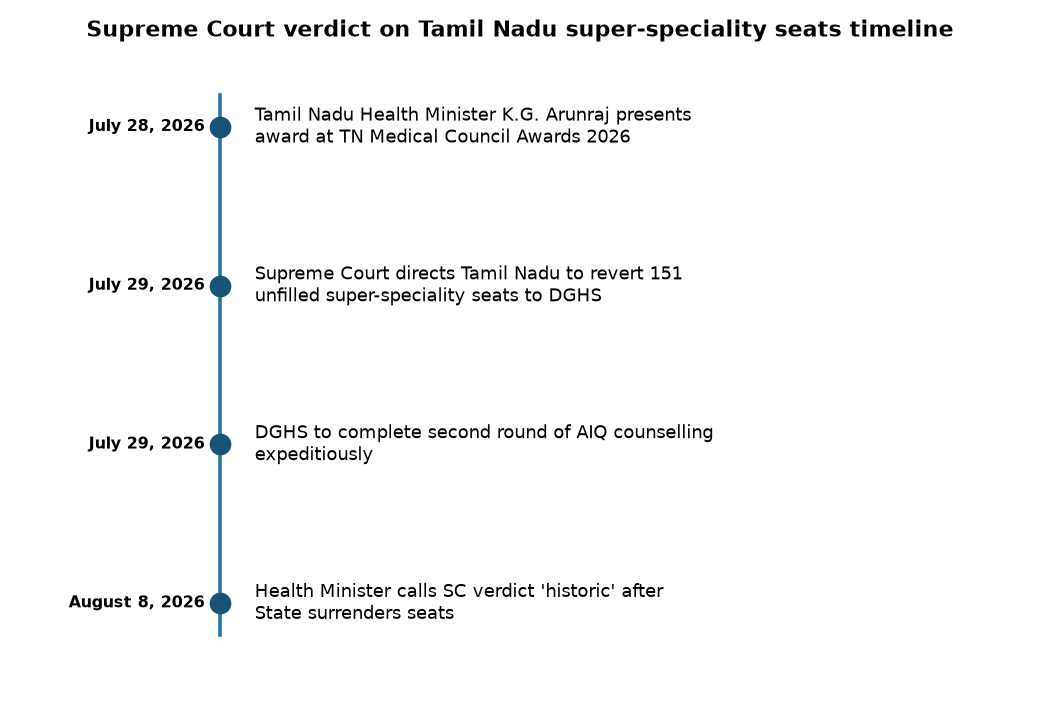
- The Supreme Court’s order directs Tamil Nadu to surrender the 151 unfilled seats to the DGHS for the second round of AIQ counselling, with specific conditions for reversion if percentile reduction is implemented.
- The verdict underscores the judiciary’s role in ensuring fairness in medical education admissions, particularly for reserved categories and in-service candidates.
What are Super-Speciality Seats (DM/MCh) and the All India Quota (AIQ)?
- Super-speciality seats (DM/MCh) are postgraduate medical courses in highly specialised branches such as Cardiology, Neurosurgery, and Surgical Gastroenterology, requiring prior completion of MD/MS.
- The All India Quota (AIQ) is a centralised counselling system for medical admissions, including super-speciality seats, managed by the Directorate General of Health Services (DGHS) under the Ministry of Health and Family Welfare.
- Under the AIQ, 50% of seats in government medical colleges are reserved for candidates from all States, while the remaining 50% are State-specific seats.
- Tamil Nadu reserves 50% of its super-speciality seats for in-service medical officers, a policy designed to address regional healthcare workforce shortages and incentivise service in public health systems.
- The Supreme Court’s verdict ensures that if unfilled seats are surrendered to the AIQ, Tamil Nadu retains a claim to 50% of these seats if the DGHS reduces the percentile for subsequent counselling rounds.
- The AIQ counselling process for super-speciality seats is conducted in multiple rounds, with percentile cut-offs determining eligibility for admission.
- The verdict highlights the tension between meritocracy (as reflected in NEET-SS scores) and affirmative action policies aimed at retaining medical talent within States.
- The decision also reflects broader judicial scrutiny of State-level reservation policies in medical education, particularly in the context of federalism and equitable resource distribution.
Key Features
| Feature | Significance |
|---|---|
| Supreme Court verdict on super-speciality seats | Establishes a precedent for the surrender and reallocation of unfilled super-speciality seats under the All India Quota (AIQ) system, ensuring equitable distribution and adherence to state reservation policies. |
| 50% reservation for in-service candidates in DM/MCh seats | Upholds the state’s commitment to retaining skilled medical professionals within its healthcare system, addressing regional healthcare disparities. |
| Surrender of 151 unfilled seats to DGHS | Prevents wastage of critical medical training opportunities and ensures these seats are utilised through subsequent counselling rounds. |
| Conditional percentile reduction in counselling | Protects the interests of in-service candidates by mandating that any percentile reduction must revert 50% of vacant seats to the state, preventing unilateral decisions by central authorities. |
| Timely intervention by Tamil Nadu government | Demonstrates proactive governance in addressing systemic inefficiencies in medical education and healthcare delivery through judicial recourse. |
Why it Matters
Judicial and Governance
- The verdict reinforces the balance of power between state and central authorities in medical education policy, particularly in the allocation of super-speciality seats.
- It sets a legal precedent for future disputes involving state-specific reservation policies in higher medical education.
- Highlights the role of the judiciary in resolving inter-governmental conflicts in public health administration.
Public Health Infrastructure
- Ensures optimal utilisation of super-speciality training seats, addressing the critical shortage of specialised medical professionals in Tamil Nadu.
- Strengthens the state’s healthcare workforce by prioritising in-service candidates, who are more likely to serve rural and underserved areas post-training.
- May incentivise more medical graduates to opt for super-speciality courses, given the improved certainty in seat allocation.
Economic Implications
- Reduces the financial burden on the state by preventing the wastage of public funds invested in medical education infrastructure.
- Potential long-term economic benefits from retaining highly skilled medical professionals within the state’s healthcare system.
Challenges
1. Disparity in Seat Allocation Across Specialities
- Certain super-speciality branches (e.g., Cardiothoracic Surgery, Paediatric Surgery) have historically remained vacant, indicating a lack of interest or preparedness among candidates.
- The state’s reservation policy may inadvertently disadvantage in-service candidates in highly competitive specialities due to lower cut-offs in subsequent counselling rounds.
UPSC Link: GS2: Issues relating to development and management of Social Sector/Services relating to Health
2. Declining Interest Among In-Service Candidates
- Reduced promotional opportunities and financial incentives for super-speciality courses deter in-service doctors from pursuing advanced training.
- Absence of structured career progression pathways post-super-speciality training discourages long-term commitment to public healthcare.
UPSC Link: GS2: Government policies and interventions for development in various sectors and issues arising out of their design and implementation
3. Administrative and Logistical Hurdles
- Timely surrender and reallocation of seats require seamless coordination between state and central authorities, which may be hindered by bureaucratic delays.
- The directive to revert 50% of seats to the state if percentile reduction occurs adds complexity to the counselling process, potentially leading to further vacancies.
UPSC Link: GS2: Role of Civil Services in a democracy
4. Perceived Erosion of State Autonomy
- Critics argue that the verdict may undermine the state’s ability to independently manage its medical education policies, particularly in reservation matters.
- The centralised control over percentile reduction could be seen as a dilution of federal principles in healthcare governance.
UPSC Link: GS2: Functions and responsibilities of the Union and the States
Challenges — UPSC Perspective
| Issue | Concern |
|---|---|
| Vacancy in high-demand specialities | Lack of candidates opting for competitive branches like Cardiology or Surgical Gastroenterology despite available seats. |
| Inadequate career incentives for in-service doctors | Absence of structured promotions or financial rewards post-super-speciality training discourages participation. |
| Bureaucratic delays in seat surrender | Potential lapses in timely compliance with Supreme Court directives due to administrative bottlenecks. |
| Centralised control over percentile reduction | State’s reduced autonomy in determining cut-offs for super-speciality courses within its jurisdiction. |
| Historical underutilisation of reserved seats | Past inefficiencies in filling in-service reserved seats have led to systemic distrust in state policies. |
Way Forward
- The Tamil Nadu government must expedite the surrender of 151 unfilled seats to DGHS and ensure seamless coordination for the second round of counselling.
- Conduct a state-wide survey to identify reasons for declining interest among in-service candidates in super-speciality courses and address them through targeted incentives.
- Introduce structured career progression pathways and financial rewards for doctors pursuing super-speciality training to enhance retention in public healthcare.
- Collaborate with medical colleges to align super-speciality course offerings with regional healthcare needs, reducing mismatches in demand and supply.
- Strengthen the state’s legal and administrative framework to proactively file cases in the Supreme Court for similar disputes in the future.
- Monitor the second round of counselling closely to ensure adherence to the verdict and prevent unilateral decisions by central authorities on percentile reduction.
- Explore public-private partnerships to expand super-speciality training infrastructure, reducing dependence on centralised seat allocation.
UPSC Value Addition
Keywords for Mains Answer-Writing
All India Quota (AIQ) counselling · super-speciality medical seats · DM/MCh seats · in-service candidates reservation · Supreme Court verdict on medical admissions · Directorate General of Health Services (DGHS) · NEET Super Speciality Examination · State quota surrender in medical admissions · Tamil Nadu Health Minister K.G. Arunraj · medical education policy and Supreme Court
Constitutional & Policy Linkages
- Article 19(1)(g) – Right to practise any profession, or to carry on any occupation, trade or business (medical profession)
- Article 21 – Right to health and medical care
- Article 29(2) – Prohibition of discrimination in admission to state-aided educational institutions (reservation policies)
Concept Flow
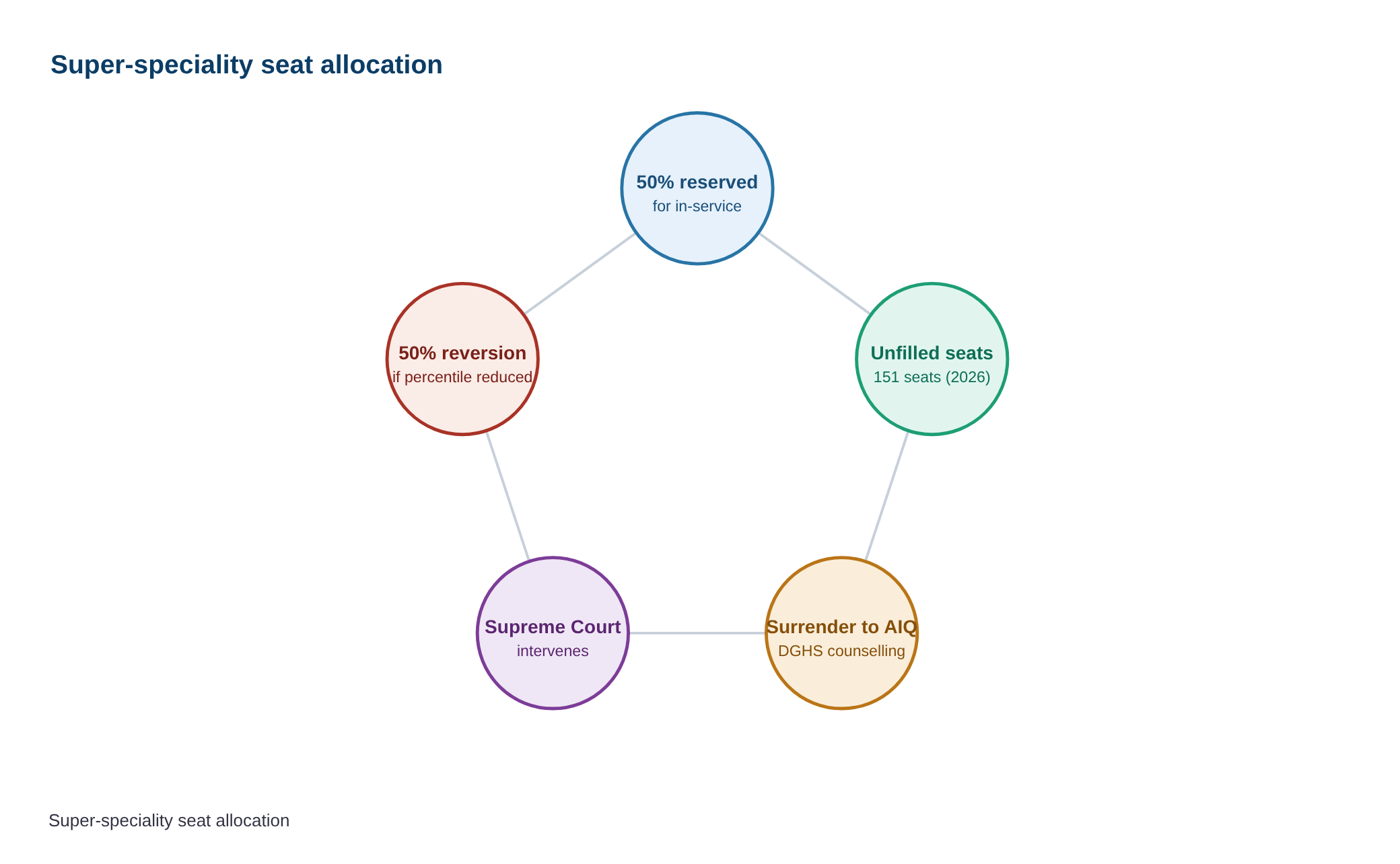
Tamil Nadu reserves 50% of DM/MCh seats for in-service candidates → Unfilled seats due to lack of candidates → State surrenders seats to DGHS for AIQ counselling → Supreme Court intervenes to protect state reservation policy → Verdict mandates 50% reversion of seats if percentile reduced → Ensures equitable seat allocation while addressing systemic inefficiencies.
Prelims Practice Questions
Q1. Consider the following statements regarding the All India Quota (AIQ) counselling for super-speciality medical seats in India:
1. The AIQ counselling is conducted by the Directorate General of Health Services (DGHS).
2. Tamil Nadu reserves 50% of its DM/MCh seats for in-service candidates.
3. The Supreme Court has directed that if seats remain vacant after the second round of counselling, the DGHS cannot reduce the percentile and fill the seats on its own.
4. The AIQ counselling is mandatory for all states and union territories in India.
How many of the above statements are correct?
- Only one
- Only two
- Only three
- All
Answer: Only three — Statements 1, 2, and 3 are correct. Statement 4 is incorrect as the AIQ counselling is not mandatory for all states; states may opt for their own counselling processes for state quota seats.
Q2. Assertion (A): The Supreme Court has directed that 50% of the unfilled super-speciality seats after the second round of AIQ counselling must be reverted to the state pool if the percentile is reduced.
Reason (R): This directive aims to ensure that in-service candidates in Tamil Nadu have equitable access to super-speciality medical seats.
Options:
A. Both A and R are true, and R is the correct explanation of A.
B. Both A and R are true, but R is not the correct explanation of A.
C. A is true, but R is false.
D. A is false, but R is true.
Answer: ? — Both Assertion (A) and Reason (R) are true, and R correctly explains A. The Supreme Court’s directive ensures that states like Tamil Nadu retain control over a portion of unfilled seats to prioritise in-service candidates.
Q3. Match the following terms related to medical education in India with their correct descriptions:
Column I
1. DM/MCh seats
2. AIQ counselling
3. In-service candidates
4. NEET Super Speciality Examination
Column II
A. Postgraduate super-speciality medical courses
B. National-level entrance examination for super-speciality courses
C. Counselling process for filling 50% of medical seats in India
D. Doctors employed in government or private institutions seeking super-speciality training
- 1-A, 2-C, 3-D, 4-B
- 1-B, 2-C, 3-D, 4-A
- 1-A, 2-D, 3-C, 4-B
- 1-C, 2-A, 3-B, 4-D
Answer: 1-A, 2-C, 3-D, 4-B — 1-A: DM/MCh seats refer to postgraduate super-speciality medical courses. 2-C: AIQ counselling is the national-level process for filling 50% of medical seats. 3-D: In-service candidates are doctors employed in institutions seeking super-speciality training. 4-B: NEET Super Speciality Examination is the national-level entrance examination for these courses.
Mains Practice Question
✍ The Supreme Court’s recent verdict on the surrender of unfilled super-speciality medical seats under the All India Quota (AIQ) counselling mechanism has been hailed as a historic intervention in medical education policy. Critically examine the implications of this verdict for the reservation of seats for in-service candidates in Tamil Nadu and the broader federal dynamics of medical education governance in India. (15 Marks)
Approach: MODEL-ANSWER SKELETON:
1. **Context and Background**: Briefly outline the Supreme Court’s directive, including the surrender of 151 unfilled DM/MCh seats in Tamil Nadu, the reservation of 50% seats for in-service candidates, and the role of the DGHS in AIQ counselling.
2. **Legal and Constitutional Dimensions**:
– Examine the federal structure of medical education governance, highlighting the division of powers between the Union (DGHS) and States (e.g., Tamil Nadu).
– Discuss the constitutional validity of state-level reservations for in-service candidates under Articles 15(4) and 16(4) of the Constitution.
– Reference the Supreme Court’s reasoning in balancing national uniformity (AIQ) with state-specific needs (reservation).
3. **Policy and Equity Implications**:
– Analyse how the verdict addresses the long-standing issue of vacant super-speciality seats and the equitable distribution of opportunities for in-service doctors.
– Discuss the potential consequences for medical education equity, including the impact on service doctors in Tamil Nadu and other states with similar reservation policies.
4. **Challenges and Criticisms**:
– Highlight concerns raised by sections of government doctors regarding the filling of high-demand specialities (e.g., Cardiology, Surgical Gastroenterology) in AIQ counselling.
– Address the critique of reduced promotional opportunities and financial incentives for super-speciality candidates.
5. **Broader Federal Dynamics**:
– Evaluate how the verdict reinforces or challenges the centralised nature of AIQ counselling while allowing states to retain some control over unfilled seats.
– Discuss the implications for other states with similar reservation policies (e.g., Andhra Pradesh, Telangana).
6. **Conclusion**: Summarise the verdict’s significance in balancing national medical education standards with state-level social justice goals, and suggest measures for further harmonisation.
Source: The Hindu
Generated by AanyaAi for educational purpose.

- महाराष्ट्र में त्योहार जुलूसों पर बॉम्बे हाईकोर्ट का बड़ा फैसला: पटाखे, लेजर और संगीत पर रोक - September 24, 2026
- Bombay HC Bans Firecrackers, Music in Maharashtra Processions: Key UPSC Analysis - September 24, 2026
- तमिलनाडु में महिला कर्मचारियों के लिए सवैतनिक माहवारी अवकाश नीति पर HC का आदेश - September 24, 2026

No Comments