


08 Aug Supreme Court Verdict on Super-Speciality Seats: Tamil Nadu Doctors’ Win Explained
Supreme CourtSuper-speciality seatsAll India QuotaState-level serviceMerit-based admissions✎ The Supreme Court’s directive on super-speciality seats in Tamil Nadu underscores the primacy of merit-based admissions in medical education, as mandated by its earlier judgments, while also allowing for potential reversion of…
Subject Relevance — Where This Topic Fits
- GS Paper II — Governance, Constitution, Polity, Social Justice and International Relations | GS Paper III — Health, Human Resource Development, and Issues Relating to Development
- Prelims: All India Quota (AIQ), National Medical Commission (NMC), Directorate General of Health Services (DGHS), Supreme Court directives on medical education, Tamil Nadu Government Doctors Association (TNGDA), service candidates in super-speciality courses, qualifying percentile for NEET-SS, unfilled super-speciality seats, reservation policies in medical education
- Essay: The role of judicial interventions in shaping public health policies: A case study of super-speciality medical education, Equity in medical education: Balancing service obligations and meritocracy in postgraduate admissions
Quick Revision: The Supreme Court’s directive on super-speciality seats in Tamil Nadu underscores the primacy of merit-based admissions in medical education, as mandated by its earlier judgments, while also allowing for potential reversion of seats if the qualifying percentile is reduced in subsequent AIQ counselling rounds.
Why is this in the news?
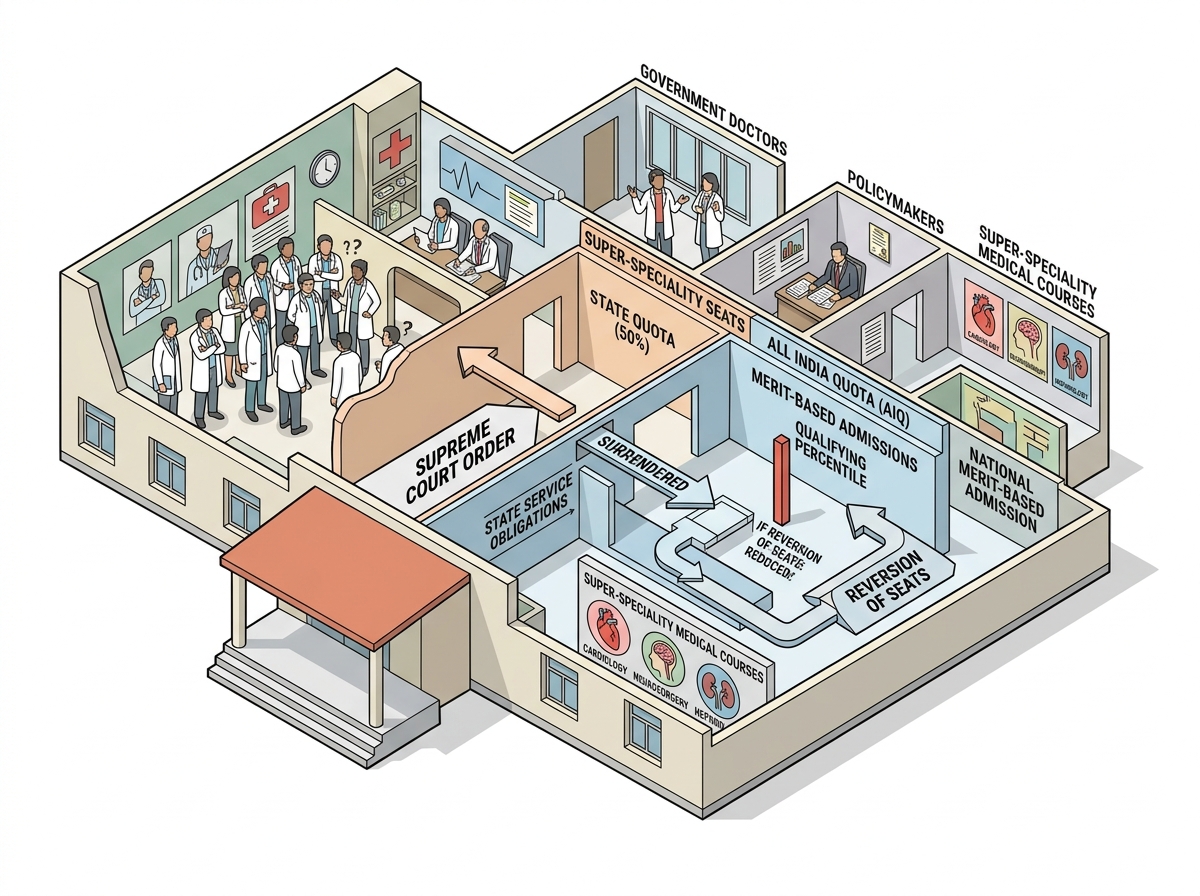
The Supreme Court’s recent directive on the allocation of 151 unfilled super-speciality medical seats in Tamil Nadu has sparked significant debate among government doctors and policymakers. The order, which mandates the surrender of these seats to the All India Quota (AIQ) while allowing for potential reversion if the qualifying percentile is reduced. This development underscores the ongoing tensions between state-level service obligations and national merit-based admission policies in medical education, particularly in the context of super-speciality courses.
Background
- The Supreme Court has, in multiple judgments, consistently ruled against caste or religion-based reservations in super-speciality medical seats, emphasizing meritocracy as the primary criterion for admissions.
- Tamil Nadu had secured a 50% reservation for service candidates in super-speciality seats through a prolonged legal battle, reflecting the state’s emphasis on retaining medical professionals within its public health system.
- The All India Quota (AIQ) system, managed by the Directorate General of Health Services (DGHS), allocates a portion of medical seats across India to candidates from all states based on NEET-SS scores, ensuring national merit-based admissions.
- The current controversy arose after the Supreme Court directed Tamil Nadu to surrender 151 unfilled super-speciality seats reserved for service candidates to the AIQ, citing the need for optimal utilisation of available seats.
- The state government’s handling of the case has faced criticism from some quarters, including the DMK, which has demanded an explanation for the surrender of the seats, while others have praised the government for securing the Supreme Court’s intervention.
What are Super-Speciality Medical Seats and the All India Quota (AIQ)?
- Super-speciality medical seats refer to postgraduate courses in highly specialised fields such as Cardiology, Neurosurgery, and Paediatric Surgery, which require additional years of training beyond standard MD/MS degrees.
- These seats are critical for addressing the acute shortage of specialists in India’s public health system, particularly in rural and underserved areas, where government doctors often serve as the primary healthcare providers.
- The All India Quota (AIQ) is a national pool of medical seats, comprising 50% of the total available seats in postgraduate medical courses, which are allocated based on merit through the NEET-SS examination conducted by the National Board of Examinations in Medical Sciences (NBEMS).
- The AIQ system was introduced to ensure equitable distribution of medical talent across the country, preventing the concentration of specialists in a few states or institutions, and promoting national integration in healthcare.
- The Directorate General of Health Services (DGHS), under the Ministry of Health and Family Welfare, is responsible for conducting the AIQ counselling process, including seat allocation, reversion, and management of vacant seats.
- The Supreme Court has repeatedly emphasised that super-speciality seats must be filled on the basis of merit, with no reservations based on caste, religion, or other non-merit criteria, to uphold the standards of medical education and patient care.
- States like Tamil Nadu have historically sought reservations for service candidates in super-speciality seats to retain doctors within their public health systems, arguing that these professionals are essential for delivering specialised care in government hospitals.
- The current controversy highlights the tension between state-level service obligations and national merit-based policies, with the Supreme Court’s directives often serving as the final arbiter in such disputes.
Key Features
| Feature | Significance |
|---|---|
| Supreme Court directive on super-speciality seats | Reinforces the constitutional principle of merit-based selection in medical education, while balancing service obligations of government doctors. |
| Reduction of qualifying percentile in AIQ counselling | Enables reversion of vacant seats to State quota if unfilled, addressing equity concerns for service candidates. |
| 50% reversion clause for vacant seats | Ensures that a portion of surrendered seats is restored to the State if AIQ counselling fails to fill them, protecting service candidate interests. |
| Tamil Nadu Government Doctors Association (TNGDA) advocacy | Demonstrates the role of professional bodies in interpreting judicial orders and safeguarding institutional interests. |
| Legal precedence on reservation in super-speciality seats | Affirms the Supreme Court’s stance against caste/religion-based reservations in super-speciality courses, upholding meritocracy. |
Why it Matters
Judicial-Executive Interface
- The Supreme Court’s intervention underscores the judiciary’s role in resolving inter-sectoral disputes between the State and central authorities in medical education governance.
- The verdict reinforces the primacy of the AIQ system while allowing limited State-level adjustments for service candidates, balancing federalism and equity.
- Judicial directives on seat reversion highlight the need for coordinated policymaking between the State and central authorities to prevent systemic inefficiencies.
Equity in Medical Education
- The case exemplifies the tension between meritocracy and affirmative action in super-speciality medical seats, a critical issue in India’s healthcare workforce planning.
- The State’s 50% reservation for service candidates reflects the constitutional duty to reward institutional loyalty and public service, while adhering to judicial limits.
- The reversion clause ensures that vacant seats are not lost entirely to the State, mitigating inequities faced by government doctors in competitive admissions.
Healthcare Workforce Management
- Super-speciality seats are pivotal for India’s tertiary healthcare infrastructure, and their allocation impacts the availability of specialists in public hospitals.
- The dispute highlights the need for robust State-level policies to retain specialists within the public health system, reducing brain drain to private or foreign sectors.
- Effective utilisation of surrendered seats can address critical shortages in super-speciality disciplines like cardiology, neurology, and oncology in Tamil Nadu.
Challenges
1. Balancing Meritocracy and Affirmative Action
- The Supreme Court’s prohibition on caste/religion-based reservations in super-speciality seats limits the State’s ability to address historical underrepresentation.
- Reducing the qualifying percentile risks diluting academic standards, potentially compromising the quality of super-specialists trained in public institutions.
- The State must navigate the fine line between protecting service candidate interests and adhering to judicial strictures on merit-based admissions.
UPSC Link: GS2: Indian Polity – Judiciary
2. Coordination Between State and Central Authorities
- The AIQ system, managed by the DGHS, operates independently of State-level counselling, leading to potential conflicts in seat allocation priorities.
- Delays or miscommunication in implementing judicial directives can result in seat wastage, as seen in the surrender of 151 seats initially.
- The State must ensure seamless integration of judicial orders with its own counselling processes to avoid further disputes.
UPSC Link: GS2: Federalism
3. Retention of Specialists in Public Health System
- Tamil Nadu’s 50% reservation for service candidates is a retention strategy, but its effectiveness depends on the availability of training opportunities and career progression pathways.
- Competitive AIQ counselling may lure specialists away from public hospitals, exacerbating shortages in critical super-speciality disciplines.
- The State must invest in infrastructure and incentives to ensure that super-specialists remain committed to public service post-training.
UPSC Link: GS2: Health – Human Resource
4. Legal and Policy Uncertainty
- Frequent judicial interventions in medical education policies create uncertainty for aspirants and institutions, affecting long-term planning.
- The State’s legal battles over reservations highlight the need for a stable, consensus-driven policy framework in medical education.
- Over-reliance on judicial directives may undermine the role of elected representatives in shaping equitable policies.
UPSC Link: GS2: Indian Polity – Judiciary
Challenges — UPSC Perspective
| Issue | Concern |
|---|---|
| Judicial overreach in medical education | Risk of excessive judicial interference in policy domains traditionally managed by executive and legislative branches. |
| Seat wastage due to AIQ counselling | Unfilled seats in AIQ may lead to underutilisation of critical super-speciality training capacity. |
| Service candidate eligibility criteria | Narrow definitions of ‘service candidates’ may exclude deserving doctors, reducing the impact of reservations. |
| Public-private sector imbalance | Incentives for super-specialists to migrate to private or foreign sectors may weaken public health systems. |
| Data asymmetry between State and Centre | Lack of real-time coordination in seat allocation data can lead to avoidable conflicts and seat losses. |
Way Forward
- The State government should expedite the second round of AIQ counselling to minimise seat wastage and ensure timely reversion of vacant seats to the State quota.
- Tamil Nadu must strengthen its internal monitoring mechanism to track the utilisation of super-speciality seats and identify bottlenecks in the counselling process.
- The State should collaborate with the DGHS to streamline data-sharing protocols, ensuring alignment between AIQ and State-level counselling schedules.
- Policymakers should explore supplementary training programmes or incentives to retain super-specialists within the public health system post-qualification.
- The State must engage in sustained dialogue with professional bodies like TNGDA to refine reservation policies and address grievances of service candidates.
- Judicial and executive branches should establish a consultative framework to preempt conflicts in medical education governance, reducing reliance on post-facto judicial interventions.
- The State should invest in infrastructure upgrades in government hospitals to enhance the attractiveness of super-speciality training and practice in public institutions.
- A clear, transparent policy on the definition and eligibility of ‘service candidates’ should be formulated to avoid disputes and ensure fairness.
UPSC Value Addition
Keywords for Mains Answer-Writing
All India Quota (AIQ) counselling · Supreme Court directives on medical admissions · reservation in super-speciality medical seats · service candidates in medical education · Tamil Nadu Government Doctors Association (TNGDA) · qualifying percentile in NEET-SS · medical education policy and federalism · constitutional provisions on reservation · Directorate General of Health Services (DGHS) · surrender of unfilled medical seats
Constitutional & Policy Linkages
- Article 14: Equality before law and equal protection of laws – Ensures merit-based selection processes are free from arbitrary discrimination.
- Seventh Schedule: Distribution of legislative powers – Highlights the concurrent nature of medical education policy, necessitating coordination between State and Centre.
Concept Flow
Supreme Court directs Tamil Nadu to surrender 151 unfilled super-speciality seats reserved for service candidates to the AIQ pool → State complies, but seeks judicial clarification on reversion terms → Supreme Court rules that 50% of vacant seats may revert to State if AIQ counselling fails to fill them → TNGDA hails the verdict, highlighting potential for 75-100 seats to be restored → Association cautions against overreach in demands, citing judicial limits on reservations → State and professional bodies must now implement the directive while balancing meritocracy and service obligations → Outcome will influence healthcare workforce planning and public health infrastructure in Tamil Nadu.
Prelims Practice Questions
Q1. Consider the following statements regarding the All India Quota (AIQ) system in medical admissions:
1. The AIQ system allows for 50% reservation for service candidates in super-speciality seats.
2. The Supreme Court has ruled that there should be no caste or religion-based reservation in super-speciality medical seats.
3. The Directorate General of Health Services (DGHS) conducts the AIQ counselling for super-speciality seats.
How many of the above statements are correct?
- Only one
- Only two
- All three
- None
Answer: All three — Statement 1 is incorrect as the AIQ system does not mandate 50% reservation for service candidates; this is a state-specific provision. Statements 2 and 3 are correct as per the Supreme Court’s rulings and the role of DGHS in AIQ counselling.
Q2. Assertion (A): The Supreme Court has directed Tamil Nadu to surrender 151 unfilled super-speciality seats reserved for service candidates to the All India Quota (AIQ).
Reason (R): The Supreme Court has consistently ruled against caste or religion-based reservation in super-speciality medical seats.
Options:
A. Both A and R are true, and R is the correct explanation of A.
B. Both A and R are true, but R is not the correct explanation of A.
C. A is true, but R is false.
D. A is false, but R is true.
- A
- B
- C
- D
Answer: B — Both the assertion and reason are true. The Supreme Court’s directive to Tamil Nadu to surrender seats is part of its broader stance against caste-based reservation in super-speciality seats, as stated in the reason.
Q3. Match the following provisions with their respective contexts:
Column I (Provision) — Column II (Context)
1. Article 15(4) — A. Reservation for socially and educationally backward classes
2. Article 16(4) — B. Reservation in admissions to educational institutions
3. Article 29(2) — C. Reservation in public employment
4. Article 30(1) — D. Rights of minorities to establish educational institutions
Options:
A. 1-A, 2-C, 3-B, 4-D
B. 1-B, 2-A, 3-D, 4-C
C. 1-A, 2-B, 3-C, 4-D
D. 1-C, 2-A, 3-B, 4-D
- A
- B
- C
- D
Answer: A — The correct match is: 1-A (Article 15(4) allows reservation for socially and educationally backward classes), 2-C (Article 16(4) allows reservation in public employment), 3-B (Article 29(2) prohibits discrimination in admissions to educational institutions), and 4-D (Article 30(1) grants minorities the right to establish educational institutions).
Mains Practice Question
✍ The Supreme Court’s recent directive to Tamil Nadu regarding the surrender of 151 unfilled super-speciality seats reserved for service candidates to the All India Quota (AIQ) system underscores the tension between federal autonomy in education policy and judicial oversight over reservation norms. Critically examine the constitutional and judicial dimensions of this issue, with reference to relevant Supreme Court judgments and the principles of federalism in India. Also, analyse the implications of such directives for the federal structure of education governance in India. (15 Marks)
Approach: MODEL-ANSWER SKELETON:
1. **Introduction (2 marks)**
– Briefly state the context: Tamil Nadu’s reservation policy for service candidates in super-speciality seats and the Supreme Court’s directive to surrender 151 unfilled seats to the AIQ.
– Mention the constitutional tension between Article 29(2) (prohibition of discrimination in admissions) and Article 15(4) (special provisions for backward classes) and the role of the Supreme Court in balancing these provisions.
2. **Judicial Dimensions (5 marks)**
– Cite key Supreme Court judgments:
– *T.M.A. Pai Foundation v. State of Karnataka* (2002): Upholds the right of private unaided institutions to admit students, subject to regulatory measures.
– *P.A. Inamdar v. State of Maharashtra* (2005): Reiterates that unaided institutions cannot be compelled to provide reservation.
– *Indra Sawhney v. Union of India* (1992): Establishes the 50% ceiling on reservations and the exclusion of the creamy layer.
– *Rojer Mathew v. South Indian Bank Ltd.* (2020): Affirms that reservations in super-speciality courses must adhere to the 50% ceiling and cannot be based on caste alone.
– Highlight the Supreme Court’s stance against caste-based reservations in super-speciality seats, as reiterated in the present case.
3. **Federalism and Education Governance (5 marks)**
– Discuss the constitutional framework: Education is a concurrent subject (Article 246 read with List III, Seventh Schedule).
– Explain the tension between state autonomy (e.g., Tamil Nadu’s reservation policy for service candidates) and judicial intervention (e.g., directives to surrender seats to AIQ).
– Analyse the implications of such directives for federalism: Potential erosion of state autonomy in policy-making, centralisation of power, and the impact on state-specific affirmative action policies.
4. **Conclusion and Balanced View (3 marks)**
– Summarise the judicial and federal dimensions, acknowledging the need for judicial oversight to prevent misuse of reservations while respecting the federal structure.
– Argue for a balanced approach: The Supreme Court should provide clarity on the extent of its intervention in state-specific reservation policies, ensuring that federalism is not undermined while upholding constitutional principles.
Source: The Hindu
Generated by AanyaAi for educational purpose.

- महाराष्ट्र में त्योहार जुलूसों पर बॉम्बे हाईकोर्ट का बड़ा फैसला: पटाखे, लेजर और संगीत पर रोक - September 24, 2026
- Bombay HC Bans Firecrackers, Music in Maharashtra Processions: Key UPSC Analysis - September 24, 2026
- तमिलनाडु में महिला कर्मचारियों के लिए सवैतनिक माहवारी अवकाश नीति पर HC का आदेश - September 24, 2026

No Comments