


08 Aug Andhra Pradesh Faces 52.4% Rainfall Deficit: Drought Threat Looms
✎ A rainfall deficit of 52.4% in Andhra Pradesh by July-end, classified as 'deficient' by IMD standards, necessitates immediate drought mitigation measures, including relief for farmers, water rationing, and long-term climate…
Subject Relevance — Where This Topic Fits
- GS Paper I — Geography (Climate and Monsoon Systems) | GS Paper III — Agriculture (Rainfed Agriculture, Drought Management) | GS Paper III — Disaster Management (Drought Mitigation and Relief) | GS Paper III — Environment and Ecology (Water Scarcity and Sustainable Management)
- Prelims: Southwest Monsoon, El Niño, IMD rainfall classification, Rainfed agriculture, Drought declaration criteria, NITI Aayog’s Drought Management Manual, Mahatma Gandhi National Rural Employment Guarantee Scheme (MGNREGS) for drought relief, Andhra Pradesh’s agro-climatic zones, Water budgeting, Crop insurance schemes
- Essay: Climate Change and its Socio-Economic Impacts: The Case of Andhra Pradesh, Water Security in India: Balancing Development and Sustainability
Quick Revision: A rainfall deficit of 52.4% in Andhra Pradesh by July-end, classified as ‘deficient’ by IMD standards, necessitates immediate drought mitigation measures, including relief for farmers, water rationing, and long-term climate adaptation strategies.
Why is this in the news?
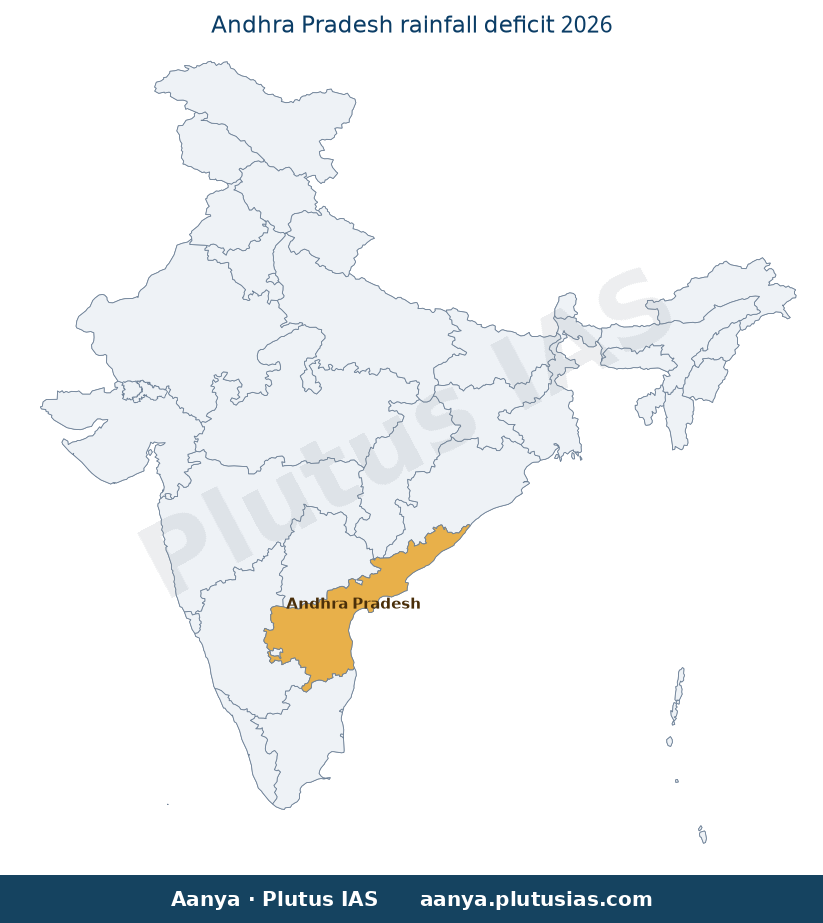
As of July 30, 2026, Andhra Pradesh has recorded a severe rainfall deficit of 52.4%, with no district reporting normal precipitation. This meteorological anomaly, exacerbated by the El Niño phenomenon, has triggered concerns over agricultural distress, water scarcity, and the potential declaration of drought-affected mandals. The situation demands an integrated policy response, including relief measures, crop diversification, and long-term climate adaptation strategies, given the state’s heavy reliance on rainfed agriculture and the IMD’s forecast of continued dry conditions until August 3, 2026.
Background
- The Southwest Monsoon, which accounts for 75-80% of Andhra Pradesh’s annual rainfall, is critical for kharif crop cultivation, particularly paddy, groundnut, and pulses.
- Andhra Pradesh’s agro-climatic zones—Coastal Andhra and Rayalaseema—exhibit varying rainfall patterns, with Coastal Andhra receiving the highest average precipitation (1,000–1,200 mm) and Rayalaseema the lowest (500–700 mm).
- The El Niño-Southern Oscillation (ENSO) phenomenon, characterised by warmer-than-average sea surface temperatures in the equatorial Pacific, is strongly correlated with reduced monsoon rainfall in India, particularly in peninsular and eastern regions.
- Historically, Andhra Pradesh has faced droughts in 2002, 2009, 2015, and 2023, with the 2015 drought affecting over 2.5 million hectares of cropland and necessitating central assistance under the National Disaster Response Fund (NDRF).
- The state’s water resources are predominantly dependent on monsoon rains, with major irrigation projects like the Polavaram and Nagarjunasagar relying on timely inflows to meet agricultural and drinking water demands.
- The IMD’s classification of rainfall deficits—normal (within ±19%), deficient (within -20% to -59%), and large deficient (below -60%)—provides the framework for drought assessment and relief measures.
What constitutes a rainfall deficit and how is it classified?
- Rainfall deficit refers to the shortfall in actual precipitation compared to the long-period average (LPA) for a given region and time period, typically measured over the monsoon season (June–September).
- The India Meteorological Department (IMD) classifies rainfall deficits into three categories: normal (within ±19% of LPA), deficient (within -20% to -59% of LPA), and large deficient (below -60% of LPA).
- A cumulative deficit of 52.4% by July-end in Andhra Pradesh places the state in the ‘deficient’ category, with some districts like Prakasam, East Godavari, and Visakhapatnam experiencing ‘large deficient’ conditions.
- Rainfall deficits are monitored at the district level, with cumulative data updated weekly to inform agricultural advisories, water resource planning, and drought declarations.
- The IMD also issues extended-range forecasts (up to four weeks) and seasonal outlooks (June–September) to provide early warnings for agricultural and water management decisions.
- The El Niño phenomenon, a key driver of monsoon variability, is associated with suppressed convection over the Indian subcontinent, leading to reduced cloud formation and rainfall during the Southwest Monsoon.
Key Features
| Feature | Significance |
|---|---|
| Rainfall Deficit of 52.4% | Indicates severe meteorological drought conditions across all districts, disrupting agricultural cycles and water availability. |
| District-wise Variation | Prakasam, East Godavari, Visakhapatnam, Annamayya, and Chittoor report large deficits, while NTR and SPSR Nellore districts transitioned from normal to deficient rainfall. |
| IMD Forecast Absence of Rain | No significant rainfall expected until August 3, exacerbating the deficit and delaying monsoon recovery. |
| Surface Wind Activity | Strong winds (40-50 kmph) in Coastal Andhra Pradesh and Rayalaseema may cause soil erosion and crop damage. |
| El Niño Threat | Persistent El Niño conditions heighten the risk of prolonged monsoon failure, compounding Andhra Pradesh’s vulnerability. |
Why it Matters
Agricultural Impact
- Delayed kharif sowing due to deficient pre-monsoon and monsoon rainfall, threatening crop yields and farmer incomes.
- Increased reliance on groundwater for irrigation, accelerating depletion of aquifers in regions like Rayalaseema.
- Potential shortfall in paddy cultivation, a staple crop in Andhra Pradesh, with cascading effects on food security.
- Rise in input costs (e.g., diesel for pumps) as farmers resort to artificial irrigation amid water scarcity.
Economic Consequences
- Contraction in rural demand, reducing consumption of non-essential goods and impacting GDP growth.
- Increased government expenditure on drought relief measures, straining fiscal resources.
- Potential migration of agricultural laborers to urban areas, exacerbating unemployment in rural districts.
- Impact on allied sectors such as dairy and poultry, where feed availability depends on monsoon-dependent agriculture.
Water Resource Management
- Critical stress on major irrigation projects (e.g., Polavaram, Srisailam) due to reduced inflows, affecting hydroelectric generation.
- Over-extraction of groundwater in districts like Chittoor and Prakasam leading to land subsidence and salinity ingress.
- Increased competition for water between agricultural, domestic, and industrial sectors, necessitating prioritization frameworks.
- Urgent need for rainwater harvesting and revival of traditional water bodies to mitigate long-term deficits.
Political and Governance Implications
- Pressure on the state government to declare drought-hit mandals and release relief funds under the National Disaster Response Fund (NDRF).
- Opposition parties (e.g., CPI) demanding proactive measures, potentially influencing electoral politics.
- Coordination challenges between state agencies (e.g., Revenue, Agriculture, Water Resources) in implementing drought mitigation strategies.
- Public scrutiny over the efficacy of existing schemes like the Andhra Pradesh Drought Prone Area Programme (DPAP).
Challenges
1. Meteorological Uncertainty
- Prolonged absence of monsoon systems (e.g., low-pressure areas, depressions) over the Bay of Bengal, deviating from climatological norms.
- El Niño-Southern Oscillation (ENSO) phase persistence, reducing predictability of monsoon revival.
- Limited lead time for agricultural and water management adaptations due to erratic rainfall patterns.
UPSC Link: GS3: Climate Change and Monsoon Variability
2. Agricultural Distress
- Failure of contingency crops (e.g., millets, pulses) due to moisture stress, increasing farmer indebtedness.
- Delayed sowing leading to reduced crop duration and lower productivity, particularly for paddy and sugarcane.
- Increased incidence of pest attacks (e.g., brown plant hopper in paddy) in water-stressed conditions.
UPSC Link: GS3: Agriculture and Farmer Suicide
3. Water Security Crisis
- Depletion of major reservoirs (e.g., Nagarjunasagar, Srisailam) below critical levels, threatening irrigation and drinking water supply.
- Groundwater overexploitation in districts like Chittoor and Anantapur, with falling water tables and increased fluoride contamination.
- Urban water shortages in cities like Vijayawada and Visakhapatnam due to reduced inflows from upstream catchments.
UPSC Link: GS3: Water Resources and Groundwater Depletion
4. Governance and Implementation Gaps
- Delays in declaring drought-affected areas, hindering timely disbursal of relief funds and subsidies.
- Inadequate coordination between IMD forecasts and state-level drought management plans.
- Limited capacity of local institutions (e.g., Panchayati Raj bodies) to implement micro-level water conservation measures.
UPSC Link: GS2: Disaster Management and Local Governance
5. Socio-Economic Vulnerabilities
- Marginal farmers and landless laborers are disproportionately affected, exacerbating rural poverty and inequality.
- Increased out-migration from drought-prone districts to urban centers, straining urban infrastructure.
- Health risks due to waterborne diseases (e.g., cholera, diarrhea) due to contaminated water sources.
UPSC Link: GS1: Poverty and Migration
Challenges — UPSC Perspective
| Issue | Concern |
|---|---|
| Delayed Monsoon Revival | Prolonged dry spells disrupt agricultural calendars and water availability. |
| Groundwater Depletion | Overexploitation in districts like Chittoor and Anantapur threatens long-term water security. |
| Agricultural Input Costs | Rising diesel and electricity costs for irrigation strain farmer incomes. |
| Urban Water Shortages | Reduced inflows to reservoirs affect municipal water supply in major cities. |
| Political Pressure | Opposition demands for drought declarations and relief measures create governance challenges. |
| Climate Change Linkages | Increased frequency of El Niño events exacerbates monsoon variability. |
Government Initiatives — Must-Memorise for Prelims
- National Disaster Response Fund (NDRF)
Way Forward
- Accelerate the declaration of drought-hit mandals and release relief funds under NDRF to provide immediate succor to farmers.
- Promote drought-resistant crop varieties (e.g., millets, pulses) and agroforestry to reduce water dependency.
- Implement large-scale rainwater harvesting structures (e.g., farm ponds, check dams) to augment groundwater recharge.
- Enhance IMD’s sub-district level rainfall forecasting to improve early warning systems for farmers.
- Strengthen the Andhra Pradesh State Disaster Management Authority (APSDMA) with real-time monitoring of water resources.
- Leverage MGNREGS for water conservation works (e.g., desilting tanks, afforestation) to create rural employment.
- Introduce water pricing reforms to incentivize efficient irrigation practices in water-stressed districts.
- Collaborate with neighboring states (e.g., Odisha, Telangana) for joint monsoon management and reservoir sharing.
UPSC Value Addition
Keywords for Mains Answer-Writing
Andhra Pradesh rainfall deficit · Southwest Monsoon variability · El Niño impact on agriculture · Drought management in India · IMD rainfall classification · Agricultural distress in Andhra Pradesh · Climate change and monsoon patterns · Disaster management framework for drought · Water resource management in India · Union Government’s role in drought relief · Interstate monsoon dynamics · Agricultural subsidies and relief measures
Concept Flow
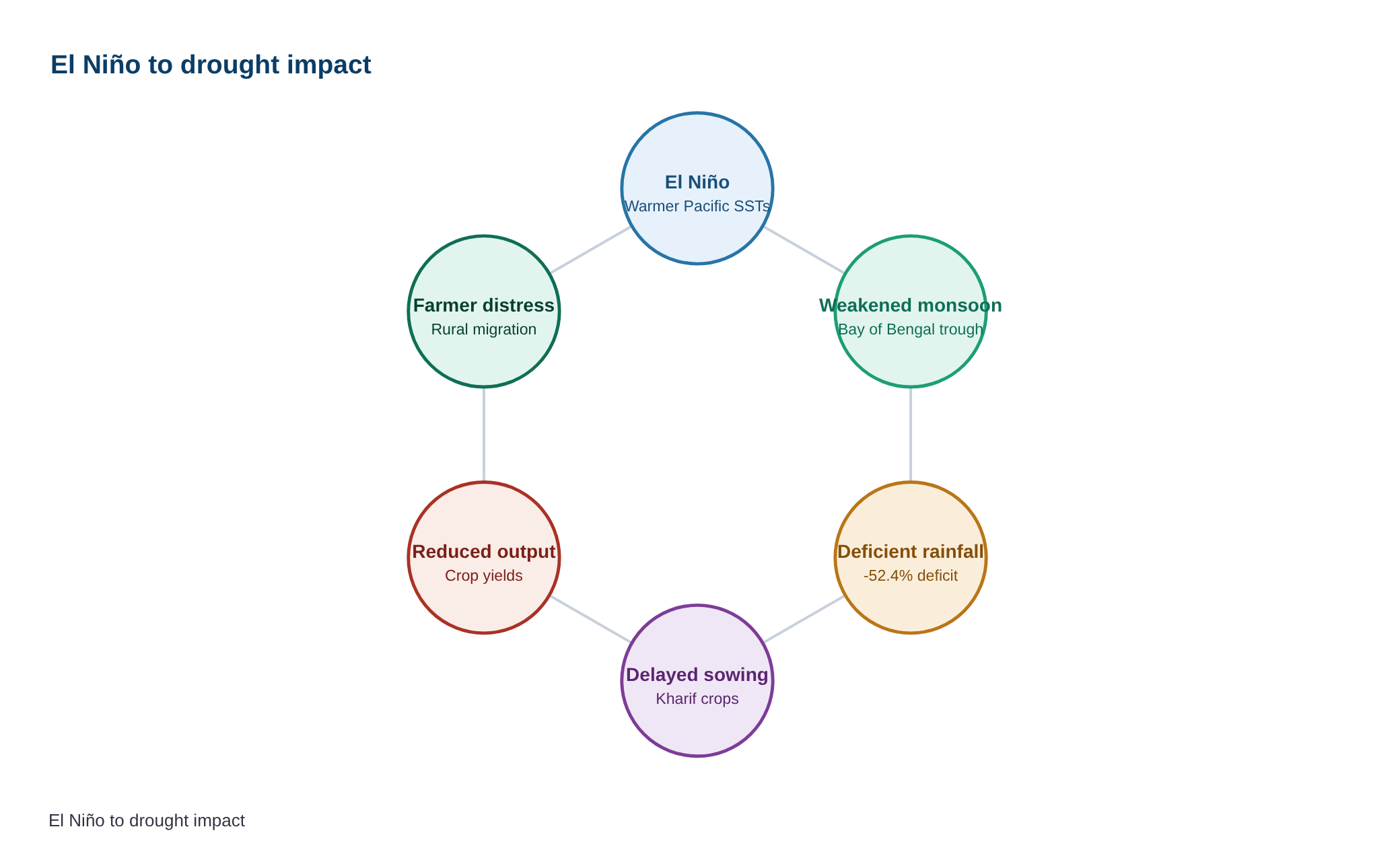
El Niño conditions → Weakened monsoon trough over Bay of Bengal → Deficient rainfall in Andhra Pradesh → Delayed kharif sowing → Reduced agricultural output → Farmer distress and rural migration → Deficient rainfall → Reduced reservoir inflows → Water scarcity in urban and rural areas → Groundwater overexploitation → Long-term water security threats → IMD forecast of no rain → Prolonged dry spell → Increased pest attacks and crop failure → Higher input costs for farmers → Financial strain and indebtedness → Deficient rainfall → Drought declaration → Release of NDRF funds → Relief distribution delays → Political pressure on state government → Groundwater depletion → Falling water tables → Increased fluoride contamination → Health risks for rural populations → Need for water treatment infrastructure → Agricultural distress → Reduced rural demand → Contraction in allied sectors (dairy, poultry) → Economic slowdown in rural areas → Water scarcity → Competition between agriculture and domestic sectors → Prioritization conflicts → Need for integrated water resource management
Prelims Practice Questions
Q1. Consider the following statements regarding the classification of rainfall by the India Meteorological Department (IMD):
1. Normal rainfall is defined as rainfall within ±19% of the Long Period Average (LPA).
2. Deficient rainfall is defined as rainfall between 20% and 59% below the LPA.
3. Large deficient rainfall is defined as rainfall below 60% of the LPA.
4. Excess rainfall is defined as rainfall above 20% of the LPA.
How many of the above statements are correct?
- Only one
- Only two
- Only three
- All four
Answer: Only three — Statements 1 and 2 are correct. Statement 3 is incorrect as large deficient rainfall is below 20% of the LPA, not 60%. Statement 4 is incorrect as excess rainfall is defined as rainfall above 20% of the LPA, but the threshold for excess is not explicitly stated in the IMD classification.
Q2. Assertion (A): The El Niño phenomenon is associated with warmer-than-average sea surface temperatures in the central and eastern tropical Pacific Ocean.
Reason (R): El Niño events typically lead to reduced rainfall over the Indian subcontinent due to changes in the Walker circulation and disruption of the Southwest Monsoon.
Options:
A. Both A and R are true, and R is the correct explanation of A.
B. Both A and R are true, but R is not the correct explanation of A.
C. A is true, but R is false.
D. A is false, but R is true.
Answer: ? — Assertion (A) is true as El Niño is indeed associated with warmer-than-average sea surface temperatures in the central and eastern tropical Pacific. Reason (R) is also true and correctly explains the impact of El Niño on the Indian Southwest Monsoon.
Q3. Match the following districts of Andhra Pradesh with their respective rainfall deficit categories as reported by the Directorate of Economics and Statistics (July 30, 2026):
Column I (District) | Column II (Rainfall Deficit Category)
1. Prakasam | A. Large Deficient
2. East Godavari | B. Deficient
3. Visakhapatnam | C. Normal (initially)
4. NTR District | D. Large Deficient
Options:
A. 1-A, 2-A, 3-A, 4-C
B. 1-A, 2-A, 3-B, 4-C
C. 1-B, 2-A, 3-A, 4-D
D. 1-A, 2-B, 3-B, 4-C
Answer: ? — Prakasam, East Godavari, and Visakhapatnam are reported as large deficient, while NTR District was initially normal but later reported deficient. The correct match is 1-A, 2-A, 3-A, 4-C.
Mains Practice Question
✍ Critically analyse the causes and consequences of the deficient rainfall in Andhra Pradesh, with particular reference to the El Niño phenomenon. Also, evaluate the adequacy of India’s institutional framework for drought management in mitigating agricultural distress. (15 Marks)
Approach: MODEL-ANSWER SKELETON:
I. Causes of Deficient Rainfall in Andhra Pradesh:
1. El Niño-Southern Oscillation (ENSO): Explain the mechanism of El Niño and its impact on the Southwest Monsoon, citing IMD data and reports.
2. Climate Change: Discuss the role of climate change in altering monsoon patterns, citing studies or reports (e.g., IPCC AR6).
3. Local Factors: Mention any regional meteorological conditions (e.g., weak depressions in the Bay of Bengal) as per the IMD forecast.
II. Consequences for Andhra Pradesh:
1. Agricultural Distress: Highlight the impact on kharif crops, water availability, and farmer livelihoods, using the 52.4% deficit figure.
2. Economic Impact: Discuss potential GDP contraction, rural distress, and food inflation.
3. Social Impact: Mention migration, indebtedness, and health impacts (e.g., water-borne diseases).
III. Institutional Framework for Drought Management:
1. National Framework: Outline key components of the National Disaster Management Framework (NDMF) and National Drought Management Policy (2016).
2. State-Level Mechanisms: Discuss Andhra Pradesh’s State Disaster Management Authority (APSDMA) and its role in relief and mitigation.
3. Schemes: Evaluate the effectiveness of schemes like PM-KISAN, MGNREGA, and State-specific initiatives (e.g., Rythu Bharosa).
4. Gaps: Critique the adequacy of early warning systems, inter-departmental coordination, and long-term resilience measures.
IV. Way Forward:
1. Short-Term: Suggest immediate measures like crop insurance payouts, fodder supply, and water rationing.
2. Long-Term: Recommend climate-resilient agriculture, water harvesting, and diversification of livelihoods.
Balance of Views: Present both the government’s perspective (e.g., Naidu’s directives) and critiques (e.g., CPI’s demand for declaring drought-hit mandals).
Source: The Hindu
Generated by AanyaAi for educational purpose.

- महाराष्ट्र में त्योहार जुलूसों पर बॉम्बे हाईकोर्ट का बड़ा फैसला: पटाखे, लेजर और संगीत पर रोक - September 24, 2026
- Bombay HC Bans Firecrackers, Music in Maharashtra Processions: Key UPSC Analysis - September 24, 2026
- तमिलनाडु में महिला कर्मचारियों के लिए सवैतनिक माहवारी अवकाश नीति पर HC का आदेश - September 24, 2026

No Comments