


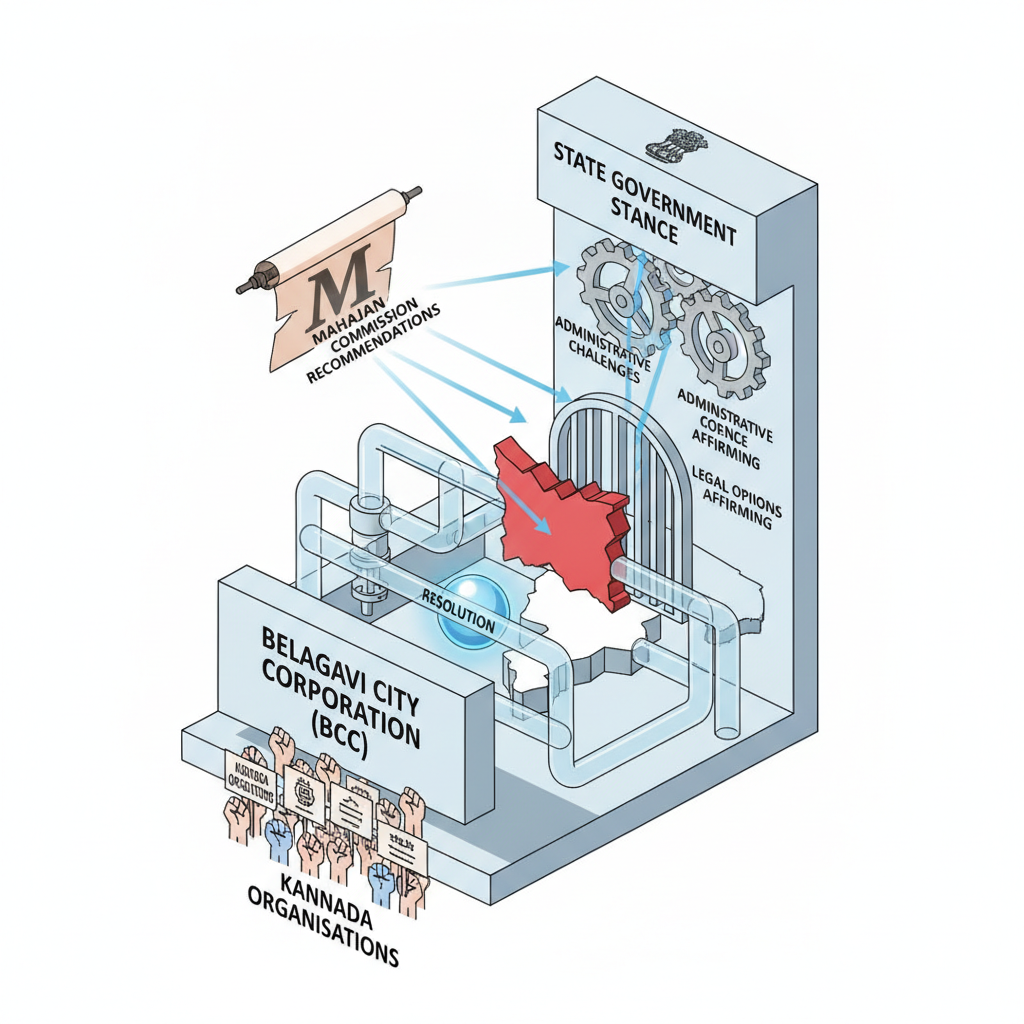
08 Aug Kannada groups demand action against BCC over Mahajan Commission delay
Belagavi City CorporationMahajan CommissionKannada organisationsState government✎ The delay by the Belagavi City Corporation (BCC) in passing a resolution affirming Belagavi as an integral part of Karnataka, despite the Mahajan Commission’s recommendations and the State government’s stance, has escalated…
Subject Relevance — Where This Topic Fits
- GS Paper II — Functions and Responsibilities of the Union and the States, Issues and Challenges Pertaining to the Federal Structure, Devolution of Powers and Finances up to Local Levels | GS Paper II — Role of Civil Services in a Democracy | GS Paper III — Role of External State and Non-State Actors in Creating Challenges to Internal Security
- Prelims: Mahajan Commission, Belagavi dispute, Karnataka-Karnataka border issues, Urban Local Bodies (ULBs), Article 243 of the Constitution, State Legislature resolutions, Federalism in India, Inter-State Water Disputes, Local Self-Government, Supreme Court opinions on inter-state disputes
- Essay: Federalism and Cooperative Governance in India: Lessons from the Belagavi Border Dispute, The Role of Constitutional Bodies in Resolving Inter-State Disputes: A Case Study of the Mahajan Commission
Why is this in the news?
The delay by the Belagavi City Corporation (BCC) in passing a resolution affirming Belagavi as an integral part of Karnataka, despite the Mahajan Commission’s recommendations and the State government’s stance, has escalated tensions between Kannada organisations and local authorities. This issue underscores the constitutional and administrative challenges in ensuring uniformity in policy implementation at the local level, particularly in matters concerning territorial integrity and federal harmony. The refusal of the BCC to act, despite legal opinions affirming the absence of barriers to such a resolution, highlights the need for mechanisms to enforce constitutional and statutory obligations on local bodies.
Background
- The Mahajan Commission, constituted in 1966 under Justice Mehr Chand Mahajan, was tasked with resolving the border dispute between Karnataka and Maharashtra, particularly concerning Belagavi (then known as Belgaum), which was a part of the erstwhile Bombay Presidency.
- The dispute resurfaced intermittently, with political and cultural organisations in Karnataka asserting Belagavi’s integral status within the state, while Maharashtra has historically contested this claim.
- The Karnataka State border and river protection commission, chaired by Justice Nagamohan Das, has reiterated the Mahajan Commission’s recommendations, affirming that Belagavi is constitutionally and legally part of Karnataka.
- Urban Local Bodies (ULBs) such as the Belagavi City Corporation are mandated under the 74th Constitutional Amendment Act, 1992, to function as institutions of self-government with defined roles in local administration and policy implementation.
- The delay in passing the resolution by the BCC, despite clear legal opinions and state government directives, reflects broader challenges in the enforcement of constitutional and statutory obligations at the grassroots level.
What is the Mahajan Commission and its relevance to the Belagavi dispute?
- The Mahajan Commission was a judicial body constituted by the Government of India in 1966 to resolve the inter-state border dispute between Karnataka and Maharashtra, primarily concerning the Belagavi region.
- The Commission’s mandate included examining historical, linguistic, and administrative claims to determine the territorial jurisdiction of the disputed areas.
- The Commission submitted its report in 1967, recommending that Belagavi and 264 surrounding villages remain within Karnataka, based on linguistic and administrative considerations.
- The recommendations of the Mahajan Commission have been periodically reaffirmed by subsequent state commissions, including the Karnataka State border and river protection commission, chaired by Justice Nagamohan Das.
- The dispute has persisted due to political and cultural assertions from both Karnataka and Maharashtra, with Maharashtra historically staking claims over parts of the Belagavi region based on linguistic and administrative grounds.
- The current impasse in the Belagavi City Corporation highlights the need for constitutional mechanisms to ensure that local bodies align their actions with state and national policies, particularly in matters of territorial integrity.
Key Features
| Feature | Significance |
|---|---|
| Mahajan Commission Recommendations | Establishes Belagavi as an integral part of Karnataka, resolving a long-standing border dispute with Maharashtra. |
| Belagavi City Corporation (BCC) Resolution | A local governance mechanism to affirm Karnataka’s territorial integrity, demonstrating administrative alignment with state policy. |
| State Government’s Legal Opinion | Confirms no legal impediments to passing the resolution, reinforcing constitutional and statutory backing for Karnataka’s claim. |
| Mayor’s Referral to State Government | Demonstrates procedural ambiguity in local governance, potentially delaying resolution despite clear directives. |
| Kannada Organisations’ Protests | Highlights societal mobilisation for linguistic and territorial identity, exerting pressure on administrative bodies. |
Why it Matters
Political/Administrative
- Reinforces Karnataka’s sovereign claim over Belagavi, a region historically contested with Maharashtra, through local governance resolution.
- Demonstrates the interplay between state policy and municipal governance in asserting territorial integrity.
- Exposes administrative delays in local bodies, undermining public trust in governance mechanisms.
- Shows the role of political leadership in resolving inter-state disputes and ensuring administrative coherence.
Legal/Judicial
- Affirms the Mahajan Commission’s findings as legally sound, with no constitutional or statutory barriers to the resolution.
- Underlines the judiciary’s role in clarifying legal ambiguities, as seen in opinions from the Supreme Court and Karnataka State Border Commission.
- Highlights the necessity of legal clarity in resolving territorial disputes, preventing prolonged administrative ambiguity.
Societal/Cultural
- Reflects the linguistic and cultural identity movements in Karnataka, particularly the assertion of Kannada-speaking regions.
- Shows the mobilisation of civil society organisations in advocating for regional pride and administrative accountability.
- Illustrates the intersection of identity politics with governance, where cultural symbols (e.g., language) drive political action.
Challenges
1. Administrative Delay in Local Governance
- BCC’s failure to pass the resolution despite clear directives from the state government and legal opinions.
- Mayor’s referral to the state government for a legal opinion, despite prior clarification, indicating procedural inefficiency.
- Risk of eroding public confidence in local governance institutions due to prolonged inaction.
- Potential for further protests and unrest if the resolution remains unaddressed.
UPSC Link: 73rd and 74th Constitutional Amendments Act
2. Inter-State Border Disputes
- Long-standing territorial disputes between Karnataka and Maharashtra over Belagavi, requiring sustained political and legal resolution.
- Risk of escalation if local governance bodies fail to align with state and judicial positions.
- Need for institutional mechanisms to prevent recurring disputes over inter-state boundaries.
UPSC Link: Article 3 of the Constitution
3. Public Trust and Governance Accountability
- Perception of indifference or inaction by local bodies, leading to societal mobilisation and protests.
- Challenge of balancing administrative efficiency with public expectations in governance.
- Risk of undermining democratic institutions if resolutions are delayed without justification.
UPSC Link: Right to Constitutional Remedies (Article 32)
4. Legal Ambiguity in Local Governance
- Mayor’s referral to the state government for a legal opinion, despite prior state and judicial clarity, indicating procedural confusion.
- Potential for conflicting interpretations of local governance powers under municipal laws.
- Need for standardised procedures to resolve such ambiguities promptly.
UPSC Link: 74th Constitutional Amendment Act (Part IXA)
Challenges — UPSC Perspective
| Issue | Concern |
|---|---|
| BCC’s Delay in Passing Resolution | Undermines state policy and judicial clarity, raising questions about local governance efficacy. |
| Mayor’s Referral to State Government | Creates procedural delays despite clear legal opinions, indicating administrative inefficiency. |
| Public Protests and Arrests | Signals societal discontent with governance inaction, risking law-and-order challenges. |
| Inter-State Border Dispute | Requires sustained political and legal resolution to prevent recurring tensions. |
| Legal Ambiguity in Local Governance | Highlights gaps in municipal law interpretation, necessitating standardised procedures. |
Way Forward
- State government must issue explicit directives to the BCC to pass the resolution without further delay.
- Convene a special meeting of the BCC, chaired by the Minister for Urban Development, to ensure compliance.
- Establish a time-bound action plan for local bodies to align with state and judicial positions on territorial integrity.
- Engage with Kannada organisations to address their concerns and incorporate their suggestions in the resolution.
- Strengthen mechanisms for inter-state border dispute resolution, including regular consultations with neighbouring states.
- Enhance transparency in local governance by publishing reasons for delays and progress updates.
- Conduct capacity-building programmes for municipal officials on legal and procedural clarity in governance.
UPSC Value Addition
Keywords for Mains Answer-Writing
Belagavi border dispute · Mahajan Commission · Karnataka-Karnataka border issues · Belagavi City Corporation (BCC) · Article 243Q of the Constitution · Urban Local Bodies (ULBs) · State legislature resolutions on border disputes · inter-state boundary disputes · federalism in India · local self-government and federalism · Mahajan Commission report · Karnataka State Border and River Protection Commission · executive-legislature relations in local governance · legal opinions on territorial integrity · Kannada organisations and regional identity politics
Constitutional & Policy Linkages
- Article 3 (Powers of Parliament to admit new States and alter areas, boundaries or names of existing States)
- Article 263 (Inter-State Council to promote coordination between States)
Concept Flow
Historical border dispute between Karnataka and Maharashtra over Belagavi → Formation of the Mahajan Commission to resolve the dispute → Commission’s recommendations affirming Belagavi as part of Karnataka → State government’s acceptance of the recommendations and passing of legislative resolution → Introduction of resolution in BCC but failure to pass due to procedural delays → Kannada organisations’ protests and legal clarifications from state and judiciary → BCC’s continued inaction despite clear directives, risking administrative and societal discontent
Prelims Practice Questions
Q1. Consider the following statements regarding the Mahajan Commission and its recommendations on the Belagavi border dispute:
1. The Mahajan Commission was constituted to resolve inter-state border disputes between Karnataka and Maharashtra.
2. The Commission recommended that Belagavi be declared an integral part of Karnataka.
3. The State government of Karnataka has not yet accepted the Commission’s recommendations.
4. The Belagavi City Corporation (BCC) is constitutionally mandated to pass resolutions on territorial integrity.
How many of the above statements are correct?
- Only one
- Only two
- Only three
- All
Answer: Only three — Statements 1 and 2 are correct. The Mahajan Commission was indeed constituted to resolve the Belagavi border dispute between Karnataka and Maharashtra, and its recommendations favoured Belagavi as part of Karnataka. Statement 3 is incorrect as the Karnataka government has accepted the Commission’s recommendations. Statement 4 is correct as the BCC, being an urban local body under Article 243Q, has the mandate to pass resolutions on local governance, including territorial integrity.
Q2. Assertion (A): The Belagavi City Corporation (BCC) is constitutionally obligated to pass a resolution on the Mahajan Commission’s recommendations.
Reason (R): Urban Local Bodies (ULBs) in India derive their authority from Part IX of the Constitution, which empowers them to address local governance issues, including those related to territorial integrity.
Options:
A. Both A and R are true, and R is the correct explanation of A.
B. Both A and R are true, but R is not the correct explanation of A.
C. A is true, but R is false.
D. A is false, but R is true.
Answer: ? — Assertion (A) is true as the BCC, being an urban local body, is expected to align its actions with state policies, including resolutions on territorial integrity. Reason (R) is also true as ULBs derive authority from Part IX of the Constitution, but the obligation to pass a resolution on the Mahajan Commission’s recommendations is not explicitly stated in the Constitution; it is a matter of political and administrative compliance rather than constitutional mandate.
Q3. Match the following committees/commissions with their respective functions:
Column I
1. Mahajan Commission
2. State Border and River Protection Commission
3. Belagavi City Corporation (BCC)
4. Karnataka State Legislature
Column II
A. Resolves inter-state border disputes and recommends territorial adjustments
B. Passes resolutions on local governance and territorial integrity
C. Constituted by the State government to protect state borders and rivers
D. Enacts laws and resolutions on state-wide issues, including border disputes
Options:
A. 1-A, 2-C, 3-B, 4-D
B. 1-B, 2-A, 3-D, 4-C
C. 1-C, 2-D, 3-A, 4-B
D. 1-D, 2-B, 3-C, 4-A
Answer: ? — 1-A: The Mahajan Commission was constituted to resolve inter-state border disputes, including the Belagavi issue. 2-C: The State Border and River Protection Commission is tasked with protecting state borders and rivers. 3-B: The Belagavi City Corporation (BCC) is an urban local body that passes resolutions on local governance, including territorial integrity. 4-D: The Karnataka State Legislature enacts laws and resolutions on state-wide issues, including border disputes.
Mains Practice Question
✍ The delay in the Belagavi City Corporation (BCC) passing a resolution affirming the Mahajan Commission’s recommendations on Belagavi’s territorial integrity raises questions about the efficacy of federalism and local self-governance in India. Critically examine the role of urban local bodies in resolving inter-state border disputes, with particular reference to the constitutional framework and recent developments. Also, discuss the implications of such delays for federalism and regional identity politics in India. (15 Marks)
Approach: MODEL-ANSWER SKELETON:
1. **Introduction (2 marks)**
– Briefly define the Belagavi border dispute and the Mahajan Commission’s role.
– State the constitutional framework governing urban local bodies (ULBs) under Part IX of the Constitution, particularly Article 243Q.
– Highlight the significance of the BCC’s resolution in the context of federalism and regional identity.
2. **Role of Urban Local Bodies in Resolving Border Disputes (5 marks)**
– **Constitutional Mandate**: Explain the powers and functions of ULBs under the 74th Constitutional Amendment Act, 1992, and their role in local governance.
– **Territorial Integrity and Local Governance**: Discuss whether ULBs have the authority to pass resolutions on territorial integrity, citing relevant provisions (e.g., Article 243Q, 7th Schedule).
– **Practical Constraints**: Analyse why ULBs like the BCC may hesitate to pass such resolutions, including political, administrative, and legal challenges.
– **Judicial Precedents**: Reference any judicial observations on the role of ULBs in inter-state disputes (e.g., Supreme Court’s stance on federalism and cooperative governance).
3. **Federalism and Regional Identity Politics (5 marks)**
– **Federalism in India**: Discuss the principles of cooperative and competitive federalism, and how inter-state disputes are typically resolved (e.g., through inter-state councils, judicial intervention, or political negotiations).
– **Regional Identity and Politics**: Examine how regional identity movements (e.g., Kannada organisations) influence state policies and local governance.
– **Recent Developments**: Reference recent cases or political developments where regional identity has played a role in border disputes (e.g., Maharashtra-Karnataka border issue, Assam-Nagaland disputes).
4. **Implications of Delays and Way Forward (3 marks)**
– **Impact on Federalism**: Discuss how delays in resolving such disputes can erode trust in federal institutions and exacerbate regional tensions.
– **Administrative Reforms**: Suggest measures to streamline the resolution process, such as time-bound resolutions by ULBs, state government directives, or judicial intervention.
– **Balancing Local and National Interests**: Highlight the need to balance local aspirations with national unity, citing examples of successful border dispute resolutions (e.g., Andhra Pradesh-Telangana bifurcation).
Source: The Hindu
Generated by AanyaAi for educational purpose.

- RBI to Sell ₹25,000 Crore Govt Securities via OMO on Sept 28, 2026 - September 23, 2026
- भारत-श्रीलंका नौसैनिक अभ्यास ‘स्लाईनेक्स-26’: विशाखापत्तनम में संपन्न, जानें प्रमुख बिंदु - September 23, 2026
- SLINEX-26: India-Sri Lanka Maritime Exercise Enhances Naval Cooperation - September 23, 2026

No Comments