


08 Aug UPSC Alert: Bill to Bar Under-13s from Social Media & Gaming Accounts
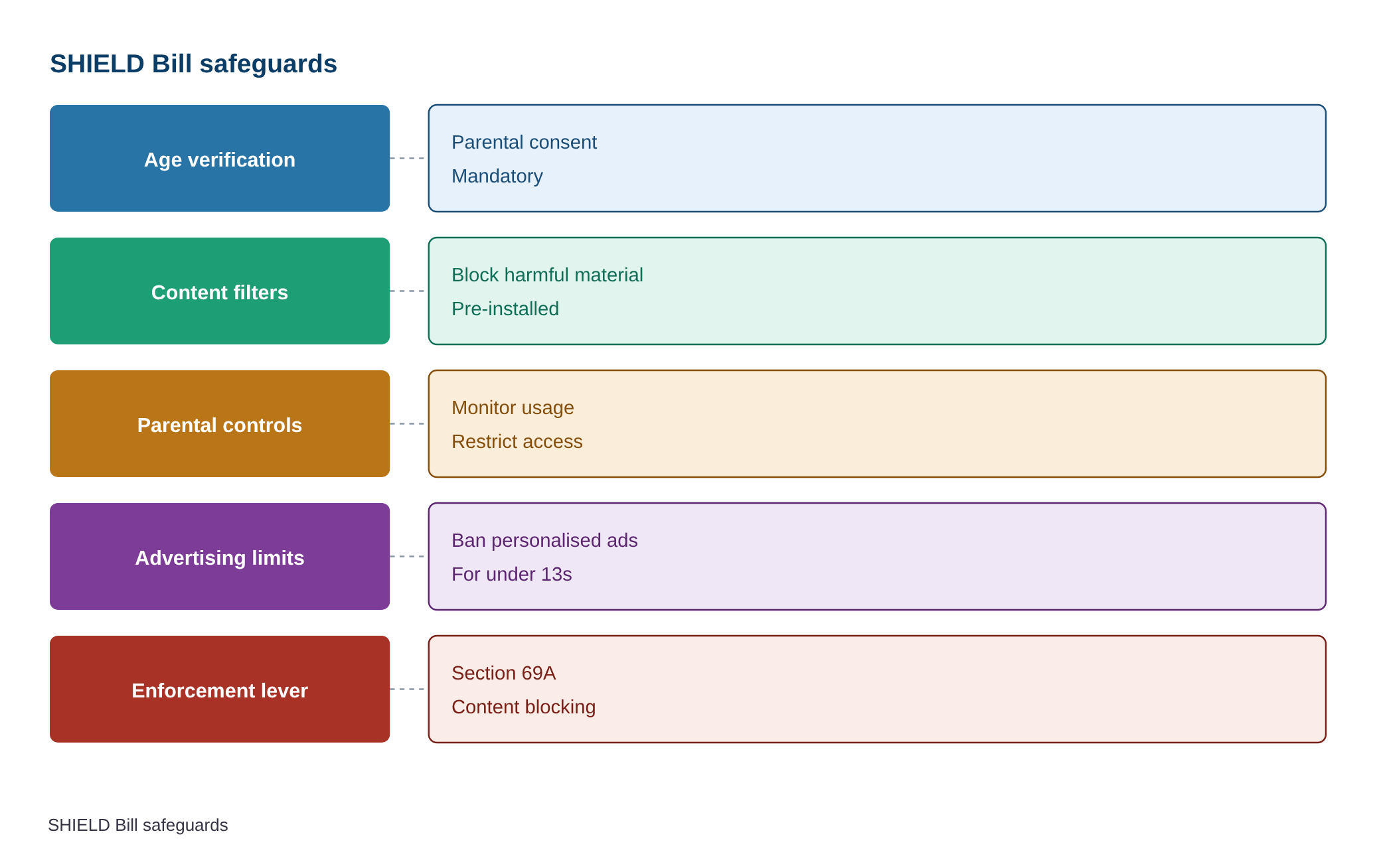
✎ The SHIELD Bill 2025 proposes mandatory age-verification, parental consent for minors’ accounts, and prohibits personalised advertising targeting children under 18.
Subject Relevance — Where This Topic Fits
- GS Paper II — Governance, Constitution, Polity, Social Justice and International Relations (Digital Governance and Child Protection Policies) | GS Paper III — Science and Technology (Cybersecurity, AI Regulation, and Digital Platform Governance)
- Prelims: Digital Personal Data Protection Act 2023, Information Technology (Intermediary Guidelines and Digital Media Ethics Code) Rules 2021, Section 69A of the IT Act, UN Convention on the Rights of the Child, Parental consent mechanisms, Age-verification systems, Personalised advertising restrictions, Online gaming regulations, Pornography and extremist content moderation
- Essay: The ethical obligations of technology platforms in safeguarding vulnerable populations, Balancing innovation with regulation: The case of digital spaces for minors
Quick Revision: The SHIELD Bill 2025 proposes mandatory age-verification, parental consent for minors’ accounts, and prohibits personalised advertising targeting children under 18.
Why is this in the news?
The proposed ‘Safeguarding Healthy Internet Environments for Little Digital-Natives (SHIELD) Bill, 2025’, introduced by BJP MP Baijayant Panda, seeks to prohibit children under 13 from creating social media or gaming accounts without verified parental consent. It also aims to restrict personalised advertising targeting minors and mandate age-verification systems, reflecting growing legislative intent to address online harms faced by children in India.
Background
- The proliferation of social media and online gaming platforms has raised concerns about the exposure of minors to harmful content, including violence, extremism, and gambling.
- India’s digital ecosystem has witnessed a surge in child-specific online risks, necessitating regulatory interventions to align with global standards such as the UN Convention on the Rights of the Child (1989).
- Existing frameworks like the Digital Personal Data Protection Act 2023 and IT Rules 2021 provide partial safeguards but lack specific provisions for minors’ digital rights and protections.
- The IT Act’s Section 69A empowers the government to block online content in the interest of sovereignty, security, or public order, which the bill seeks to leverage for enforcement.
- Private member’s bills rarely pass into law, with fewer than a dozen enacted since Independence, underscoring the procedural challenges ahead for the SHIELD Bill.
- Global precedents, such as the EU’s Digital Services Act and the UK’s Online Safety Act, have introduced stringent obligations for platforms to protect minors, influencing India’s legislative approach.
What is the SHIELD Bill 2025?
- The SHIELD Bill, formally titled ‘Safeguarding Healthy Internet Environments for Little Digital-Natives (SHIELD) Bill, 2025,’ is a private member’s bill introduced to regulate digital platforms accessible to minors in India.
- It defines a ‘child’ as any individual below 18 years of age.
- Key provisions include mandatory age-verification systems to prevent underage account creation without verified parental consent, ensuring compliance with the bill’s safeguards.
- The bill prohibits social media and gaming platforms from tracking, profiling, or targeting minors with personalised advertising, aiming to mitigate manipulative digital practices.
- Platforms are mandated to implement parental-control dashboards, enabling guardians to monitor activity, manage privacy settings, and restrict screen time for minors.
- To address exposure to harmful content, the bill requires platforms to prevent minors from accessing pornography, gambling, extremist material, and drug-related content through algorithmic and policy controls.
- The bill reflects a multi-stakeholder approach, balancing child protection with platform accountability, and draws from international best practices in digital governance.
Key Features
| Feature | Significance |
|---|---|
| Age verification system | Mandatory verification to confirm parental consent for minors under 13, ensuring age-appropriate access and reducing exposure to harmful content. |
| Parental-control dashboards | Empowers guardians to monitor activity, manage privacy settings, and restrict screen time, aligning with the principle of shared responsibility in child safety. |
| Prohibition on personalised advertising | Restricts tracking, profiling, and targeted advertising for minors, mitigating risks of manipulation and overconsumption of inappropriate content. |
| Content restriction obligations | Platforms must prevent exposure to pornography, gambling, extremist material, and drug-related content, addressing the psychological and developmental risks for children. |
| Penal provisions (₹10 crore fine, Section 69A) | Deterrent mechanism to enforce compliance, including temporary suspension or blocking of services for repeated violations, reinforcing accountability of digital intermediaries. |
Why it Matters
Child Protection and Digital Rights
- Aligns with the United Nations Convention on the Rights of the Child (UNCRC), which mandates protection from exploitation, abuse, and harmful content in digital spaces.
- Recognises the developmental vulnerability of children to manipulative algorithms, addictive design, and exposure to inappropriate material, necessitating regulatory safeguards.
- Balances digital access with safety, ensuring minors are not subject to unchecked commercial exploitation or psychological harm in online environments.
Regulatory Framework for Digital Intermediaries
- Extends the principle of ‘duty of care’ to digital platforms, holding them accountable for content moderation and user safety, similar to obligations in traditional media and broadcasting.
- Introduces a tiered compliance mechanism, where platforms must implement age-verification, content filters, and parental controls, reflecting a shift toward proactive regulation.
- Complements existing laws like the Information Technology (Intermediary Guidelines and Digital Media Ethics Code) Rules, 2021, by addressing gaps in child-specific protections.
Economic and Industry Impact
- May necessitate significant technological upgrades for platforms to implement age-verification systems, increasing operational costs and potentially reducing user bases in the short term.
- Could incentivise innovation in child-safe digital design, fostering a market for ethical AI and privacy-preserving technologies tailored for minors.
- Raises questions about the feasibility of uniform enforcement across diverse platforms, particularly in gaming and social media, where user-generated content complicates moderation.
Parental and Societal Responsibilities
- Shifts part of the burden of child safety from parents to platforms, while also empowering guardians through monitoring tools, reflecting a collaborative approach to digital parenting.
- Highlights the need for digital literacy programs to educate parents and children about safe online practices, risk mitigation, and the ethical use of technology.
- May spark debates on the role of the state in regulating private digital spaces, balancing individual freedoms with collective safety in a democratic society.
Challenges
1. Implementation and Enforcement
- Age-verification systems may face resistance from users concerned about privacy violations, particularly if they require government-issued IDs or biometric data.
- The effectiveness of content filters is limited by the dynamic nature of online content, where new harmful material can emerge faster than moderation systems can adapt.
- Cross-border enforcement challenges arise, as many platforms operate globally, requiring international cooperation to ensure consistent standards and penalties.
UPSC Link: GS2: Government Policies & Interventions
2. Technological and Ethical Dilemmas
- False positives in age verification could exclude legitimate young users, while false negatives might allow underage access, undermining the system’s reliability.
- Personalised advertising bans may reduce revenue for platforms, raising questions about sustainable business models for child-safe digital services.
- The use of AI for content moderation risks biases, over-censorship, or under-censorship, particularly in culturally diverse societies like India.
UPSC Link: GS3: Science & Technology
3. Legal and Constitutional Concerns
- The bill’s definition of a ‘child’ as anyone under 18 may conflict with existing laws, such as the Protection of Children from Sexual Offences (POCSO) Act, which defines a child as under 18 but has different implications for consent and accountability.
- Mandatory parental consent could infringe on the autonomy of older minors (e.g., 16-17 years), raising questions about the balance between protection and independence.
- Section 69A of the IT Act, which allows for blocking of services, must be applied judiciously to avoid overreach and ensure due process, particularly given its potential impact on freedom of expression.
UPSC Link: GS2: Fundamental Rights
4. Digital Divide and Accessibility
- Rural and economically disadvantaged children may face disproportionate barriers to accessing digital platforms if age-verification systems are not designed inclusively.
- Limited digital literacy in certain communities could hinder effective use of parental-control tools, exacerbating inequalities in digital safety awareness.
- The bill’s focus on social media and gaming may overlook other digital spaces (e.g., educational platforms) where children also require protection, leading to fragmented safeguards.
UPSC Link: GS1: Social Issues
5. Private Member’s Bill Limitations
- Private member’s bills rarely become law due to procedural hurdles, limited parliamentary time, and the need for government support, raising doubts about the bill’s eventual passage.
- The absence of a government-backed version of the bill may delay or dilute its provisions, as executive agencies often drive major legislative reforms.
- Public and stakeholder consultations are essential to refine the bill, but private members lack the institutional resources to conduct extensive outreach.
UPSC Link: GS2: Parliament & State Legislatures
Challenges — UPSC Perspective
| Issue | Concern |
|---|---|
| Age-verification systems | Privacy risks associated with mandatory ID or biometric verification, and potential exclusion of legitimate users due to technical failures. |
| Content moderation | Difficulty in real-time filtering of harmful content, particularly user-generated material, leading to gaps in protection. |
| Enforcement across jurisdictions | Challenges in ensuring consistent application of rules across international platforms and varying national laws. |
| Parental-control tools | Limited digital literacy among parents may render these tools ineffective, requiring extensive awareness campaigns. |
| Revenue impact on platforms | Potential loss of advertising revenue due to personalised advertising bans, affecting platform sustainability. |
| Balancing autonomy and protection | Risk of over-regulation stifling minors’ digital independence, particularly for older teens (16-17 years). |
Way Forward
- Conduct comprehensive consultations with child psychologists, educators, and digital rights experts to refine age-verification and content-moderation mechanisms.
- Develop a phased implementation roadmap, prioritising high-risk platforms (e.g., social media, gaming) and gradually expanding to other digital spaces.
- Invest in public digital literacy programs to educate parents and children about safe online practices, privacy settings, and the ethical use of technology.
- Establish a multi-stakeholder oversight body to monitor compliance, investigate violations, and recommend improvements to the regulatory framework.
- Strengthen cross-border cooperation with international bodies (e.g., UNICEF, EU) to harmonise age-verification standards and content-moderation practices.
- Pilot age-verification systems in select states or union territories to assess feasibility, gather feedback, and address implementation challenges before nationwide rollout.
- Explore public-private partnerships to develop cost-effective, privacy-preserving age-verification technologies that do not rely on intrusive data collection.
- Amend existing laws (e.g., IT Rules, 2021) to explicitly incorporate child-specific protections, ensuring consistency with the proposed bill.
UPSC Value Addition
Keywords for Mains Answer-Writing
Digital Personal Data Protection Act 2023 · children’s online safety · age verification mechanisms · personalised advertising to minors · Information Technology (Intermediary Guidelines and Digital Media Ethics Code) Rules 2021 · Article 19(1)(a) of the Constitution · UN Convention on the Rights of the Child · parental consent in digital spaces · profiling and tracking of minors · Regulation of Online Gaming
Constitutional & Policy Linkages
- Article 14: Equality before law (ensuring non-discriminatory application of age-verification systems).
- Article 19(1)(a): Freedom of speech (balancing protection with censorship concerns).
- Article 21: Right to privacy (protecting personal data in age-verification processes).
- Article 39(f): Directive Principle (protection of children’s moral and material welfare).
Concept Flow
Rise of social media and gaming platforms → Increased exposure of minors to harmful content and manipulative algorithms. → Recognition of developmental vulnerabilities of children in digital spaces → Public demand for regulatory safeguards. → Proposal of the SHIELD Bill → Mandatory age-verification, parental controls, and content restrictions. → Implementation challenges → Privacy concerns, technological limitations, and enforcement hurdles. → Balancing protection with autonomy → Amendments to existing laws and public consultations. → Long-term impact → Shift toward child-centric digital design and global harmonisation of standards.
Prelims Practice Questions
Q1. Consider the following statements regarding the proposed SHIELD Bill, 2025:
1. The bill proposes to bar children under 13 from creating social media accounts without parental consent.
2. Platforms would be prohibited from tracking, profiling, or targeting minors with personalised advertising.
3. The bill defines a child as anyone below 18 years of age.
4. Violations of the proposed law could result in penalties of up to ₹5 crore.
How many of the above statements are correct?
- Only one
- Only two
- Only three
- All four
Answer: Only three — Statements 1, 2, and 3 are correct. Statement 4 is incorrect as the penalty proposed is up to ₹10 crore, not ₹5 crore.
Q2. Assertion (A): The proposed SHIELD Bill, 2025, seeks to impose mandatory age-verification systems for platforms accessible to minors.
Reason (R): The bill aims to prevent children from being exposed to harmful content such as pornography, gambling, and extremist material.
Options:
A. Both A and R are true, and R is the correct explanation of A.
B. Both A and R are true, but R is not the correct explanation of A.
C. A is true, but R is false.
D. A is false, but R is true.
Answer: ? — Both the assertion and reason are true. The bill indeed proposes mandatory age-verification systems (A) to achieve the objective of protecting minors from harmful content (R), making R the correct explanation of A.
Q3. Match the following provisions of the proposed SHIELD Bill, 2025, with their corresponding objectives:
Column I (Provision) | Column II (Objective)
1. Parental-control dashboards | A. To monitor and manage children’s online activity
2. Prohibition on personalised advertising | B. To prevent tracking and profiling of minors
3. Age-verification systems | C. To restrict children’s exposure to harmful content
4. Penalties up to ₹10 crore | D. To ensure compliance with the proposed law
- 1-A, 2-B, 3-C, 4-D
- 1-B, 2-A, 3-D, 4-C
- 1-A, 2-B, 3-D, 4-C
- 1-C, 2-D, 3-A, 4-B
Answer: 1-A, 2-B, 3-C, 4-D — The correct match is: 1-A (Parental-control dashboards allow guardians to monitor and manage activity), 2-B (Prohibition on personalised advertising prevents tracking and profiling), 3-D (Age-verification systems ensure compliance with age restrictions), 4-C (Penalties ensure adherence to safety obligations).
Mains Practice Question
✍ Critically examine the constitutional and statutory framework governing children’s online safety in India, with particular reference to the proposed SHIELD Bill, 2025. How does the bill address the challenges posed by personalised advertising, profiling, and exposure to harmful content? Also, discuss the potential implications of the bill on the right to freedom of speech and expression under Article 19(1)(a) of the Constitution. (15 Marks)
Approach: 1. **Constitutional and Statutory Framework**:
– Article 19(1)(a) (Freedom of speech and expression) and its reasonable restrictions under Article 19(2).
– Digital Personal Data Protection Act, 2023, and its provisions on data protection for minors.
– Information Technology (Intermediary Guidelines and Digital Media Ethics Code) Rules, 2021, and their limitations in addressing children’s safety.
– UN Convention on the Rights of the Child (1989) and India’s obligations.
2. **Provisions of the SHIELD Bill, 2025**:
– Age-verification mechanisms and parental consent requirements.
– Prohibition on tracking, profiling, and personalised advertising for minors.
– Mandatory parental-control dashboards and restrictions on harmful content (pornography, gambling, extremism).
– Penalties and enforcement mechanisms under Section 69A of the IT Act.
3. **Challenges Addressed**:
– Personalised advertising: How profiling and targeted ads exploit children’s data.
– Exposure to harmful content: Mechanisms to filter and restrict access.
– Data privacy: Ensuring compliance with the Data Protection Act.
4. **Constitutional Implications**:
– Conflict between children’s safety and freedom of expression (e.g., educational content vs. harmful material).
– Balancing parental rights with the child’s autonomy in digital spaces.
– Potential overreach and censorship concerns.
5. **Critical Analysis**:
– Effectiveness of age-verification systems in practice.
– Role of intermediaries in compliance and enforcement.
– Need for multi-stakeholder collaboration (government, platforms, civil society).
6. **Conclusion**:
– The bill is a progressive step but requires safeguards to avoid over-regulation and ensure proportionality.
Source: Hindustan Times
Generated by AanyaAi for educational purpose.

- महाराष्ट्र में त्योहार जुलूसों पर बॉम्बे हाईकोर्ट का बड़ा फैसला: पटाखे, लेजर और संगीत पर रोक - September 24, 2026
- Bombay HC Bans Firecrackers, Music in Maharashtra Processions: Key UPSC Analysis - September 24, 2026
- तमिलनाडु में महिला कर्मचारियों के लिए सवैतनिक माहवारी अवकाश नीति पर HC का आदेश - September 24, 2026

No Comments