


08 Aug Policy Support Crucial to Save India’s Traditional Occupations: Expert Insights
✎ Traditional occupations in India are at risk due to market distortions, social exclusion, and inadequate policy implementation, necessitating constitutional safeguards, market linkages, and dignified livelihood frameworks to…
Subject Relevance — Where This Topic Fits
- GS Paper II — Social Justice and Governance | GS Paper III — Employment and Inclusive Growth
- Prelims: Traditional knowledge systems, Artisan communities, Middlemen exploitation, Constitutional safeguards for marginalised groups, Gig economy challenges, Social inclusion mechanisms
- Essay: The erosion of traditional livelihoods: A paradox of economic growth, Balancing modernity and heritage: The case for inclusive development
Quick Revision: Traditional occupations in India are at risk due to market distortions, social exclusion, and inadequate policy implementation, necessitating constitutional safeguards, market linkages, and dignified livelihood frameworks to ensure their survival and equitable growth.
Why is this in the news?
A two-day national seminar on ‘Traditional Occupation Communities in a Changing Economy’ highlighted the urgent need for policy interventions to protect India’s traditional occupations, which face existential threats from mechanisation, market distortions, and social exclusion despite existing welfare measures. The deliberations underscored the disproportionate impact on artisans, with nearly 30% having exited their vocations due to changing market dynamics, while emphasising the role of constitutional safeguards and dignified livelihood frameworks in preserving these socio-economic pillars.
Background
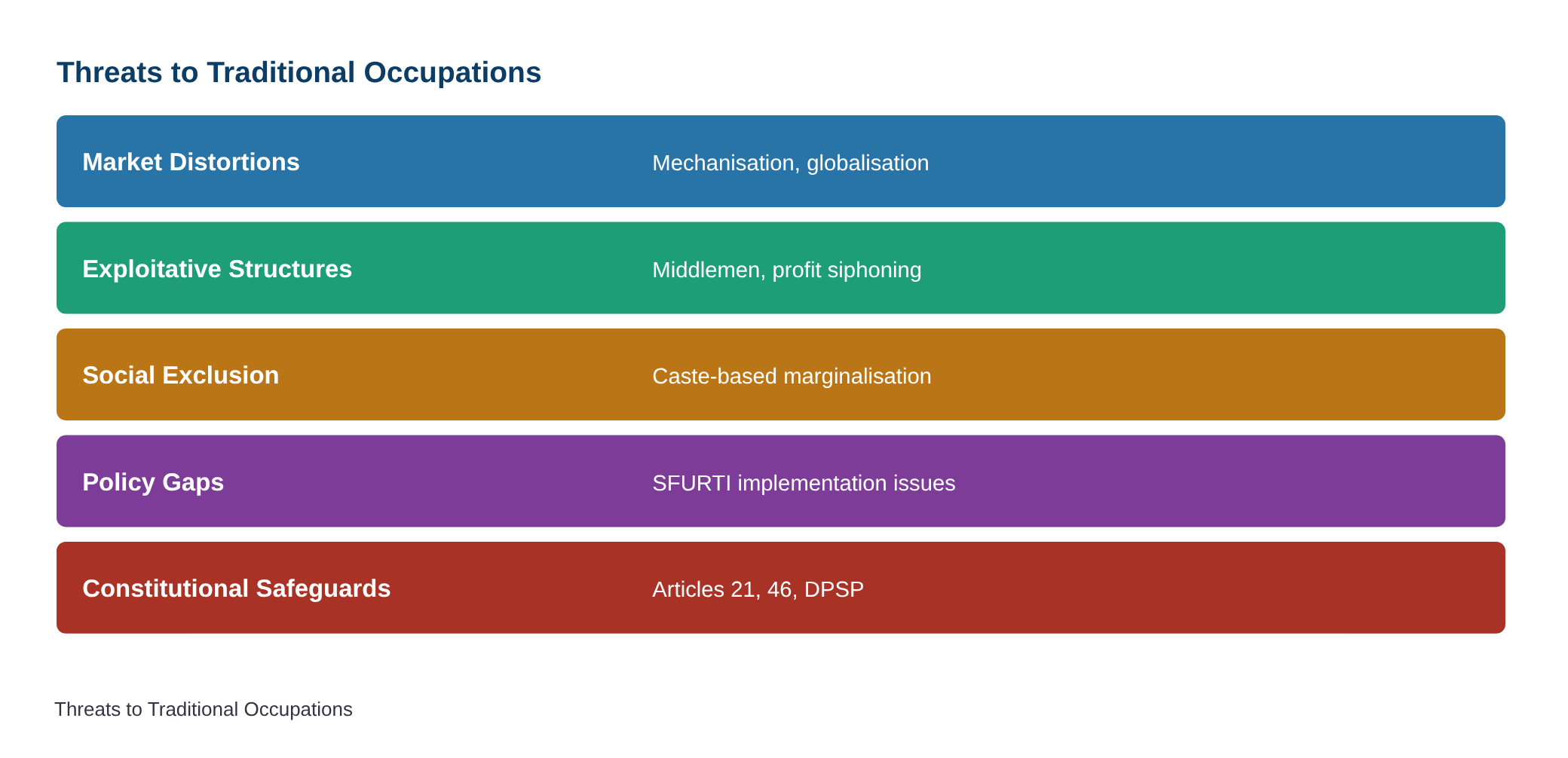
- India’s traditional occupational communities—spanning weaving, pottery, blacksmithing, and other artisanal trades—have historically been the backbone of rural and semi-urban economies, contributing to both material culture and intangible heritage.
- The advent of industrialisation and globalisation has disrupted traditional supply chains, with mechanised production and factory-made goods reducing demand for handcrafted items, thereby displacing artisans from their primary livelihoods.
- Middlemen and exploitative market structures have further exacerbated the crisis by siphoning off profits, leaving artisans with minimal earnings despite their skilled labour, as highlighted by the seminar’s keynote address.
- Government schemes such as the ‘Scheme of Fund for Regeneration of Traditional Industries’ (SFURTI) have been implemented to support artisans, but implementation gaps and inadequate market linkages persist.
- The Constitution of India, through Articles 21 (Right to Livelihood), 46 (Promotion of Educational and Economic Interests of Scheduled Castes, Scheduled Tribes, and Other Weaker Sections), and Directive Principles of State Policy, provides a legal framework for protecting traditional occupations and ensuring social justice.
- Social discrimination and exclusion continue to marginalise certain traditional communities, particularly those engaged in occupations historically deemed ‘lower caste’, thereby perpetuating cycles of poverty and deprivation.
What are Traditional Occupations and Why Do They Matter?
- Traditional occupations refer to livelihood practices rooted in indigenous knowledge systems, cultural heritage, and artisanal skills passed down through generations, often associated with specific communities or castes.
- These occupations are not merely economic activities but embody cultural identity, social cohesion, and intergenerational transmission of knowledge, making them critical to India’s intangible cultural heritage.
- The economic contribution of traditional occupations includes employment generation in rural areas, export earnings from handicrafts and handlooms, and the preservation of biodiversity through sustainable practices (e.g., organic farming, natural dyeing).
- Artisans and traditional workers face a dual challenge: external pressures from mechanisation and globalisation, and internal vulnerabilities such as lack of access to credit, technology, and formal education.
- The decline of traditional occupations is linked to the broader phenomenon of ‘deindustrialisation’ in post-colonial India, where colonial policies disrupted indigenous industries to favour British manufacturing, a trend that continues in modified forms today.
- Constitutional provisions and statutory bodies like the National Commission for Scheduled Castes (NCSC) and National Commission for Scheduled Tribes (NCST) are tasked with protecting the rights of traditional occupational communities, particularly those from marginalised sections.
- Policy frameworks such as the ‘National Handloom Development Programme’ aim to integrate traditional skills with modern markets, though implementation remains uneven across states.
- The seminar’s emphasis on ‘occupational freedom’ and ‘dignified livelihoods’ aligns with global commitments under the ILO’s ‘Decent Work Agenda’ and the United Nations Sustainable Development Goals (SDG 8: Decent Work and Economic Growth, SDG 10: Reduced Inequalities).
Key Features
| Feature | Significance |
|---|---|
| National Seminar on Traditional Occupations | Highlights systemic challenges faced by artisans and traditional communities, providing a platform for policy discourse and empirical documentation of their socio-economic conditions. |
| Economic Stress Indicators | Mechanisation, factory-made products, and irregular incomes have reduced the viability of traditional livelihoods, pushing nearly 30% of artisans out of their occupations. |
| Market Access Barriers | Dependence on middlemen and inadequate market linkages limit artisans’ earnings, exacerbating vulnerability to market fluctuations. |
| Social Inclusion Challenges | Continued social discrimination against traditional occupational communities undermines their dignity and economic participation. |
| Policy Intervention Needs | Strengthening welfare measures, providing market access, and ensuring occupational freedom are critical to sustain traditional occupations. |
Why it Matters
Economic
- Traditional occupations contribute significantly to India’s GDP through handicrafts, handlooms, and rural artisanal sectors, which are often informal but culturally and economically pivotal.
- Preservation of these occupations ensures livelihood security for millions, particularly in rural and tribal regions, reducing migration to urban centres.
- Artisanal products, such as handloom textiles and pottery, are high-value exports, contributing to India’s trade balance and global cultural soft power.
Cultural
- Traditional occupations are repositories of indigenous knowledge, craftsmanship, and heritage, embodying India’s pluralistic cultural identity.
- Loss of these occupations erodes intangible cultural heritage, including indigenous techniques, oral traditions, and community-specific skills passed down generations.
- Safeguarding traditional occupations aligns with the UNESCO Convention for the Safeguarding of the Intangible Cultural Heritage (2003), which India has ratified.
Social
- Traditional occupational communities often face marginalisation, with limited access to education, healthcare, and financial services, necessitating inclusive development policies.
- Empowerment of these communities through dignified livelihoods fosters social cohesion and reduces inter-generational poverty traps.
- Constitutional provisions, such as Articles 15(4) and 16(4), mandate affirmative action to uplift socially and educationally backward classes, including traditional artisans.
Policy
- Effective policy support requires a multi-pronged approach, including skill upgradation, market integration, financial inclusion, and anti-discrimination measures.
- The National Handloom Development Programme (NHDP) and Comprehensive Handicrafts Cluster Development Scheme (CHCDS) are existing frameworks that need stronger implementation.
- Decentralised governance models, such as Gram Panchayat-level artisan cooperatives, can enhance localised policy delivery and reduce middlemen exploitation.
Challenges
1. Market Disruption and Competition
- Mechanisation and factory-produced goods offer cost advantages, reducing demand for handmade products and rendering traditional occupations economically unviable.
- Globalisation and e-commerce platforms often bypass traditional artisans, favouring large-scale manufacturers with better supply chain access.
UPSC Link: GS-III: Employment and Industrial Policy
2. Middlemen Exploitation and Income Inequality
- Artisans remain dependent on middlemen for raw material procurement and market access, leading to exploitative pricing and reduced profit margins.
- Income disparities widen as artisans lack bargaining power, while middlemen and retailers capture a disproportionate share of the value chain.
UPSC Link: GS-III: Agricultural and Rural Development
3. Social Discrimination and Marginalisation
- Traditional occupational communities, such as weavers, potters, and blacksmiths, often face caste-based discrimination, limiting their social mobility and economic opportunities.
- Stereotypes and occupational stigma perpetuate exclusion, discouraging youth from pursuing traditional livelihoods.
UPSC Link: GS-I: Social Empowerment and Inclusion
4. Lack of Skill Upgradation and Innovation
- Stagnation in design and production techniques reduces the appeal of traditional products in modern markets, particularly among younger consumers.
- Limited access to training programmes and digital tools hinders artisans’ ability to adapt to evolving consumer preferences.
UPSC Link: GS-III: Skill Development and Entrepreneurship
5. Policy Implementation Gaps
- Despite numerous schemes, poor inter-departmental coordination, bureaucratic delays, and leakages undermine their effectiveness.
- Lack of data on artisans’ socio-economic conditions hampers targeted policy formulation and monitoring.
UPSC Link: GS-II: Governance and Public Policy
Challenges — UPSC Perspective
| Issue | Concern |
|---|---|
| Mechanisation and Factory Competition | Undermines the cost-competitiveness of handmade products, reducing demand for traditional occupations. |
| Middlemen Dominance | Exploitative pricing structures and lack of market access reduce artisans’ earnings and bargaining power. |
| Social Stigma and Caste Barriers | Perpetuates exclusion, discouraging youth from adopting traditional livelihoods and limiting social mobility. |
| Skill Stagnation | Outdated techniques and lack of innovation reduce the market appeal of traditional products. |
| Policy Implementation Deficits | Bureaucratic inefficiencies and poor monitoring dilute the impact of welfare schemes. |
| Data Deficiency | Inadequate documentation of artisans’ socio-economic conditions impedes evidence-based policymaking. |
Government Initiatives — Must-Memorise for Prelims
- National Handloom Development Programme (NHDP)
- Comprehensive Handicrafts Cluster Development Scheme (CHCDS)
- Prime Minister’s Employment Generation Programme (PMEGP) – for artisans’ entrepreneurship
- Stand-Up India Scheme – for financial inclusion of traditional artisans
Way Forward
- Strengthen market linkages by integrating artisans with e-commerce platforms (e.g., GeM, Amazon Karigar) and promoting direct-to-consumer sales models.
- Enhance skill upgradation through targeted programmes under the Skill India Mission, focusing on digital literacy, design innovation, and sustainable practices.
- Implement caste-based reservation policies effectively in educational institutions and government procurement to uplift traditional artisans.
- Establish artisan cooperatives at the Gram Panchayat level to reduce middlemen dependence and enhance collective bargaining power.
- Introduce a national database of artisans with real-time monitoring of their socio-economic conditions to inform policy design.
- Promote geo-tagged handicrafts under the ‘One District, One Product’ (ODOP) initiative to enhance brand visibility and market access.
- Encourage public-private partnerships (PPPs) to invest in artisan clusters, providing infrastructure, technology, and export facilitation.
- Conduct periodic socio-economic surveys to assess the impact of welfare schemes and identify gaps in implementation.
UPSC Value Addition
Keywords for Mains Answer-Writing
Traditional occupations · Artisan communities · Social inclusion · Inclusive development · Economic stress on artisans · Policy support for livelihoods · Constitutional safeguards for marginalised communities · Market access for traditional crafts · Mechanisation and traditional occupations · Welfare measures for artisans · Dignified livelihoods · Empowerment of traditional communities · Social discrimination and economic exclusion · Centre for Study of Social Inclusion (CSSI) · Constitutional provisions for marginalised groups
Constitutional & Policy Linkages
- Article 21: Right to Livelihood and Dignified Life – Ensures protection of traditional occupations as part of fundamental rights.
- Article 46: Promotion of Educational and Economic Interests of SCs/STs/Weaker Sections – Mandates state support for marginalised occupational groups.
- Article 15(4): Special Provisions for Advancement of Backward Classes – Allows affirmative action for traditional artisans.
- Article 16(4): Reservation in Public Employment – Can be extended to uplift artisans in government-linked sectors.
Concept Flow
Globalisation and Mechanisation → Reduced demand for handmade products → Economic stress on artisans → 30% artisans exit traditional occupations. → Middlemen Exploitation → Low earnings and dependence → Perpetuation of poverty cycles → Youth migration to urban centres. → Social Discrimination → Limited social mobility → Stigma against traditional occupations → Decline in inter-generational skill transfer. → Lack of Skill Upgradation → Outdated techniques → Reduced market appeal → Loss of cultural heritage. → Policy Gaps → Poor implementation of welfare schemes → Inadequate market access → Persistent marginalisation of artisans. → Constitutional Safeguards → Article 46 and Article 21 → Need for affirmative action and livelihood protection → Policy reforms for inclusion.
Prelims Practice Questions
Q1. Consider the following statements regarding traditional occupations in India:
1. Nearly 30% of artisans have been pushed out of their traditional occupations due to changing market conditions.
2. Mechanisation and factory-made products have placed traditional occupational communities under severe economic stress.
3. The Centre for Study of Social Inclusion (CSSI) is a statutory body established under the Constitution of India.
How many of the above statements are correct?
- Only one
- Only two
- All three
- None
Answer: Only two — Statements 1 and 2 are correct as per the news report. Statement 3 is incorrect because the CSSI is not a statutory body but an academic/research centre.
Q2. Assertion (A): Social discrimination continues to affect many traditional occupational communities in India.
Reason (R): Inadequate market access and dependence on middlemen have reduced artisans’ earnings.
- Both A and R are true, and R is the correct explanation of A.
- Both A and R are true, but R is NOT the correct explanation of A.
- A is true, but R is false.
- A is false, but R is true.
Answer: Both A and R are true, but R is NOT the correct explanation of A. — Both A and R are true, and R correctly explains the economic hardship faced by artisans, which is exacerbated by social discrimination.
Q3. Match the following traditional occupations with their associated challenges:
Column I (Traditional Occupation) Column II (Challenge)
A. Handloom weaving 1. Dependence on middlemen
B. Pottery 2. Mechanisation and factory-made substitutes
C. Blacksmithing 3. Market access issues
D. Dhokra art 4. Irregular income and social discrimination
Select the correct match:
- A-1, B-2, C-3, D-4
- A-3, B-1, C-2, D-4
- A-2, B-3, C-1, D-4
- A-4, B-2, C-1, D-3
Answer: A-2, B-3, C-1, D-4 — Handloom weaving faces market access issues (A-3). Pottery is impacted by mechanisation and factory-made substitutes (B-2). Blacksmithing is affected by dependence on middlemen (C-1). Dhokra art suffers from irregular income and social discrimination (D-4).
Mains Practice Question
✍ Traditional occupations are not merely economic activities but are deeply intertwined with India’s cultural heritage and social fabric. However, they face existential threats from market forces, mechanisation, and social exclusion. Critically examine the challenges confronting traditional occupational communities in India and evaluate the role of state intervention in preserving these livelihoods. (15 Marks)
Approach: MODEL-ANSWER SKELETON:
1. **Introduction** (2 marks): Define traditional occupations and their significance in India’s socio-economic and cultural landscape. Mention the constitutional commitment to social inclusion (e.g., Articles 38, 39, 46, and Directive Principles of State Policy).
2. **Challenges to Traditional Occupations** (5 marks):
– **Economic Pressures**: Mechanisation, factory-made substitutes, and irregular incomes (cite the 30% artisans leaving traditional occupations as per the report).
– **Market Access Issues**: Dependence on middlemen, lack of direct market linkages, and global competition.
– **Social Discrimination**: Caste-based exclusion, stigma, and limited access to resources.
– **Policy Gaps**: Inadequate implementation of welfare schemes (e.g., PM Vishwakarma Kaushal Samman, Handloom Development Schemes).
3. **Role of State Intervention** (5 marks):
– **Constitutional Safeguards**: Articles 15(4), 16(4), 46, and the Right to Livelihood (Article 21). Discuss the role of the state in promoting inclusive development.
– **Policy Measures**: Highlight schemes like the National Handloom Development Programme, Skill India Mission, and initiatives for artisan empowerment. Critique their effectiveness.
– **Judicial Role**: Reference recent Supreme Court judgments on artisan rights (e.g., *Bandhua Mukti Morcha v. Union of India* on bonded labour; *Olive Ridley Sea Turtle v. Union of India* on livelihood rights).
4. **Way Forward** (3 marks):
– Strengthen market access through e-commerce platforms (e.g., GeM, Amazon Karigar).
– Promote cooperative models (e.g., Self-Help Groups, Weaver Cooperative Societies).
– Enhance skill development and financial inclusion (e.g., Mudra loans, Jan Dhan Yojana).
– Address social discrimination through awareness campaigns and affirmative action.
Balance of Views: Acknowledge the tension between economic modernisation and cultural preservation, and argue for a balanced approach that integrates traditional knowledge with contemporary market demands.
Source: The Hindu
Generated by AanyaAi for educational purpose.

- केरल लोक सेवा आयोग ने उच्च न्यायालय में दायर किया मामला, सदस्यों के खिलाफ मामला रद्द करने की मांग - September 23, 2026
- KPSC Challenges Prosecution Sanction in Kerala High Court: Key UPSC Polity Insight - September 23, 2026
- केरल में एंटीमाइक्रोबियल रेजिस्टेंस: सरकारी रिपोर्ट में चौंकाने वाले आँकड़े सामने - September 23, 2026

No Comments