


08 Aug Andhra Pradesh Faces 52.4% Rainfall Deficit: Drought Threat Looms for UPSC 2026
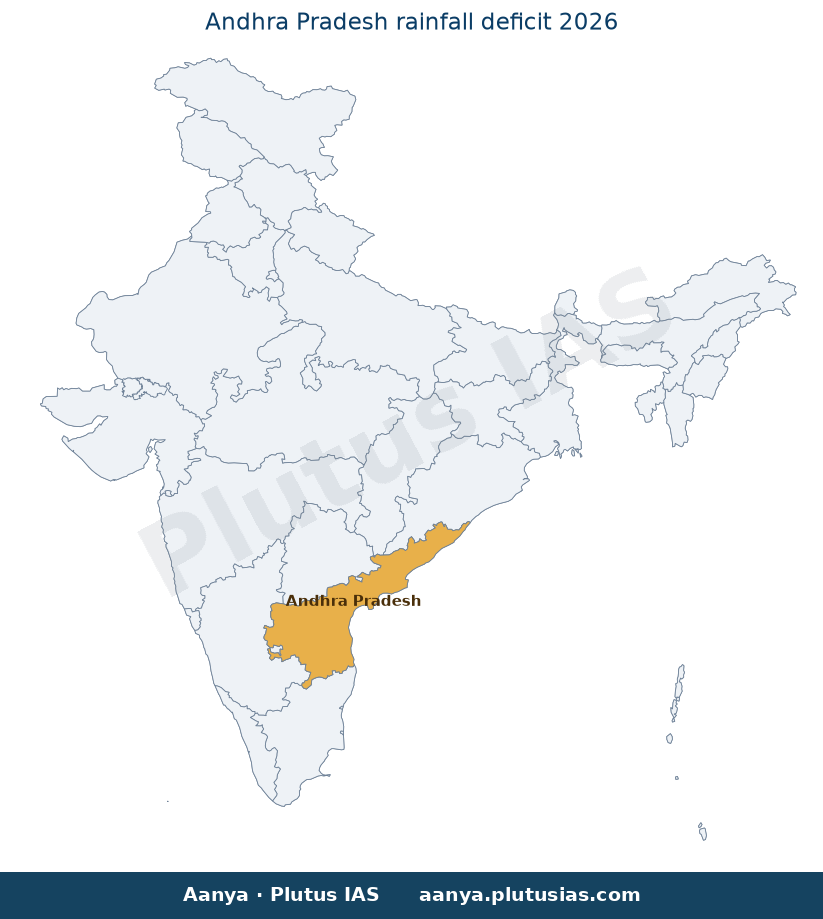
✎ Andhra Pradesh’s rainfall deficit of 52.4% by July-end, driven by a weak Southwest Monsoon and El Niño conditions, threatens kharif crop output, groundwater reserves, and rural livelihoods, necessitating immediate drought…
Subject Relevance — Where This Topic Fits
- GS Paper II — Governance, Constitution, Polity, Social Justice and International Relations (Disaster Management and Drought Mitigation) | GS Paper III — Agriculture, Environment, Disaster Management, and Economic and Sustainable Development
- Prelims: Rainfed agriculture, Southwest Monsoon, Drought classification, El Niño-Southern Oscillation (ENSO), Krishna and Godavari river basins, Drought Management Manual, National Disaster Response Fund (NDRF), Pradhan Mantri Fasal Bima Yojana (PMFBY), Andhra Pradesh Drought Declaration Rules, Groundwater depletion in Rayalaseema
- Essay: Climate change and its impact on Indian agriculture: A case study of Andhra Pradesh, The role of fiscal federalism in disaster mitigation: Lessons from drought response in India
Quick Revision: Andhra Pradesh’s rainfall deficit of 52.4% by July-end, driven by a weak Southwest Monsoon and El Niño conditions, threatens kharif crop output, groundwater reserves, and rural livelihoods, necessitating immediate drought mitigation measures under the State Disaster Management Plan.
Why is this in the news?
The report that all districts in Andhra Pradesh have recorded deficient rainfall as of July-end, with a cumulative deficit of 52.4%, marks a significant deviation from normal monsoon patterns and raises concerns about agricultural output, water availability, and rural livelihoods. This situation is exacerbated by the absence of significant rainfall forecasts until August 3 and the concurrent El Niño threat, which historically correlates with reduced monsoon activity in peninsular India. The State’s response, including directives for comprehensive farmer support and calls for drought declaration, underscores the urgency of coordinated policy intervention.
Background
- The Southwest Monsoon, which accounts for 75–90% of Andhra Pradesh’s annual rainfall, is critical for kharif crop cultivation, particularly paddy, groundnut, and pulses, which are predominantly rainfed.
- Andhra Pradesh, with its two major river basins—the Krishna and the Godavari—relies heavily on monsoon precipitation for reservoir recharge, groundwater replenishment, and irrigation sustainability.
- The state’s agro-climatic zones, including the Rayalaseema region, are particularly vulnerable to rainfall deficits due to their semi-arid conditions and high dependence on monsoon rains.
- Historically, Andhra Pradesh has experienced cyclical droughts, with severe episodes in 2002, 2009, and 2015, leading to significant agricultural losses and migration pressures.
- El Niño events, characterized by anomalous warming of the equatorial Pacific Ocean, are associated with suppressed monsoon rainfall over India, particularly in peninsular and eastern regions.
What constitutes a rainfall deficit and its implications for Andhra Pradesh?
- A rainfall deficit occurs when actual precipitation during the monsoon season falls short of the Long Period Average (LPA), which is the average rainfall recorded over a 50-year period for a given region. In Andhra Pradesh, the LPA for the Southwest Monsoon is approximately 600–700 mm, depending on the district.
- The IMD categorizes rainfall deficits as follows: normal (within 10% of LPA), deficient (19–59% below LPA), and large deficient (60–99% below LPA). As of July 30, 2026, all districts in Andhra Pradesh fall under the ‘deficient’ or ‘large deficient’ categories.
- Rainfed agriculture, which covers 60% of the state’s cultivated area, is highly vulnerable to rainfall deficits. Key crops such as paddy, groundnut, and pulses require consistent soil moisture during the vegetative and reproductive phases.
- Groundwater depletion in districts like Anantapur, Kadapa, and Chittoor exacerbates the impact of deficient rainfall, as farmers rely heavily on borewells for irrigation, leading to over-extraction and declining water tables.
- The Krishna and Godavari river basins, which supply water to major irrigation projects such as the Nagarjuna Sagar and Srisailam dams, are dependent on monsoon inflows. A prolonged deficit reduces reservoir storage, limiting irrigation potential for rabi crops.
- Drought conditions trigger cascading effects, including reduced fodder availability, livestock mortality, and increased rural-urban migration due to loss of livelihoods.
- The El Niño phenomenon, currently active, is associated with a 50–60% probability of below-normal monsoon rainfall in peninsular India, further heightening the risk of drought in Andhra Pradesh.
Key Features
| Feature | Significance |
|---|---|
| Rainfall Deficit of 52.4% | Exposes vulnerability of agrarian economy dependent on monsoon; triggers drought-like conditions in Andhra Pradesh. |
| Uniform Deficiency Across Districts | Contradicts spatial variability norms; indicates systemic failure in monsoon distribution or climate anomaly. |
| El Niño Threat | Amplifies drought risk as El Niño phases correlate with reduced Indian monsoon precipitation. |
| IMD Forecast of Minimal Rainfall | Extends agricultural distress; necessitates immediate contingency planning for kharif season. |
| Surface Wind Activity (40-50 kmph) | Accelerates soil moisture loss; exacerbates drought effects on standing crops. |
Why it Matters
Agricultural Impact
- Kharif sowing delayed or abandoned in 52% deficit regions; threatens food security in a rice-surplus state.
- Groundnut and cotton yields in Rayalaseema and Coastal Andhra Pradesh at risk due to moisture stress.
- Livestock dependent on fodder crops faces acute scarcity; pastoral communities vulnerable to income loss.
Economic Consequences
- State GDP contraction likely in agriculture sector; may reduce per capita income growth projections.
- Increased procurement costs for food grains if deficit persists beyond August; fiscal burden on exchequer.
- Rural distress may trigger migration to urban centers; strain on social infrastructure.
Hydrological Stress
- Groundwater depletion accelerates due to reduced recharge; long-term threat to irrigation sustainability.
- Reservoir levels in Krishna and Godavari basins likely below normal; impacts hydroelectric generation.
- Drinking water shortages in rural and peri-urban areas; health risks from waterborne diseases.
Policy and Governance
- Drought declaration mechanisms under Andhra Pradesh Drought Mitigation and Management Policy (2016) may need activation.
- Need for real-time data integration between IMD, state agencies, and local bodies for adaptive governance.
- Coordination failures between central and state agencies in cyclone tracking and rainfall forecasting.
Challenges
1. Agricultural Drought
- Failure of kharif sowing due to moisture deficit; risk of crop failure in 80% of sown area.
- Lack of drought-resistant seed varieties in sufficient quantity for large-scale distribution.
- Farmers’ indebtedness escalates due to input costs incurred without yield realization.
UPSC Link: Agricultural Drought – GS III
2. Hydrological Drought
- Critical decline in reservoir storage; potential power shortages in deficit regions.
- Groundwater overexploitation continues unabated; long-term sustainability compromised.
- Inter-state water disputes may intensify if deficit persists into Rabi season.
UPSC Link: Hydrological Drought – GS III
3. Socioeconomic Distress
- Rural unemployment spikes as agricultural labor demand collapses.
- Increased indebtedness among marginal farmers; risk of farmer distress suicides.
- Urban migration pressures exacerbate slum proliferation and informal sector strain.
UPSC Link: Socioeconomic Impact – GS II
4. Governance and Data Gaps
- Delayed drought declaration due to bureaucratic inertia; violates statutory timelines.
- Inadequate early warning systems for farmers; reliance on informal networks for advisories.
- Fragmented data sharing between IMD, state agencies, and local bodies.
UPSC Link: Governance Challenges – GS II
5. Climate Change Adaptation
- Absence of climate-resilient agricultural practices in state policy frameworks.
- Limited adoption of drought-proofing measures like micro-irrigation and soil moisture conservation.
- Insufficient investment in weather-indexed crop insurance schemes.
UPSC Link: Climate Adaptation – GS III
Challenges — UPSC Perspective
| Issue | Concern |
|---|---|
| Delayed Drought Declaration | Exacerbates farmer distress; violates Andhra Pradesh Drought Mitigation Policy (2016) timelines. |
| El Niño Persistence | Correlates with prolonged monsoon deficit; increases uncertainty in rainfall forecasting. |
| Groundwater Depletion | Accelerates due to reduced recharge; threatens irrigation sustainability beyond 2026. |
| Inter-State Water Disputes | Risk of escalation if deficit persists into Rabi season; impacts Telangana-Andhra Pradesh relations. |
| Farmer Indebtedness | Escalates due to input costs without yield; increases suicide risk in vulnerable districts. |
| Urban Migration Surge | Strains urban infrastructure; increases informal sector burden in cities. |
Way Forward
- Activate Andhra Pradesh Drought Mitigation and Management Policy (2016) with immediate drought declarations for affected mandals.
- Distribute drought-resistant seed varieties and subsidized micro-irrigation equipment to 50% of vulnerable farmers by August 15.
- Launch a state-wide soil moisture conservation campaign using ridge-and-furrow techniques and mulching.
- Accelerate implementation of Pradhan Mantri Krishi Sinchai Yojana (PMKSY) in deficit districts to enhance irrigation coverage.
- Strengthen real-time agro-meteorological advisories via mobile platforms and local self-government bodies.
- Establish a dedicated fund for distressed farmers with zero-interest loans and debt moratoriums for 2026-27.
- Conduct rapid assessment of groundwater levels and enforce regulatory measures to curb overexploitation.
- Coordinate with IMD for enhanced rainfall forecasting and early warning dissemination to farming communities.
UPSC Value Addition
Keywords for Mains Answer-Writing
Andhra Pradesh rainfall deficit · Southwest Monsoon variability · Drought management in India · El Niño and Indian monsoon · Agricultural distress in Andhra Pradesh · IMD rainfall classification · Drought relief measures · Climate change and monsoon patterns · Agricultural contingency planning · Farmers’ welfare schemes · Bay of Bengal depressions · Rayalaseema and Coastal Andhra Pradesh rainfall · India Meteorological Department (IMD) forecasts · Agricultural drought declaration · Disaster management framework for droughts
Concept Flow
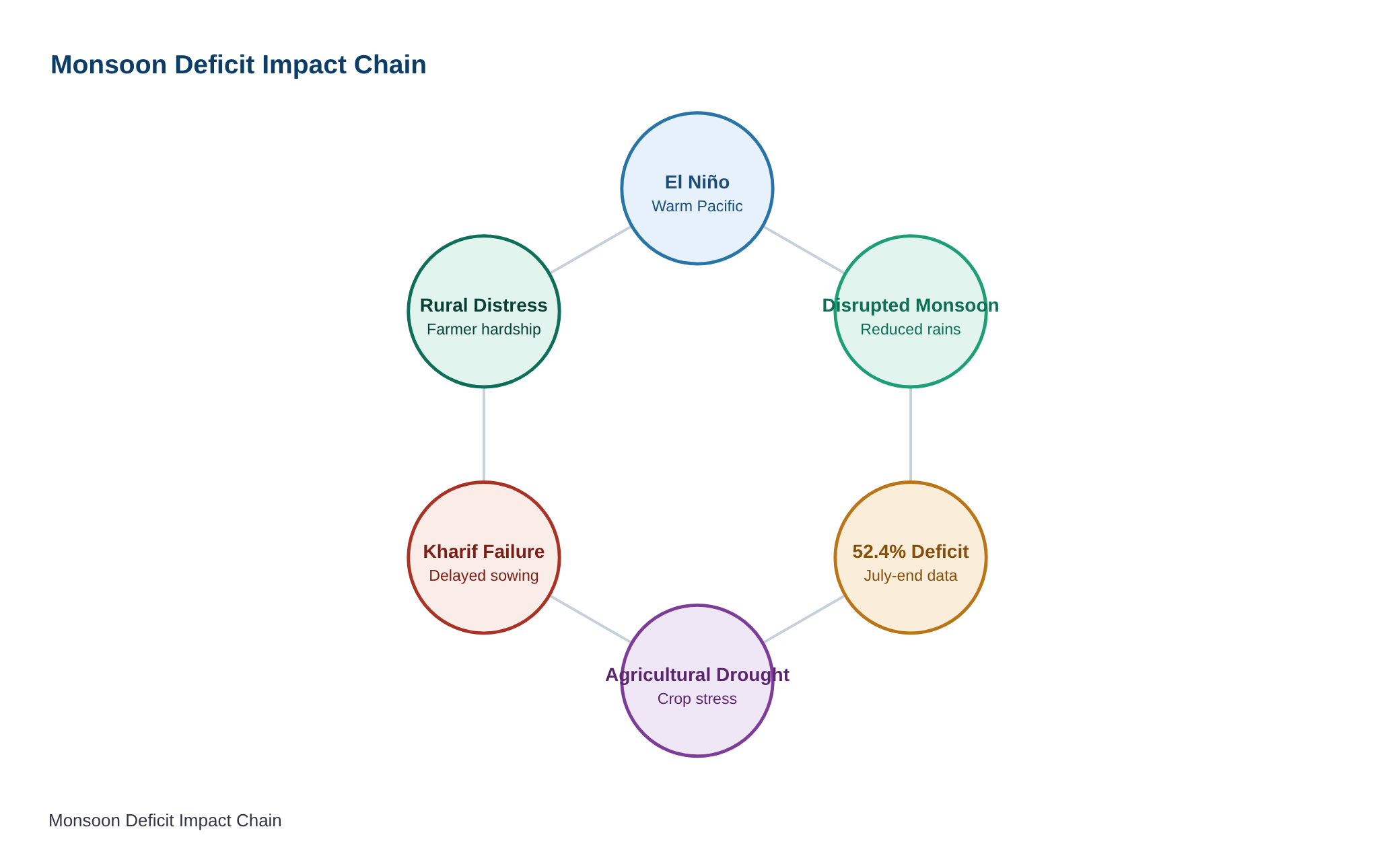
El Niño Phase → Disrupted Monsoon Patterns → 52.4% Rainfall Deficit → Agricultural Drought → Kharif Crop Failure → Rural Distress → Farmer Indebtedness → Migration to Urban Centers → Urban Infrastructure Strain → Policy Response Activation → Drought Declaration → Relief Measures
Prelims Practice Questions
Q1. Consider the following statements regarding rainfall classification in India as per the India Meteorological Department (IMD):
1. ‘Deficient’ rainfall is defined as rainfall that is between 26% and 50% below the long-period average (LPA).
2. ‘Large deficient’ rainfall is defined as rainfall that is more than 50% below the long-period average (LPA).
3. ‘Normal’ rainfall is defined as rainfall that is within ±19% of the long-period average (LPA).
How many of the above statements are correct?
- Only one
- Only two
- All three
- None
Answer: All three — Statement 1 and 2 are correct as per IMD’s rainfall classification norms. Statement 3 is incorrect because ‘Normal’ rainfall is defined as within ±19% of the LPA, not ±20% or more.
Q2. Assertion (A): The India Meteorological Department (IMD) has forecasted that Andhra Pradesh is unlikely to receive significant rainfall until August 3, 2026.
Reason (R): The deep depression over western parts of central Chhattisgarh and Madhya Pradesh is moving southwestwards and is expected to weaken gradually, reducing its influence on Andhra Pradesh’s rainfall.
Options:
A. Both A and R are true, and R is the correct explanation of A.
B. Both A and R are true, but R is NOT the correct explanation of A.
C. A is true, but R is false.
D. A is false, but R is true.
Answer: ? — Both Assertion (A) and Reason (R) are true, and Reason (R) correctly explains Assertion (A) as the movement and weakening of the depression reduce its capacity to bring rainfall to Andhra Pradesh.
Q3. Match the following districts of Andhra Pradesh with their respective rainfall status as reported by the Directorate of Economics and Statistics on July 30, 2026:
Column I (District) | Column II (Rainfall Status)
—————————————-|———————————-
1. Prakasam | A. Large deficient
2. East Godavari | B. Deficient
3. Visakhapatnam | C. Normal
4. NTR | D. Large deficient
5. SPSR Nellore | E. Deficient
Answer: ? — Correct matches: 1-A (Prakasam – Large deficient), 2-A (East Godavari – Large deficient), 3-A (Visakhapatnam – Large deficient), 4-E (NTR – Deficient), 5-E (SPSR Nellore – Deficient).
Mains Practice Question
✍ The South-West Monsoon, a critical determinant of India’s agricultural productivity, has exhibited significant variability in 2026, with Andhra Pradesh experiencing a rainfall deficit of 52.4% by July-end. Critically analyse the implications of such deficient monsoon rainfall for agricultural productivity, rural livelihoods, and the economy of Andhra Pradesh. Also, outline the constitutional and statutory framework for drought management and relief in India, and assess its effectiveness in addressing such crises. (15 Marks)
Approach: MODEL-ANSWER SKELETON:
1. **Introduction (2 marks)**
– Define South-West Monsoon and its significance for India’s agriculture (e.g., 60% of India’s net sown area dependent on monsoon; Andhra Pradesh’s agriculture heavily reliant on monsoon rains for kharif crops like paddy, maize, and pulses).
– State the 2026 rainfall deficit in Andhra Pradesh (52.4% by July-end) and its immediate impact on sowing and crop growth.
2. **Implications of Deficient Monsoon (5 marks)**
– **Agricultural Productivity**: Reduced kharif output, delayed sowing, and increased input costs (e.g., reliance on groundwater for irrigation, leading to higher electricity and diesel costs).
– **Rural Livelihoods**: Income loss for small and marginal farmers, migration to urban areas, and increased debt burdens.
– **Economic Impact**: Decline in agricultural GDP, reduced demand for rural non-farm goods, and pressure on food inflation.
– **Environmental Consequences**: Depletion of groundwater resources, increased vulnerability to desertification in Rayalaseema region.
3. **Constitutional and Statutory Framework for Drought Management (4 marks)**
– **Constitutional Provisions**: Entry 14 (Agriculture), Entry 23 (Social security), and Entry 24 (Economic and social planning) of the State List (7th Schedule); Article 21 (Right to Life) as interpreted by courts to include the right to livelihood.
– **Statutory Framework**:
– *Drought Management Manual* (2016) by the National Disaster Management Authority (NDMA).
– *National Disaster Response Fund (NDRF)* and *State Disaster Response Fund (SDRF)* under the Disaster Management Act, 2005.
– *Mahatma Gandhi National Rural Employment Guarantee Scheme (MGNREGS)* for drought-proofing activities.
– *Pradhan Mantri Fasal Bima Yojana (PMFBY)* for crop insurance.
– *National Food Security Act, 2013* for food entitlements during droughts.
– **State-Level Measures**: Andhra Pradesh’s *Rythu Bharosa* scheme, *Crop Holiday Scheme*, and *Drought Declaration Guidelines* under the Andhra Pradesh Relief and Rehabilitation Code, 1977.
4. **Effectiveness of the Framework (3 marks)**
– **Strengths**: Timely declaration of drought (e.g., Andhra Pradesh’s 2026 drought declaration), provision of relief (e.g., cash transfers, subsidised seeds, and waiver of irrigation charges), and integration with MGNREGS for water conservation.
– **Challenges**: Delayed disbursement of funds, inadequate coverage of tenant farmers and landless labourers, and gaps in inter-departmental coordination.
– **Recommendations**: Strengthening early warning systems (e.g., real-time soil moisture monitoring), expanding crop insurance coverage, and promoting climate-resilient agriculture (e.g., drought-resistant seed varieties, micro-irrigation).
5. **Conclusion (1 mark)**
– Reiterate the need for a multi-dimensional approach combining immediate relief, long-term drought-proofing, and climate adaptation strategies to mitigate the impact of deficient monsoon rainfall on Andhra Pradesh’s agrarian economy.
Source: The Hindu
Generated by AanyaAi for educational purpose.

- बिहार सरकार का बड़ा कदम: 25 हजार परिवारों को सौर ऊर्जा सहायता, 534 प्रखंडों में सोलर मार्ट खोले जाएंगे - September 23, 2026
- Bihar Launches Mega Solar Scheme: 25,000 Families to Benefit, 534 Solar Marts - September 23, 2026
- सुपर एल नीनो से भारत में 15,800 अतिरिक्त गर्मी से मौतें: जानिए पूरा मामला - September 23, 2026

No Comments