


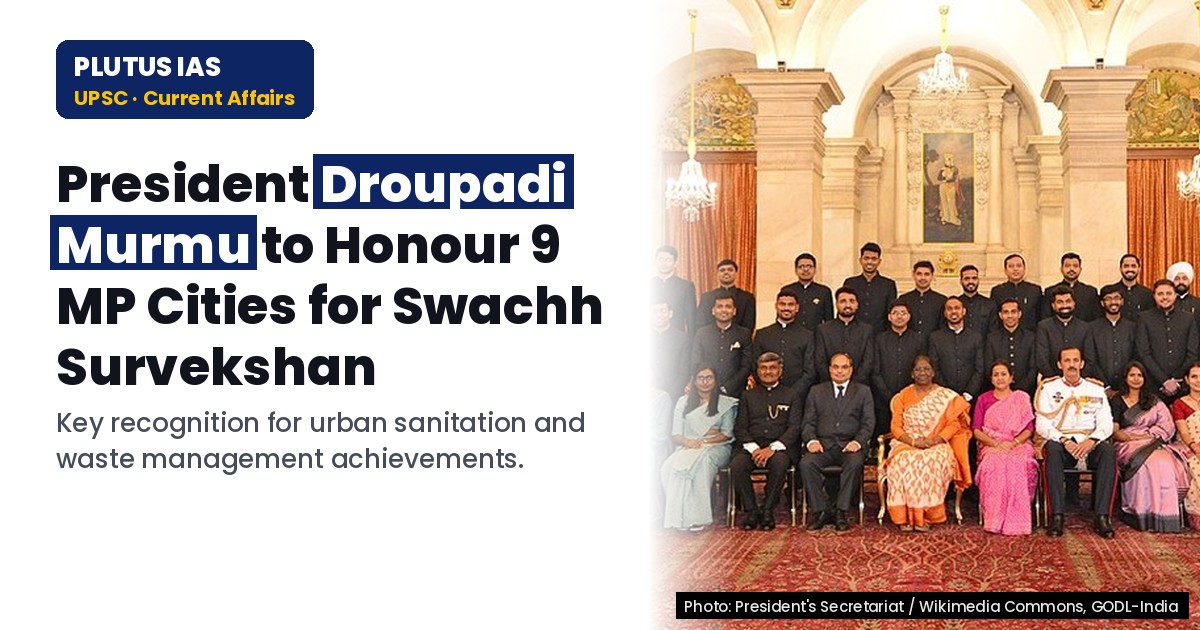
08 Nov Swachh Survekshan: MP’s 9 Cities Honored by President
✎ Swachh Survekshan is an annual cleanliness survey conducted by the Ministry of Housing and Urban Affairs to rank cities on sanitation and waste management under the Swachh Bharat Abhiyan-Urban.
Subject Relevance — Where This Topic Fits
- GS Paper II — Government Policies and Interventions for Development in various sectors and Issues arising out of their Design and Implementation | GS Paper III — Environment; Conservation, Environmental Pollution and Degradation, Environmental Impact Assessment
- Prelims: Swachh Survekshan, Swachh Bharat Abhiyan-Urban (SBM-U), Ministry of Housing and Urban Affairs (MoHUA), Waste Management, Solid Waste Management Rules, 2016, Urban Local Bodies (ULBs)
- Essay: Sustainable Urbanisation and the Role of Citizen Participation, The Imperative of Effective Waste Management for a Healthy Nation
Quick Revision: Swachh Survekshan is an annual cleanliness survey conducted by the Ministry of Housing and Urban Affairs to rank cities on sanitation and waste management under the Swachh Bharat Abhiyan-Urban.
Why is this in the news?
Nine cities from Madhya Pradesh, including Indore, have been selected for national recognition under the Swachh Survekshan initiative. The President of India is scheduled to confer these awards on November 11 in New Delhi, acknowledging their exemplary performance in sanitation and waste management practices. This selection underscores the progress made by these Urban Local Bodies (ULBs) in fostering cleaner urban environments.
Background
- Swachh Survekshan is an annual survey conducted by the Ministry of Housing and Urban Affairs (MoHUA) under the Swachh Bharat Abhiyan-Urban (SBM-U) since 2016.
- The primary objective of the survey is to assess the cleanliness, hygiene, and sanitation standards in cities and towns across India.
- It encourages cities to improve their service delivery in sanitation and waste management, fostering a spirit of healthy competition among ULBs.
- The survey evaluates various parameters, including waste collection, segregation, processing, disposal, open defecation free (ODF) status, citizen feedback, and capacity building.
- Indore has consistently been recognised as one of the cleanest cities in India, demonstrating sustained efforts in urban sanitation.
- The recognition of cities like Depalpur, which significantly improved its ranking, highlights the potential for transformative change through focused interventions and community engagement.
What is Swachh Survekshan?
- Swachh Survekshan is a comprehensive sanitation survey initiated by the Government of India as part of the Swachh Bharat Abhiyan-Urban (SBM-U).
- It aims to rank cities based on their performance in sanitation and cleanliness, thereby encouraging improvements in urban hygiene.
- The survey evaluates cities on a set of parameters, which include municipal solid waste management (collection, transportation, processing, and disposal), open defecation status, citizen engagement, and innovation.
- Data collection for the survey involves direct observation, citizen feedback, and documentation submitted by ULBs, ensuring a multi-faceted assessment.
- The methodology and weightage of different parameters are periodically revised to align with evolving sanitation goals and technological advancements.
- The survey has played a crucial role in creating public awareness about sanitation and motivating cities to adopt best practices in waste management.
- It serves as a monitoring tool for the Swachh Bharat Abhiyan-Urban, providing insights into the progress and challenges in achieving its objectives.
Key Features
| Feature | Significance |
|---|---|
| Swachh Survekshan | Annual survey assessing sanitation and hygiene in urban and rural areas across India, promoting competitive federalism among local bodies. |
| National Recognition | Awards conferred by the President of India to cities demonstrating exemplary performance in cleanliness and waste management, fostering motivation. |
| Waste Management Focus | Key criteria for evaluation include segregation of wet and dry waste, scientific processing of waste, and remediation of legacy waste sites. |
| Citizen Participation | Emphasis on public awareness campaigns and community engagement to encourage source segregation and responsible waste disposal practices. |
| Mentorship Model | Larger, high-performing urban local bodies (ULBs) like Indore guiding smaller ULBs such as Depalpur to improve their sanitation outcomes. |
| Progressive Improvement | Demonstrates the potential for significant advancement in sanitation rankings through focused efforts and strategic interventions. |
Why it Matters
Governance and Public Administration
- Reinforces the principles of cooperative and competitive federalism by incentivizing states and urban local bodies to improve sanitation services.
- Provides a robust framework for performance evaluation and benchmarking among cities, promoting accountability and transparency in municipal governance.
- Highlights effective strategies for urban planning and service delivery, particularly in waste management, which can be replicated across other regions.
Environmental Sustainability
- Drives the adoption of scientific waste management practices, including segregation, processing, and disposal, reducing environmental pollution.
- Contributes to the remediation of legacy waste, mitigating long-term ecological damage and reclaiming land resources.
- Promotes resource efficiency through waste-to-wealth initiatives and circular economy principles in urban areas.
Public Health and Well-being
- Directly improves public health outcomes by reducing the incidence of vector-borne diseases and creating cleaner living environments.
- Enhances the quality of life for urban residents through better sanitation infrastructure and reduced exposure to pollutants.
- Fosters a sense of civic responsibility and community participation in maintaining urban hygiene, leading to sustainable behavioral changes.
Socio-Economic Development
- Attracts investment and tourism by enhancing the aesthetic appeal and liveability of cities.
- Generates employment opportunities in the waste management sector, including collection, processing, and recycling.
- Reduces the economic burden associated with environmental degradation and public health crises caused by poor sanitation.
Challenges
1. Sustaining Behavioral Change
- Ensuring long-term adherence to waste segregation and responsible disposal practices among citizens.
- Overcoming ingrained habits and resistance to new sanitation norms in diverse urban populations.
UPSC Link: Social Justice; Urbanization
2. Infrastructure and Technology Gaps
- Developing adequate infrastructure for scientific waste processing, including waste-to-energy plants and composting facilities.
- Adopting advanced technologies for waste collection, monitoring, and treatment across all urban local bodies, especially smaller ones.
UPSC Link: Infrastructure; Science & Technology
3. Financial Sustainability
- Securing consistent funding for ongoing waste management operations, maintenance, and infrastructure upgrades.
- Establishing viable revenue models for waste management services to reduce dependence on government grants.
UPSC Link: Government Budgeting; Local Governance
4. Legacy Waste Management
- Addressing the challenge of remediating existing landfill sites and processing accumulated legacy waste.
- Preventing the generation of new legacy waste through effective daily waste management practices.
UPSC Link: Environment & Ecology; Disaster Management
Challenges — UPSC Perspective
| Issue | Concern |
|---|---|
| Inadequate Segregation at Source | Compromises the efficiency of waste processing and recycling, leading to higher landfill volumes. |
| Limited Processing Capacity | Many urban local bodies lack sufficient facilities for scientific treatment of solid waste, resulting in environmental pollution. |
| Informal Sector Integration | Integrating ragpickers and informal waste collectors into formal waste management systems remains a challenge, impacting their livelihoods and safety. |
| Inter-Municipal Coordination | Effective collaboration between larger and smaller urban local bodies for waste management solutions can be inconsistent. |
| Public Awareness Gaps | Despite campaigns, a significant portion of the population may still lack complete awareness or motivation for proper waste management. |
| Monitoring and Enforcement | Ensuring strict adherence to waste management rules and penalizing non-compliance effectively requires robust monitoring mechanisms. |
Government Initiatives — Must-Memorise for Prelims
- Swachh Survekshan
- Swachh Bharat Abhiyan (Urban)
Way Forward
- Strengthen capacity building for urban local bodies in scientific waste management techniques and financial planning.
- Promote innovative technologies for waste processing, including waste-to-energy, composting, and recycling, through public-private partnerships.
- Intensify public awareness and behavioral change campaigns, focusing on sustained citizen participation in waste segregation.
- Develop robust monitoring and evaluation frameworks to ensure accountability and transparency in sanitation service delivery.
- Facilitate inter-municipal cooperation and mentorship programs for knowledge sharing and replication of best practices.
- Explore sustainable financing mechanisms, including user charges and green bonds, to fund waste management infrastructure and operations.
- Formulate comprehensive policies for the formalization and integration of the informal waste collection sector, ensuring their welfare.
UPSC Value Addition
Keywords for Mains Answer-Writing
Swachh Survekshan · Urban Local Bodies · Waste Management · Citizen Participation · Sustainable Development Goals · Sanitation Initiatives · Municipal Solid Waste · Behavioral Change Communication · Decentralized Governance · Public-Private Partnership
Constitutional & Policy Linkages
- {‘Article’: ‘Article 243W’, ‘note’: ‘Powers of Municipalities’}
- {‘Article’: ‘Twelfth Schedule’, ‘note’: ‘Functions of Urban Local Bodies’}
Concept Flow
Swachh Survekshan conducts annual assessment → Cities implement waste management practices → Performance evaluated on various parameters → Top-performing cities receive national awards → Recognition incentivizes further improvements → Enhanced sanitation and public health outcomes
Prelims Practice Questions
Q1. Consider the following statements regarding the Swachh Survekshan:
1. It is an annual survey conducted by the Ministry of Housing and Urban Affairs.
2. The survey assesses urban and rural areas based on various sanitation and cleanliness parameters.
3. Citizen feedback is a significant component of the evaluation methodology.
How many of the above statements are correct?
- Only one
- Only two
- Only three
- None
Answer: Only three — Statement 1 is correct: Swachh Survekshan is indeed an annual survey conducted by the Ministry of Housing and Urban Affairs. Statement 2 is incorrect: Swachh Survekshan primarily focuses on urban areas, while Swachh Survekshan Gramin covers rural areas. Statement 3 is correct: Citizen feedback is a crucial parameter in the evaluation framework of Swachh Survekshan, contributing to the overall scoring.
Q2. Which of the following initiatives is NOT directly associated with the Swachh Bharat Abhiyan (Urban)?
- Construction of individual household latrines (IHHLs)
- Promotion of solid waste management practices
- Provision of piped water supply to rural households
- Behavioral change communication for sanitation
Answer: Provision of piped water supply to rural households — The provision of piped water supply to rural households is primarily associated with the Jal Jeevan Mission, not directly with the Swachh Bharat Abhiyan (Urban). The other options are core components of the Swachh Bharat Abhiyan (Urban) aimed at achieving universal sanitation and scientific waste management in urban areas.
Mains Practice Question
✍ The Swachh Survekshan has played a pivotal role in fostering a competitive spirit among Urban Local Bodies towards achieving sanitation goals. Examine the key parameters and methodologies employed in this survey and discuss its impact on urban governance and public health outcomes. (15 Marks)
Approach: MODEL-ANSWER SKELETON:
1. Introduction: Briefly define Swachh Survekshan as an annual cleanliness survey by MoHUA under Swachh Bharat Abhiyan (Urban) to encourage competition among ULBs.
2. Key Parameters: Detail the main assessment categories, including:
a. Service Level Progress (e.g., waste collection, processing, disposal, ODF status).
b. Certification (e.g., ODF+, ODF++, Water+).
c. Citizen Voice (citizen feedback, engagement).
d. Direct Observation (cleanliness of public places, waste infrastructure).
3. Methodologies: Explain the process, including:
a. Data collection from ULBs.
b. Independent third-party assessment.
c. Citizen feedback mechanisms (e.g., Swachhata App).
d. On-site inspections.
4. Impact on Urban Governance: Discuss how it has:
a. Enhanced accountability of ULBs.
b. Promoted data-driven decision-making.
c. Fostered inter-city competition and peer learning.
d. Increased focus on infrastructure development for waste management.
5. Impact on Public Health Outcomes: Elaborate on:
a. Reduction in vector-borne diseases due to improved sanitation.
b. Better public hygiene and environmental quality.
c. Increased awareness and behavioral change among citizens.
d. Contribution to Sustainable Development Goals (SDG 6 and 11).
6. Conclusion: Summarize the transformative potential of Swachh Survekshan in driving India’s urban sanitation agenda and its role in promoting a cleaner, healthier urban environment.
Source: amarujala.com
Madhya Pradesh PCS (MPPSC) — State PCS Practice
Prelims: Which of the following cities from Madhya Pradesh, besides Indore, is among the nine cities to receive national honors under the Swachh Survekshan, to be felicitated by the President?
- Bhopal
- Jabalpur
- Gwalior
- Ujjain
Answer: Bhopal — The provided topic mentions Indore and ‘nine cities’ from Madhya Pradesh receiving national honors, implying other cities besides Indore are included in this count.
Mains: Discuss the significance of Madhya Pradesh cities, particularly Indore, consistently receiving national recognition in the Swachh Survekshan for the state’s urban development and public health initiatives.
Generated by AanyaAi for educational purpose.
Related guides on our sites
- Best PSIR optional coaching for upsc
- Best economics optional coaching for upsc
- Best PSIR optional teacher for upsc
- Best teacher of PSIR optional for upsc

- Swachh Survekshan: MP’s 9 Cities Honored by President - November 8, 2026
- ईपीएफओ का विशेष अभियान 6: जनसेवा, स्वच्छता और रिकॉर्ड प्रबंधन में सफलता - November 8, 2026
- Andhra Pradesh: Drought to Deluge & Cyclones Impact - November 8, 2026

No Comments