


08 Aug UPSC Alert: Bill Proposes Ban on Social Media Accounts for Kids Under 13
✎ The SHIELD Bill, 2025, proposes mandatory parental consent for account creation by children under 13, restrictions on personalised advertising for minors, and penalties for platforms failing to protect children from harmful…
Subject Relevance — Where This Topic Fits
- GS Paper II — Governance, Constitution, Polity, Social Justice and International Relations (Digital Governance, Child Protection Policies) | GS Paper III — Science and Technology (Digital Security, Data Privacy, Regulation of Online Platforms)
- Prelims: Digital Personal Data Protection Act, 2023, Information Technology (Intermediary Guidelines and Digital Media Ethics Code) Rules, 2021, Section 69A of the IT Act, Age Verification Systems, Personalised Advertising, Online Gaming Regulation, Pornography and Extremist Content, Parental Consent Mechanisms
- Essay: The Ethical Imperative of Balancing Digital Innovation with Child Protection in the 21st Century, Regulating the Digital Public Sphere: Sovereignty, Privacy, and the Role of the State
Quick Revision: The SHIELD Bill, 2025, proposes mandatory parental consent for account creation by children under 13, restrictions on personalised advertising for minors, and penalties for platforms failing to protect children from harmful content, aligning with global child protection frameworks.
Why is this in the news?
The proposed ‘Safeguarding Healthy Internet Environments for Little Digital-Natives (SHIELD) Bill, 2025’ by BJP MP Baijayant Panda seeks to introduce stringent regulatory measures for social media and online gaming platforms to protect minors under 18 from digital harms, including mandatory parental consent for account creation, restrictions on personalised advertising, and penalties for exposure to harmful content. The Bill’s introduction in Parliament highlights the growing legislative focus on digital child protection amid rising concerns over online exploitation, mental health impacts, and data privacy risks for young users.
Background
- The exponential growth of digital platforms has increased minors’ exposure to online risks, including cyberbullying, grooming, and addictive content, necessitating regulatory intervention.
- India’s digital ecosystem is governed by the Information Technology (Intermediary Guidelines and Digital Media Ethics Code) Rules, 2021, which mandate due diligence by intermediaries but lack specific provisions for child protection.
- The Digital Personal Data Protection Act, 2023, provides a framework for data privacy but does not explicitly address the protection of minors in digital spaces.
- Global precedents exist, such as the Children’s Online Privacy Protection Act (COPPA) in the U.S., which restricts data collection from children under 13 without parental consent.
- The Bill aligns with the UN Convention on the Rights of the Child (1989), which obligates states to protect children from all forms of physical or mental violence, injury, abuse, neglect, or exploitation.
- Private member’s bills rarely pass into law, with only about a dozen having been enacted since Independence, underscoring the procedural challenges in legislative adoption.
What is the SHIELD Bill, 2025?
- The SHIELD Bill, formally titled ‘Safeguarding Healthy Internet Environments for Little Digital-Natives (SHIELD) Bill, 2025,’ is a private member’s bill introduced by BJP MP Baijayant Panda to regulate digital platforms accessible to minors.
- The Bill defines a ‘child’ as any individual below the age of 18.
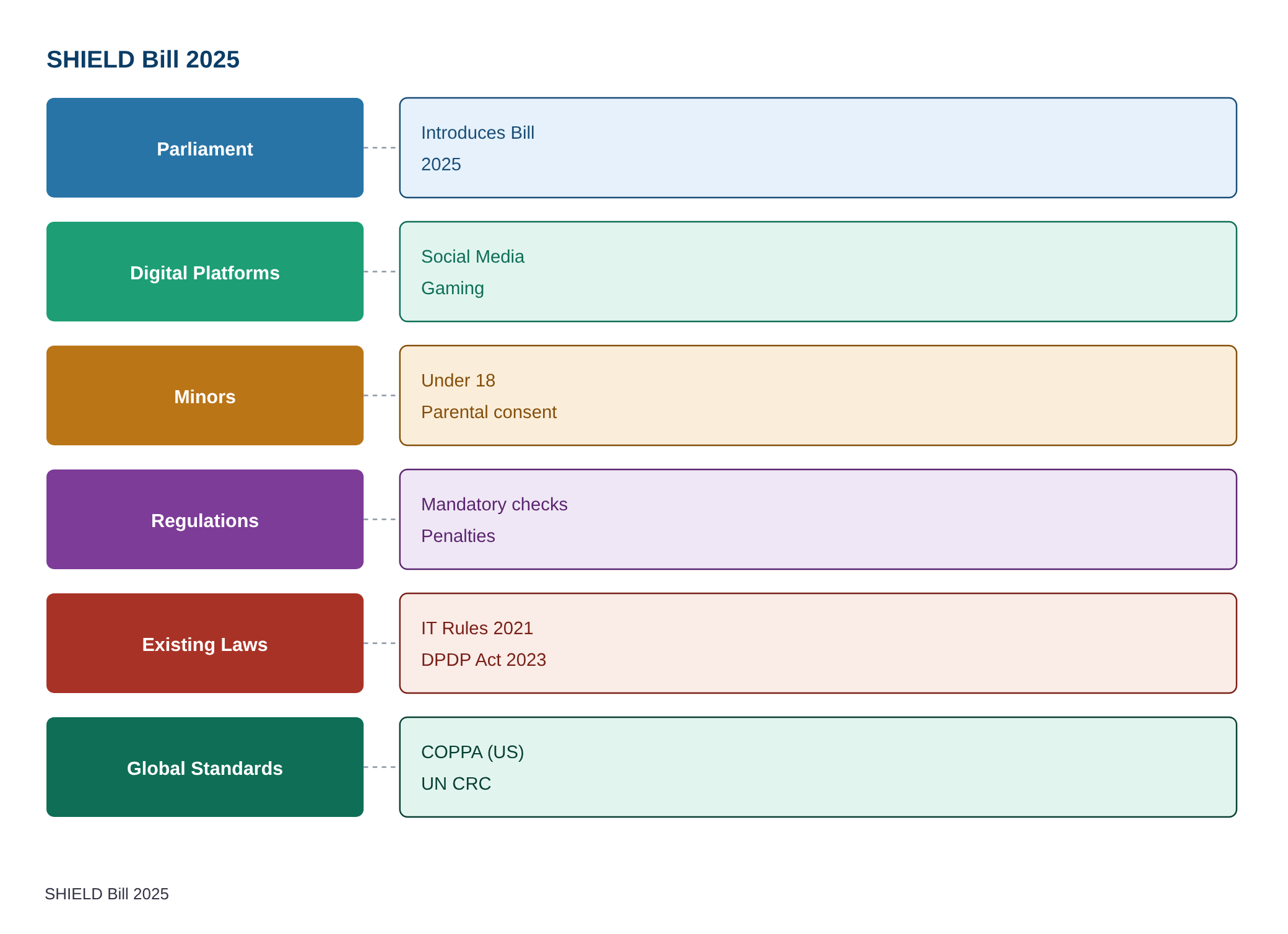
- Key provisions include: (a) mandatory age-verification systems for platforms accessible to minors; (b) prohibition of account creation for children under 13 without verified parental consent; (c) restrictions on personalised advertising targeting minors; and (d) mandatory parental-control dashboards for monitoring activity, managing privacy settings, and restricting screen time.
- The Bill imposes obligations on social media services, online gaming platforms, and other digital intermediaries to prevent exposure to harmful content, including pornography, gambling, extremist material, and drug-related content.
- The Bill reflects a broader trend of legislative efforts to balance innovation with safeguarding vulnerable populations in digital spaces, drawing on global best practices while addressing India-specific challenges.
Key Features
| Feature | Significance |
|---|---|
| Age verification systems | Mandates platforms to verify the age of users to ensure compliance with age-based restrictions, enhancing child safety in the digital ecosystem. |
| Parental consent for account creation (below 13 years) | Restricts unsupervised access to social media and gaming platforms, aligning with global child protection norms such as the Children’s Online Privacy Protection Act (COPPA) in the United States. |
| Prohibition on personalised advertising for minors | Reduces exposure to targeted marketing, mitigating risks of manipulative content and safeguarding mental and emotional well-being of children. |
| Parental-control dashboards | Empowers guardians to monitor digital activity, manage privacy settings, and enforce screen-time limits, fostering responsible internet usage. |
| Penalties for non-compliance (up to ₹10 crore) | Acts as a deterrent for platforms, ensuring adherence to safeguarding obligations and accountability for violations. |
Why it Matters
Legal and Regulatory
- Introduces a structured legal framework for digital intermediaries to safeguard minors, addressing gaps in existing regulations like the Information Technology (Intermediary Guidelines and Digital Media Ethics Code) Rules, 2021.
- Aligns with the Constitution’s Directive Principles of State Policy (Article 39(f)) to protect children from exploitation and moral degradation in the digital sphere.
- Establishes a precedent for age-based digital governance, potentially influencing future amendments to the Protection of Children from Sexual Offences (POCSO) Act and the Juvenile Justice Act.
Social and Ethical
- Addresses rising concerns over mental health impacts of social media on adolescents, including addiction, cyberbullying, and exposure to harmful content.
- Promotes digital literacy among parents and children, fostering a culture of responsible online engagement.
- Balances the right to freedom of expression (Article 19(1)(a)) with the state’s obligation to protect vulnerable groups under Article 21 (Right to Life and Personal Liberty).
Technological and Economic
- Encourages platforms to invest in robust age-verification technologies, such as biometric authentication or government-issued ID checks, driving innovation in digital identity solutions.
- May impose compliance costs on social media and gaming companies, potentially affecting their revenue models, particularly those reliant on advertising targeted at minors.
- Could spur demand for child-centric digital products and services, creating opportunities for startups in parental-control software and educational technology.
Challenges
1. Implementation and Enforcement
- Verification of age without infringing on privacy rights, particularly for children in rural or low-income households with limited access to government-issued IDs.
- Risk of platforms using proxy measures (e.g., self-declaration) that may be easily circumvented, undermining the efficacy of the law.
- Need for a dedicated regulatory authority to oversee compliance, investigate violations, and impose penalties, which may face bureaucratic delays.
UPSC Link: https://main.sci.gov.in/jonew/judis/23527.pdf
2. Balancing Rights and Restrictions
- Potential conflict with the right to privacy (Article 21) if age-verification systems require excessive personal data collection, raising concerns under the Puttaswamy judgment.
- Risk of over-censorship, where platforms may err on the side of caution by restricting access for all users below 18, rather than implementing nuanced safeguards.
- Challenge of defining ‘harmful content’ objectively, which may lead to subjective interpretations and disputes over what constitutes age-appropriate material.
UPSC Link: https://main.sci.gov.in/jonew/judis/10306.pdf
3. Global Harmonisation
- Divergence from international standards, such as the EU’s Digital Services Act (DSA) or the UK’s Online Safety Act, which set the age of digital consent at 16 or 18, respectively.
- Risk of jurisdictional arbitrage, where platforms may relocate operations to countries with laxer regulations, undermining the law’s effectiveness.
- Need for bilateral and multilateral cooperation to establish consistent age-verification frameworks across borders.
UPSC Link: https://eur-lex.europa.eu/legal-content/EN/TXT/?uri=CELEX%3A32022R2065
4. Digital Divide and Accessibility
- Exclusion of children from marginalised communities who lack access to parental consent mechanisms or digital literacy, exacerbating socio-economic disparities.
- Potential for platforms to prioritise monetisation over child safety in regions with lower regulatory oversight, disproportionately affecting vulnerable groups.
- Challenge of ensuring that age-verification systems are user-friendly and accessible to children with disabilities or those from non-English-speaking backgrounds.
UPSC Link: https://www.ohchr.org/en/documents/themes/children/digital-divide
Challenges — UPSC Perspective
| Issue | Concern |
|---|---|
| Data privacy risks in age verification | Collection and storage of sensitive personal data (e.g., biometric information) may expose minors to breaches or misuse by third parties. |
| Over-reliance on self-declaration | Platforms may use unverified age declarations, allowing minors to bypass restrictions without effective safeguards. |
| Lack of standardised age-verification tools | Inconsistent or outdated verification methods may fail to accurately determine age, leading to either under-protection or over-restriction. |
| Cultural and regional variations in parenting norms | Diverse attitudes toward digital supervision across states may result in uneven enforcement and compliance. |
| Economic burden on small platforms | Smaller social media or gaming companies may struggle to afford robust verification systems, creating a competitive disadvantage. |
Way Forward
- Constitute a multi-stakeholder task force comprising child psychologists, technologists, legal experts, and platform representatives to draft detailed age-verification guidelines.
- Pilot age-verification systems in select states with high digital penetration to assess feasibility, challenges, and impact before nationwide rollout.
- Amend the Information Technology (Intermediary Guidelines and Digital Media Ethics Code) Rules, 2021, to incorporate the SHIELD Bill’s provisions, ensuring legal coherence.
- Launch nationwide awareness campaigns to educate parents, teachers, and children about digital safety, parental controls, and the risks of unsupervised online activity.
- Collaborate with the Ministry of Electronics and Information Technology (MeitY) to develop a centralised, secure database for age verification, leveraging Aadhaar or other government-issued IDs.
- Establish a grievance redressal mechanism for parents and children to report violations, with a dedicated helpline and online portal for swift resolution.
- Encourage platforms to adopt ethical design principles, such as default privacy settings for minors and clear labelling of age-restricted content.
- Conduct periodic audits and impact assessments to evaluate the law’s effectiveness, with provisions for amendments based on emerging challenges.
UPSC Value Addition
Keywords for Mains Answer-Writing
Digital Personal Data Protection Act 2023 · Protection of Children from Sexual Offences Act 2012 · Information Technology (Intermediary Guidelines and Digital Media Ethics Code) Rules 2021 · United Nations Convention on the Rights of the Child · Article 17 of the Constitution of India · Right to Privacy under Article 21 · Parental consent mechanisms for minors · Age-verification systems in digital platforms · Prohibition of targeted advertising to minors · Section 69A of the Information Technology Act 2000 · Digital India Act 2023 · Safeguarding Healthy Internet Environments for Little Digital-Natives (SHIELD) Bill 2025 · Bharatiya Nyaya Sanhita 2023 · Cyberbullying and online harms · Data localisation and cross-border data transfer · Role of the Data Protection Board of India
Constitutional & Policy Linkages
- Article 21 (Right to Life and Personal Liberty) – Protection from harm in digital spaces.
- Article 19(1)(a) (Freedom of Speech and Expression) – Balancing with child protection.
- Article 39(f) (Directive Principles) – Safeguarding children’s moral and material welfare.
Concept Flow
Rising concerns over child safety in digital spaces → Proposal of SHIELD Bill to regulate social media and gaming platforms → Mandatory age verification and parental consent → Prohibition of personalised advertising for minors → Penalties for non-compliance → Potential challenges in enforcement and privacy → Need for balanced implementation → Long-term impact on digital governance and child welfare.
Prelims Practice Questions
Q1. Consider the following statements regarding the Safeguarding Healthy Internet Environments for Little Digital-Natives (SHIELD) Bill, 2025:
1. The Bill defines a child as anyone below the age of 18.
2. It proposes to prohibit platforms from tracking, profiling, or using personalised advertising for children.
3. The Bill mandates platforms to provide parental-control dashboards to monitor activity and manage privacy settings.
4. The Bill allows platforms to track and profile children for personalised advertising with prior consent from the child.
How many of the above statements are correct?
- Only one
- Only two
- Only three
- All four
Answer: Only three — Statements 1, 2, and 3 are correct as per the Bill. Statement 4 is incorrect because the Bill explicitly prohibits tracking, profiling, or personalised advertising for children.
Q2. Which of the following provisions is NOT included in the proposed Safeguarding Healthy Internet Environments for Little Digital-Natives (SHIELD) Bill, 2025?
A. Mandatory age-verification systems for platforms accessible to minors
B. Prohibition of exposure to pornography, gambling, and violent content for children
C. Imposition of penalties up to ₹10 crore for violations
D. Allowing children under 13 to create accounts without parental consent
- A
- B
- C
- D
Answer: D — Option D is incorrect as the Bill proposes to bar children under 13 from creating accounts without verified parental consent. Options A, B, and C are explicitly mentioned in the Bill.
Q3. Assertion (A): The Safeguarding Healthy Internet Environments for Little Digital-Natives (SHIELD) Bill, 2025, seeks to regulate the misuse of artificial intelligence (AI) to create realistic imitations of people.
Reason (R): The Bill includes provisions to prohibit platforms from tracking, profiling, or using personalised advertising for children.
In the context of the above two statements, which one of the following is correct?
- Both A and R are true, and R is the correct explanation of A
- Both A and R are true, but R is not the correct explanation of A
- A is true, but R is false
- A is false, but R is true
Answer: A is false, but R is true — Assertion (A) is false because the SHIELD Bill does not address the misuse of AI to create realistic imitations of people; that is the subject of a separate private member’s bill. Reason (R) is true as it correctly states a provision of the SHIELD Bill.
Mains Practice Question
✍ The proposed Safeguarding Healthy Internet Environments for Little Digital-Natives (SHIELD) Bill, 2025, seeks to create a protective framework for children in the digital ecosystem by imposing stringent obligations on social media, gaming platforms, and other intermediaries. Critically examine the constitutional and statutory foundations of this Bill, including its alignment with the Right to Privacy under Article 21 and the United Nations Convention on the Rights of the Child. Also, analyse the challenges in its implementation and the potential impact on digital innovation in India. (15 Marks)
Approach: MODEL-ANSWER SKELETON:
1. **Constitutional and Statutory Foundations** (4 marks):
– Right to Privacy under Article 21 (Puttaswamy Judgment, 2017) and its extension to digital spaces.
– United Nations Convention on the Rights of the Child (UNCRC), ratified by India, emphasizing protection of children from exploitation and harm.
– Alignment with the Digital Personal Data Protection Act (DPDP) 2023, particularly provisions on consent and data minimisation for minors.
– Section 69A of the Information Technology Act, 2000, enabling blocking of services for violations.
2. **Provisions of the SHIELD Bill** (4 marks):
– Definition of ‘child’ as below 18 years.
– Mandatory age-verification systems and parental consent for account creation.
– Prohibition of tracking, profiling, and personalised advertising for children.
– Parental-control dashboards for monitoring activity and managing privacy settings.
– Penalties up to ₹10 crore and potential suspension under Section 69A for violations.
3. **Challenges in Implementation** (4 marks):
– Technical feasibility of age-verification systems (e.g., biometric verification, government-issued IDs).
– Privacy concerns arising from parental monitoring dashboards and data collection.
– Enforcement challenges due to the global nature of digital platforms and cross-border data flows.
– Potential for over-regulation stifling innovation in India’s burgeoning digital economy.
– Resistance from industry stakeholders and concerns over increased compliance burden.
4. **Impact on Digital Innovation** (3 marks):
– Risk of reduced user engagement and innovation in child-friendly digital products.
– Possible shift of platforms to less-regulated jurisdictions, leading to digital fragmentation.
– Encouragement of indigenous, child-safe digital platforms and technologies.
– Need for balanced regulation that protects children without stifling creativity and economic growth.
Source: Hindustan Times
Generated by AanyaAi for educational purpose.

- यूपी में पहली बार तेंदुओं का बधियाकरण: मानव-वन्यजीव संघर्ष रोकेगा अभियान - September 24, 2026
- UP’s Groundbreaking Leopard Sterilization Plan to Curb Human-Wildlife Conflict - September 24, 2026
- महाराष्ट्र में त्योहार जुलूसों पर बॉम्बे हाईकोर्ट का बड़ा फैसला: पटाखे, लेजर और संगीत पर रोक - September 24, 2026

No Comments