


08 Aug Andhra Pradesh Faces 52.4% Rainfall Deficit: Drought Looms for UPSC Aspirants
✎ El Niño-induced monsoon deficits in peninsular India, particularly in Andhra Pradesh, necessitate urgent implementation of drought mitigation strategies, including crop diversification, water conservation, and targeted relief…
Subject Relevance — Where This Topic Fits
- GS Paper I — Geography (Monsoon Variability, Drought Conditions) | GS Paper III — Agriculture (Impact of Deficient Rainfall, Drought Mitigation) | GS Paper III — Disaster Management (Drought Declaration and Relief Measures) | GS Paper III — Environment and Climate Change (El Niño and its Impact on Monsoon)
- Prelims: Southwest Monsoon, El Niño-Southern Oscillation (ENSO), Rainfall Deficit, Drought Declaration, Water Stress, Crop Failure, IMD, Agriculture Contingency Plan, National Disaster Response Fund (NDRF), State Disaster Response Fund (SDRF)
- Essay: Climate Change and Its Cascading Effects on Human Settlements, The Interplay of Technology and Tradition in Agricultural Sustainability
Quick Revision: El Niño-induced monsoon deficits in peninsular India, particularly in Andhra Pradesh, necessitate urgent implementation of drought mitigation strategies, including crop diversification, water conservation, and targeted relief measures.
Why is this in the news?
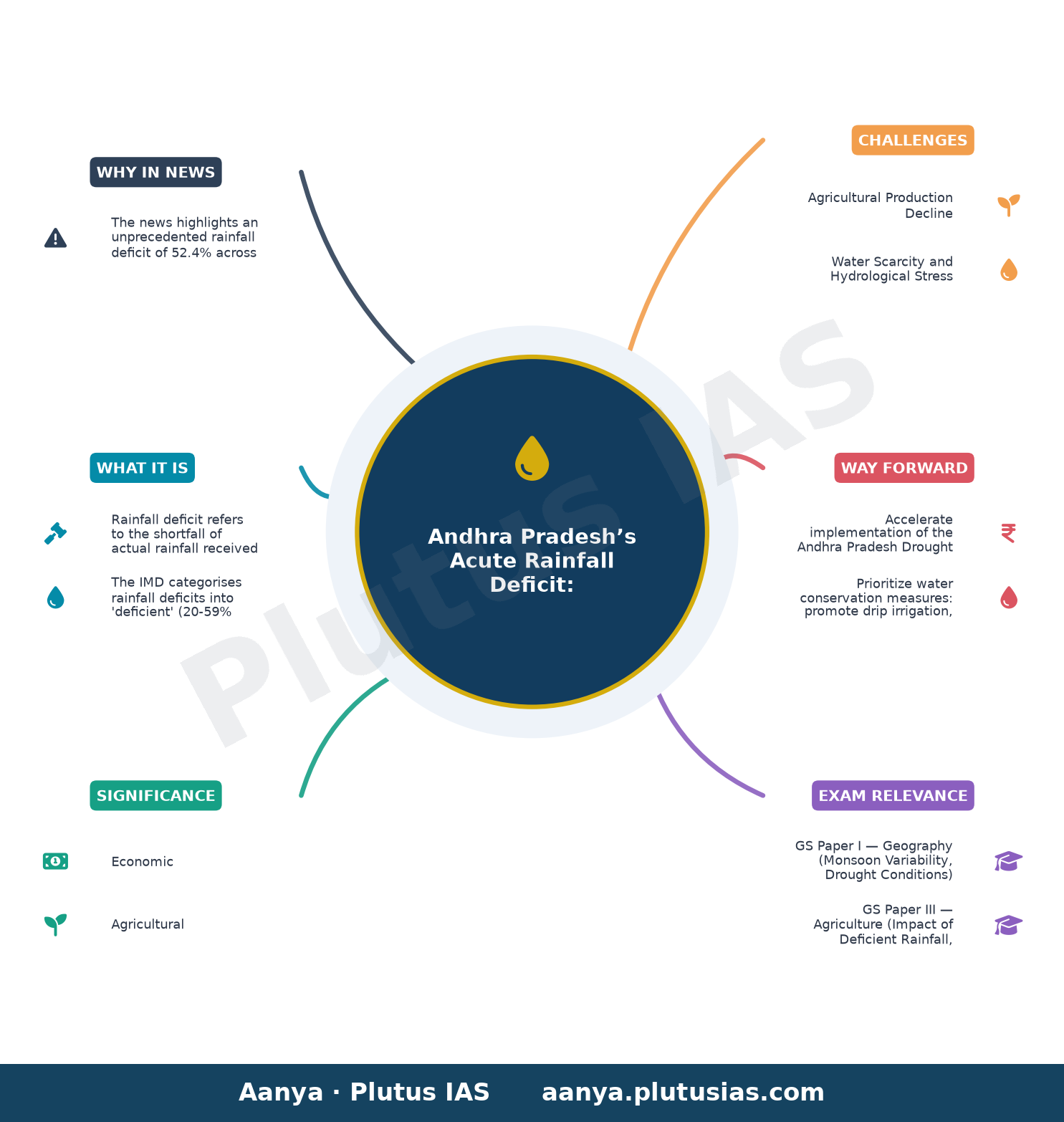
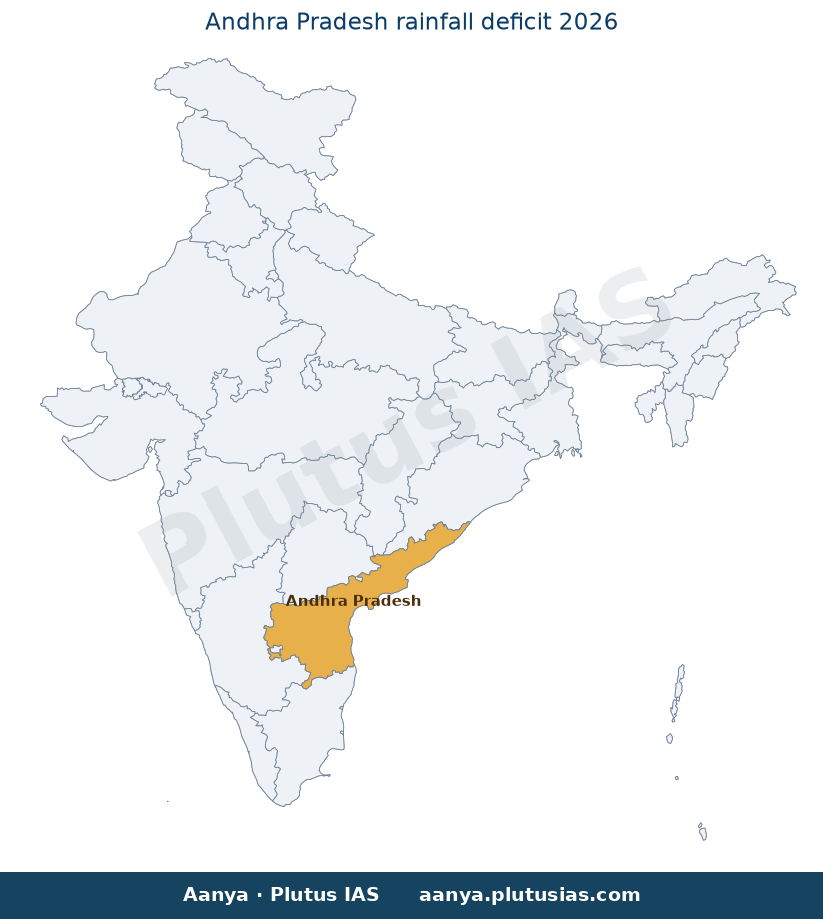
The news highlights an unprecedented rainfall deficit of 52.4% across all districts of Andhra Pradesh by the end of July 2026, marking a severe deviation from normal monsoon patterns. This situation has triggered urgent policy responses, including demands for drought declaration and comprehensive farmer support, amid looming threats from El Niño. The deficit underscores broader challenges in climate resilience, agricultural planning, and water resource management in India’s monsoon-dependent regions.
Background
- The Southwest Monsoon, which accounts for over 75% of India’s annual rainfall, is critical for kharif crops such as rice, maize, and pulses, which are vital for food security and rural livelihoods.
- Andhra Pradesh, a major agricultural state, relies heavily on monsoon rains for its rice cultivation, particularly in delta regions like Godavari and Krishna basins.
- The India Meteorological Department (IMD) classifies rainfall as ‘normal’ if it falls within 96-104% of the Long Period Average (LPA); ‘deficient’ if it is 20-59% below LPA; and ‘large deficient’ if it is 60% or more below LPA.
- El Niño, a warming of the central and eastern tropical Pacific Ocean, is historically associated with reduced monsoon rainfall in India, particularly in the southern peninsular region.
- Historically, Andhra Pradesh has faced droughts in 2002, 2009, 2015, and 2018, with the 2015 drought leading to the declaration of 269 mandals as drought-affected.
What is Rainfall Deficit and Its Implications?
- Rainfall deficit refers to the shortfall of actual rainfall received compared to the Long Period Average (LPA), a 50-year average used by the IMD to assess monsoon performance. A deficit of 52.4% in Andhra Pradesh indicates a severe deviation from normal conditions.
- The IMD categorises rainfall deficits into ‘deficient’ (20-59% below LPA) and ‘large deficient’ (60% or more below LPA).
- Rainfall deficit directly impacts soil moisture, groundwater recharge, and reservoir levels, which are critical for irrigation and drinking water supply. Andhra Pradesh’s major reservoirs, such as Srisailam and Nagarjunasagar, are likely to experience reduced storage.
- Agricultural operations, particularly kharif sowing, are severely affected. Delayed or insufficient rainfall leads to poor germination, stunted crop growth, and increased vulnerability to pests and diseases.
- The deficit exacerbates water stress in rural and urban areas, leading to increased dependence on groundwater, which is already over-exploited in many districts of Andhra Pradesh.
- El Niño conditions, as predicted by global climate models, are known to suppress monsoon rainfall in India. The current deficit aligns with historical patterns observed during El Niño years.
- The absence of significant rainfall events, such as the deep depression over the Bay of Bengal moving away from Andhra Pradesh, further limits the state’s ability to recover from the deficit.
- Policy responses, including drought declarations, relief measures, and agricultural contingency plans, become imperative to mitigate the socio-economic impact on farmers and rural communities.
Key Features
| Feature | Significance |
|---|---|
| Rainfall Deficit of 52.4% (July-end, 2026) | Triggers agricultural distress, water scarcity, and economic slowdown in Andhra Pradesh, necessitating immediate drought mitigation measures. |
| Large Deficit in Prakasam, East Godavari, Visakhapatnam, Annamayya, and Chittoor | These districts are critical for paddy cultivation, horticulture, and aquaculture, amplifying food security risks and rural livelihood impacts. |
| El Niño Threat (IMD Forecast) | Heightens probability of prolonged dry spells, reducing reservoir replenishment and groundwater recharge, exacerbating the deficit. |
| IMD’s Forecast of Minimal Rainfall (until August 3) | Delays monsoon revival, disrupts sowing schedules, and increases pressure on state-led relief measures. |
| Surface Winds (40–50 kmph) in Coastal Andhra & Rayalaseema | Accelerates soil moisture loss, hampers irrigation efficiency, and poses risks to standing crops like cotton and groundnut. |
Why it Matters
Economic
- Agricultural output decline (paddy, sugarcane, horticulture) threatens GDP growth, as agriculture contributes ~30% to Andhra Pradesh’s GSDP.
- Rural demand contraction may spill over into industrial sectors (agro-processing, textiles) due to reduced farm incomes.
- Increased expenditure on drought relief (e.g., water tankers, fodder) strains state finances, diverting funds from developmental projects.
Agricultural
- Delayed kharif sowing disrupts crop calendars, particularly for paddy in delta districts (East Godavari, West Godavari), risking yield losses.
- Groundwater depletion accelerates as farmers resort to deeper borewells, threatening long-term sustainability of irrigation systems.
- Livestock mortality rises due to fodder scarcity, impacting dairy and poultry sectors, which are key to rural livelihoods.
Hydrological
- Reservoir levels (e.g., Srisailam, Nagarjunasagar) drop below critical thresholds, reducing hydroelectric power generation and irrigation potential.
- Groundwater tables fall in Rayalaseema districts (Annamayya, Chittoor), exacerbating water conflicts between agriculture and domestic use.
- Saline water intrusion in coastal districts (Visakhapatnam, Prakasam) risks contamination of aquifers, affecting drinking water security.
Social
- Migration of agricultural laborers to urban centers (Hyderabad, Bengaluru) increases, straining urban infrastructure and social services.
- Food inflation spikes due to reduced supply of staples (rice, pulses), disproportionately affecting low-income households.
- Health risks rise from heatwaves and waterborne diseases (e.g., cholera, diarrhoea) due to poor sanitation and hygiene in drought-hit areas.
Challenges
1. Agricultural Production Decline
- Failure of kharif sowing in deficit districts (e.g., Prakasam, Chittoor) threatens food security and farmer incomes.
- Loss of standing crops (e.g., cotton, groundnut) due to moisture stress reduces export earnings.
- Increased debt burden on farmers from failed investments in seeds, fertilizers, and irrigation.
UPSC Link: GS-III: Agricultural productivity
2. Water Scarcity and Hydrological Stress
- Critical water storage levels in major reservoirs (e.g., Srisailam) jeopardize irrigation and power generation.
- Over-extraction of groundwater in Rayalaseema districts depletes aquifers, risking permanent loss of arable land.
- Competition for water between agriculture, industry, and urban use exacerbates inter-sectoral conflicts.
UPSC Link: GS-III: Water resources management
3. Economic and Fiscal Strain
- State’s revenue shortfall due to reduced agricultural tax collections and industrial slowdown.
- Increased expenditure on drought relief (e.g., MGNREGS, PM-KISAN) strains fiscal federalism and Centre-state fiscal relations.
- Reduced industrial activity (e.g., agro-processing, textiles) impacts employment and exports.
UPSC Link: GS-II: Centre-State financial relations
4. Climate Vulnerability and Long-Term Risks
- Recurrent droughts linked to El Niño-Southern Oscillation (ENSO) events undermine climate resilience strategies.
- Soil degradation and desertification in Rayalaseema districts reduce agricultural potential over time.
- Increased frequency of extreme weather events (e.g., heatwaves, cyclones) disrupts monsoon patterns.
UPSC Link: GS-III: Climate change and agriculture
5. Social Unrest and Migration
- Agricultural laborers migrate to cities, increasing urban unemployment and straining social welfare systems.
- Rural-urban disparities widen, fuelling discontent and potential agrarian distress movements.
- Youth outmigration to metropolitan areas reduces human capital in rural areas, impacting long-term development.
UPSC Link: GS-I: Social empowerment
Challenges — UPSC Perspective
| Issue | Concern |
|---|---|
| Delayed Kharif Sowing | Risk of yield loss and reduced foodgrain production, threatening national food security. |
| Groundwater Depletion | Irreversible aquifer degradation in Rayalaseema, impacting irrigation and drinking water. |
| Reservoir Water Shortage | Reduced hydroelectric power generation and irrigation capacity, affecting industrial and agricultural output. |
| Farmer Distress and Debt | Increased suicides, migration, and social unrest due to crop failures and financial stress. |
| Food Inflation | Rise in prices of staples (rice, pulses) disproportionately affects vulnerable populations. |
| Urban Migration | Overburdening of urban infrastructure and social services in cities like Hyderabad and Bengaluru. |
Way Forward
- Accelerate implementation of the Andhra Pradesh Drought Mitigation and Relief Scheme (2025) to provide immediate relief to farmers.
- Prioritize water conservation measures: promote drip irrigation, rainwater harvesting, and revival of traditional water bodies (e.g., tanks, ponds).
- Enhance groundwater recharge through MGNREGS-funded watershed development projects in Rayalaseema districts.
- Deploy agro-meteorological advisory services to guide farmers on drought-resistant crop varieties and sowing timelines.
- Strengthen inter-state coordination with Odisha and Chhattisgarh to leverage surplus rainfall in neighboring states for water sharing agreements.
- Expand crop insurance coverage (PMFBY) and expedite claim settlements to mitigate financial losses for farmers.
- Promote diversification of livelihoods in drought-prone districts through skill development in non-farm sectors (e.g., dairy, poultry, handicrafts).
- Leverage National Disaster Response Fund (NDRF) and State Disaster Response Fund (SDRF) for resource augmentation and relief operations.
UPSC Value Addition
Keywords for Mains Answer-Writing
Andhra Pradesh rainfall deficit · Southwest Monsoon variability · El Niño impact on India · Drought management in India · Agricultural distress and policy response · India Meteorological Department (IMD) · Rainfed agriculture in India · Disaster management framework · State-level drought declaration · Climate change and monsoon patterns · Agricultural insurance schemes · National Disaster Response Fund (NDRF) · State Disaster Response Fund (SDRF) · Inter-state monsoon dynamics · Bay of Bengal depressions and rainfall distribution
Concept Flow
El Niño-induced weak monsoon → Deficient rainfall (52.4% deficit) → Agricultural distress (delayed sowing, yield loss) → Farmer indebtedness and migration → Economic slowdown (reduced GSDP, food inflation) → State fiscal strain (increased relief expenditure) → Social unrest (rural-urban migration, agrarian distress). → Deficient rainfall → Groundwater over-extraction → Aquifer depletion → Irreversible hydrological stress → Long-term agricultural decline → Climate vulnerability (desertification, soil degradation). → IMD forecast of minimal rainfall → Delayed monsoon revival → Disruption of crop calendars → Reduced kharif output → Food security risks → National policy intervention (NDRF, PMFBY). → Deficient rainfall → Reservoir water shortage → Reduced hydroelectric power → Industrial slowdown → Employment contraction → Urban migration. → Agricultural distress → Farmer suicides → Social unrest → Policy response (drought relief, agro-advisories) → Institutional strengthening (watershed management, crop insurance). → Deficient rainfall → Water scarcity → Inter-sectoral conflicts (agriculture vs. industry vs. urban use) → Policy prioritization (water allocation, conservation). → Deficient rainfall → Reduced fodder availability → Livestock mortality → Dairy sector decline → Rural livelihood crisis.
Prelims Practice Questions
Q1. Consider the following statements regarding the South-West Monsoon in India:
1. The South-West Monsoon is responsible for about 75% of India’s annual rainfall.
2. The monsoon season in India is officially declared from June 1 to September 30.
3. The IMD classifies rainfall as ‘deficient’ when it is between 26% and 50% below the long-period average.
4. The Bay of Bengal branch of the monsoon is more significant for Andhra Pradesh than the Arabian Sea branch.
How many of the above statements are correct?
- Only one
- Only two
- Only three
- All four
Answer: All four — Statements 1, 2, and 4 are correct. Statement 3 is incorrect: IMD classifies rainfall as ‘deficient’ when it is between 26% and 50% below the long-period average, but ‘large deficient’ is between 51% and 70% below average.
Q2. Assertion (A): The El Niño phenomenon is associated with below-normal rainfall in India.
Reason (R): El Niño causes a weakening of the Walker circulation, leading to reduced monsoon rainfall over India.
Options:
A. Both A and R are true, and R is the correct explanation of A.
B. Both A and R are true, but R is NOT the correct explanation of A.
C. A is true, but R is false.
D. A is false, but R is true.
Answer: ? — Both A and R are true, and R correctly explains A. El Niño disrupts the Walker circulation, reducing the strength of the South-West Monsoon and leading to deficient rainfall in India.
Q3. Match the following pairs related to monsoon classifications in India:
Column I (Rainfall Category) Column II (Rainfall Deficit Range)
1. Normal A. 26% to 50% below LPA
2. Deficient B. 51% to 70% below LPA
3. Large Deficient C. 1% to 25% below LPA
4. Scanty D. 96% to 104% of LPA
Options:
A. 1-D, 2-A, 3-B, 4-C
B. 1-A, 2-B, 3-C, 4-D
C. 1-D, 2-C, 3-A, 4-B
D. 1-B, 2-A, 3-D, 4-C
Answer: ? — Correct matching: 1-D (Normal: 96% to 104% of LPA), 2-A (Deficient: 26% to 50% below LPA), 3-B (Large Deficient: 51% to 70% below LPA), 4-C (Scanty: 1% to 25% below LPA).
Mains Practice Question
✍ The deficient rainfall in Andhra Pradesh, with a 52.4% deficit by July-end, exemplifies the growing challenge of monsoon variability in India. Critically examine the institutional and policy responses required to mitigate agricultural distress in such scenarios. (15 Marks)
Approach: MODEL-ANSWER SKELETON:
1. **Contextualisation (2 marks)**
– Define monsoon variability and its impact on rainfed agriculture (e.g., Andhra Pradesh’s reliance on monsoon for kharif crops).
– Cite the IMD classification of ‘large deficient’ rainfall (51-70% below LPA) and Andhra Pradesh’s current deficit (52.4%).
2. **Institutional Responses (5 marks)**
– **IMD’s Role**: Explain the IMD’s monsoon forecasting mechanisms, including the use of statistical and dynamical models, and the limitations in predicting localized deficits.
– **State-Level Mechanisms**: Discuss the State Disaster Response Fund (SDRF) and the National Disaster Response Fund (NDRF) for drought relief, citing constitutional provisions (Article 280 for Finance Commission, Disaster Management Act, 2005).
– **Agricultural Policy**: Highlight the Pradhan Mantri Fasal Bima Yojana (PMFBY) and its efficacy in mitigating farmer distress during droughts.
3. **Policy Gaps and Challenges (4 marks)**
– **Data and Early Warning**: Critique the lag in real-time rainfall data collection and the need for granular district-level monitoring.
– **Inter-State Coordination**: Examine the role of the Bay of Bengal branch of the monsoon and its impact on Andhra Pradesh’s rainfall, emphasizing the need for inter-state coordination in monsoon forecasting.
– **Climate Change Adaptation**: Discuss the long-term need for climate-resilient agriculture, including drought-resistant crop varieties and water-efficient irrigation techniques.
4. **Way Forward (4 marks)**
– **Enhancing Forecasting**: Propose the integration of AI/ML in IMD’s monsoon models for improved accuracy.
– **Policy Integration**: Advocate for a unified drought management framework combining SDRF, NDRF, and PMFBY with real-time data sharing.
– **Farmer Awareness**: Stress the importance of farmer education on climate-smart agricultural practices and crop diversification.
**Balanced View**: Acknowledge the constraints of fiscal federalism and the need for Centre-State collaboration, while critiquing the current institutional responses for their reactive rather than proactive nature.
Source: The Hindu
Generated by AanyaAi for educational purpose.

- यूपीएससी/पीसीएस के लिए दूरसंचार विनिर्माण में निवेश: ग्वालियर टीएमजेड के अवसर - September 23, 2026
- Bengaluru Investor Meet: ₹5,500 Cr Investment Proposed for Gwalior Telecom Manufacturing Zone - September 23, 2026
- एल नीनो: दुनिया के सामने जलवायु अनुकूलन की चुनौती - September 23, 2026

No Comments