


08 Aug CPI Warns AP CM Over Telangana’s Krishna Lift Irrigation Project Threat
Krishna RiverPulichintala projectAndhra Pradesh Reorganisation Act✎ The Andhra Pradesh Reorganisation Act, 2014, mandates prior approval from the Apex Council and the Krishna River Management Board for any new lift irrigation scheme in the Krishna basin to ensure equitable water distribution and…
Subject Relevance — Where This Topic Fits
- GS Paper II — Functions and Responsibilities of the Union and the States, Issues and Challenges Pertaining to the Federal Structure | GS Paper III — Water Resources, Irrigation and Drainage
- Prelims: Krishna River Basin, Andhra Pradesh Reorganisation Act, 2014, Krishna River Management Board (KRMB), Apex Council under the Inter-State Water Disputes Act, Lift Irrigation Schemes, Pulichintala Project, Inter-State Water Disputes
- Essay: Federalism in India: Cooperative or Competitive?, Water Security and Sustainable Development
Quick Revision: The Andhra Pradesh Reorganisation Act, 2014, mandates prior approval from the Apex Council and the Krishna River Management Board for any new lift irrigation scheme in the Krishna basin to ensure equitable water distribution and prevent inter-state disputes.
Why is this in the news?
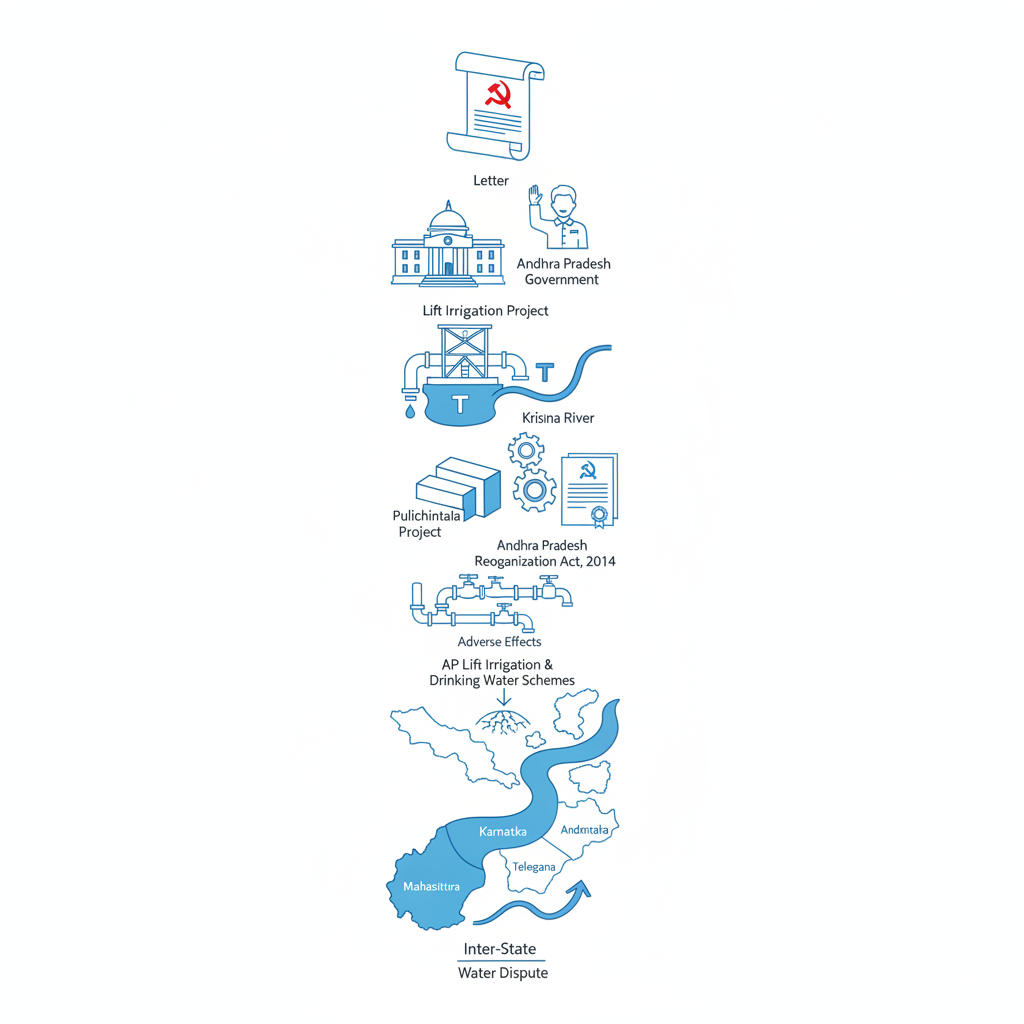
The Communist Party of India (CPI) has written to the Andhra Pradesh Chief Minister urging intervention to halt the Rajiv Gandhi Lift Irrigation Scheme being executed by Telangana near the Pulichintala project on the Krishna River. The CPI alleges that the scheme, lacking requisite approvals under the Andhra Pradesh Reorganisation Act, 2014, could adversely affect multiple lift irrigation and drinking water schemes in Andhra Pradesh, thereby escalating an inter-state water dispute in the Krishna basin.
Background
- The Krishna River, the second-largest east-flowing peninsular river, is a critical source of water for irrigation, drinking, and industrial use in Maharashtra, Karnataka, Telangana, and Andhra Pradesh.
- The Andhra Pradesh Reorganisation Act, 2014, which bifurcated the erstwhile united Andhra Pradesh, established the Krishna River Management Board (KRMB) and the Apex Council to resolve disputes and regulate water utilisation in the Krishna basin.
- Sections 84 and 85 of the Andhra Pradesh Reorganisation Act, 2014, mandate prior approval from the Apex Council and the KRMB for any new lift irrigation scheme in the Krishna basin to ensure equitable water distribution.
- Telangana has been developing multiple lift irrigation schemes to augment its agricultural and drinking water security, leading to recurring inter-state disputes with Andhra Pradesh over water allocation.
- The Rajiv Gandhi Lift Irrigation Scheme, proposed near the Pulichintala project, is estimated to lift 2,500 cusecs of water daily to irrigate 14,000 acres, raising concerns over downstream water availability in Andhra Pradesh.
What is the Rajiv Gandhi Lift Irrigation Scheme?
- The Rajiv Gandhi Lift Irrigation Scheme is a proposed lift irrigation project in Telangana, located between Bugga Madaram and Dondapadu villages in Chintalapalem mandal, Suryapet district.
- The scheme aims to lift 2,500 cusecs of water daily from the Krishna River to irrigate approximately 14,000 acres under the Muktyala Major Branch of the Nagarjunasagar Left Canal system.
- The project is estimated to cost ₹394 crore and is intended to stabilise irrigation facilities in the region, addressing water scarcity challenges.
- Lift irrigation involves pumping water from a lower elevation to higher elevation fields, making it a critical but contentious intervention in water-scarce regions.
- The scheme is part of Telangana’s broader strategy to enhance agricultural productivity and ensure water security, particularly in the Krishna basin.
- The project’s proximity to the Pulichintala reservoir in Andhra Pradesh has triggered concerns over potential disruptions to existing irrigation and drinking water schemes.
- The scheme’s implementation without prior approvals from the Apex Council and the KRMB raises legal and institutional concerns under the Andhra Pradesh Reorganisation Act, 2014.
UPSC Value Addition
Keywords for Mains Answer-Writing
Krishna River Basin · Inter-State Water Disputes · Andhra Pradesh-Telangana Water Conflict · Pulichintala Project · Rajiv Gandhi Lift Irrigation Scheme · Krishna River Management Board (KRMB) · Andhra Pradesh Reorganisation Act, 2014 · Apex Council for Water Disputes · Lift Irrigation Schemes · Inter-State River Water Disputes Act, 1956 · Water Resources Allocation · Federalism in Water Governance · Agricultural Water Security · Constitutional Provisions on Water Disputes (Article 262)
Prelims Practice Questions
Q1. Consider the following statements regarding the Pulichintala project and the Rajiv Gandhi Lift Irrigation Scheme:
1. The Pulichintala project is designed to regulate the flow of the Krishna River and provide irrigation to 1.3 million acres in Andhra Pradesh.
2. The Rajiv Gandhi Lift Irrigation Scheme is being constructed by Telangana between Bugga Madaram and Dondapadu villages.
3. The scheme has the capacity to lift 2,500 cusecs of water daily and stabilise irrigation over 14,000 acres.
4. The project does not require approval from the Krishna River Management Board (KRMB) as per the Andhra Pradesh Reorganisation Act, 2014.
How many of the above statements are correct?
- Only one
- Only two
- Only three
- All four
Answer: Only three — Statements 1, 2, and 3 are correct. Statement 4 is incorrect as the project requires approval from the KRMB under Sections 84 and 85 of the Andhra Pradesh Reorganisation Act, 2014.
Q2. Assertion (A): The Andhra Pradesh Reorganisation Act, 2014, mandates that any new lift irrigation scheme in the Krishna basin must obtain approval from the Apex Council headed by the Union Jal Shakti Minister.
Reason (R): The Krishna River Management Board (KRMB) is empowered to regulate and oversee all irrigation projects in the Krishna basin to prevent inter-state water disputes.
Options:
A. Both A and R are true, and R is the correct explanation of A.
B. Both A and R are true, but R is not the correct explanation of A.
C. A is true, but R is false.
D. A is false, but R is true.
Answer: ? — Both Assertion (A) and Reason (R) are true. The Apex Council, as per the Act, must approve new lift irrigation schemes, and the KRMB is tasked with regulating projects in the Krishna basin to prevent disputes.
Q3. Match the following pairs related to inter-state water disputes in India:
Column I (Institution/Act)
1. Krishna River Management Board (KRMB)
2. Apex Council for Water Disputes
3. Inter-State River Water Disputes Act, 1956
4. Andhra Pradesh Reorganisation Act, 2014
Column II (Function/Provision)
A. Constituted under the Inter-State River Water Disputes Act to adjudicate disputes
B. Regulates irrigation projects in the Krishna basin post-bifurcation
C. Mandates approval for new lift irrigation schemes in the Krishna basin
D. Provides for the establishment of tribunals to resolve inter-state water disputes
Options:
1. 1-B, 2-A, 3-D, 4-C
2. 1-A, 2-B, 3-C, 4-D
3. 1-D, 2-C, 3-B, 4-A
4. 1-C, 2-D, 3-A, 4-B
- 1
- 2
- 3
- 4
Answer: 1 — 1-B: KRMB regulates irrigation projects in the Krishna basin. 2-A: Apex Council adjudicates disputes under the Inter-State River Water Disputes Act. 3-D: The 1956 Act provides for tribunals. 4-C: The 2014 Act mandates approval for new lift irrigation schemes.
Mains Practice Question
✍ The construction of the Rajiv Gandhi Lift Irrigation Scheme by Telangana near the Pulichintala project on the Krishna River raises critical questions about federalism, water governance, and inter-state cooperation. Critically examine the constitutional and legal framework governing inter-state river water disputes in India, with particular reference to the role of the Krishna River Management Board (KRMB) and the Apex Council. Also, analyse the implications of unilateral construction of such projects on the federal structure of the Indian polity. (15 Marks)
Approach: MODEL-ANSWER SKELETON:
1. **Constitutional Framework**:
– Article 262 of the Constitution: Provides for the adjudication of inter-state river water disputes.
– Inter-State River Water Disputes Act, 1956: Establishes tribunals for dispute resolution.
– 42nd Amendment Act, 1976: Inserted Article 262(2) to bar judicial review of tribunal awards.
2. **Post-Bifurcation Legal Framework**:
– Andhra Pradesh Reorganisation Act, 2014: Sections 84 and 85 mandate approval from the Apex Council and KRMB for new lift irrigation schemes in the Krishna basin.
– Role of KRMB: Regulates projects, ensures equitable water distribution, and prevents disputes.
– Apex Council: Headed by the Union Jal Shakti Minister, oversees implementation of tribunal awards and resolves disputes.
3. **Federalism and Unilateral Actions**:
– Federal principle: Water is a state subject, but inter-state rivers require cooperative federalism.
– Implications of unilateral construction: Disrupts equitable distribution, violates constitutional spirit, and undermines trust.
– Case Study: Recent disputes between Andhra Pradesh and Telangana over Krishna and Godavari waters.
4. **Judicial Precedents and Governance Gaps**:
– Supreme Court’s stance on inter-state disputes (e.g., Cauvery Water Disputes Tribunal).
– Challenges in enforcement: Delayed tribunal awards, lack of compliance mechanisms.
– Need for institutional reforms: Strengthening KRMB, empowering Apex Council, and promoting data transparency.
5. **Way Forward**:
– Strengthening cooperative federalism through regular consultations.
– Implementing real-time water data sharing mechanisms.
– Expediting tribunal awards and ensuring strict compliance.
Source: The Hindu
Generated by AanyaAi for educational purpose.

- विदेश मंत्री जयशंकर की यूरोप के चार विदेश मंत्रियों से द्विपक्षीय वार्ता, भारत-ईयू एफटीए पर चर्चा - September 24, 2026
- मद्रास उच्च न्यायालय ने अनामलाई के खिलाफ मामले को रद्द किया: राजनीतिक टिप्पणियों पर न्यायिक फैसला - September 24, 2026
- Madras HC quashes case against Annamalai over Thevar remarks: UPSC Polity Analysis - September 24, 2026

No Comments