


08 Aug Andhra Pradesh Launches DIMPLE: Digital Mental Health Platform for Schools
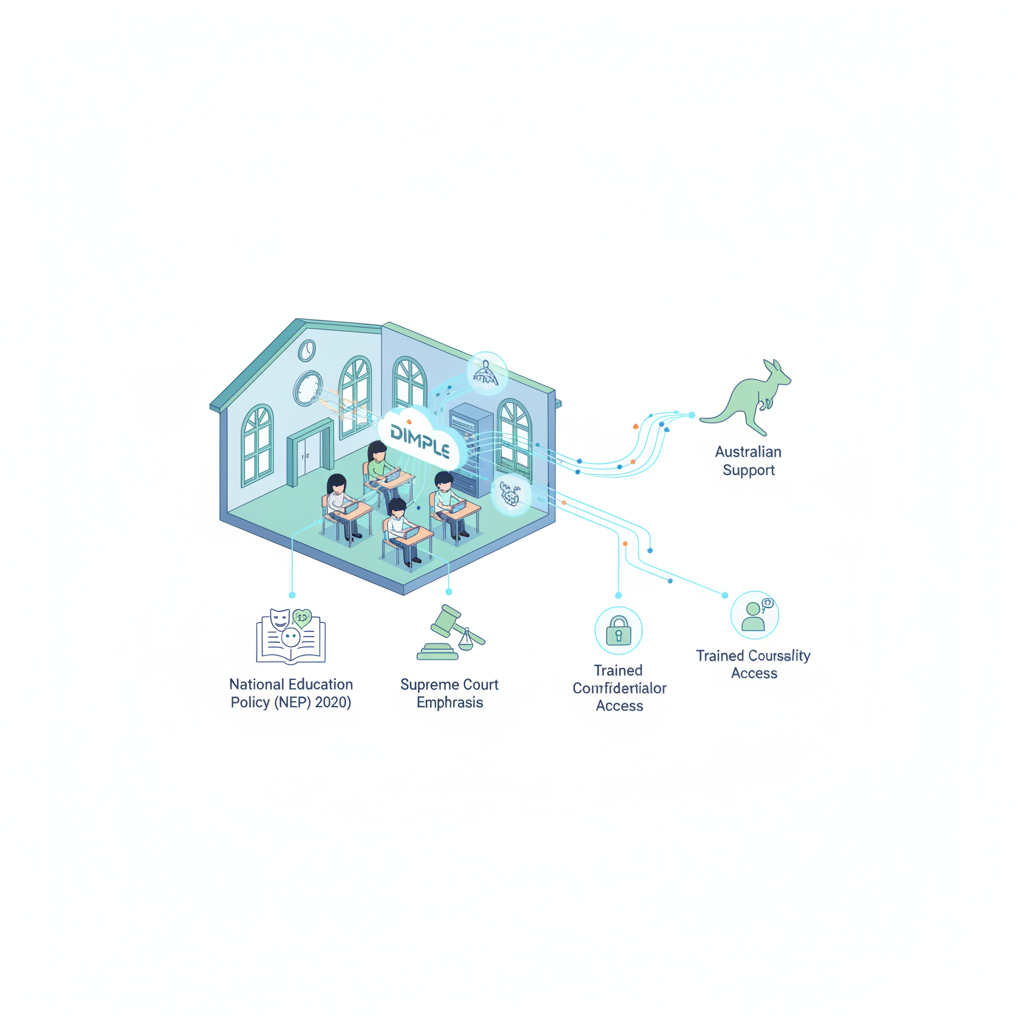
✎ DIMPLE is a digital mental health platform in Andhra Pradesh’s schools, enabling anonymous access to mental health resources and confidential counselling, developed with Australian support to address the Supreme Court’s…
Subject Relevance — Where This Topic Fits
- GS Paper II — International Relations (India-Australia bilateral cooperation in education and health) | GS Paper IV — Ethics, Integrity and Aptitude (Role of public institutions in addressing mental health challenges) | GS Paper III — Science and Technology (Digital public health interventions and AI in mental health)
- Prelims: Digital Public Health, Mental Health Care, National Education Policy 2020, UN Sustainable Development Goal 3 (Good Health and Well-being), Australia-India Comprehensive Strategic Partnership, Samagra Shiksha Abhiyan, Learning Outcome-based Pedagogy, Supreme Court directives on student mental health
- Essay: The Role of Technology in Addressing Societal Challenges: A Case Study of Digital Mental Health Platforms, Education and Well-being: The Need for a Holistic Approach in Governance
Quick Revision: DIMPLE is a digital mental health platform in Andhra Pradesh’s schools, enabling anonymous access to mental health resources and confidential counselling, developed with Australian support to address the Supreme Court’s directives on student mental health.
Why is this in the news?
The launch of the Digital Mental Health Platform (DIMPLE) in Andhra Pradesh’s schools, supported by Australia’s Rebound Group Global Ltd. and the Australian Government, marks a significant intervention in addressing the rising mental health concerns among students. This initiative aligns with the Supreme Court’s emphasis on student mental health and reflects Andhra Pradesh’s commitment to integrating digital solutions within its educational reforms under the unified HRD Department. The pilot project’s focus on anonymity, confidentiality, and trained counsellor access underscores the need for scalable, technology-driven mental health interventions in India’s education system.
Background
- The National Education Policy (NEP) 2020 emphasises the holistic development of students, including their mental and emotional well-being, as a core component of educational excellence.
- The Supreme Court of India highlighted the urgent need for mental health support systems in educational institutions.
- Andhra Pradesh’s unified Human Resource Development (HRD) Department integrates school, intermediate, higher education, and skill development under a single administrative framework to streamline policy implementation.
- The Learning Excellence in Andhra Pradesh (LEAP) initiative aims to modernise education through digital integration, teacher training, and systemic reforms, aligning with global best practices in educational governance.
- Australia’s partnership in this initiative is part of its broader engagement, which includes collaborations in education, health, and technology.
What is the Digital Mental Health Platform (DIMPLE)?
- DIMPLE is a digital mental health platform launched as a pilot in select Andhra Pradesh schools, enabling students to access mental health resources anonymously and connect with trained counsellors via a confidential interface.
- The platform was developed by Australia’s Rebound Group Global Ltd. in collaboration with the Andhra Pradesh government, following several years of research into adolescent mental health interventions.
- Key features include anonymous access to mental health resources, real-time counselling sessions, and a user-friendly interface designed for adolescent engagement and trust-building.
- The initiative is aligned with the Supreme Court’s directives on student mental health and is intended to be evaluated for scalability across the state and potentially across India.
- The platform addresses the dual challenge of rising mental health concerns among students and the stigma associated with seeking mental health support, particularly in educational settings.
- Australia’s involvement underscores the global recognition of digital mental health solutions and the potential for cross-border knowledge exchange in public health interventions.
- The initiative complements Andhra Pradesh’s broader educational reforms under the LEAP programme, which integrates digital tools to enhance learning outcomes and student well-being.
Key Features
| Feature | Significance |
|---|---|
| Anonymised access to mental health resources | Ensures confidentiality for students, reducing stigma associated with seeking mental health support. |
| Confidential counselling via trained professionals | Provides immediate, evidence-based intervention for students experiencing distress or mental health challenges. |
| Pilot initiative in selected schools | Allows for rigorous evaluation of efficacy and scalability before statewide or national rollout. |
| Integration with LEAP initiative | Aligns mental health support with broader educational reforms, including digital integration and teacher training. |
| Partnership with Rebound Group Global Ltd. and Australian Government | Leverages international expertise and funding to enhance the platform’s technical and operational robustness. |
Why it Matters
Educational
- Demonstrates a proactive approach to addressing the mental health crisis in Indian schools, which is critical for holistic student development.
- Aligns with the National Education Policy (NEP) 2020’s emphasis on student well-being and inclusive education.
- Sets a precedent for other states to adopt digital mental health platforms, fostering a culture of mental health awareness in education systems.
Technological
- Showcases the potential of digital tools in public health, particularly in reaching underserved populations like school students.
- Highlights the role of public-private partnerships in developing scalable, user-friendly digital health solutions.
Policy and Governance
- Reflects the Supreme Court’s directives on prioritising student mental health, as seen in recent judgments and policy recommendations.
- Demonstrates Andhra Pradesh’s commitment to unified governance under the HRD Department, enabling coordinated reforms in education and health.
International Relations
- Strengthens educational and health diplomacy between India and Australia, particularly in the domain of digital public health.
- Positions Andhra Pradesh as a model for South Asian countries seeking to integrate mental health support in school systems.
Challenges
1. Scalability and Sustainability
- Ensuring equitable access to the platform across rural and urban schools, including those with limited digital infrastructure.
- Maintaining consistent funding and technical support post-pilot phase to prevent discontinuation of services.
UPSC Link: GS2: Centre-State relations
2. Data Privacy and Security
- Protecting sensitive student data from breaches or misuse, particularly given the anonymised nature of the platform.
- Ensuring compliance with India’s Digital Personal Data Protection Act (DPDP) 2023 and other relevant regulations.
UPSC Link: GS3: Cybersecurity
3. Stigma and Cultural Barriers
- Overcoming societal stigma around mental health, which may deter students from utilising the platform despite its anonymity.
- Addressing cultural perceptions of mental health in diverse communities across Andhra Pradesh.
UPSC Link: GS1: Social empowerment
4. Counsellor Availability and Training
- Ensuring a sufficient number of trained counsellors to handle the volume of student queries, particularly during peak stress periods.
- Continuous professional development for counsellors to keep pace with evolving mental health challenges among students.
UPSC Link: GS2: Health services
5. Monitoring and Evaluation
- Developing robust metrics to assess the platform’s impact on student mental health outcomes and academic performance.
- Addressing potential biases in data collection and ensuring representative feedback from all demographic groups.
UPSC Link: GS4: Governance
Challenges — UPSC Perspective
| Issue | Concern |
|---|---|
| Digital divide | Limited internet connectivity and device access in rural schools may exclude marginalised students from using the platform. |
| Language barriers | Ensuring the platform is available in regional languages to cater to non-English-speaking students. |
| Teacher engagement | Teachers may lack training or motivation to promote the platform among students, reducing its reach. |
| Mental health workforce shortage | Insufficient number of trained counsellors to meet the demand for mental health services in schools. |
| Policy fragmentation | Lack of a unified national policy on school mental health may hinder scalability and inter-state collaboration. |
| Adolescent mental health literacy | Low awareness among students about mental health issues and available resources may limit platform utilisation. |
Way Forward
- Conduct a comprehensive baseline survey in pilot schools to assess pre-existing mental health challenges and resource gaps.
- Develop a phased rollout plan with clear milestones for scaling up the platform across all districts in Andhra Pradesh.
- Establish a dedicated helpline and grievance redressal mechanism for students facing technical or access issues.
- Integrate the platform with existing school health programmes, such as Ayushman Bharat’s School Health and Wellness Programme (SHWP).
- Collaborate with NGOs and civil society organisations to conduct awareness campaigns in schools and communities.
- Invest in continuous training for counsellors and teachers to enhance their capacity to support student mental health.
- Pilot a feedback mechanism to gather student and teacher input for iterative improvements to the platform.
- Explore public-private partnerships to secure long-term funding and technical expertise for sustainability.
UPSC Value Addition
Keywords for Mains Answer-Writing
Digital Mental Health Platform (DIMPLE) · Mental health of school students · Supreme Court directives on student mental health · Learning Excellence in Andhra Pradesh (LEAP) · Human Resource Development (HRD) Department · Digital integration in education · Psychosocial support for adolescents · Anonymised mental health counselling · Public-private partnership in education · Australia-India educational collaboration
Concept Flow
Rising mental health challenges among school students → Supreme Court directives on student well-being → Andhra Pradesh’s unified HRD Department initiative → Partnership with Australian entities for technical support → Launch of DIMPLE platform → Pilot evaluation → Potential statewide/national scaling → Broader impact on educational reforms and mental health policy.
Prelims Practice Questions
Q1. Consider the following statements regarding the Digital Mental Health Platform (DIMPLE) launched in Andhra Pradesh:
1. DIMPLE is a pilot initiative developed in partnership with Australia’s Rebound Group Global Ltd.
2. The platform enables students to access mental health resources anonymously and connect with trained counsellors.
3. DIMPLE is part of the Learning Excellence in Andhra Pradesh (LEAP) initiative.
4. The platform is designed to replace traditional classroom teaching methods.
How many of the above statements are correct?
- Only one
- Only two
- Only three
- All four
Answer: Only three — Statements 1, 2, and 3 are correct as they align with the reported features of DIMPLE and its integration with LEAP. Statement 4 is incorrect because DIMPLE is not intended to replace traditional teaching methods but to supplement them with mental health support.
Q2. Assertion (A): The Government of Andhra Pradesh has unified school education, intermediate education, higher education, and skill development under a single Human Resource Development (HRD) Department.
Reason (R): This unification aims to enable a coordinated approach to educational transformation.
Options:
A. Both A and R are true, and R is the correct explanation of A.
B. Both A and R are true, but R is not the correct explanation of A.
C. A is true, but R is false.
D. A is false, but R is true.
Answer: ? — Both the assertion (A) and the reason (R) are true, and R correctly explains A, as the unification under the HRD Department is explicitly stated to enable coordinated educational reforms.
Q3. Which of the following best describes the primary objective of the DIMPLE platform launched in Andhra Pradesh?
- To provide free textbooks to students across the state
- To offer anonymised mental health resources and counselling to school students
- To replace traditional classroom teaching with digital modules
- To conduct annual mental health surveys in schools
Answer: To offer anonymised mental health resources and counselling to school students — The primary objective of DIMPLE, as reported, is to provide anonymised mental health resources and confidential counselling to students, addressing their psychosocial well-being.
Mains Practice Question
✍ Critically examine the significance of the Digital Mental Health Platform (DIMPLE) launched in Andhra Pradesh for the psychosocial well-being of school students. Also, discuss the potential challenges in scaling up such initiatives across India. (15 Marks)
Approach: MODEL-ANSWER SKELETON:
1. **Introduction (2 marks)**: Define DIMPLE and its context within the Learning Excellence in Andhra Pradesh (LEAP) initiative. Highlight the Supreme Court’s emphasis on student mental health as a constitutional obligation.
2. **Significance of DIMPLE (5 marks)**:
– **Anonymised access to mental health resources**: Reduces stigma and encourages early intervention (cite WHO data on adolescent mental health burden in India).
– **Confidential counselling**: Addresses the shortage of child psychologists in government schools (reference National Mental Health Survey 2015-16 data).
– **Digital integration**: Aligns with the National Education Policy (NEP) 2020’s emphasis on technology in education (cite NEP 2020 clauses on digital infrastructure).
– **Public-private partnership (PPP)**: Leverages global expertise (Australia’s Rebound Group) to address local challenges.
3. **Potential Challenges in Scaling Up (5 marks)**:
– **Digital divide**: Rural-urban disparities in internet access and device availability (reference NITI Aayog’s Aspirational Districts Programme data).
– **Data privacy and security**: Risks of breaches in anonymised systems (discuss the Personal Data Protection Bill, 2019, and its gaps).
– **Cultural barriers**: Stigma around mental health in conservative communities may limit utilisation (cite studies on adolescent mental health in India).
– **Sustainability**: Long-term funding and maintenance of digital platforms post-pilot phase.
4. **Way Forward (3 marks)**:
– **Multi-stakeholder collaboration**: Involve NGOs, local governments, and community leaders for grassroots outreach.
– **Capacity building**: Train teachers and counsellors to recognise early signs of mental health issues (reference CBSE’s 2021 circular on mental health).
– **Monitoring and evaluation**: Use real-time data analytics to assess impact and refine interventions (cite examples from Kerala’s ‘Snehasparsham’ programme).
Source: The Hindu
Generated by AanyaAi for educational purpose.

- बिहार सरकार का बड़ा फैसला: कारोबार शुरू करने में होगी आसानी, जानिए कैसे मिलेगा फायदा - September 23, 2026
- Bihar Launches Single Window Portal for 62 Business Services: UPSC & PCS Guide - September 23, 2026
- ग्रीनलैंड समझौता: अमेरिका को मिले अतिरिक्त रक्षा क्षेत्र, जानिए पूरा मामला - September 23, 2026

No Comments