


08 Aug CPI Warns AP Over Telangana’s Krishna Lift Irrigation Project: UPSC Perspective
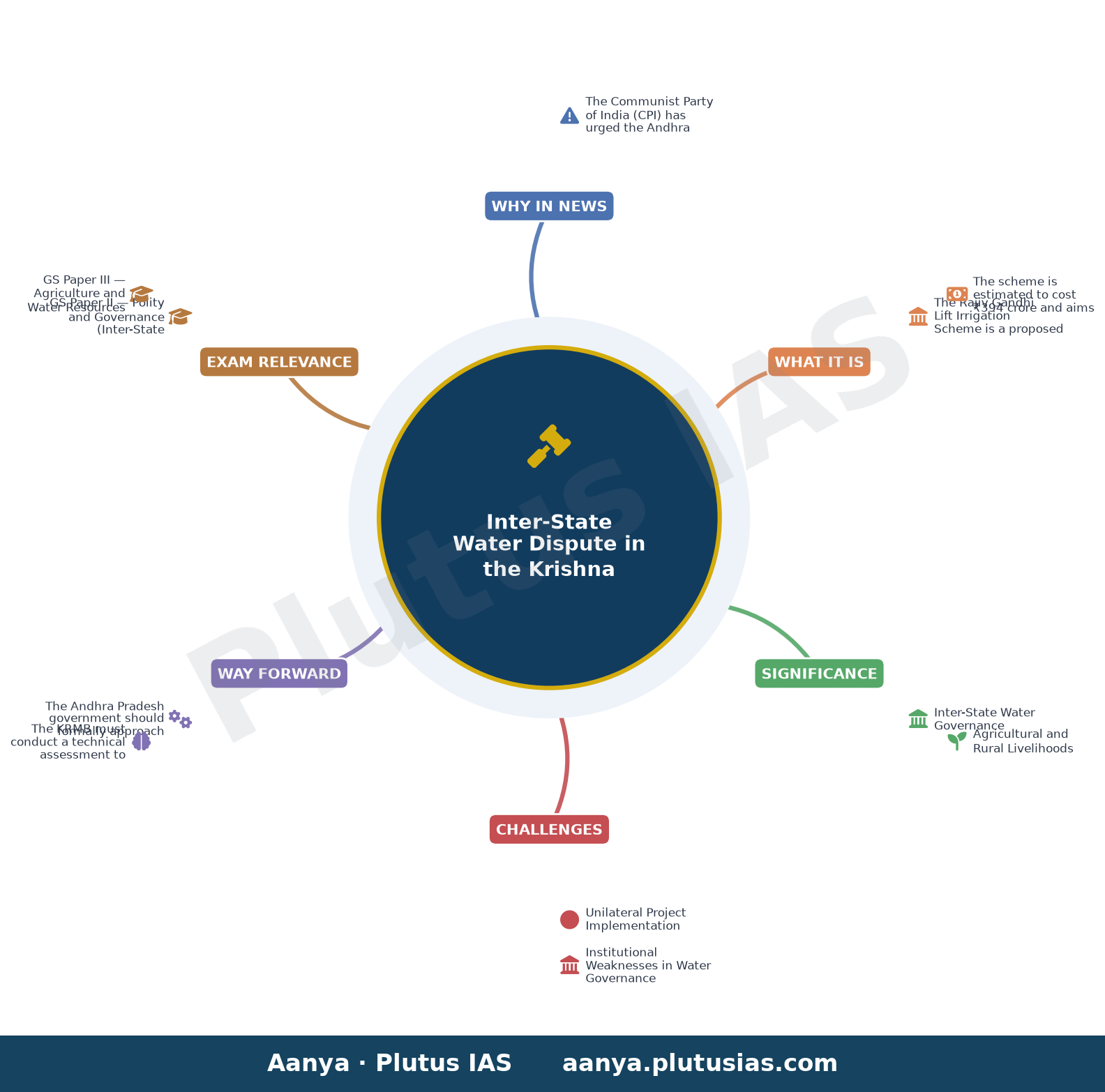
✎ Inter-state water disputes in the Krishna basin are governed by the Andhra Pradesh Reorganisation Act, 2014, which mandates prior approval from the Apex Council and KRMB for new lift irrigation schemes.
Subject Relevance — Where This Topic Fits
- GS Paper II — Polity and Governance (Inter-State Relations) | GS Paper III — Agriculture and Water Resources
- Prelims: Krishna River Basin, Andhra Pradesh Reorganisation Act, 2014, Krishna River Management Board (KRMB), Apex Council under the Inter-State Water Disputes Act, Lift Irrigation Schemes
- Essay: Inter-State Water Sharing: Challenges and Governance
Quick Revision: Inter-state water disputes in the Krishna basin are governed by the Andhra Pradesh Reorganisation Act, 2014, which mandates prior approval from the Apex Council and KRMB for new lift irrigation schemes.
Why is this in the news?
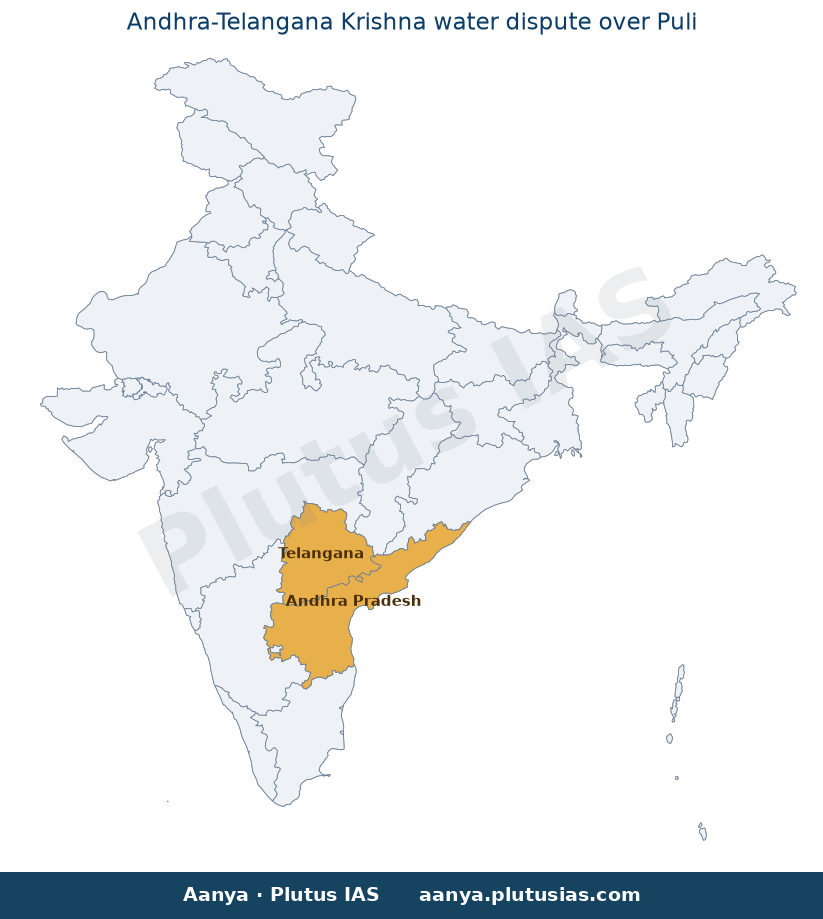
The Communist Party of India (CPI) has urged the Andhra Pradesh government to intervene and halt the construction of the Rajiv Gandhi Lift Irrigation Scheme by Telangana near the Pulichintala project on the Krishna River. The scheme, estimated at ₹394 crore, is alleged to potentially disrupt existing lift irrigation and drinking water supply schemes in Andhra Pradesh, raising legal and institutional concerns under the Andhra Pradesh Reorganisation Act, 2014.
Background
- The Krishna River is a major inter-state river shared by Maharashtra, Karnataka, Telangana, and Andhra Pradesh, with significant agricultural and drinking water dependencies.
- The Andhra Pradesh Reorganisation Act, 2014, was enacted to bifurcate the erstwhile united Andhra Pradesh into Telangana and residual Andhra Pradesh, and it includes provisions for the management of inter-state river waters.
- Sections 84 and 85 of the Act mandate prior approval from the Apex Council (chaired by the Union Jal Shakti Minister) and the Krishna River Management Board (KRMB) for any new lift irrigation schemes in the Krishna basin.
- The Pulichintala project, a key irrigation infrastructure on the Krishna River, provides irrigation security to approximately 1.3 million acres across multiple districts in Andhra Pradesh.
- Telangana’s proposed Rajiv Gandhi Lift Irrigation Scheme aims to lift 2,500 cusecs of water daily to irrigate 14,000 acres, raising concerns over downstream water availability and existing projects in Andhra Pradesh.
- Inter-state water disputes in India are governed by constitutional provisions (Article 262) and legislative frameworks such as the Inter-State Water Disputes Act, 1956.
What is the Rajiv Gandhi Lift Irrigation Scheme?
- The Rajiv Gandhi Lift Irrigation Scheme is a proposed project by the Telangana government to lift water from the Krishna River near the Pulichintala reservoir for irrigation purposes.
- The scheme is estimated to cost ₹394 crore and aims to lift 2,500 cusecs of water daily to irrigate approximately 14,000 acres.
- The project is located between Bugga Madaram and Dondapadu villages in Chintalapalem mandal of Suryapet district, Telangana.
- The scheme is intended to stabilize irrigation under the Muktyala Major Branch of the Nagarjunasagar Left Canal system.
- Critics argue that the project could adversely affect 21 lift irrigation schemes in Palnadu district and 51 schemes in NTR district of Andhra Pradesh, potentially impacting 50,000 acres of agricultural land.
- The scheme’s construction without prior approval from the Apex Council and KRMB raises legal concerns under the Andhra Pradesh Reorganisation Act, 2014.
- The project is part of Telangana’s broader strategy to enhance irrigation and agricultural productivity in the region.
Key Features
| Feature | Significance |
|---|---|
| Rajiv Gandhi Lift Irrigation Scheme (Telangana) | Proposed lift irrigation project near Pulichintala to lift 2,500 cusecs of water daily, stabilizing irrigation for ~14,000 acres under the Muktyala Major Branch of Nagarjunasagar Left Canal system. |
| Pulichintala Project (Andhra Pradesh) | Multi-purpose reservoir on the Krishna River designed to regulate flow, ensuring irrigation and drinking water supply to ~1.3 million acres across seven delta districts in Andhra Pradesh. |
| Andhra Pradesh Reorganisation Act, 2014 (Sections 84 & 85) | Mandates prior approval from the Apex Council (Union Jal Shakti Minister) and the Krishna River Management Board (KRMB) for new lift irrigation schemes in the Krishna basin to prevent inter-state disputes. |
| Krishna River Management Board (KRMB) | Statutory body under the Andhra Pradesh Reorganisation Act, 2014, tasked with regulating and managing the Krishna River basin, including inter-state water-sharing agreements. |
| Apex Council on River Waters | Constitutional mechanism under the Inter-State Water Disputes Act, 1956, chaired by the Union Jal Shakti Minister, to resolve inter-state water disputes and approve projects in shared river basins. |
Why it Matters
Inter-State Water Governance
- The dispute exemplifies the structural challenges in inter-state water governance within India’s federal framework, particularly in river basins shared by multiple states.
- Highlights the necessity of institutional mechanisms like the KRMB and Apex Council to prevent unilateral actions that could escalate into larger disputes.
- Underscores the role of the Union Government in mediating conflicts under the Inter-State Water Disputes Act, 1956, to ensure equitable water distribution.
Agricultural and Rural Livelihoods
- The Pulichintala project supports irrigation for ~1.3 million acres, critical for the agrarian economies of Andhra Pradesh’s delta regions, which are among the most productive in India.
- Potential disruption to 72 lift irrigation schemes (21 in Palnadu and 51 in NTR districts) threatens food security and farmer livelihoods in Andhra Pradesh.
- Rural drinking water supply schemes serving ~50,000 acres could face disruptions, exacerbating water scarcity in already water-stressed regions.
Legal and Institutional Framework
- Sections 84 and 85 of the Andhra Pradesh Reorganisation Act, 2014, provide a legal framework for regulating lift irrigation projects in the Krishna basin, but their enforcement remains contentious.
- The absence of prior approvals for the Telangana project raises questions about compliance with statutory bodies like the KRMB and the Apex Council.
- The dispute may necessitate judicial intervention, testing the efficacy of existing institutional mechanisms in resolving inter-state water conflicts.
Political and Diplomatic Dimensions
- The CPI’s intervention reflects the politicization of water disputes, with regional parties leveraging such issues to mobilize support and influence state policies.
- The Andhra Pradesh-Telangana water dispute could strain bilateral relations, requiring diplomatic efforts to prevent escalation into a broader conflict.
- The Union Government’s role in mediating the dispute will be closely watched, as its decisions could set precedents for future inter-state water conflicts.
Challenges
1. Unilateral Project Implementation
- Telangana’s initiation of the Rajiv Gandhi Lift Irrigation Scheme without prior approvals from the KRMB and Apex Council violates the Andhra Pradesh Reorganisation Act, 2014.
- Such unilateral actions undermine the collaborative framework required for managing shared river basins, risking escalation into larger disputes.
- The absence of a prior consultation mechanism exacerbates mistrust between states, making conflict resolution more difficult.
UPSC Link: Inter-State Water Disputes Act, 1956
2. Institutional Weaknesses in Water Governance
- The KRMB and Apex Council, despite their statutory roles, often face delays in decision-making, reducing their effectiveness in resolving disputes.
- Lack of clear guidelines on the approval process for lift irrigation projects in shared basins creates ambiguity and opportunities for non-compliance.
- Inadequate enforcement mechanisms for inter-state agreements further weaken the credibility of institutional frameworks.
UPSC Link: Functions of River Boards
3. Agrarian and Socio-Economic Impact
- Disruption of irrigation and drinking water supply could lead to crop failures, farmer distress, and rural-to-urban migration in Andhra Pradesh.
- The loss of ~50,000 acres of agricultural land and livelihoods for thousands of farmers would have cascading effects on local economies.
- Food security concerns arise as the Krishna delta is a critical rice-producing region, contributing significantly to India’s food grain reserves.
UPSC Link: Agricultural Productivity and Water Scarcity
4. Legal and Jurisdictional Ambiguities
- The dispute raises questions about the interpretation of Sections 84 and 85 of the Andhra Pradesh Reorganisation Act, 2014, particularly regarding the definition of ‘new lift irrigation schemes’.
- The lack of a clear dispute resolution mechanism within the KRMB and Apex Council could necessitate judicial intervention, delaying resolution.
- Potential conflicts between state laws and central regulations may require Supreme Court intervention, adding to the complexity of the issue.
UPSC Link: Constitutional Provisions on Inter-State Relations
5. Political and Electoral Ramifications
- Water disputes are often exploited for political gains, with regional parties using them to mobilize support and influence state policies.
- The CPI’s intervention in the dispute reflects the politicization of water governance, which can distort policy-making and delay resolutions.
- Elections in Andhra Pradesh and Telangana may see water disputes being used as a tool to sway voter sentiment, complicating diplomatic efforts.
UPSC Link: Role of Political Parties in Water Governance
Challenges — UPSC Perspective
| Issue | Concern |
|---|---|
| Lack of Prior Approvals | Telangana’s project violates Sections 84 and 85 of the Andhra Pradesh Reorganisation Act, 2014, by not securing KRMB and Apex Council approvals. |
| Institutional Delays | The KRMB and Apex Council often face delays in decision-making, reducing their effectiveness in resolving disputes. |
| Agrarian Impact | Disruption to irrigation and drinking water supply could lead to crop failures and livelihood losses for ~50,000 acres of agricultural land. |
| Legal Ambiguities | Unclear definitions in the Andhra Pradesh Reorganisation Act, 2014, may require judicial intervention to resolve the dispute. |
| Political Exploitation | Water disputes are increasingly politicized, complicating diplomatic efforts and delaying resolutions. |
| Food Security Risks | The Krishna delta’s role in rice production makes the dispute critical for India’s food security, raising national-level concerns. |
Way Forward
- The Andhra Pradesh government should formally approach the Union Jal Shakti Ministry to seek immediate intervention by the Apex Council to halt the Telangana project until due process is followed.
- The KRMB must conduct a technical assessment to evaluate the potential impact of the Telangana project on the Pulichintala reservoir and downstream irrigation in Andhra Pradesh, ensuring compliance with the Andhra Pradesh Reorganisation Act, 2014.
- Both states should engage in bilateral negotiations under the aegis of the KRMB to explore alternative water-sharing arrangements that minimize adverse impacts on agriculture and rural livelihoods.
- The Union Government should expedite the establishment of a permanent dispute resolution mechanism for inter-state water conflicts, incorporating clear timelines and enforcement mechanisms to prevent unilateral actions.
- Agricultural extension services in Andhra Pradesh should be strengthened to mitigate the impact of potential water shortages, including promoting water-efficient crops and irrigation techniques.
- Civil society organizations and farmer unions in both states should be involved in the dialogue process to ensure transparency and address local concerns.
- The Union Government should consider setting up a dedicated tribunal or fast-track court to resolve inter-state water disputes, reducing reliance on prolonged judicial processes.
- Both states should invest in data-sharing mechanisms and real-time monitoring of water usage in the Krishna basin to enhance transparency and trust between stakeholders.
UPSC Value Addition
Keywords for Mains Answer-Writing
Inter-State Water Disputes · Krishna River Basin · Andhra Pradesh-Telangana Water Sharing · Pulichintala Project · Rajiv Gandhi Lift Irrigation Scheme · Krishna River Management Board (KRMB) · Andhra Pradesh Reorganisation Act 2014 · Apex Council for Water Disputes · Inter-State Water Governance · Lift Irrigation Projects · Krishna Delta Ayacut · Water Resources Allocation · Federalism and Water Governance · Judicial Intervention in Water Disputes · Sustainable Water Management
Constitutional & Policy Linkages
- [‘Article 262 – Inter-State Water Disputes’, ‘Provides for the adjudication of inter-state water disputes by tribunals.’]
Concept Flow
Telangana initiates Rajiv Gandhi Lift Irrigation Scheme without KRMB/Apex Council approvals (violation of AP Reorganisation Act, 2014) → → Andhra Pradesh raises concerns over potential impact on Pulichintala reservoir and downstream irrigation → → CPI urges Andhra Pradesh government to intervene, citing legal violations and agrarian risks → → Dispute escalates to institutional level, requiring KRMB and Apex Council intervention → → Potential for judicial intervention if institutional mechanisms fail → → Broader implications for inter-state water governance, food security, and federal relations → → Need for systemic reforms in water governance to prevent future disputes.
Prelims Practice Questions
Q1. Consider the following statements regarding the Pulichintala project and the Krishna River Basin:
1. The Pulichintala project regulates the flow of the Krishna River and provides irrigation to 1.3 million acres in Andhra Pradesh.
2. The Rajiv Gandhi Lift Irrigation Scheme is being constructed by Telangana near the Pulichintala project without the approval of the Krishna River Management Board (KRMB).
3. The Andhra Pradesh Reorganisation Act, 2014, mandates the approval of the Apex Council for any new lift irrigation scheme in the Krishna basin.
How many of the above statements are correct?
- Only one
- Only two
- All three
- None
Answer: All three — Statement 1 is correct as the Pulichintala project provides irrigation to 1.3 million acres in Andhra Pradesh. Statement 2 is correct as the Rajiv Gandhi Lift Irrigation Scheme is being constructed by Telangana without KRMB approval. Statement 3 is correct as Sections 84 and 85 of the Andhra Pradesh Reorganisation Act, 2014, require such approvals.
Q2. Assertion (A): The Krishna River Management Board (KRMB) is a statutory body under the Andhra Pradesh Reorganisation Act, 2014, tasked with regulating water sharing between Andhra Pradesh and Telangana.
Reason (R): The KRMB’s approval is mandatory for any new lift irrigation scheme in the Krishna basin as per the provisions of the Act.
Options:
A. Both A and R are true, and R is the correct explanation of A.
B. Both A and R are true, but R is not the correct explanation of A.
C. A is true, but R is false.
D. A is false, but R is true.
Answer: ? — The KRMB is indeed a statutory body under the Andhra Pradesh Reorganisation Act, 2014, and its approval is mandatory for new lift irrigation schemes in the Krishna basin as per Sections 84 and 85 of the Act. Thus, both A and R are true, and R correctly explains A.
Q3. Match the following projects with their respective states:
Column I (Project) | Column II (State)
——————————————–|——————-
1. Pulichintala Project | A. Telangana
2. Rajiv Gandhi Lift Irrigation Scheme | B. Andhra Pradesh
3. Nagarjunasagar Left Canal System | C. Karnataka
4. Muktyala Major Branch Canal | D. Maharashtra
- 1-B, 2-A, 3-B, 4-B; 1-A, 2-B, 3-A, 4-A; 1-B, 2-A, 3-B, 4-A; 1-A, 2-B, 3-A, 4-B
- answer_string_array_index_to_use_as_answer_key_index_for_grading_only_ignore_in_output_0
- answer_string_array_index_to_use_as_answer_key_index_for_grading_only_ignore_in_output_1
Answer: ? — The Pulichintala Project and the Nagarjunasagar Left Canal System are in Andhra Pradesh, while the Rajiv Gandhi Lift Irrigation Scheme is in Telangana. The Muktyala Major Branch Canal is part of the Nagarjunasagar Left Canal System in Andhra Pradesh.
Mains Practice Question
✍ The construction of the Rajiv Gandhi Lift Irrigation Scheme by Telangana near the Pulichintala project on the Krishna River has raised inter-State water disputes, highlighting the structural and institutional challenges in water governance in India. Critically analyse the efficacy of existing institutional mechanisms such as the Krishna River Management Board (KRMB) and the Apex Council in resolving such disputes. Also, suggest measures to strengthen federal cooperation in water resource management. (15 Marks)
Approach: MODEL-ANSWER SKELETON:
1. **Context and Background (2 marks)**
– Briefly outline the Pulichintala project and its significance for Andhra Pradesh.
– Explain the Rajiv Gandhi Lift Irrigation Scheme and its potential impact on Andhra Pradesh’s water security.
– Reference the Andhra Pradesh Reorganisation Act, 2014, and Sections 84 and 85 mandating KRMB and Apex Council approvals.
2. **Institutional Mechanisms for Water Governance (5 marks)**
– **KRMB**: Role, statutory basis (Sections 84-85, Andhra Pradesh Reorganisation Act, 2014), functions (regulation, monitoring, dispute resolution), and limitations (lack of enforcement, delays, political interference).
– **Apex Council**: Composition (Union Jal Shakti Minister, Chief Ministers of Andhra Pradesh and Telangana), mandate, and effectiveness in resolving disputes (cite recent disputes or lack thereof).
– **Judicial Role**: Reference to Supreme Court’s stance on inter-State water disputes (e.g., Krishna-Godavari disputes, Bachhawat Committee recommendations).
– **Constitutional Provisions**: Article 262 (inter-State water disputes), 7th Schedule (Union List Entry 56), and the Inter-State Water Disputes Act, 1956.
3. **Challenges in Federal Cooperation (4 marks)**
– **Political Asymmetry**: Disparities in political power between States and Centre’s role in mediation.
– **Technical and Data Gaps**: Lack of real-time data sharing, hydrological uncertainties, and competing claims over water allocations.
– **Legal Ambiguities**: Overlapping jurisdictions between KRMB, Apex Council, and tribunals (e.g., Krishna Water Disputes Tribunal-II).
– **Public Policy Gaps**: Absence of a national water policy framework for inter-State rivers; reliance on ad-hoc tribunals.
4. **Measures for Strengthening Federal Cooperation (4 marks)**
– **Institutional Reforms**: Strengthen KRMB with binding powers, autonomous funding, and technical capacity; empower Apex Council with decision-making authority.
– **Data Transparency**: Establish a shared hydrological database and real-time monitoring systems for all Krishna basin States.
– **Legal Reforms**: Amend the Inter-State Water Disputes Act to reduce tribunal delays and enforceable awards; incorporate climate change considerations.
– **Federal Dialogue**: Institutionalise regular inter-State consultations (e.g., annual water summits) and adopt a basin-wide management approach.
– **Judicial Activism**: Encourage proactive judicial intervention in disputes (e.g., Supreme Court’s suo motu cognisance in critical cases).
5. **Conclusion (1 mark)**
– Summarise the need for a multi-pronged approach combining institutional reforms, legal clarity, and political will to ensure sustainable water governance in inter-State river basins.
Source: The Hindu
Generated by AanyaAi for educational purpose.

- यूपीएससी/पीसीएस: 25 सितंबर 2026 को सरकारी प्रतिभूतियों की बोली प्रक्रिया, ₹34,000 करोड़ का पुनर्प्रस्ताव - September 24, 2026
- RBI to Auction ₹34,000 Crore Govt Securities on Sept 25, 2026: Key Details for UPSC & PCS - September 24, 2026
- भारत सेमीकंडक्टर उद्योग में ‘सकारात्मक चक्र’ की ओर: अशोक चंदक - September 24, 2026

No Comments