


08 Aug Centre releases ₹2,597 crore to Kerala as tax devolution boost
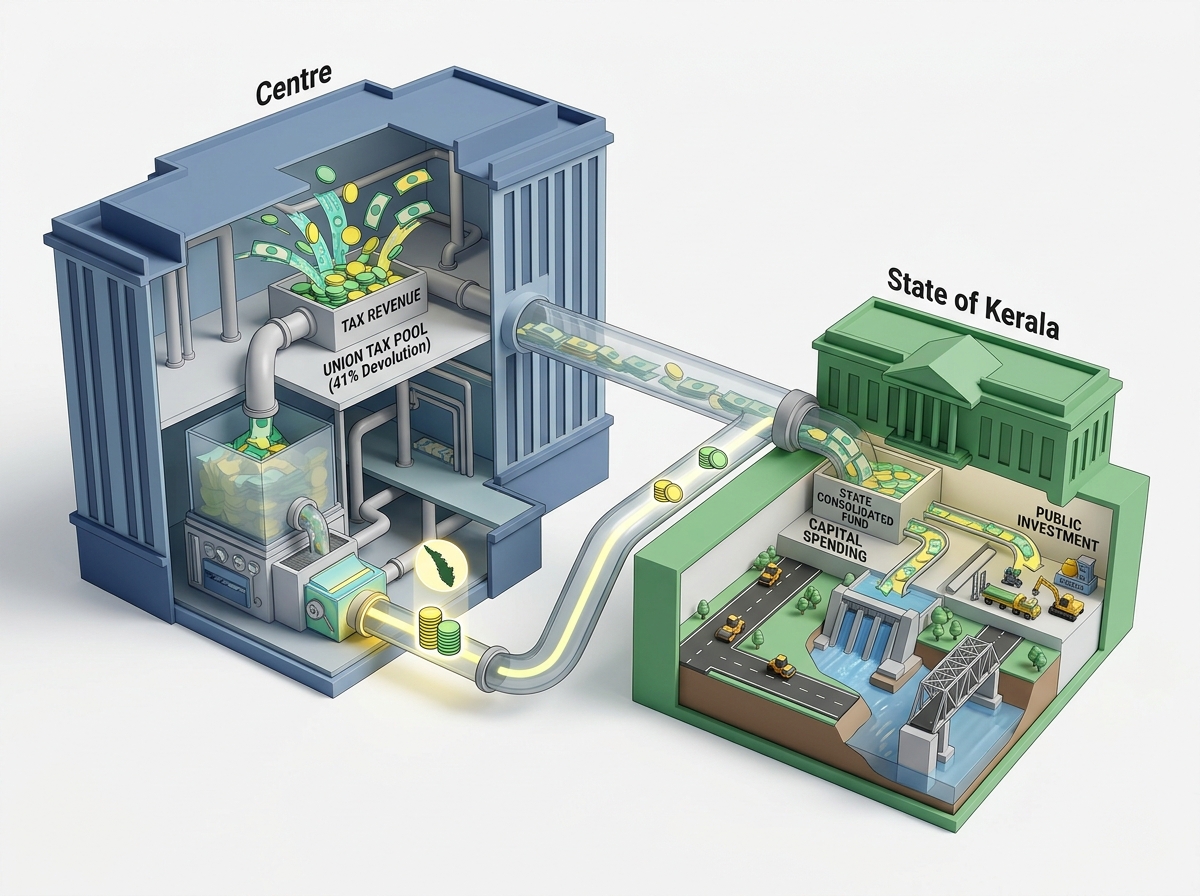
Tax devolutionCapital expenditureFiscal federalismUnion taxesState finances✎ Tax devolution under Article 270 is a constitutional mechanism for distributing 41% of the net proceeds of Union taxes to States, as recommended by the 15th Finance Commission, to enhance fiscal federalism and enable capital…
Subject Relevance — Where This Topic Fits
- GS Paper II — Functions and Responsibilities of the Union and the States, Issues and Challenges Pertaining to the Federal Structure, Devolution of Powers and Finances up to Local Levels | GS Paper III — Indian Economy and Issues Relating to Planning, Mobilisation of Resources, Growth, Development and Employment
- Prelims: Article 270, Article 280, Finance Commission, Tax Devolution, Net Proceeds of Union Taxes, 15th Finance Commission, GST Compensation, Fiscal Federalism, Capital Expenditure, Revenue Deficit, Union Budget
- Essay: Fiscal Federalism in India: Balancing Autonomy and Accountability, The Role of Finance Commissions in India’s Developmental Trajectory
Quick Revision: Tax devolution under Article 270 is a constitutional mechanism for distributing 41% of the net proceeds of Union taxes to States, as recommended by the 15th Finance Commission, to enhance fiscal federalism and enable capital expenditure.
Why is this in the news?
The Union Government’s release of ₹2,597 crore to Kerala as an ‘additional instalment’ of tax devolution, beyond the routine monthly transfers, underscores the Centre’s emphasis on augmenting States’ capital expenditure. This measure, part of a ₹1,09,019 crore advance distribution to States, aligns with the broader fiscal federalism framework and the Centre’s commitment to bolster State finances for developmental priorities. The timing, preceding the routine August 10 devolution, highlights the Centre’s proactive stance in addressing liquidity constraints and accelerating public investment.
Background
- The Constitution of India, under Article 270, mandates the distribution of net proceeds of Union taxes and duties between the Union and the States, with a fixed percentage (currently 41%) devolved to States in multiple instalments.
- The 15th Finance Commission (2021-26) recommended a vertical devolution of 41% of the divisible pool of Union taxes to States, with horizontal adjustments based on criteria such as population, area, forest cover, and fiscal capacity.
- Tax devolution is a critical component of fiscal federalism, enabling States to finance their developmental and capital expenditure without resorting to excessive borrowing or tax hikes.
- The Centre’s decision to release an ‘additional instalment’ reflects a departure from the traditional monthly schedule, aimed at addressing liquidity constraints and ensuring timely capital spending by States.
- Kerala, like other States, relies on tax devolution for a significant portion of its revenue, particularly for capital expenditure in sectors such as infrastructure, health, and education.
- The release of ₹2,597 crore to Kerala is part of a larger advance distribution of ₹1,09,019 crore to States, indicating a broader strategy to front-load fiscal transfers during the financial year.
What is Tax Devolution to States?
- Tax devolution refers to the constitutional mechanism under Article 270 of the Indian Constitution, whereby a fixed percentage of the net proceeds of Union taxes and duties is distributed to States in multiple instalments.
- The divisible pool of Union taxes includes income tax, central excise duties, and customs duties, excluding cess and surcharges, as specified by the Finance Commission.
- The 15th Finance Commission recommended a vertical devolution of 41% of the divisible pool to States, with horizontal adjustments to account for differential needs and fiscal capacities.
- Tax devolution is a non-conditional transfer, enabling States to utilise funds for any purpose, including capital expenditure, subject to their fiscal priorities and constitutional obligations.
- The Finance Commission, a constitutional body under Article 280, determines the principles governing tax devolution, including the vertical and horizontal distribution of funds.
- Tax devolution is distinct from grants-in-aid (Article 275), which are conditional transfers for specific purposes, such as centrally sponsored schemes or State-specific developmental needs.
- The Centre’s decision to release an ‘additional instalment’ of tax devolution is a discretionary measure aimed at addressing liquidity constraints and accelerating capital spending by States.
- Kerala’s receipt of ₹2,597 crore as an additional instalment is part of a broader strategy to front-load fiscal transfers, ensuring timely availability of funds for developmental priorities.
Key Features
| Feature | Significance |
|---|---|
| Additional instalment of ₹2,597 crore | Provides immediate liquidity to Kerala for accelerating capital expenditure, addressing short-term fiscal gaps and enabling timely project execution. |
| Advance instalment of ₹1,09,019 crore | Demonstrates the Centre’s proactive approach to augmenting State finances, particularly for developmental and capital outlays, ahead of routine devolution. |
| 41% devolution of Union taxes | Reflects the constitutional mandate under Article 270(2) for horizontal distribution of tax proceeds, ensuring fiscal federalism and resource equity among States. |
| Routine monthly devolution on August 10 | Ensures continuity in State finances while the additional tranche provides supplementary support for urgent developmental needs. |
| Focus on capital spending | Aligns with the Centre’s objective of enhancing infrastructure creation, job generation, and long-term economic growth through State-led investments. |
Why it Matters
Economic Significance
- The additional devolution enhances Kerala’s fiscal capacity, enabling it to undertake critical capital projects without resorting to additional borrowings or fiscal compression.
- Boosts aggregate demand through increased public expenditure, particularly in sectors like infrastructure, healthcare, and education, contributing to macroeconomic stability.
- Demonstrates the Centre’s commitment to fiscal federalism by prioritising State-level developmental priorities through flexible devolution mechanisms.
- Supports Kerala’s post-disaster recovery and reconstruction efforts, particularly in the context of recent floods or infrastructure deficits.
Fiscal Federalism
- Reinforces the constitutional principle of cooperative federalism by ensuring timely and adequate resource transfer to States, reducing inter-State fiscal disparities.
- The 41% devolution rate, though below the 42% recommended by the 14th Finance Commission, reflects a balance between Centre’s fiscal consolidation and State autonomy.
- The advance instalment mechanism mitigates the volatility in State finances caused by delayed or irregular tax collections, ensuring predictability in budgetary planning.
Developmental Impact
- Capital expenditure by States has a higher multiplier effect on GDP growth compared to revenue expenditure, as it creates durable assets and enhances productive capacity.
- Enables Kerala to address critical infrastructure gaps in urban and rural areas, improving connectivity, digital access, and service delivery.
- Supports employment generation in labour-intensive sectors such as construction, manufacturing, and allied services, particularly in semi-urban and rural regions.
Policy Coherence
- The Centre’s decision aligns with the broader objective of the Government of India to enhance public investment in infrastructure, as outlined in the National Infrastructure Pipeline (NIP).
- Complements the Union Budget’s emphasis on ‘capex-led growth’ by ensuring that States have the financial headroom to participate in national developmental priorities.
Challenges
1. Fiscal Imbalance Between States
- Despite the 41% devolution, certain States continue to face fiscal stress due to lower tax buoyancy, higher expenditure commitments, or demographic pressures.
- Kerala, while fiscally robust compared to many States, faces challenges in balancing developmental expenditure with debt sustainability, particularly in the aftermath of natural disasters.
UPSC Link: GS-II: Fiscal Federalism
2. Volatility in Tax Devolution
- The reliance on tax devolution makes State finances vulnerable to fluctuations in the Centre’s tax collections, particularly during economic slowdowns or policy changes.
- The advance instalment, while helpful, does not fully address the structural issue of delayed or insufficient devolution, which can disrupt State budgetary cycles.
UPSC Link: GS-II: Centre-State Financial Relations
3. Implementation Bottlenecks
- Even with adequate funds, Kerala may face challenges in project execution due to land acquisition delays, regulatory hurdles, or lack of technical capacity in local bodies.
- The effectiveness of capital spending is contingent on robust project identification, prioritisation, and monitoring mechanisms to avoid cost overruns or underutilisation of funds.
UPSC Link: GS-III: Infrastructure Development
4. Debt Sustainability Concerns
- While the additional devolution provides short-term relief, Kerala’s overall debt-to-GSDP ratio remains a concern, particularly if capital spending leads to higher future liabilities.
- The Centre’s fiscal consolidation targets may limit the scope for further devolution increases, constraining States’ ability to undertake large-scale investments.
UPSC Link: GS-III: Public Finance Management
Challenges — UPSC Perspective
| Issue | Concern |
|---|---|
| Inter-State Fiscal Disparities | States with lower tax bases or higher expenditure needs may continue to lag behind despite devolution adjustments. |
| Delayed Tax Devolution | Routine delays in releasing devolved funds can disrupt State budgetary cycles and planning. |
| Project Execution Delays | Land acquisition, environmental clearances, and bureaucratic inefficiencies may hinder the utilisation of funds. |
| Debt Sustainability | Excessive reliance on borrowings to fund capital projects could strain State finances in the long term. |
| Centre-State Coordination Gaps | Lack of alignment between Centre’s developmental priorities and State-level implementation capacities may lead to suboptimal outcomes. |
Way Forward
- Kerala should prioritise high-impact capital projects with clear deliverables, ensuring timely completion to maximise the multiplier effect of the additional funds.
- The State government must strengthen its project monitoring and evaluation frameworks to track expenditure and outcomes, reducing leakages and inefficiencies.
- The Centre should consider institutionalising advance instalments for all States, particularly those with higher developmental needs, to ensure fiscal predictability.
- States should explore innovative financing mechanisms, such as public-private partnerships (PPPs) or municipal bonds, to supplement devolution funds for large-scale projects.
- The 15th Finance Commission’s recommendations should be leveraged to address structural fiscal imbalances, including the devolution formula and grants-in-aid mechanisms.
- Kerala’s disaster management infrastructure should be integrated into capital spending plans to build resilience against future natural calamities.
- The Centre and States must enhance data-sharing and transparency in fund utilisation to facilitate evidence-based policy adjustments and public accountability.
UPSC Value Addition
Keywords for Mains Answer-Writing
Tax Devolution to States · Finance Commission · Federal Financial Relations · Union-State Fiscal Architecture · Capital Expenditure · Vertical Devolution · Horizontal Devolution · Net Proceeds of Union Taxes and Duties · State Finances · Developmental Expenditure · Public Finance Management · Fiscal Federalism · Fourteenth Finance Commission · GST Compensation · Union Budget 2026-27
Constitutional & Policy Linkages
- Article 270(2): Horizontal distribution of Union tax proceeds to States.
- Article 280: Role of the Finance Commission in determining devolution criteria.
Concept Flow
Union tax collection → Net proceeds of Union taxes and duties → Horizontal distribution to States (41% devolution) → Advance instalment mechanism → Additional ₹2,597 crore to Kerala → Capital expenditure by Kerala → Enhanced infrastructure and economic growth → Job creation and poverty reduction.
Prelims Practice Questions
Q1. Consider the following statements regarding the tax devolution mechanism in India:
1. The Union government devolves 41% of the taxes collected to the States in multiple instalments.
2. The Finance Commission determines the vertical and horizontal devolution of taxes.
3. The GST Compensation Cess is a part of the net proceeds of Union taxes and duties shared with States.
How many of the above statements are correct?
- Only one
- Only two
- All three
- None
Answer: All three — Statements 1 and 2 are correct. Statement 3 is incorrect as the GST Compensation Cess is not a part of the divisible pool of taxes; it is a separate cess levied to compensate States for revenue loss due to GST implementation.
Q2. Assertion (A): The Union Finance Ministry released ₹2,597 crore to Kerala as an additional instalment of tax devolution to boost capital spending.
Reason (R): The Union government aims to strengthen the finances of States to accelerate their capital and developmental expenditure.
In the context of the above two statements, which one of the following is correct?
- Both A and R are true, and R is the correct explanation of A.
- Both A and R are true, but R is not the correct explanation of A.
- A is true, but R is false.
- A is false, but R is true.
Answer: Both A and R are true, but R is not the correct explanation of A. — Both the assertion and reason are true, and the reason correctly explains the assertion. The additional instalment is part of the Union government’s commitment to strengthen State finances for capital expenditure.
Q3. Match the following columns regarding the Finance Commission and its functions:
Column I (Finance Commission Reports)
A. 14th Finance Commission
B. 15th Finance Commission
C. 16th Finance Commission
Column II (Key Recommendations)
1. Increased the vertical devolution to 42%
2. Introduced performance-based incentives for States
3. Recommended the formation of a Disaster Management Fund
Select the correct match:
- A-1, B-2, C-3
- A-2, B-1, C-3
- A-3, B-1, C-2
- A-1, B-3, C-2
Answer: A-1, B-2, C-3 — A-1: The 14th Finance Commission increased the vertical devolution to 42%. B-2: The 15th Finance Commission introduced performance-based incentives for States. C-3: The 16th Finance Commission recommended the formation of a Disaster Management Fund.
Mains Practice Question
✍ Critically examine the significance of the Union government’s decision to release an additional instalment of ₹2,597 crore to Kerala as part of tax devolution for capital expenditure. In your answer, elucidate the constitutional and institutional framework governing tax devolution in India, and analyse how such measures impact fiscal federalism and State autonomy. (15 Marks)
Approach: MODEL-ANSWER SKELETON:
1. **Constitutional Framework**:
– Article 270 and 280 of the Constitution: Taxes levied and collected by the Union are shared with States.
– Finance Commission (Art. 280): Determines the principles governing the distribution of net proceeds of taxes between the Union and States (vertical devolution) and among States (horizontal devolution).
– Recent Finance Commissions (14th, 15th, 16th): Highlight changes in devolution percentages and criteria (e.g., 14th FC increased vertical devolution to 42%).
2. **Institutional Mechanism**:
– Role of the Union Finance Ministry in releasing devolution instalments.
– The concept of ‘advance instalment’ and its purpose in enabling States to plan capital expenditure.
– Example: The ₹1,09,019 crore released as advance instalment on August 1, 2026, including Kerala’s ₹2,597 crore.
3. **Impact on Fiscal Federalism and State Autonomy**:
– **Strengthening State Finances**: Additional devolution aids States in bridging fiscal gaps and accelerating capital expenditure (e.g., infrastructure, health, education).
– **Fiscal Federalism**: Enhances cooperative federalism by ensuring equitable resource distribution, but may also lead to debates on conditionalities attached to such funds.
– **State Autonomy**: While devolution promotes decentralisation, over-reliance on Union transfers may limit States’ fiscal independence. The balance between autonomy and Union oversight remains a critical debate.
4. **Critique and Challenges**:
– **Vertical Imbalance**: Persistent vertical imbalance (Union retains a larger share) despite increased devolution.
– **Horizontal Imbalance**: Disparities in horizontal devolution due to criteria like population, income distance, and area.
– **GST Compensation**: The withdrawal of GST compensation (post-July 2022) has strained State finances, necessitating alternative mechanisms for fiscal support.
5. **Way Forward**:
– Strengthening the role of the Finance Commission in addressing both vertical and horizontal imbalances.
– Exploring innovative fiscal instruments (e.g., disaster management funds, performance-linked grants) to align with developmental priorities.
– Ensuring transparency and predictability in the devolution process to enhance State planning.
Source: The Hindu
Generated by AanyaAi for educational purpose.

- अमेरिकी रूस प्रतिबंध बिल: भारत की ऊर्जा सुरक्षा पर बढ़ा जोखिम, जानिए पूरा मामला - August 9, 2026
- US Senate Russia Sanctions Bill: Threat to India’s Energy Security Explained for UPSC 2026 - August 9, 2026
- महिला आरक्षण विधेयक: शिअद ने केंद्र से तुरंत लागू करने की मांग, जानें पूरा मामला - August 9, 2026

No Comments