


08 Aug Centre Reaffirms Stand on Mekedatu Dam: No Need for Tamil Nadu’s NOC in Lok Sabha
Mekedatu dam projectCauvery riverLok SabhaSupreme CourtCauvery disputeKarnataka-Tamil Nadu✎ The Mekedatu dam project hinges on the interpretation of the Cauvery Water Disputes Tribunal’s final award and the Supreme Court’s 2018 judgment, which permit Karnataka to construct structures on the Cauvery without requiring…
Subject Relevance — Where This Topic Fits
- GS Paper II — Functions and Responsibilities of the Union and the States, Federalism | GS Paper III — Water Resources, Environmental Impact Assessment
- Prelims: Inter-State Water Disputes Act, 1956, Cauvery Water Disputes Tribunal (CWDT), Final Award of the CWDT (2007), Riparian Principle, Supreme Court Judgment (2018) in Cauvery Water Disputes Case, Article 262 of the Constitution, Inter-State River Water Disputes (Amendment) Act, 2019
- Essay: Federalism in India: Balancing Development and Environmental Justice, Water Governance and Inter-State Conflicts: Lessons from the Cauvery
Quick Revision: The Mekedatu dam project hinges on the interpretation of the Cauvery Water Disputes Tribunal’s final award and the Supreme Court’s 2018 judgment, which permit Karnataka to construct structures on the Cauvery without requiring consent from other riparian states, provided the regulated flow regime is not violated.
Why is this in the news?
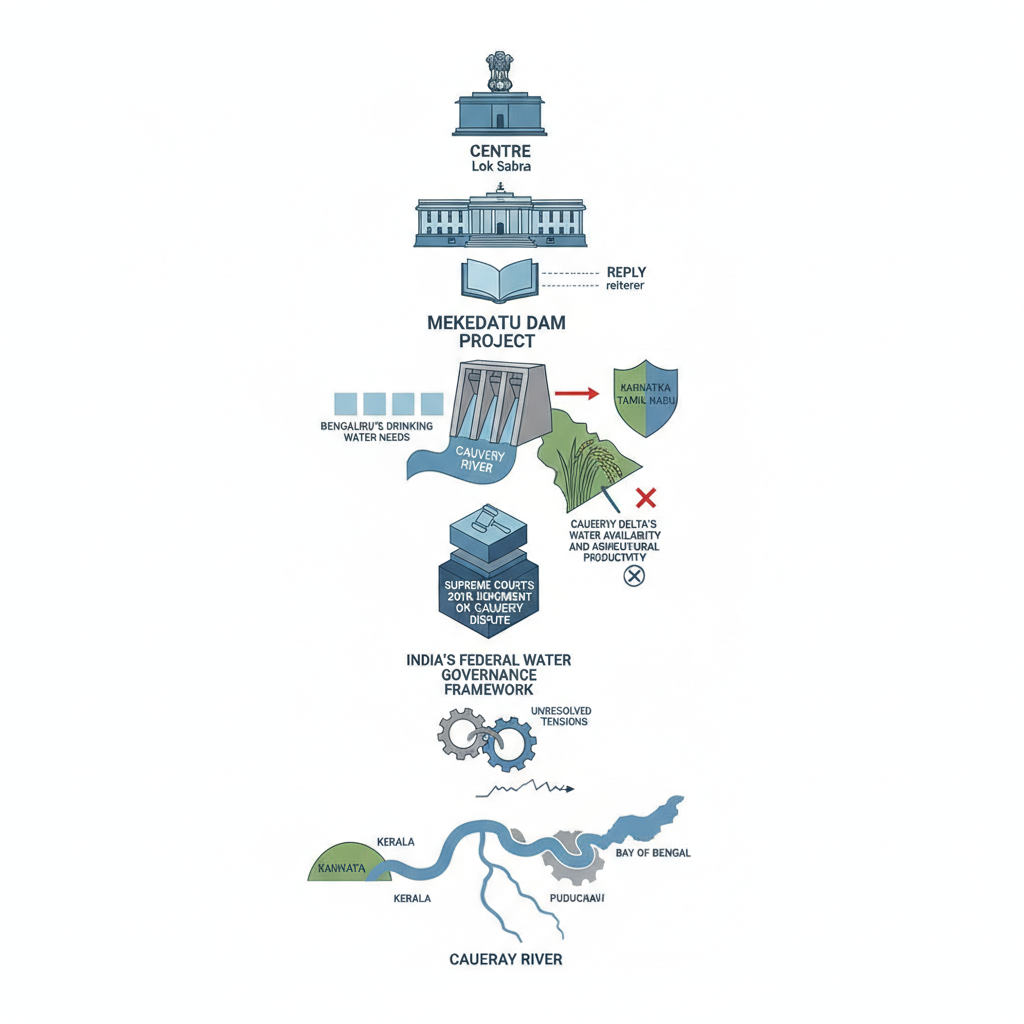
The Union Government’s reiteration in the Lok Sabha of its stance on the Mekedatu dam project, citing the Supreme Court’s 2018 judgment on the Cauvery dispute, has reignited the long-standing inter-state water conflict between Karnataka and Tamil Nadu. The project, proposed by Karnataka to meet Bengaluru’s drinking water needs, has drawn objections from Tamil Nadu, which fears adverse impacts on the Cauvery delta’s water availability and agricultural productivity. The renewed political and legal discourse underscores the unresolved tensions in India’s federal water governance framework.
Background
- The Cauvery river, a classical example of an inter-state river, originates in Karnataka and flows through Tamil Nadu, Kerala, and Puducherry before draining into the Bay of Bengal.
- The Cauvery Water Disputes Tribunal (CWDT), constituted in 1990 under the Inter-State Water Disputes Act, 1956, delivered its final award in 2007, allocating water shares among the riparian states and specifying regulated flow regimes.
- The Supreme Court, in its 2018 judgment, upheld the CWDT’s award while modifying certain aspects, including the water allocation to Tamil Nadu and Karnataka.
- Karnataka’s proposal for the Mekedatu dam, located 100 km from Bengaluru, aims to meet Bengaluru’s drinking water needs.
- Tamil Nadu has consistently opposed the project, citing concerns over reduced water availability in the Cauvery delta, which is critical for agriculture, and potential violations of the CWDT’s award and the Supreme Court’s directives.
- The Union Government’s position, as reiterated in Parliament, is based on the Supreme Court’s observation that Karnataka is not obligated to seek consent from other riparian states for constructing structures on the Cauvery, provided such structures do not violate the regulated flow regime established by the CWDT.
What is the Mekedatu Dam Project?
- The Mekedatu dam is a proposed multipurpose project across the Cauvery river near Kanakapura in Karnataka’s Ramanagara district.
- The project is located in the upper reaches of the Cauvery basin, upstream of the existing Krishna Raja Sagar (KRS) dam in Karnataka and the Mettur dam in Tamil Nadu.
- Karnataka has justified the project as a necessity for urban water supply, arguing that it does not violate the CWDT’s award, as it does not reduce the quantum of water allocated to Tamil Nadu or Kerala.
- The Union Government has stated that the project will be implemented in accordance with the Supreme Court’s directives and the CWDT’s award, ensuring no adverse impact on the regulated flow regime.
Key Features
| Feature | Significance |
|---|---|
| Mekedatu Dam Project | A proposed dam across the Cauvery River in Karnataka to meet Bengaluru’s drinking water needs, with potential implications for inter-State water sharing and ecological balance. |
| Supreme Court Judgment (2018) on Cauvery Dispute | The final award of the Cauvery Water Disputes Tribunal (CWDT) was upheld, establishing a regulated flow regime and prohibiting upper riparian States from actions that disrupt scheduled deliveries to lower riparian States. |
| Union Government’s Stand on Consent | The Union government asserts that Karnataka is not required to obtain consent from other riparian States (Tamil Nadu, Kerala, Puducherry) for constructing structures across the Cauvery, citing the CWDT award. |
| Tamil Nadu’s Objection | Tamil Nadu argues that any project affecting the regulated flow regime must be scrutinised for consistency with the CWDT award, citing specific clauses that prohibit actions disrupting downstream deliveries. |
| Lok Sabha and Rajya Sabha Replies | The Union government reiterated its position in both Houses of Parliament, responding to queries about the Mekedatu project’s impact on Tamil Nadu’s water security and agricultural needs. |
Why it Matters
Inter-State Water Disputes
- The Mekedatu project exemplifies the persistent challenge of balancing developmental needs with inter-State water-sharing obligations under the Constitution.
- The CWDT award and Supreme Court judgment serve as critical legal frameworks for resolving disputes, but their interpretation remains contested.
- The project underscores the need for cooperative federalism in water resource management, particularly in shared river basins.
Water Security and Urban Demand
- Bengaluru’s rapid urbanisation and growing water demand necessitate long-term solutions, but such projects must not compromise the water security of downstream States.
- The project highlights the tension between meeting urban water needs and sustaining agricultural productivity in riparian States like Tamil Nadu.
Legal and Policy Implications
- The Union government’s stance on consent requirements for inter-State river projects sets a precedent for future disputes in shared river basins.
- The case illustrates the role of judicial pronouncements in shaping inter-State water governance and the limits of executive discretion.
Environmental and Ecological Concerns
- The project raises concerns about its impact on the Cauvery delta’s ecology, biodiversity, and agricultural productivity in Tamil Nadu.
- Environmental clearances and sustainability assessments are critical to mitigate long-term ecological damage.
Challenges
1. Legal and Constitutional Challenges
- Disputes over the interpretation of the CWDT award and Supreme Court judgment regarding consent requirements for inter-State river projects.
- Potential for prolonged litigation if Tamil Nadu challenges the Union government’s stand in the Supreme Court.
- The need for a clear legal framework to resolve conflicts between developmental projects and inter-State water-sharing obligations.
UPSC Link: GS Paper 2: Federalism
2. Inter-State Relations and Cooperative Federalism
- Risk of strained Centre-State and inter-State relations if the project proceeds without Tamil Nadu’s consent.
- The challenge of balancing Karnataka’s developmental needs with Tamil Nadu’s water security and agricultural livelihoods.
- The need for structured dialogue and negotiation mechanisms to resolve disputes before escalating to judicial intervention.
UPSC Link: GS Paper 2: Federalism
3. Environmental and Ecological Risks
- Potential disruption of the Cauvery delta’s ecological balance due to altered river flow regimes.
- Risk of soil salinisation and reduced agricultural productivity in Tamil Nadu’s delta regions.
- The need for comprehensive environmental impact assessments (EIAs) and mitigation measures.
UPSC Link: GS Paper 3: Environment
4. Policy and Governance Gaps
- Lack of a unified national policy on inter-State river projects that balances developmental and ecological concerns.
- Inadequate mechanisms for real-time monitoring and enforcement of water-sharing agreements.
- The need for institutional reforms to enhance transparency and accountability in water resource management.
UPSC Link: GS Paper 2: Governance
5. Economic and Social Implications
- Potential economic losses for Tamil Nadu’s agricultural sector if water availability is reduced.
- The project’s impact on the livelihoods of farmers and rural communities in the Cauvery delta.
- The need for alternative water resource management strategies to mitigate socio-economic disruptions.
UPSC Link: GS Paper 3: Economy
Challenges — UPSC Perspective
| Issue | Concern |
|---|---|
| Legal Interpretation of CWDT Award | Ambiguity in whether Karnataka requires consent from other riparian States for the Mekedatu project. |
| Inter-State Water Sharing | Risk of Tamil Nadu’s water security and agricultural productivity being compromised. |
| Environmental Impact | Potential ecological damage to the Cauvery delta due to altered river flow regimes. |
| Urban Water Demand vs. Agricultural Needs | Tension between meeting Bengaluru’s water needs and sustaining Tamil Nadu’s agriculture. |
| Policy and Governance Gaps | Lack of a unified national policy on inter-State river projects and inadequate enforcement mechanisms. |
| Strained Centre-State Relations | Risk of escalating tensions between Karnataka and Tamil Nadu, and between the Union government and States. |
Way Forward
- Constitute a high-powered inter-State committee with representatives from Karnataka, Tamil Nadu, Kerala, and Puducherry to negotiate a mutually acceptable solution.
- Undertake a comprehensive environmental impact assessment (EIA) of the Mekedatu project, including its impact on the Cauvery delta’s ecology and agricultural productivity.
- Explore alternative water resource management strategies for Bengaluru, such as rainwater harvesting, wastewater recycling, and desalination, to reduce dependence on the Cauvery.
- Strengthen the institutional framework for monitoring and enforcing water-sharing agreements under the Cauvery Water Disputes Tribunal (CWDT) award.
- Promote public awareness and stakeholder consultations to ensure transparency and accountability in the decision-making process.
- Encourage research and innovation in water-efficient technologies and agricultural practices to mitigate the impact of reduced water availability.
- Develop a national policy on inter-State river projects that balances developmental needs with ecological sustainability and inter-State equity.
- Explore the possibility of a joint Cauvery Basin Authority to manage the river holistically, integrating developmental and ecological concerns.
UPSC Value Addition
Keywords for Mains Answer-Writing
Inter-State River Water Disputes (ISRWD) Act, 1956 · Cauvery Water Disputes Tribunal (CWDT) Award · Mekedatu project · Inter-State Water Disputes · Riparian rights · Supreme Court judgment on Cauvery (2018) · Federalism in water governance · Union-State relations in river water disputes · Drinking water security · Constitutional provisions on water (Entry 17, State List) · Inter-State Water Disputes Act, 2002 (repealed and replaced by ISRWD Act, 1956) · Doctrine of Equitable Apportionment
Constitutional & Policy Linkages
- Article 262: Adjudication of disputes relating to waters of inter-State rivers or river valleys.
- Article 253: Legislation for giving effect to international agreements and decisions of international conferences.
Concept Flow
Urban water demand in Bengaluru drives Karnataka to propose the Mekedatu dam project. → Tamil Nadu opposes the project, citing potential disruption to the Cauvery delta’s ecology and agricultural productivity. → The Union government asserts that Karnataka is not required to obtain consent from other riparian States, citing the CWDT award and Supreme Court judgment. → Tamil Nadu challenges the Union government’s stand, arguing that the project must comply with the CWDT award’s regulated flow regime. → The dispute escalates to parliamentary debates, with the Union government reiterating its position in both the Lok Sabha and Rajya Sabha. → The legal and constitutional interpretations of the CWDT award and Supreme Court judgment become central to resolving the dispute. → The project’s progress hinges on negotiations, environmental assessments, and potential judicial intervention.
Prelims Practice Questions
Q1. Consider the following statements regarding the Mekedatu project across the Cauvery river:
1. The project is proposed by Karnataka to meet Bengaluru’s drinking water needs.
2. The Union government has cited the Supreme Court’s 2018 judgment to assert that Karnataka need not obtain consent from Tamil Nadu for the project.
3. The Cauvery Water Disputes Tribunal (CWDT) Award explicitly prohibits any upper riparian State from taking action affecting scheduled deliveries to lower riparian States.
How many of the above statements are correct?
- Only one
- Only two
- All three
- None
Answer: All three — Statements 1 and 2 are correct. Statement 3 is incorrect as the CWDT Award does not explicitly prohibit such actions but regulates the flow regime to ensure equitable apportionment.
Q2. Assertion (A): The Union government’s stand on the Mekedatu project is based on the Supreme Court’s interpretation of the Cauvery Water Disputes Tribunal (CWDT) Award.
Reason (R): The CWDT Award vests the power to regulate river water usage exclusively with the Union government under Entry 56 of the Union List.
Options:
A. Both A and R are true, and R is the correct explanation of A.
B. Both A and R are true, but R is not the correct explanation of A.
C. A is true, but R is false.
D. A is false, but R is true.
- A
- B
- C
- D
Answer: C — Assertion (A) is true as the Union government cited the Supreme Court’s 2018 judgment interpreting the CWDT Award. Reason (R) is false because Entry 56 of the Union List does not vest exclusive power with the Union government; water is primarily a State subject under Entry 17 of the State List.
Mains Practice Question
✍ The Union government has reiterated its stance on the Mekedatu project, citing the Supreme Court’s 2018 judgment on the Cauvery dispute. In this context, critically examine the constitutional and legal framework governing inter-State river water disputes in India. Also, analyse the implications of the Union government’s stand for federalism and inter-State relations. (15 Marks)
Approach: MODEL-ANSWER SKELETON:
1. Constitutional Framework:
– Entry 17 (State List) and Entry 56 (Union List) under the Seventh Schedule.
– Article 262 (Adjudication of disputes relating to waters of inter-State rivers).
– Inter-State Water Disputes Act, 1956 (as amended in 2002).
2. Legal Framework:
– Role of the Cauvery Water Disputes Tribunal (CWDT) and its Award (2007).
– Supreme Court’s 2018 judgment interpreting the CWDT Award and the doctrine of equitable apportionment.
– Relevant clauses of the CWDT Award cited in the judgment (e.g., prohibition on upper riparian States affecting scheduled deliveries).
3. Union Government’s Stand:
– Citing the Supreme Court’s interpretation to assert that Karnataka need not obtain consent from Tamil Nadu.
– Contrast with Tamil Nadu’s contention that the project violates the CWDT Award’s regulated flow regime.
4. Implications for Federalism:
– Balance between Union and State powers in water governance.
– Potential erosion of State autonomy in water resource management.
– Impact on inter-State relations and cooperative federalism.
5. Broader Context:
– Recent trends in inter-State water disputes (e.g., Krishna, Godavari, Mahadayi).
– Role of judicial intervention in resolving such disputes.
6. Concluding Remarks:
– Need for a more robust institutional mechanism to address inter-State water disputes.
– Suggestions for reform (e.g., constitution of a permanent tribunal, data-sharing mechanisms).
Source: The Hindu
Generated by AanyaAi for educational purpose.

- मुस्लिम महिलाओं को विरासत में समान अधिकार: सुप्रीम कोर्ट ने केंद्र से पूछा जवाब - September 23, 2026
- Supreme Court Questions Muslim Women’s Inheritance Rights Under Personal Law - September 23, 2026
- सुप्रीम कोर्ट ने पटना हाईकोर्ट के बलात्कार फैसले पर लिया स्वतः संज्ञान - September 23, 2026

No Comments