


08 Aug HP Economic Health Survey 2026: Centre to Assess Himachal’s Economy via Massive Survey
✎ The National Statistical Surveys in Himachal Pradesh aim to generate granular socio-economic data to inform policy-making, with findings used for employment generation, agricultural reforms, and resource allocation under…
Subject Relevance — Where This Topic Fits
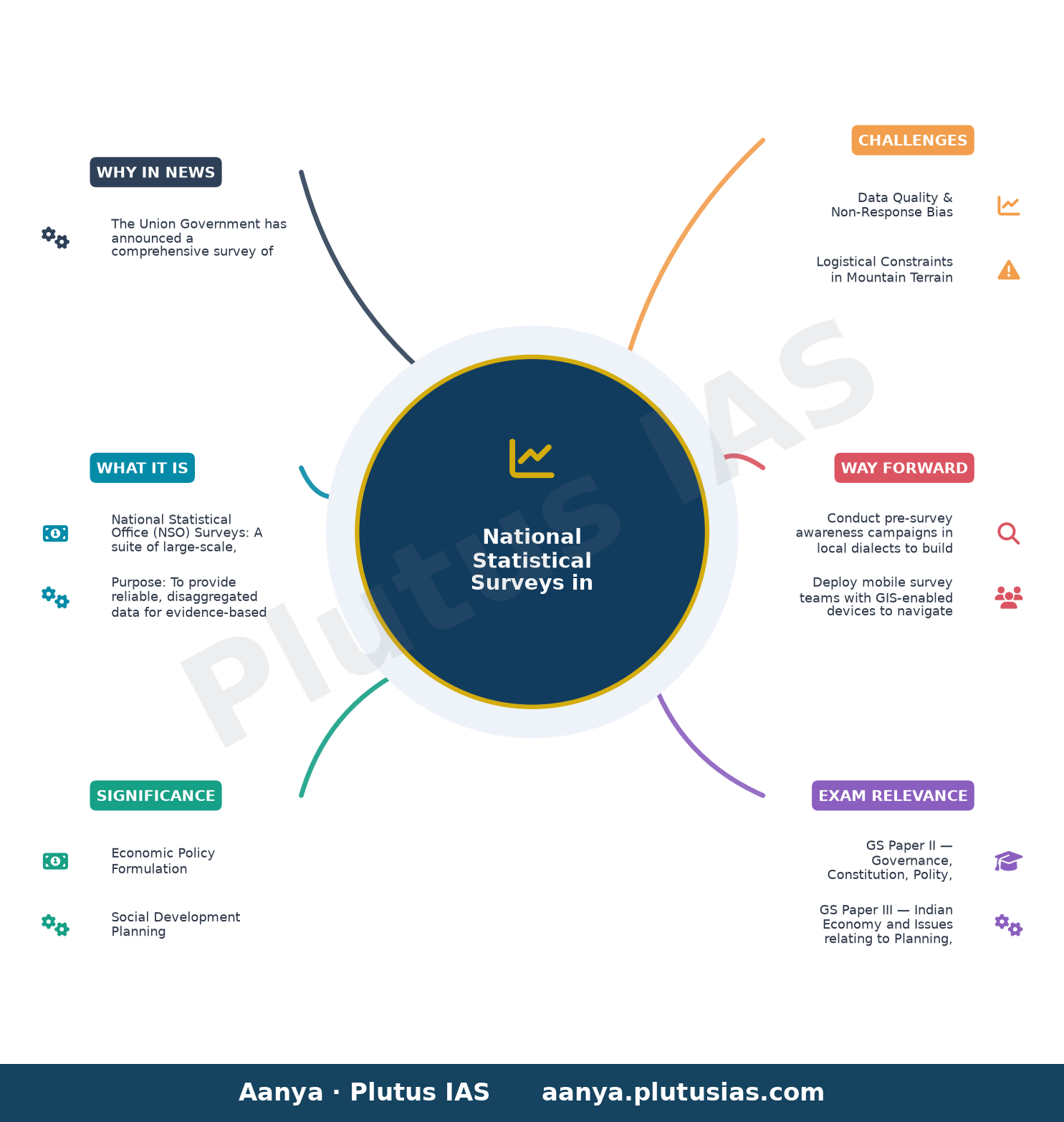
- GS Paper II — Governance, Constitution, Polity, Social Justice and International Relations (Centre-State Relations) | GS Paper III — Indian Economy and Issues relating to Planning, Mobilization of Resources, Growth, Development and Employment
- Prelims: National Statistical Office (NSO), Periodic Labour Force Survey (PLFS), All India Debt and Investment Survey, Consumer Price Index (CPI), Migration Survey, Agricultural Household Survey, Centre-State fiscal relations
- Essay: Data-Driven Governance: The Imperative of Reliable Statistical Systems for Inclusive Development, Balancing Economic Growth and Social Equity: The Role of Evidence-Based Policy in Himalayan States
Quick Revision: The National Statistical Surveys in Himachal Pradesh aim to generate granular socio-economic data to inform policy-making, with findings used for employment generation, agricultural reforms, and resource allocation under evidence-based governance.
Why is this in the news?
The Union Government has announced a comprehensive survey of Himachal Pradesh’s economic and social conditions, involving multiple statistical exercises under the National Statistical Office (NSO). Scheduled for August 2026, the initiative aims to generate granular data on household income, employment, migration, agriculture, indebtedness, and inflation to inform future policy formulation, budgetary allocations, and developmental planning. This reflects a renewed emphasis on evidence-based governance and the integration of micro-level socio-economic realities into macro-level policy design.
Background
- The National Statistical Office (NSO), under the Ministry of Statistics and Programme Implementation (MoSPI), conducts regular large-scale surveys to assess socio-economic parameters across Indian states, including Himachal Pradesh.
- Himachal Pradesh, a predominantly mountainous state, faces unique developmental challenges such as high out-migration, seasonal employment fluctuations, and vulnerability to climate change impacts on agriculture and tourism.
- The state’s economy is characterized by a mix of agriculture, horticulture, tourism, and small-scale industries, with significant regional disparities between urban centers and rural hinterlands.
- Recent policy initiatives, such as the Himachal Pradesh State Employment Guarantee Scheme and the Mukhya Mantri Khet Sanrakshan Yojana, underscore the need for reliable data to evaluate their effectiveness and scalability.
- The announcement aligns with the government’s broader push for ‘data-driven governance,’ as articulated in the National Data Governance Framework Policy (NDGFP) 2023.
- Himachal Pradesh’s fiscal federalism dynamics, including its reliance on central transfers and its status as a Special Category State, make robust sub-national data critical for equitable resource allocation.
What are the National Statistical Surveys and their objectives?
- National Statistical Office (NSO) Surveys: A suite of large-scale, periodic surveys conducted by the NSO to assess socio-economic conditions, including household income, employment, indebtedness, migration, agriculture, and inflation.
- Purpose: To provide reliable, disaggregated data for evidence-based policy formulation, budgetary planning, and developmental interventions at the state and national levels.
- Key Surveys Included: The August 2026 exercise in Himachal Pradesh will encompass the National Household Income Survey, Periodic Labour Force Survey (PLFS), All India Debt and Investment Survey, Migration Survey, Agricultural Household Survey, and Consumer Price Index (CPI) Survey.
- Methodology: Trained enumerators collect primary data through household interviews, covering socio-economic indicators such as income sources, employment status, debt levels, savings, agricultural practices, and migration patterns.
- Geographical Coverage: Surveys are conducted across selected rural and urban clusters in Himachal Pradesh, ensuring representation of diverse economic activities, including agriculture, horticulture, tourism, and industrial zones.
- Data Utilization: Survey findings inform the design of employment generation schemes, agricultural reforms, social security measures, rural development programs, and investment policies.
- Confidentiality: All data collected is treated as confidential under the provisions of the Collection of Statistics Act, 2008, and is used solely for statistical purposes.
- Policy Feedback Loop: The data generated helps assess the impact of existing schemes, identify gaps, and guide future policy adjustments to address regional disparities and emerging challenges.
Key Features
| Feature | Significance |
|---|---|
| National Statistical Office (NSO) led survey | Ensures data collection by a statutory body under the Ministry of Statistics and Programme Implementation, guaranteeing methodological rigour and credibility. |
| Multi-topic survey design | Integrates income, employment, debt, investment, agriculture, migration, and inflation metrics to provide a holistic economic and social profile of Himachal Pradesh. |
| Simultaneous national surveys | Aligns with national-level data collection efforts, enabling comparative analysis and policy coherence across states. |
| Micro-level data granularity | Collects household-level data to identify disparities between rural and urban areas, and between districts like Nahan, Paonta Sahib, and Nalagarh. |
| Policy feedback loop | Data directly informs future budget allocations, employment generation schemes, agricultural reforms, and social security interventions. |
Why it Matters
Economic Policy Formulation
- Provides empirical basis for designing employment-intensive growth strategies in a hill state with fragile ecology and high out-migration.
- Enables evidence-based allocation of resources under centrally sponsored schemes such as MGNREGA, PM-KISAN, and PMGSY.
- Facilitates calibration of fiscal devolution under the Finance Commission’s horizontal formula, considering Himachal’s unique socio-economic constraints.
Social Development Planning
- Highlights structural unemployment and skill gaps, guiding vocational training and higher education policy in a state with limited industrial base.
- Assesses debt burden and savings patterns among farming households, informing agricultural credit policies and crop diversification initiatives.
- Maps seasonal and permanent migration trends to design welfare schemes for left-behind communities in rural districts.
Fiscal Federalism & Governance
- Strengthens the Centre-State data exchange framework, enhancing transparency in fund utilisation under Article 282 (Grants-in-Aid) and Article 275 (Statutory Grants).
- Supports performance-based incentive disbursement under schemes like the ‘Aspirational Districts Programme’ for targeted hill districts.
Climate-Resilient Development
- Captures the impact of climate-induced distress on agriculture and livelihoods, aiding the integration of climate adaptation into state development plans.
- Provides baseline data for disaster risk reduction strategies in ecologically sensitive Himalayan regions.
Challenges
1. Data Quality & Non-Response Bias
- Risk of underreporting of income and debt due to cultural aversion to disclosing financial details in rural and tribal communities.
- Seasonal migration may lead to incomplete enumeration of households during survey periods, skewing labour force metrics.
UPSC Link: GS-II: Governance, GS-III: Economic Survey
2. Logistical Constraints in Mountain Terrain
- Difficulty in accessing remote villages and border areas due to poor road connectivity and harsh weather conditions.
- High operational costs for deploying survey teams across steep terrains and dispersed settlements.
UPSC Link: GS-III: Infrastructure, GS-II: Centre-State Relations
3. Integration with Existing Databases
- Need for seamless linkage with SECC 2011, Aadhaar-based identification, and land records to avoid duplication and ensure accuracy.
- Challenge of harmonising survey data with GSTN, EPFO, and NREGA databases for cross-verification.
UPSC Link: GS-III: Economic Survey, GS-II: Digital Governance
4. Policy Implementation Gaps
- Even with robust data, translating findings into actionable policies faces delays due to bureaucratic inertia and political economy constraints.
- Risk of ‘data paralysis’ where excessive focus on data collection delays programme rollout.
UPSC Link: GS-II: Governance, GS-IV: Ethics
5. Climate Change & Economic Volatility
- Frequent natural disasters (landslides, flash floods) disrupt survey schedules and distort baseline economic indicators.
- Volatile commodity prices (e.g., apple, potato) complicate income estimation for agrarian households.
UPSC Link: GS-III: Environment, GS-III: Disaster Management
Challenges — UPSC Perspective
| Issue | Concern |
|---|---|
| Underreporting of income | Distorts fiscal policy design and tax base estimation. |
| Seasonal migration | Leads to incomplete labour force data and misallocation of resources. |
| Terrain accessibility | Increases survey costs and reduces coverage in remote areas. |
| Data integration | Hinders cross-database validation and policy targeting. |
| Climate-induced disruptions | Compromises data reliability and survey timelines. |
Way Forward
- Conduct pre-survey awareness campaigns in local dialects to build trust and ensure maximum participation.
- Deploy mobile survey teams with GIS-enabled devices to navigate difficult terrain and track coverage.
- Establish a real-time dashboard for monitoring data collection progress and identifying gaps.
- Integrate survey findings with existing welfare databases (Aadhaar, SECC) to eliminate duplication.
- Formulate a ‘Himachal Economic Development Index’ using survey data to prioritise interventions.
- Strengthen state-level statistical capacity through training programmes for enumerators and data analysts.
- Incorporate climate vulnerability mapping into the survey framework to align with SDG 13.
- Publish a public report within six months to ensure transparency and accountability.
UPSC Value Addition
Keywords for Mains Answer-Writing
National Statistical Office · Himachal Pradesh Economic Survey · Periodic Labour Force Survey · Migration Survey · Agricultural Household Survey · Consumer Price Index · Employment and Unemployment · Rural-Urban Divide · Fiscal Federalism · Data-Driven Policy Making · Structural Transformation of Economy · Socio-Economic Indicators · Centre-State Coordination · Evidence-Based Governance
Constitutional & Policy Linkages
- Article 282: Grants-in-Aid to States for specified purposes.
- Article 275: Statutory Grants to States for promoting welfare.
Concept Flow
Himachal Pradesh faces economic challenges: high out-migration, agrarian distress, and climate vulnerability. → Centre launches NSO-led multi-topic survey to assess real economic and social conditions. → Data collection covers income, employment, debt, investment, agriculture, migration, and inflation. → Survey findings inform Centre-State fiscal transfers, employment schemes, and agricultural policies. → Policy feedback loop strengthens governance, reduces leakages, and enhances climate resilience. → Outcome: Evidence-based development planning for a fragile Himalayan economy.
Prelims Practice Questions
Q1. Consider the following statements about the National Statistical Office (NSO) in India: 1. NSO conducts the Periodic Labour Force Survey (PLFS) to estimate employment and unemployment. 2. NSO is responsible for the compilation of the Consumer Price Index (CPI) in rural and urban areas. 3. NSO operates under the Ministry of Statistics and Programme Implementation. 4. NSO conducts the Agricultural Household Survey exclusively for tribal regions. How many of the above statements are correct?
- Only one
- Only two
- Only three
- All four
Answer: Only three — Statements 1, 2, and 3 are correct as NSO conducts PLFS, CPI, and operates under MoSPI. Statement 4 is incorrect as the Agricultural Household Survey covers all agricultural households, not exclusively tribal regions.
Q2. Assertion (A): The Himachal Pradesh Economic Health Survey aims to assess the socio-economic status of households, including income, employment, and migration patterns. Reason (R): The survey will be conducted by the National Sample Survey Office (NSSO) under the Ministry of Rural Development.
- Both A and R are true, and R is the correct explanation of A
- Both A and R are true, but R is not the correct explanation of A
- A is true, but R is false
- A is false, but R is true
Answer: A is true, but R is false — Assertion (A) is correct as the survey aims to assess socio-economic indicators. Reason (R) is incorrect because the survey is conducted by the National Statistical Office (NSO) under the Ministry of Statistics and Programme Implementation, not NSSO under the Ministry of Rural Development.
Q3. Match the following surveys conducted by the National Statistical Office (NSO) with their primary objectives: Column I (Survey) Column II (Objective) A. Periodic Labour Force Survey 1. To measure rural and urban inflation B. Consumer Price Index Survey 2. To estimate employment and unemployment C. Agricultural Household Survey 3. To assess the socio-economic status of agricultural households D. Migration Survey 4. To study inter-state and intra-state migration patterns
Answer: ? — A-2 (PLFS estimates employment and unemployment), B-1 (CPI measures inflation), C-3 (Agricultural Household Survey assesses socio-economic status of agricultural households), D-4 (Migration Survey studies migration patterns).
Mains Practice Question
✍ The Government of India has announced a comprehensive economic health survey for Himachal Pradesh to assess socio-economic indicators such as income, employment, migration, and agricultural productivity. Critically examine the significance of such surveys in shaping evidence-based policy formulation for states with unique geographical and socio-economic characteristics like Himachal Pradesh. Also, discuss the challenges in ensuring data accuracy and representativeness in such surveys. (15 Marks)
Approach: MODEL-ANSWER SKELETON:
1. Introduction (2 marks):
– Define evidence-based policy making and its importance in governance.
– Briefly introduce Himachal Pradesh’s unique geographical (Himalayan terrain, high-altitude agriculture) and socio-economic characteristics (tourism dependency, migration, rural economy).
2. Significance of Economic Health Surveys (5 marks):
– Data-Driven Policy Formulation: Surveys like PLFS, CPI, and Migration Survey provide empirical data to design targeted interventions (e.g., employment generation, inflation control, migration management).
– Resource Allocation: Accurate data ensures optimal allocation of funds under schemes like MGNREGA, PM-KISAN, or state-specific initiatives.
– Monitoring SDGs: Surveys help track progress on Sustainable Development Goals (e.g., SDG 1, 8, 10) at the sub-national level.
– Addressing Structural Issues: Identify gaps in rural-urban divide, informal sector employment, and agricultural productivity—critical for Himachal’s economy.
– Fiscal Federalism: Enable states to negotiate with the Centre for special financial assistance (e.g., for hill states with unique challenges).
3. Challenges in Data Accuracy and Representativeness (5 marks):
– Sampling Frame Issues: Difficulty in covering remote, inaccessible areas (e.g., tribal regions, high-altitude villages) leading to underrepresentation.
– Non-Response Bias: Reluctance of households to share accurate income/employment data due to distrust or fear of taxation.
– Temporal Lags: Delays in survey completion and data dissemination reduce relevance for real-time policy decisions.
– Methodological Constraints: Challenges in capturing informal sector employment, seasonal migration, and non-monetized agricultural activities.
– Technological Barriers: Limited digital literacy in rural areas may hinder data collection via digital platforms.
4. Way Forward (3 marks):
– Strengthening Local Institutions: Involve Panchayati Raj Institutions (PRIs) and self-help groups in data collection for better trust and coverage.
– Use of Technology: Leverage GIS mapping, mobile apps, and AI for real-time data collection and validation.
– Pilot Surveys: Conduct smaller-scale pilot surveys in diverse regions to refine methodologies before full-scale implementation.
– Transparency and Feedback: Publish preliminary findings and seek public feedback to improve data quality and credibility.
Source: amarujala.com
Generated by AanyaAi for educational purpose.

- महाराष्ट्र में त्योहार जुलूसों पर बॉम्बे हाईकोर्ट का बड़ा फैसला: पटाखे, लेजर और संगीत पर रोक - September 24, 2026
- Bombay HC Bans Firecrackers, Music in Maharashtra Processions: Key UPSC Analysis - September 24, 2026
- तमिलनाडु में महिला कर्मचारियों के लिए सवैतनिक माहवारी अवकाश नीति पर HC का आदेश - September 24, 2026

No Comments