


08 Aug DMK Moves SC Over Karnataka’s Cauvery Water Release Violation
Supreme CourtKarnatakaTamil NaduCauvery WaterCWRC✎ The Cauvery Water Disputes Tribunal (CWDT) award of 2007, as modified by the Supreme Court in 2018, allocates 419 TMC of water annually to Tamil Nadu, 270 TMC to Karnataka, 30 TMC to Kerala, and 7 TMC to Puducherry, with the CWMA…
Subject Relevance — Where This Topic Fits
- GS Paper II — Functions and Responsibilities of the Union and the States, Issues and Challenges Pertaining to the Federal Structure, Devolution of Powers and Finances up to Local Levels and Challenges Therein | GS Paper II — Structure, Organization and Functioning of the Executive and the Judiciary — Ministries and Departments of the Government; Pressure Groups and Formal/Informal Associations and their Role in the Polity | GS Paper III — Conservation, Environmental Pollution and Degradation, Environmental Impact Assessment
- Prelims: Cauvery Water Disputes Tribunal (CWDT), Cauvery Water Management Authority (CWMA), Cauvery Water Regulation Committee (CWRC), Inter-State River Water Disputes Act, 1956, Article 262 of the Constitution, Biligundlu contact point, cusecs, TMC (Thousand Million Cubic Feet), riparian rights, federalism, judicial review of executive action
- Essay: Federalism in India: Cooperative vs. Competitive Models, The Role of Judiciary in Resolving Inter-State Disputes: Strengths and Limitations
Quick Revision: The Cauvery Water Disputes Tribunal (CWDT) award of 2007, as modified by the Supreme Court in 2018, allocates 419 TMC of water annually to Tamil Nadu, 270 TMC to Karnataka, 30 TMC to Kerala, and 7 TMC to Puducherry, with the CWMA and CWRC established to enforce these allocations.
Why is this in the news?
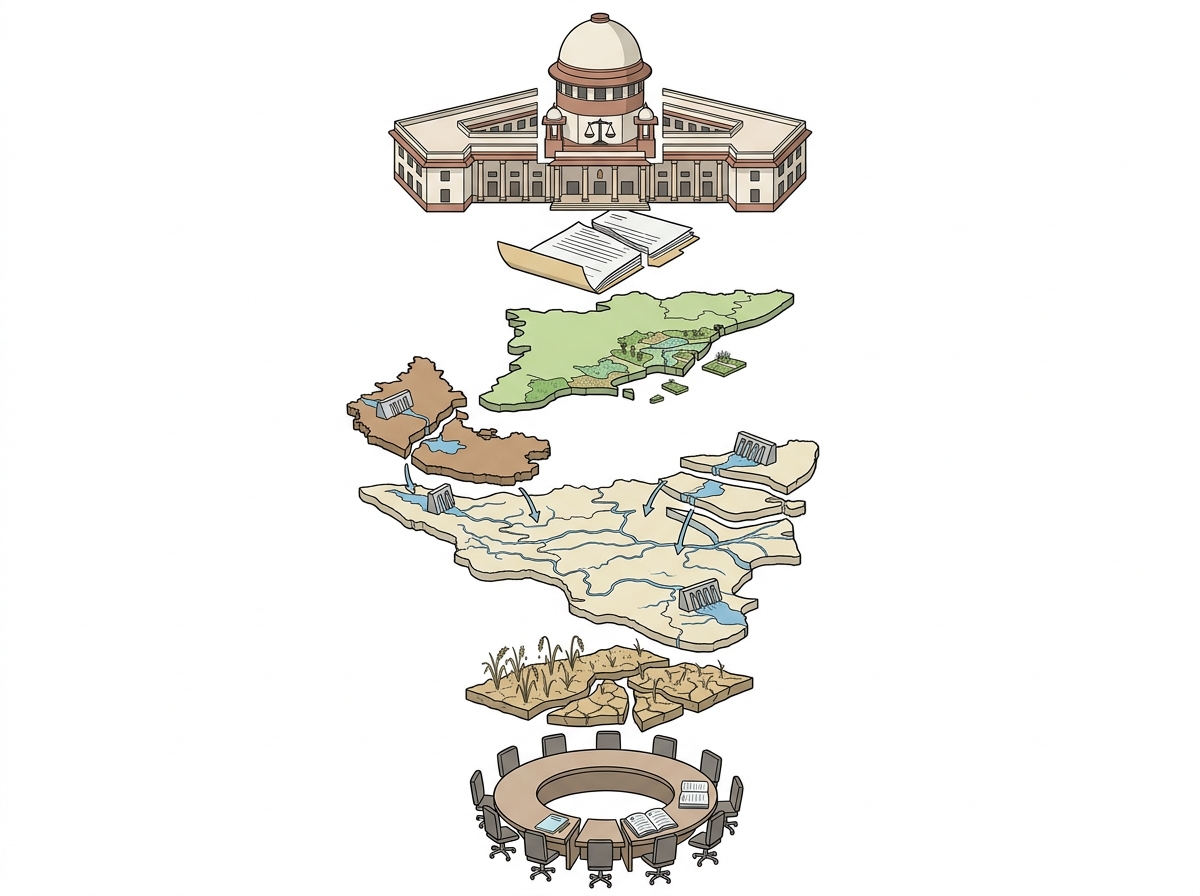
The Dravida Munnetra Kazhagam (DMK) has approached the Supreme Court seeking directions to Karnataka for the immediate release of Tamil Nadu’s stipulated share of Cauvery water, citing non-compliance with the directives of the Cauvery Water Regulation Committee (CWRC) and Cauvery Water Management Authority (CWMA). The application highlights the acute agricultural distress in Tamil Nadu’s delta districts due to the non-release of water, threatening the kharif (kuruvai) crop and the livelihoods of millions of farmers and agricultural labourers. The case underscores the recurring challenges in inter-state water governance and the judiciary’s role in enforcing constitutional and statutory obligations.
Background
- The Cauvery river basin is a shared resource between Karnataka, Tamil Nadu, Kerala, and the Union Territory of Puducherry, with Karnataka and Tamil Nadu being the primary stakeholders in the dispute.
- The Cauvery Water Disputes Tribunal (CWDT), constituted in 1990 under the Inter-State River Water Disputes Act, 1956, delivered its final award in 2007, allocating specific water shares to the basin states based on historical usage and availability.
- The Supreme Court, in its 2018 judgment, modified the CWDT award, increasing Tamil Nadu’s share and reducing Karnataka’s share, while also directing the constitution of the Cauvery Water Management Authority (CWMA) and Cauvery Water Regulation Committee (CWRC) for implementation and regulation.
- The CWMA and CWRC were established to monitor and enforce the allocation of Cauvery waters, with the CWRC issuing daily directives for water releases at inter-state contact points such as Biligundlu.
- The dispute has historically been marked by periodic non-compliance by Karnataka, leading to recurring litigation and judicial interventions, particularly during periods of water scarcity.
- The current application by the DMK follows a deficient southwest monsoon in 2026, exacerbating the water scarcity in the basin and triggering the legal recourse.
What is the Cauvery Water Dispute?
- The Cauvery Water Dispute is an inter-state river water dispute between Karnataka and Tamil Nadu, with Kerala and Puducherry as other stakeholders, arising from competing claims over the utilisation of the Cauvery river’s waters.
- The dispute centres on the allocation of water shares, particularly during periods of deficit, and the mechanisms for ensuring equitable distribution as per the Cauvery Water Disputes Tribunal (CWDT) award of 2007 and the Supreme Court’s 2018 judgment.
- The Cauvery Water Management Authority (CWMA) and Cauvery Water Regulation Committee (CWRC) were constituted under the Inter-State River Water Disputes Act, 1956, to implement and regulate the allocation of waters, respectively.
- The CWRC issues daily directives for water releases at inter-state contact points, such as Biligundlu, to ensure compliance with the stipulated shares, while the CWMA monitors overall compliance and addresses grievances.
- The dispute is governed by the constitutional provisions of Article 262, which empowers Parliament to provide for the adjudication of such disputes and to exclude the jurisdiction of all courts, including the Supreme Court.
- The dispute exemplifies the challenges of federal water governance in India, where competing demands, historical usage patterns, and climatic variability intersect with legal and political dynamics.
Key Features
| Feature | Significance |
|---|---|
| Cauvery Water Regulation Committee (CWRC) | Constitutional statutory body under the Inter-State Water Disputes Act, 1956, tasked with regulating Cauvery water distribution between Tamil Nadu and Karnataka. |
| Cauvery Water Management Authority (CWMA) | Statutory authority established under the Inter-State River Water Disputes (Amendment) Act, 2019, to enforce CWRC decisions and ensure compliance with tribunal awards. |
| Biligundlu Inter-State Contact Point | Critical gauging station where Cauvery water flows are measured to determine compliance with inter-State water-sharing agreements. |
| Pro-rata/Distress-sharing Basis | Mechanism for adjusting water allocation during deficient monsoon years, as defined in the Cauvery Water Disputes Tribunal Award (2007) and subsequent orders. |
| Kuruvai Crop Season | Critical agricultural season in Tamil Nadu’s delta districts (June–September), heavily dependent on Cauvery water releases for irrigation. |
Why it Matters
Economic
- Agricultural productivity in Tamil Nadu’s Cauvery delta, valued at over ₹20,000 crore annually, is critically dependent on timely water releases, directly impacting livelihoods of ~4 million farmers and 10 million agricultural laborers.
- Non-release of water risks irreversible crop loss, increasing input costs and debt burdens on marginal farmers, exacerbating rural distress and migration pressures.
- Disruption in water supply may trigger food inflation due to reduced paddy production, a staple crop in the region, with cascading effects on national food security.
Legal
- The Supreme Court’s intervention underscores the binding nature of CWRC/CWMA directives under the Inter-State Water Disputes Act, 1956, and the doctrine of ‘prior appropriation’ in inter-State water disputes.
- The application tests the enforceability of tribunal awards and statutory bodies’ decisions, setting a precedent for future inter-State water disputes.
- Public declarations by Karnataka’s officials challenging CWRC/CWMA orders highlight the tension between political posturing and constitutional obligations under Article 262.
Environmental
- Deficient southwest monsoon (2026) has reduced inflows into the Cauvery basin, intensifying the need for equitable and sustainable water allocation to prevent ecological degradation of delta ecosystems.
- Over-extraction and delayed releases risk long-term salinization of delta soils, reducing agricultural productivity and biodiversity loss in wetland habitats.
Social
- The Cauvery delta districts are home to historically marginalized agrarian communities, whose socio-economic vulnerability is exacerbated by water scarcity, amplifying demands for equitable water governance.
- Delay in water releases disproportionately affects women farmers and laborers, who bear the brunt of household food security and income loss during agricultural crises.
Challenges
1. Non-compliance by Upper Riparian State
- Karnataka’s refusal to implement CWRC/CWMA directives despite statutory obligations under the Inter-State Water Disputes Act, 1956.
- Political rhetoric undermining institutional credibility of CWRC/CWMA, eroding trust in inter-State water governance mechanisms.
- Risk of unilateral actions by Karnataka, such as diversion of water for non-agricultural uses, exacerbating downstream scarcity in Tamil Nadu.
UPSC Link: GS2: Inter-State Relations
2. Deficient Monsoon and Climate Variability
- Southwest monsoon deficit (2026) has reduced inflows into the Cauvery basin, intensifying inter-State water disputes and complicating equitable allocation.
- Climate change-induced erratic rainfall patterns necessitate adaptive water management strategies, including storage and conjunctive use of groundwater.
- Lack of integrated basin-level planning to address long-term hydrological uncertainties in the Cauvery basin.
UPSC Link: GS3: Disaster Management
3. Agricultural Dependency and Livelihood Risks
- Kuruvai crop season (June–September) is highly vulnerable to water scarcity, with irreversible crop loss if releases are delayed beyond critical growth stages.
- Small and marginal farmers lack financial resilience to absorb losses, increasing indebtedness and rural distress.
- Dependence on a single river system (Cauvery) for irrigation limits diversification options, amplifying vulnerability to water disputes.
UPSC Link: GS3: Agriculture
4. Institutional and Governance Gaps
- Delays in CWMA’s compliance monitoring and reporting mechanisms hinder timely intervention in water disputes.
- Lack of a permanent tribunal or binding dispute resolution mechanism for inter-State water conflicts, leading to repeated judicial interventions.
- Inadequate data-sharing and transparency between riparian states on water storage, releases, and usage patterns.
UPSC Link: GS2: Constitutional Bodies
5. Legal and Constitutional Ambiguities
- Ambiguity in the enforceability of tribunal awards under Article 262, particularly when states challenge directives in higher courts.
- Conflict between state autonomy (Article 246) and the Union’s responsibility to ensure inter-State equity under Article 262.
- Lack of clarity on the role of the Supreme Court in enforcing inter-State water-sharing agreements, beyond its advisory jurisdiction.
UPSC Link: GS2: Federalism
Challenges — UPSC Perspective
| Issue | Concern |
|---|---|
| Statutory Non-compliance | Karnataka’s refusal to implement CWRC/CWMA directives despite legal obligations under the Inter-State Water Disputes Act, 1956. |
| Climate-Induced Scarcity | Deficient southwest monsoon (2026) has reduced Cauvery inflows, intensifying inter-State water disputes and complicating equitable allocation. |
| Agrarian Vulnerability | Kuruvai crop season is highly dependent on Cauvery water; delays risk irreversible crop loss and rural distress. |
| Institutional Delays | CWMA’s compliance monitoring and reporting mechanisms are slow, hindering timely intervention in disputes. |
| Legal Ambiguities | Ambiguity in enforcing tribunal awards under Article 262 and the Supreme Court’s role in inter-State water disputes. |
| Data Asymmetry | Lack of real-time data-sharing between riparian states on water storage, releases, and usage patterns. |
Way Forward
- Direct the CWMA to establish a real-time monitoring mechanism at Biligundlu, with daily compliance reports to the Supreme Court and both states.
- Constitute a joint technical committee of CWMA, CWRC, and state representatives to assess basin-wide water availability and adjust allocations dynamically.
- Enforce penalties for non-compliance with CWRC/CWMA directives, including withholding central grants to defaulting states under Article 282.
- Develop a climate-resilient water management plan for the Cauvery basin, integrating drought forecasting, groundwater recharge, and conjunctive use strategies.
- Strengthen the Cauvery Water Disputes Tribunal’s enforcement mechanism by amending the Inter-State Water Disputes Act, 1956, to include binding arbitration.
- Promote agricultural diversification in delta districts to reduce dependence on Cauvery water, with subsidies for alternative crops and micro-irrigation systems.
- Establish a Cauvery Basin Authority under the National Water Policy (2012) to coordinate inter-State water management and resolve disputes proactively.
- Enhance public awareness campaigns on equitable water use and the economic costs of non-compliance, engaging local communities in water governance.
UPSC Value Addition
Keywords for Mains Answer-Writing
Inter-State Water Disputes Act, 1956 · Cauvery Water Management Authority (CWMA) · Cauvery Water Regulation Committee (CWRC) · Inter-State Water Disputes Tribunal (ISWD Tribunal) · Riparian rights and equitable apportionment · Constitutional provisions under Article 262 · Doctrine of prior appropriation · Inter-State River Water Disputes (Amendment) Act, 2019 · Supreme Court’s role in inter-State water disputes · Agricultural dependency on Cauvery basin · Environmental flows in river basins · Federalism and Centre-State relations in water governance · Water scarcity and climate change impacts on river basins
Constitutional & Policy Linkages
- {‘article’: ‘Article 262’, ‘note’: ‘Inter-State water disputes resolution’}
- {‘article’: ‘Article 246’, ‘note’: ‘State vs. Union legislative powers’}
- {‘article’: ‘Article 282’, ‘note’: ‘Discretionary grants to states’}
Concept Flow
Deficient southwest monsoon (2026) → Reduced Cauvery inflows → Karnataka’s refusal to release stipulated water (3,500 cusecs/day) → Accumulated backlog of 9.46 TMC → Tamil Nadu’s kuruvai crops wither → DMK files SC petition → SC directs CWMA to monitor compliance → CWMA’s directives remain unimplemented → Riparian states’ political posturing undermines institutional credibility → Supreme Court’s intervention tests enforceability of tribunal awards → Risk of irreversible agricultural loss and rural distress → Need for climate-resilient basin management and statutory reforms.
Prelims Practice Questions
Q1. Consider the following statements regarding the Cauvery Water Management Authority (CWMA):
1. It was established under the Inter-State River Water Disputes (Amendment) Act, 2019.
2. It is mandated to implement and monitor the decisions of the Cauvery Water Regulation Committee (CWRC).
3. The CWMA is chaired by the Prime Minister of India.
4. The CWMA can suo motu take cognisance of violations of its directions by any riparian State.
How many of the above statements are correct?
- Only one
- Only two
- Only three
- All four
Answer: Only three — Statements 1 and 2 are correct. The CWMA was established under the Inter-State River Water Disputes (Amendment) Act, 2019, and it monitors the implementation of CWRC decisions. Statement 3 is incorrect as the CWMA is chaired by the Union Minister for Jal Shakti. Statement 4 is incorrect as the CWMA does not have suo motu powers; it acts on references or complaints.
Q2. Assertion (A): The Supreme Court has original jurisdiction over disputes relating to the use, distribution, or control of inter-State rivers.
Reason (R): The Constitution of India, under Article 262, excludes the jurisdiction of the Supreme Court in inter-State water disputes by vesting exclusive jurisdiction in Parliament.
Options:
A. Both A and R are true, and R is the correct explanation of A.
B. Both A and R are true, but R is not the correct explanation of A.
C. A is true, but R is false.
D. A is false, but R is true.
Answer: ? — Assertion (A) is true: the Supreme Court has original jurisdiction under Article 131 for disputes between States, including inter-State water disputes. Reason (R) is false: Article 262 empowers Parliament to adjudicate inter-State water disputes but does not exclude the Supreme Court’s jurisdiction entirely; the Supreme Court can still hear appeals or review matters under its writ jurisdiction or constitutional provisions.
Q3. Which of the following pairs is correctly matched with respect to the Cauvery water dispute?
Column I (Institution) | Column II (Function)
—————————————|—————————————
1. Cauvery Water Regulation Committee | A. Monitors implementation of tribunal awards
2. Inter-State River Water Disputes Tribunal | B. Regulates day-to-day water releases
3. Cauvery Water Management Authority | C. Adjudicates disputes under the Inter-State Water Disputes Act
4. Central Water Commission | D. Advises States on water resource management
Select the correct answer using the codes below:
- 1-B, 2-C, 3-A, 4-D
- 1-A, 2-B, 3-C, 4-D
- 1-C, 2-A, 3-D, 4-B
- 1-D, 2-C, 3-B, 4-A
Answer: 1-B, 2-C, 3-A, 4-D — Pair 1-B: The Cauvery Water Regulation Committee (CWRC) regulates day-to-day water releases. Pair 2-C: The Inter-State River Water Disputes Tribunal adjudicates disputes under the Inter-State Water Disputes Act. Pair 3-A: The Cauvery Water Management Authority (CWMA) monitors implementation of tribunal awards. Pair 4-D: The Central Water Commission advises States on water resource management.
Mains Practice Question
✍ The non-implementation of the Cauvery Water Management Authority’s directions by Karnataka, despite binding judicial and statutory frameworks, threatens the livelihoods of millions of farmers in Tamil Nadu’s delta districts. Critically examine the legal, institutional, and federal dimensions of this crisis. Also, analyse the consequences of such non-compliance on India’s federal structure and inter-State relations. (15 Marks)
Approach: INTRODUCTION: Briefly contextualise the Cauvery dispute, its historical background, and the role of the Cauvery Water Management Authority (CWMA) and Cauvery Water Regulation Committee (CWRC) under the Inter-State River Water Disputes (Amendment) Act, 2019. Mention the Supreme Court’s role in adjudicating inter-State water disputes under Article 131 and Article 262. LEGAL FRAMEWORK: Discuss the constitutional and statutory basis for inter-State water governance—Article 262, Inter-State Water Disputes Act, 1956, and the 2019 Amendment. Explain the binding nature of CWMA/CWRC directions and the legal recourse available under Article 136 (Special Leave Petition) and Article 32 (Writ Jurisdiction). INSTITUTIONAL FAILURES: Analyse the institutional lacunae—delayed adjudication by tribunals, lack of enforcement mechanisms, and the absence of a permanent dispute resolution body. Reference the 2018 Supreme Court judgment in *State of Karnataka v. State of Tamil Nadu & Ors.* which reallocated Cauvery waters and upheld the doctrine of prior appropriation. FEDERAL DIMENSIONS: Examine the federal tensions—State autonomy vs. national interest, Centre’s role in water governance, and the principle of cooperative federalism. Discuss how non-compliance erodes trust and exacerbates inter-State conflicts, citing examples like the Krishna and Godavari disputes. ECONOMIC AND SOCIAL IMPACTS: Highlight the agricultural dependency on Cauvery waters in Tamil Nadu’s delta districts (Thanjavur, Tiruvarur, Nagapattinam), the livelihood of ~4 million farmers and 10 million agricultural labourers, and the environmental costs of water scarcity and climate change. CONSEQUENCES OF NON-COMPLIANCE: Discuss the erosion of constitutional morality, judicial credibility, and the potential for escalation into broader political conflicts. Reference the doctrine of ‘equitable apportionment’ and the need for a permanent inter-State water disputes resolution mechanism. CONCLUSION: Argue for urgent reforms—strengthening the CWMA’s enforcement powers, establishing a permanent tribunal, and integrating climate-resilient water management strategies. Emphasise the need for Centre-State cooperation to prevent future crises.
Source: The Hindu
Generated by AanyaAi for educational purpose.

- महाराष्ट्र में त्योहार जुलूसों पर बॉम्बे हाईकोर्ट का बड़ा फैसला: पटाखे, लेजर और संगीत पर रोक - September 24, 2026
- Bombay HC Bans Firecrackers, Music in Maharashtra Processions: Key UPSC Analysis - September 24, 2026
- तमिलनाडु में महिला कर्मचारियों के लिए सवैतनिक माहवारी अवकाश नीति पर HC का आदेश - September 24, 2026

No Comments