


08 Aug Kerala NGO Manappat Faces FCRA Scrutiny Over Punarjani Funds: Key UPSC Insights
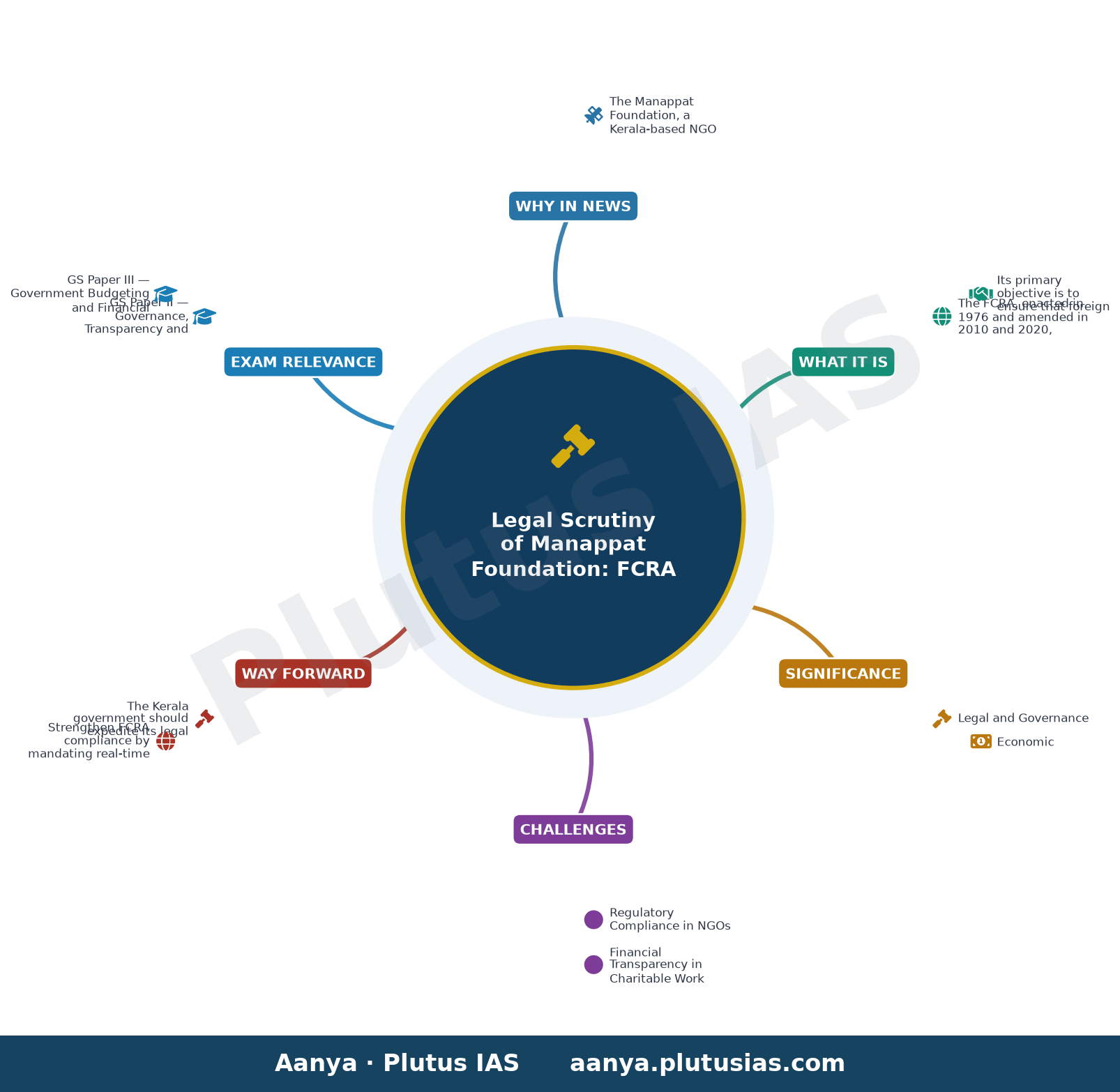
✎ The Foreign Contribution (Regulation) Act, 2010 (FCRA) mandates NGOs to maintain meticulous records of foreign contributions and their utilisation, with violations punishable under the Act and potentially invoking the Prevention…
Subject Relevance — Where This Topic Fits
- GS Paper II — Governance, Transparency and Accountability | GS Paper III — Government Budgeting and Financial Accountability | GS Paper IV — Ethics in Governance
- Prelims: Foreign Contribution (Regulation) Act, 2010, Rule 19 of FCRA, Vigilance and Anti-Corruption Bureau (VACB), Prevention of Corruption Act (PCA), Prohibition of Benami Property Transactions Act, 1988, Prevention of Money Laundering Act (PMLA), Central Bureau of Investigation (CBI), Public servant under PCA
- Essay: Ethical dimensions of political fundraising and transparency in governance, Role of NGOs in disaster relief: accountability and regulatory oversight
Quick Revision: The Foreign Contribution (Regulation) Act, 2010 (FCRA) mandates NGOs to maintain meticulous records of foreign contributions and their utilisation, with violations punishable under the Act and potentially invoking the Prevention of Corruption Act (PCA) if public servants are involved.
Why is this in the news?
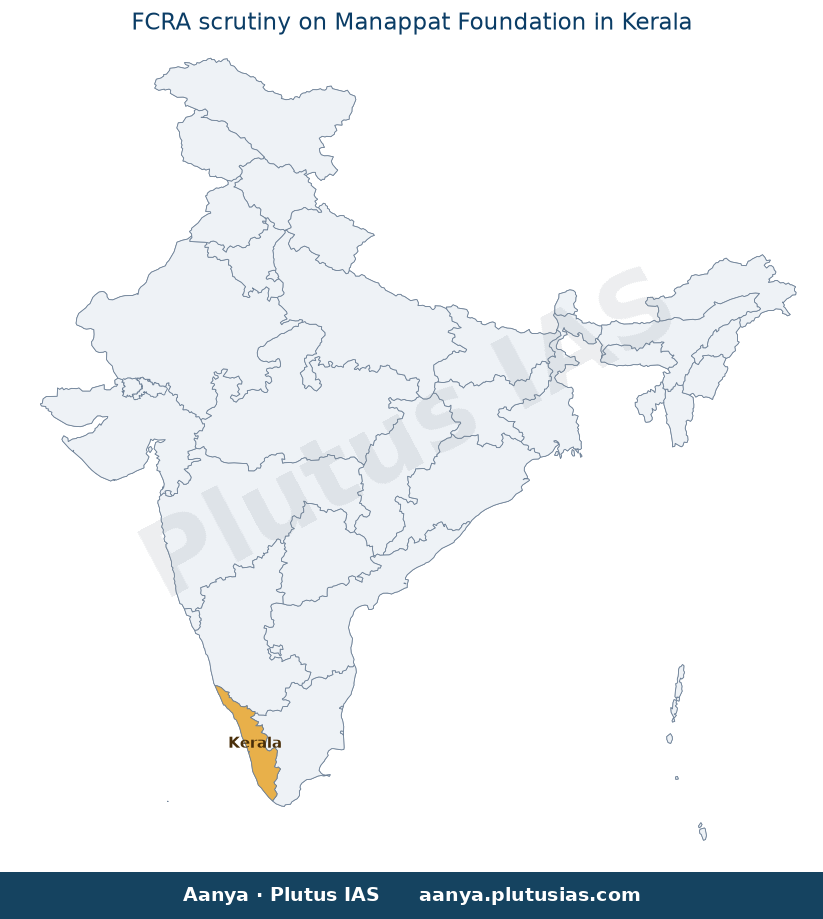
The Manappat Foundation, a Kerala-based NGO that mobilised foreign funds for the Punarjani flood rehabilitation scheme led by the Leader of the Opposition V.D. Satheesan, is under legal scrutiny for alleged violations of the Foreign Contribution (Regulation) Act, 2010 (FCRA). The Kerala government is examining a 2025 Vigilance and Anti-Corruption Bureau (VACB) report that accuses the foundation of failing to maintain records of foreign donations and their utilisation, potentially invoking provisions of the Prevention of Corruption Act (PCA) and other financial laws. The case raises critical questions about the accountability of NGOs, the legality of political fundraising, and the enforcement of FCRA in India.
Background
- The Foreign Contribution (Regulation) Act, 2010 (FCRA) regulates the acceptance and utilisation of foreign contributions by individuals, associations, and companies in India, aiming to prevent foreign interference in domestic affairs.
- Rule 19 of the FCRA mandates NGOs to maintain detailed records of foreign contributions received, their sources, and their utilisation, failing which constitutes a violation punishable under the Act.
- The Punarjani scheme was launched by V.D. Satheesan, the Leader of the Opposition in Kerala, to rehabilitate flood-affected constituents in Paravoor, Ernakulam, and relied heavily on foreign donations.
- The Vigilance and Anti-Corruption Bureau (VACB) of Kerala submitted a report in 2025 to the Home Department, alleging that Manappat Foundation violated Rule 19 of the FCRA by failing to maintain records of foreign donations and their utilisation.
- The VACB also recommended a Central Bureau of Investigation (CBI) inquiry into suspicious transactions amounting to ₹1.22 crore linked to the foundation’s FCRA account, current account, and personal accounts of its chairperson, Ameer Ahammed.
- The case has political overtones, with the Congress party terming the scrutiny as a ‘political witch-hunt’ against Satheesan, while the Kerala government seeks legal opinion on the matter.
What is the Foreign Contribution (Regulation) Act (FCRA), 2010?
- The FCRA, enacted in 1976 and amended in 2010 and 2020, regulates the acceptance and utilisation of foreign contributions by individuals, associations, and companies in India.
- Its primary objective is to ensure that foreign contributions do not compromise India’s sovereignty, integrity, or public interest, and to prevent their use for activities detrimental to national security.
- The Act mandates NGOs and other entities to register with the Ministry of Home Affairs (MHA) to receive foreign funds and to utilise them only for the stated purposes.
- Rule 19 of the FCRA requires NGOs to maintain detailed records of foreign contributions, including the source, amount, and purpose of utilisation, and submit annual returns to the MHA.
- Violations of the FCRA, such as failure to maintain records or utilising funds for unauthorised purposes, are punishable with imprisonment, fines, or cancellation of FCRA registration.
- The Act also prohibits the transfer of foreign funds to other organisations without prior approval from the MHA, ensuring transparency in fund utilisation.
- Enforcement of the FCRA is overseen by the MHA, with the Central Bureau of Investigation (CBI) and state vigilance bodies playing a role in investigating violations.
Key Features
| Feature | Significance |
|---|---|
| FCRA Rule 19 Violation | Mandates NGOs receiving foreign contributions to maintain meticulous records of receipt and utilisation; non-compliance criminalises the act under PCA if public servants are involved. |
| VACB Report (2025) | Provides prima facie evidence of alleged financial irregularities, including ₹1.22 crore in suspicious transactions, prompting legal scrutiny and potential CBI investigation. |
| Punarjani Scheme | A flood-rehabilitation initiative in Kerala mobilising foreign funds for constituents of the Leader of the Opposition, now under scrutiny for alleged FCRA breaches. |
| Prohibition of Benami Property Transactions Act, 1988 | Potential applicability to trace illicit financial flows linked to alleged FCRA violations, ensuring accountability for benami transactions. |
| Prevention of Money Laundering Act (PMLA) | Relevant for investigating financial trails of foreign contributions if proceeds are suspected to be laundered through domestic channels. |
Why it Matters
Legal and Governance
- Demonstrates the enforcement of FCRA against NGOs, particularly those associated with political figures, ensuring transparency in foreign funding for public welfare projects.
- Highlights the role of the Vigilance and Anti-Corruption Bureau (VACB) in investigating financial irregularities, reinforcing institutional checks on public funds.
- Raises questions about the accountability of public representatives in overseeing NGOs utilising foreign contributions for constituency work.
Economic
- Underscores the importance of regulatory compliance in foreign funding to prevent misuse, which could distort market perceptions of charitable organisations.
- Potential financial penalties or legal actions against the NGO may impact donor confidence in similar initiatives, affecting future rehabilitation efforts.
Political
- Exemplifies the intersection of political opposition and governance scrutiny, where allegations of financial impropriety are weaponised for partisan advantage.
- Reflects the broader trend of political witch-hunts in Indian politics, where opposition leaders face legal challenges amid electoral dynamics.
Challenges
1. Regulatory Compliance in NGOs
- Ensuring NGOs maintain accurate records of foreign contributions and their utilisation remains a persistent challenge, particularly for politically connected organisations.
- The FCRA framework, while robust, faces implementation gaps due to delayed audits and lack of real-time monitoring mechanisms.
- Political interference in investigations may undermine the credibility of legal proceedings, as seen in allegations of witch-hunts.
UPSC Link: GS Paper 2: Statutory Bodies (FCRA, 2010)
2. Financial Transparency in Charitable Work
- Lack of standardised reporting mechanisms for foreign-funded projects hampers accountability and enables potential misuse of funds.
- The Punarjani case highlights the need for third-party audits of NGOs to verify the utilisation of foreign contributions.
UPSC Link: GS Paper 3: Money Laundering & Financial Crimes
3. Politicisation of Legal Proceedings
- Allegations of political witch-hunts risk eroding public trust in investigative agencies and the judiciary.
- The case underscores the need for impartial investigations to distinguish genuine violations from politically motivated actions.
UPSC Link: GS Paper 2: Role of Constitutional Bodies (CBI, VACB)
Challenges — UPSC Perspective
| Issue | Concern |
|---|---|
| Delayed Investigations | Prolonged legal scrutiny may delay justice and allow financial irregularities to persist unchecked. |
| Political Interference | Allegations of partisan investigations undermine the credibility of legal proceedings. |
| Lack of Real-Time Monitoring | Absence of digital tracking systems for foreign contributions hinders transparency. |
| NGO Accountability Gaps | Weak enforcement of FCRA rules enables misuse of funds by politically connected organisations. |
| Public Perception | Scrutiny of opposition leaders may polarise public opinion, affecting electoral outcomes. |
Way Forward
- The Kerala government should expedite its legal opinion on the VACB report to determine the appropriate course of action, including potential CBI involvement.
- Strengthen FCRA compliance by mandating real-time digital reporting of foreign contributions and their utilisation by NGOs.
- Conduct independent audits of NGOs receiving foreign funds, particularly those linked to political figures, to ensure transparency.
- Clarify the role of public representatives in overseeing NGOs to prevent conflicts of interest and ensure accountability.
- Enhance inter-agency coordination between the Home Department, VACB, and CBI to streamline investigations into FCRA violations.
- Promote public awareness campaigns on the legal provisions governing foreign contributions to NGOs, fostering a culture of compliance.
- Establish a grievance redressal mechanism for donors and beneficiaries to report irregularities in NGO operations.
UPSC Value Addition
Keywords for Mains Answer-Writing
Foreign Contribution (Regulation) Act, 2010 · Rule 19 of FCRA · Punarjani scheme · Manappat Foundation · FCRA violations · Vigilance and Anti-Corruption Bureau (VACB) · Prevention of Corruption Act, 1988 · Central Bureau of Investigation (CBI) · Prohibition of Benami Property Transactions Act, 1988 · Prevention of Money Laundering Act, 2002 · Public servant under PCA · Foreign donations and utilisation records
Concept Flow
Foreign Contributions (FCRA, 2010) → NGOs mobilise funds for public welfare (Punarjani Scheme) → Alleged violations of Rule 19 (record-keeping) → VACB investigation → Potential CBI probe under PCA/PMLA → Political scrutiny of opposition leader → Legal opinion sought by Home Department.
Prelims Practice Questions
Q1. Consider the following statements regarding the Foreign Contribution (Regulation) Act (FCRA), 2010:
1. Under Rule 19, every registered NGO must maintain separate accounts and records of foreign contributions received and utilised.
2. The Act empowers the Central Government to prohibit the acceptance and utilisation of foreign contributions if it is likely to prejudicially affect public interest.
3. The Act mandates that foreign contributions must be received only in an FCRA account opened in the State Bank of India, New Delhi.
4. The Act does not apply to contributions received from Indian citizens residing abroad.
How many of the above statements are correct?
- Only one
- Only two
- Only three
- All four
Answer: Only three — Statements 1, 2, and 3 are correct. Statement 4 is incorrect as the FCRA applies to contributions received from foreign sources, including Indian citizens residing abroad.
Q2. Assertion (A): The Prevention of Corruption Act, 1988, can be invoked against a public servant for alleged violations of the Foreign Contribution (Regulation) Act, 2010.
Reason (R): Rule 19 of the FCRA mandates strict maintenance of records of foreign contributions, and its violation by a public servant constitutes an offence under the PCA.
- Both A and R are true, and R is the correct explanation of A
- Both A and R are true, but R is not the correct explanation of A
- A is true, but R is false
- A is false, but R is true
Answer: Both A and R are true, and R is the correct explanation of A — Both A and R are true. Rule 19 of the FCRA requires NGOs to maintain records of foreign contributions, and its violation by a public servant can be prosecuted under the PCA, as per Section 13 of the PCA.
Q3. Match the following legal provisions with their respective Acts:
Column I
A. Rule 19
B. Section 13
C. Section 2(1)(d)
D. Section 4
Column II
1. Foreign Contribution (Regulation) Act, 2010
2. Prevention of Corruption Act, 1988
3. Prohibition of Benami Property Transactions Act, 1988
4. Prevention of Money Laundering Act, 2002
Select the correct match:
- A-1, B-2, C-3, D-4
- A-1, B-2, C-4, D-3
- A-2, B-1, C-3, D-4
- A-4, B-2, C-1, D-3
Answer: A-1, B-2, C-4, D-3 — A-1: Rule 19 is under the FCRA, 2010. B-2: Section 13 of the PCA deals with offences by public servants. C-4: Section 2(1)(d) of the PMLA defines ‘beneficial owner’. D-3: Section 4 of the Prohibition of Benami Property Transactions Act prohibits benami transactions.
Mains Practice Question
✍ The Foreign Contribution (Regulation) Act, 2010, is often hailed as a regulatory framework to ensure transparency and accountability in the receipt and utilisation of foreign contributions by NGOs. However, recent scrutiny of the Manappat Foundation in Kerala has raised critical questions about the efficacy of Rule 19 of the FCRA in preventing violations. Critically examine the provisions of Rule 19 of the FCRA and evaluate its role in ensuring transparency and accountability in the utilisation of foreign funds by NGOs. Also, analyse the legal consequences that may arise under the Prevention of Corruption Act, 1988, and other allied laws in cases of non-compliance. (15 Marks)
Approach: MODEL-ANSWER SKELETON:
1. **Introduction (2 marks)**: Define the FCRA, 2010, and its objective to regulate foreign contributions to NGOs. Briefly state the context of the Manappat Foundation case and the alleged violations of Rule 19.
2. **Provisions of Rule 19 (4 marks)**:
– Rule 19 mandates NGOs to maintain separate accounts and records of foreign contributions received and utilised.
– It requires the submission of annual returns (Form FC-4) and audited statements to the Ministry of Home Affairs.
– Rule 19(1) specifies that foreign contributions must be received only in an FCRA account opened in the State Bank of India, New Delhi.
– Rule 19(3) prohibits the transfer of foreign contributions to any other account.
– Rule 19(4) requires NGOs to maintain records for a minimum of 6 years.
3. **Role in Ensuring Transparency and Accountability (4 marks)**:
– Rule 19 acts as a safeguard against misuse of foreign funds by ensuring traceability and auditability.
– It enables the government to monitor the utilisation of funds and prevent diversion or misappropriation.
– The requirement for annual returns and audited statements enhances transparency and accountability.
– However, the efficacy of Rule 19 depends on robust enforcement, which is often lacking due to resource constraints and delays in investigations.
4. **Legal Consequences under Allied Laws (3 marks)**:
– **Prevention of Corruption Act, 1988 (PCA)**: Section 13 of the PCA criminalises offences by public servants, including violations of the FCRA if the public servant is involved in the receipt or utilisation of foreign contributions.
– **Prohibition of Benami Property Transactions Act, 1988**: If foreign contributions are utilised to acquire benami properties, the Act can be invoked.
– **Prevention of Money Laundering Act (PMLA), 2002**: If foreign contributions are routed through shell entities or layered transactions to disguise their origin, the PMLA can be applied.
5. **Conclusion (2 marks)**:
– Rule 19 is a critical provision for ensuring transparency and accountability in the utilisation of foreign funds.
– However, its effectiveness is contingent on strict enforcement, timely investigations, and cooperation between central and state agencies.
– The Manappat Foundation case underscores the need for stronger oversight mechanisms and penalties for non-compliance.
Source: The Hindu
Generated by AanyaAi for educational purpose.

- राजस्थान पंचायत चुनाव 2026: सरपंच-वार्ड पदों की आरक्षण लॉटरी आज, जानिए आरक्षण तय करने की प्रक्रिया - September 24, 2026
- Rajasthan Panchayat Polls 2026: Reservation Lottery for Sarpanch & Ward Panch Seats Today - September 24, 2026
- यूपी में पहली बार तेंदुओं का बधियाकरण: मानव-वन्यजीव संघर्ष रोकेगा अभियान - September 24, 2026

No Comments